Click the image below to be taken to the actual page. Then click on “SUBMIT YOUR COMMENTS ON MAUNA KEA” Whatever your opinion may be, here is an opportunity to make it known.

Click the image below to be taken to the actual page. Then click on “SUBMIT YOUR COMMENTS ON MAUNA KEA” Whatever your opinion may be, here is an opportunity to make it known.
We are rapidly getting all of the 500,000 Japanese away from our Pacific coast danger zone, but what about the timewhen the war is over?
A resident from the Lake Labish district told the editor of the Greater Oregon yesterday of a series of raids conducted on Jap farms in that district. We are not at liberty to tell the full story but we can say that many machine guns were found in hay mows and in straw stacks and that a large amount of ammunition and weapons was taken from the Japs, who profess to be so friendly to us and so sorry that Japan has declared war upon us. Continue reading
Some people went fishing, all sorts of fishing where you would catch fish, until the fishing of the women who drape the malo of their men over their necks. The famous fishing of Kohala is malolo fishing [kapaepae malolo]. The type of fishing of that land of the apaapaa winds is one where the women drape the malo of their men over their necks and slap their chests in grief [paiauma] as they walk the sea capes. Continue reading
Does anyone know how the fishing for flying fish called kapaepae malolo worked? It seems that Kohala was especially famous for this type of fishing!
Where is the land of the Kukalahale rain? Where is the land of the fragrant bowers (of hala) [na paia aala]? Continue reading
Hiiakaikapoliopele looks at her elder sisters who hang their heads down, they being the ones who were sent to fetch the man; they are the ones who hang their heads, and Hiiakaikapoliopele chants out thus:
Ke ku nei au e hele, Continue reading
It seems J. P. Kaapuwai, the composer of the previous kanikau for Eda Kalua reports on the death of J. M. Kaapuwai. The article, and much of the page upon which it appears is hardly legible.
(Kuokoa, 1/28/1910, p. 7)
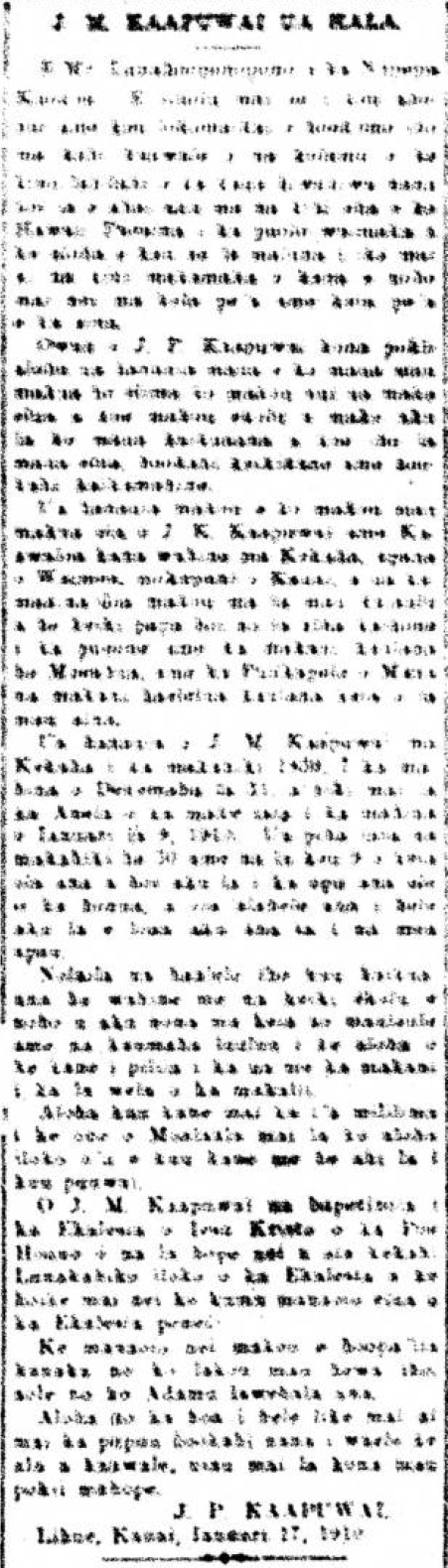
Ka Nupepa Kuokoa, Buke XLVII, Helu 4, Aoao 7. Ianuari 28, 1910.
S. M. Kamakau seems to write two Hawaiian language articles responding to R. Kapihe’s critiques. The first one, “He papa hulikoa; he alukakoa; he ahikahalelo, he iliohalawaena,” appears in Au Okoa on 7/23/1868, p. 3. Kamakau says he is responding to a letter from R. Kapihe of perhaps Kailua, Koolaupoko, that appears “on the 16th of this month.” He responds to a number of criticisms that appeared in Kapihe’s letter about Kamakau’s history of Kamehamehas. Continue reading
This article is difficult to read for two reasons. 1. The newspaper is not scanned clearly. 2. The typesetting seems not to have been done very carefully.
What we can learn from this article that was not included in the previous English article is that:
His father died earlier, but his mother, Sarah Hapai, survives him although she is frail. She is known to all the young ones of Hilo as Aunty Sarah.
Archie was greatly trusted by his coworkers. He was kind and a gentleman. He left behind a wife and many children, as well as a sister and his mother. Continue reading
This is just one more article that is only partially legible. The Hawaiian newspapers need to be rescanned clearly!
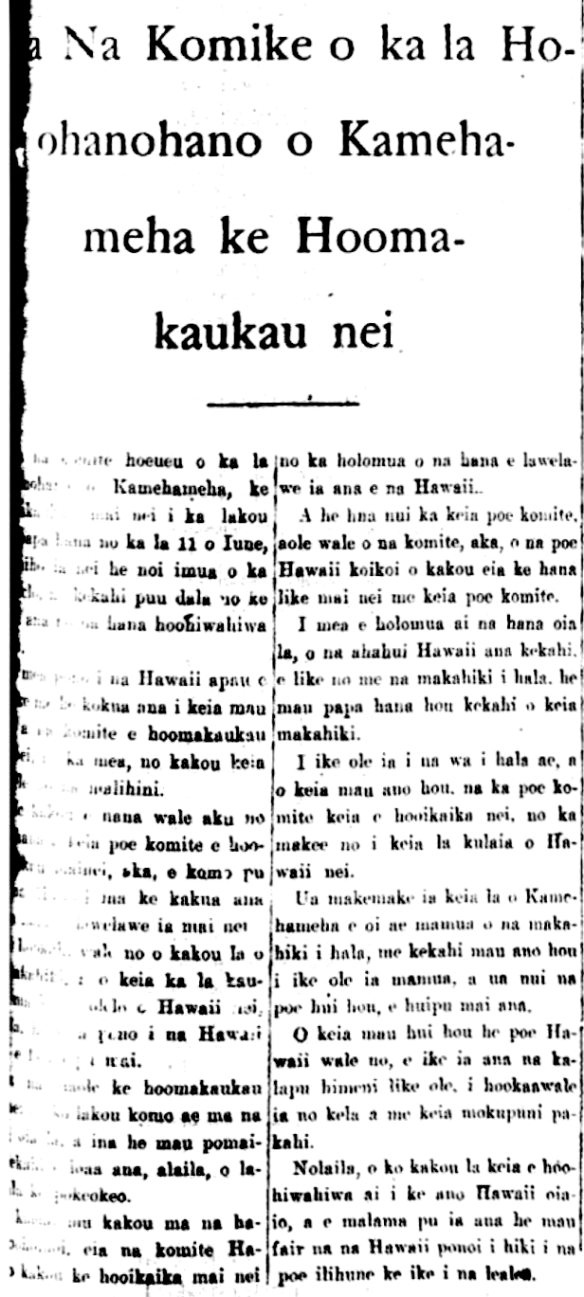
Ke Aloha Aina, Buke XXXIV, Helu 9, Aoao 1. Maraki 8, 1919.
 nupepa