A set of mele including “E aha ia ana o Maunakea,” composed by Lioe Kaanaana of Waimea for Ane Bell, 1894.

[The title is illegible in the digital copy. Hopefully all of the newspapers can get clearly scanned one day before it is too late.]*

1.

Hanohano Mana i ka uhiwai
Haaheo i ka liko o ka mamane
O ka noe a ka ua kikoni ili
Me he la o kuu aloha kekahi
Akahi ka manao a hoonioni
E uila ke aloha pili me au
Heaha nei hana a ka nui manu
Hauwalaau nei puni Waimea
Aohe hana a ka wai koiawe
Lana malie i ka poli o Malio
Ua like a like me ke Aniani
Ka alohi i ke alo a o Maukele
Haina ia mai ana ka puana
O Ane ka wahine no e ka lei.

2.

E aha ia ana o Maunakea
Kuahiwi alo pu me ke kehau Continue reading

History from the old Hawaiian newspapers!

Perhaps these posts will be useful to someone you know?

Help support the recovery of all kinds of people, places, and information from the old Hawaiian newspapers! Just read and share these posts wherever you can—online or off. Hopefully at the same time the ads will make some money to help pay for the yearly cost of hosting the website.

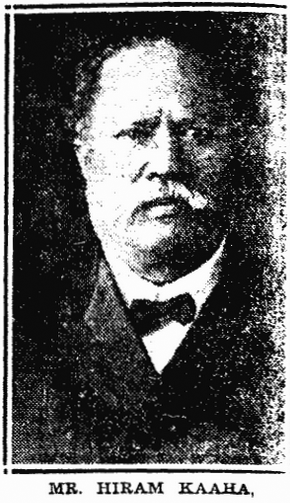
Hiram_Kaaha.png

Road to hell is paved with gold, 1915.

GIVES UP PLAN TO RESTORE OLD HAWAII TEMPLES

C. R. Forbes Warned from Undertaking by John G. Stokes; Will Put Up Markers

Plans that Charles R. Forbes, superintendent of public works, has had for the restoration of the heiaus on Hawaii will probably be abandoned as a result of a letter received by him recently from John G. Stokes, curator at the Bishop museum.

Mr. Stokes objects to having the heiaus built up again to a semblance of their original shape, as was the plan proposed by Superintendent Forbes, by taking rock that had fallen and resetting it in its old position. Mr. Stokes’ contention is that this would be an unwise thing to do, even in the interest of preserving the old relics. His statement is made after a careful study of them. Continue reading

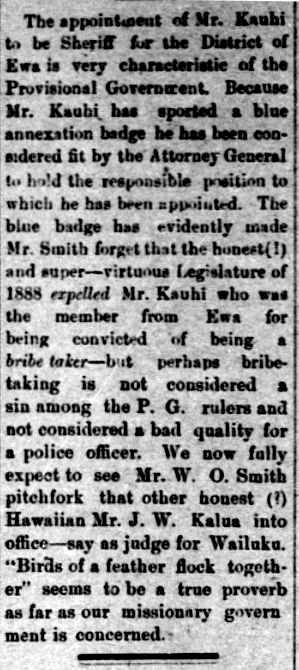
Anybody ever see one of these blue ribbons or blue badges of the annexationists? 1893.

[Found under: “TOPICS OF THE DAY.”]

The appointment of Mr. Kauhi to be Sheriff for the District of Ewa is very characteristic of the Provisional Government. Because Mr. Kauhi has sported a blue annexation badge he has been considered fit by the Attorney General to hold the responsible position to which he has been appointed. The blue badge has evidently made Mr. Smith forget that the honest(!) and super—virtuous Legislature of 1888 expelled Mr. Kauhi who was the member from Ewa for being convicted of being a bribe taker—but perhaps bribe-taking is not considered a sin among the P. G. rulers and not considered a bad quality for a police officer. We now fully expect to see Mr. W. O. Smith pitchfork that other honest (?) Hawaiian Mr. J. W. Kalua into office—say as judge for Wailuku. “Birds of a feather flock together” seems to be a true proverb as far as our missionary government is concerned.

[In the article, “BLOUNT AT HAWAII” printed on the front page of the Chicago Daily Tribune on 4/6/1893, mentioned is a dark-blue ribbon with the words ANNEXATION CLUB being worn by the members of said club to present themselves to James Blount.]

(Hawaii Holomua, 1/10/1893, p. 2)

HawaiiHolomua_1_10_1894_2.png

Hawaii Holomua, Volume II, Number 8, Page 2. January 10, 1893.

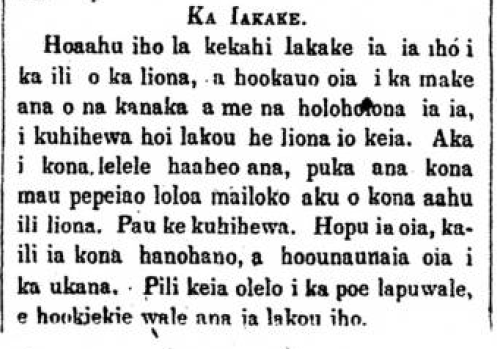
The haughty ass, 1865.

The Ass.

An ass clothed himself in the skin of a lion, and acted as if he’d bring death to man and beast so that they would mistake him for a real lion. But when he lept proudly, his long ears stuck out from his lion skin cloak. The illusion was no more. He was captured, his glory was taken away, and he was made to transport goods. This story pertains to those scoundrels who lord over others.

[This story appeared right below yesterday’s crab story. And once again, the theme is unfortunately timeless.]

(Kuokoa, 3/23/1865, p. 4)

Kuokoa_3_23_1865_4.png

Ka Nupepa Kuokoa, Buke IV, Helu 12, Aoao 4. Maraki 23, 1865.

Lead by example, 1865 / timeless.

The Crab.

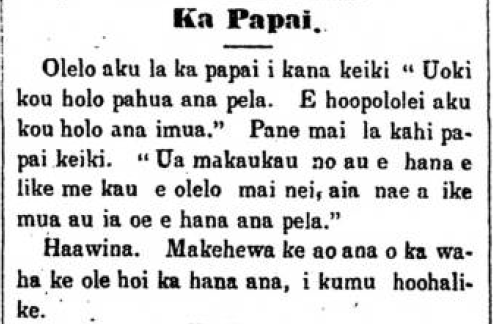
A crab said to its child, “Quit that walking sideways. Walk straight ahead.” The child crab responded. “I am ready to do as you say, but only when I see you do so first.”

Lesson. It is useless to say things with your mouth without doing so as an example.

[What kind of nation is it where the heads speaks words of disrespect? What kind of an example does that serve for the young and those that seemingly know no better?

Many of Aesop’s fables like this one were translated in the Hawaiian-language newspapers.]

(Kuokoa, 3/23/1865, p. 4)

kuokoa_3_23_1865_4

Ka Nupepa Kuokoa, Buke IV, Helu 12, Aoao 4. Maraki 23, 1865.

Some advice from the past to composers of today, 1893.

ALL MELE HAVE KAONA.

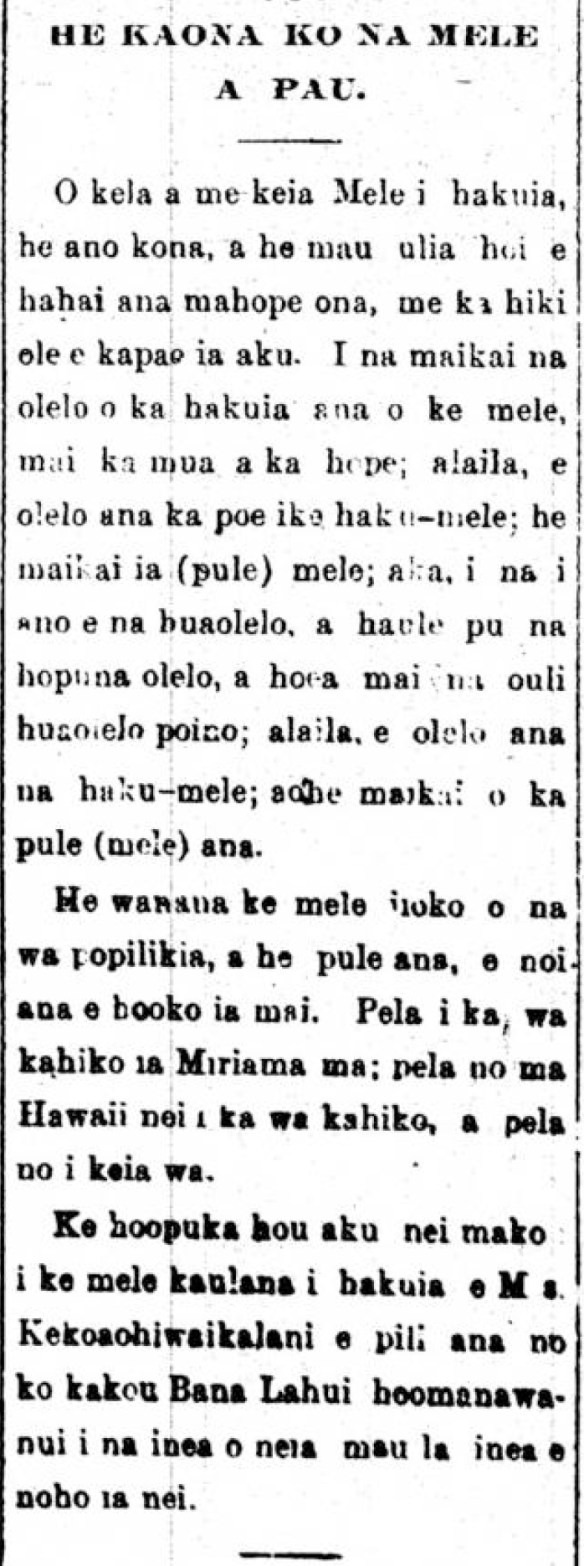
Each Mele that is composed has its own nature, and there are results that follow that cannot be avoided. Should the words of the composition be good from beginning to end, then those who understand mele composition [haku mele] will say that the mele (prayer) is a good one; however, should the words be off, and syllables are dropped, and words of unfortunate nature result, those knowledgeable in haku mele will say that the pule (mele) is not good.

A mele is a prophesy in times of trouble, and it is a prayer that asks to be fulfilled. So it was in the ancient times of Miriam folks; and so it was in ancient times in Hawaii nei, and so it is today.

We publish once again the famous mele composed by Mrs. Kekoaohiwaikalani pertaining to our Hawaiian Band [Bana Lahui] who are enduring the hardships of these trying times we are living in.

[Doesn’t this sound like a call from the past to those of today?]

(Leo o ka Lahui, 9/8/1893, p. 2)

LOKL_9_8_1893_2.png

Ka Leo o ka Lahui, Buke II, Helu 765, Aoao 2. Sepatemaba 8, 1893.

English coverage of Kamehameha Schools graduation, 1908.

CLOSING EXERCISES AT KAMEHAMEHA SCHOOLS

The Kamehameha Manual Schools will have their closing exercises this evening and the graduating class have invited their many friends to be present to enjoy the following program which has been arranged:

Prelude—Offertoire in D Minor ..Batiste
Miss S. L. Byington.

Invocation—
Rev. Bradford Leavitt, D. D.

Response—”He Aloha no ka Haku”..Liliuokalani
Choir Boys.

Essay—”Ancient Hawaii as Told by a Retainer”
Julia Lazaro.

Mele—”He Inoa no Pauahi”..Prince Leleiohoku

Essay—”Modern Hawaii”
Henry Waiau.

Essay—”Industries of Ancient Hawaii”
Elizabeth Macy.

Chorus—Hawaiian Hymn ..E. A. P. Newcomb
Boys’ Glee Club.

Essay—”Industries of Modern Hawaii”
John Pahia.

Essay—”Influence of Kamehameha in the Future of Hawaii”
Joseph Ordenstein.

Chorus of Vintages ..Henry Smart
School for Girls.

Essay—”Woman in Ancient and Modern Hawaii”
Lillian Broad.

Essay—”Hawaii of Tomorrow”
James Mahikoa.

Chorus—Recessional ..De Koven
Boys’ Glee Club.

Presentation of Certificates.

“Hawaii Ponoi”

Benediction—
Rev. John L. Hopwood.

“Kamehameha School for Girls’ Call”
Senior Class.

Postlude in E Flat..Lefebure Wely

The graduating class of 1908 consists of the following pupils of the school: Continue reading