Patriotic mele of a different sort, 1893.

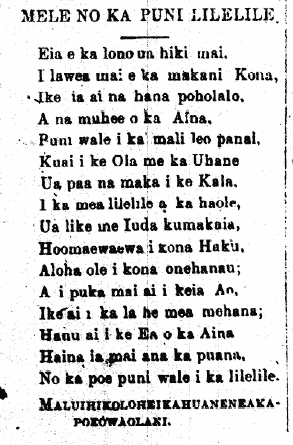
MELE NO KA PUNI LILELILE

Eia e ka lono ua hiki mai,

I lawea mai e ka makani Kona,

Ike ia ai na hana poholalo,

A na muhee o ka Aina,

Puni wale i ka mali leo panai,

Kuai i ke Ola me ka Uhane,

Ua paa na maka i ke Kala,

I ka mea lilelile a ka haole,

Ua like me Iuda kumakaia,

Hoomaewaewa i kona Haku,

Aloha ole i kona onehanau;

A i puka mai ai i keia Ao,

Ike ai i ka la he mea mehana;

Hanu ai i ke Ea o ka Aina,

Haina ia mai ana ka puana,

No ka poe puni wale i ka lilelile.

Maluihikoloheikahuaneneakapoeowaolani.

[There are not only patriotic compositions that laud and encourage, but there are also those like this one here which ridicule and disparage. This one goes something like:]

A SONG FOR THOSE WHO COVET SHINY THINGS.

The news has arrived,

Carried by the Kona breeze,

Witnessed are the deeds of deceit,

By the squids¹ of the Land,

Fawning after the sweet talk of reciprocity,

Selling away Life and Soul,

Eyes set on Riches,

That shiny thing of the haole,

Just like Judas the traitor,

Scorning his Lord,

With no aloha for his homeland;

If he’d come forth into the Light,

He’d see that the sun is a thing of warmth,

He’d breathe in the Ea² of the Land.

Let the story be told,

Of those who covet shiny things.

Maluihikoloheikahuaneneakapoeowaolani.

¹A squid can swim as easily backward as forward, so you never know if it is coming or going, and is thus used to describe a two-faced person.

²Ea can be seen as a play on the idea of Air as well as Sovereignty.

(Leo o ka Lahui, 2/21/1893, p. 3)
MELE NO KA PUNI LILELILE.

Ka Leo o ka Lahui, Buke II, Helu 646, Aoao 3. Feberuari 21, 1893.
Patriotic mele, 1893.

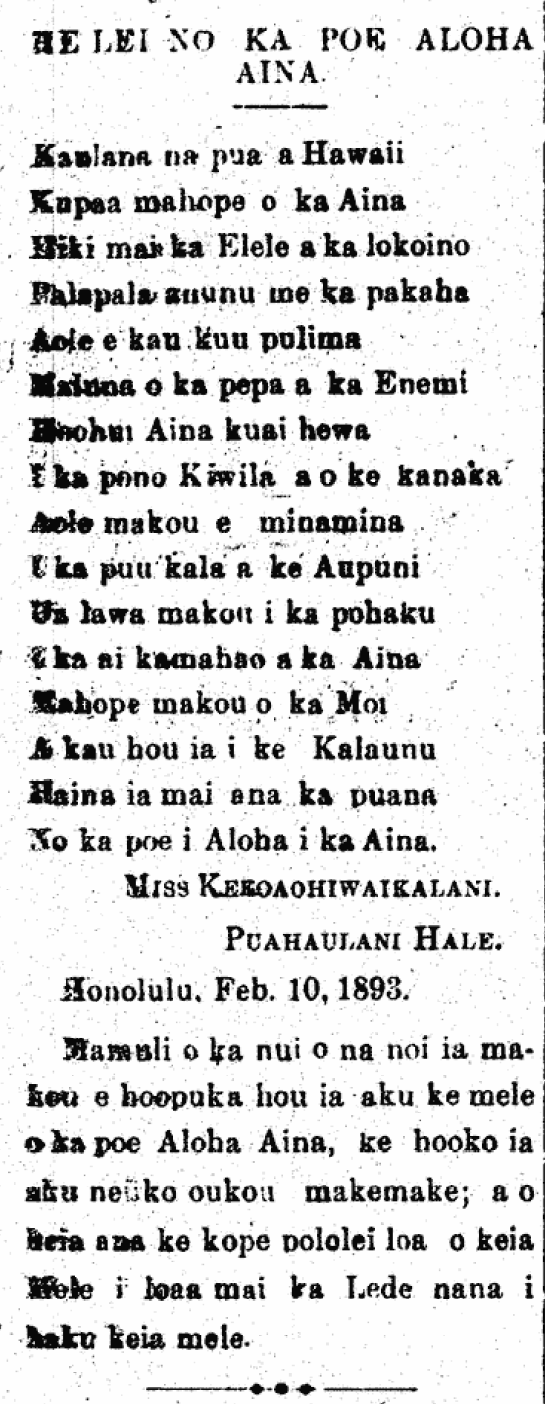
[Here is a patriotic mele famous to this day, it is also known as Mele Ai Pohaku, but familiar to most as Kaulana na Pua. This composition is published many times and in more than one Hawaiian-Language Newspaper. It is a song which both lauds and encourages.]

AN ADORNMENT FOR THE PATRIOTS.

Famous are the blossoms of Hawaii

Who stand steadfast behind the Land

When the evil Messenger arrives

With his documents of greed and plunder

I won’t affix my signature

To the papers of the Enemy

That Annex and sell wrongfully

The Civil rights of the people

We will not feel longing

For the sums of money of the Government

We are satisfied with the stones

The amazing food of the land

We stand behind the Sovereign

She will be placed back upon the Throne

Let the refrain be told

Of the people who Love the Land.

Miss Kekoaohiwaikalani.
Puahaulani Hale.
Honolulu, Feb. 10, 1893.

Because of the many requests for us to reprint the song of the Patriots, we are fulfilling your desire; and this is a correct copy of this song which we received from the Lady who composed this song.

(Leo o ka Lahui, 5/11/1893, p. 3)

HE LEI NO KA POE ALOHA AINA.

Ka Leo o ka Lahui, Buke II, Helu 703, Aoao 3. Mei 11, 1893.

J. J. Williams Photographer advertisement, 1902.

J. J. WILLIAMS

PHOTOGRAPHER

CRAYONS
WATER COLORS
LANTERN SHOWS

ONLY COMPLETE
COLLECTION OF
ANCIENT
& MODERN
HAWAIIAN VIEWS.

Fort Street

Photography shoots are very reasonable at Wiliama’s place; you will receive beautiful prints from 4.00 for a dozen.

[Speaking of photography, the microfilming of these newspapers were done many years ago, and the resulting images taken from those microfilms are many times not legible. I barely could make out the tiny print. There needs to be funding to reshoot the Hawaiian-Language Papers, so that the words from the past can be seen clearly today!!]

(Aloha Aina, 1/11/1902, p. 3)

J. J. WILLIAMS PHOTOGRAPHER

Ke Aloha Aina, Buke VIII, Helu 2, Aoao 3. Ianuari 11, 1902.

More on different papers, 1912.

Yesterday, we saw three different articles from three different papers reporting on the same incident. Just as we need to look in all of the available Hawaiian-Language Newspapers to see how an event was covered, we should not neglect the other language papers as well….

Here for instance is an article talking about the same event from one of the English papers.

Different papers, different views, 1912.

It is not unusual for different newspapers to cover the same story differently. Most papers were slanted in some way or another. If heads or editors of a paper changed, the coverage could change as well.

The following three articles deal with the same event, but are considerably different in content. This isn’t even a politically charged article, it’s about a fireworks accident…

It is important to consider what paper an article comes from and the circumstances of its publication.

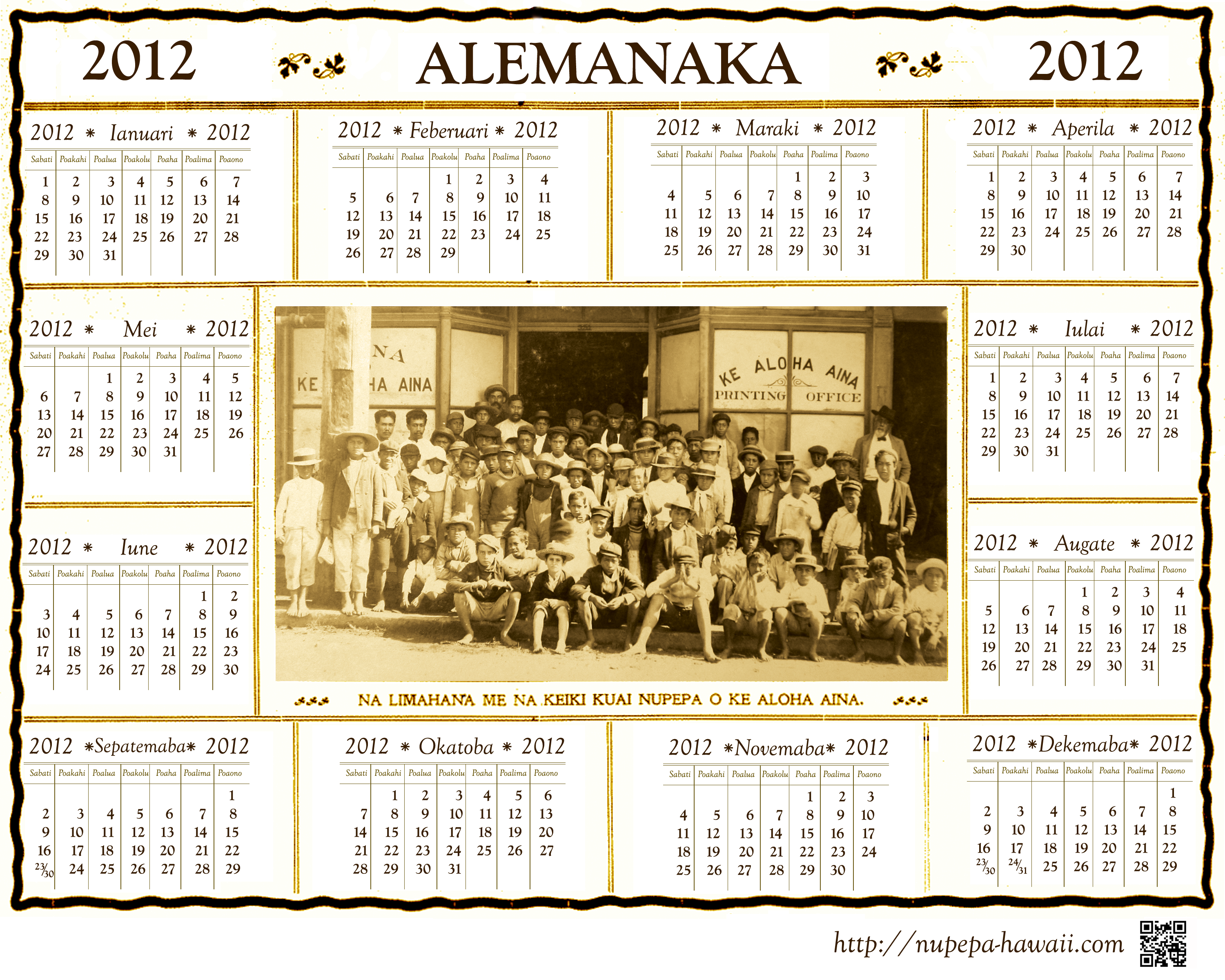
Oh, one more thing before we go, here is a Happy New Year’s makana to all you readers out there! 2012.

This Calendar is fashioned after one given by “Ke Aloha Aina” to its readers in 1906. It was a custom of many papers to give something extra to the readers who subscribed for another year, whether it be a calendar like this or a picture of the king and queen. Hopefully you will download the image and print it out and tack it to your walls to remind you that the Hawaiian-Language Newspapers hold priceless information, and that you might find just a tiny bit of that here on this blog…

Here is what the original calendar looked like: http://wp.me/p1Wb7O-3B

And here is the article that went along with it: http://wp.me/p1Wb7O-3x

2012 ALEMANAKA 2012

Alemanaka no ka MH 2012

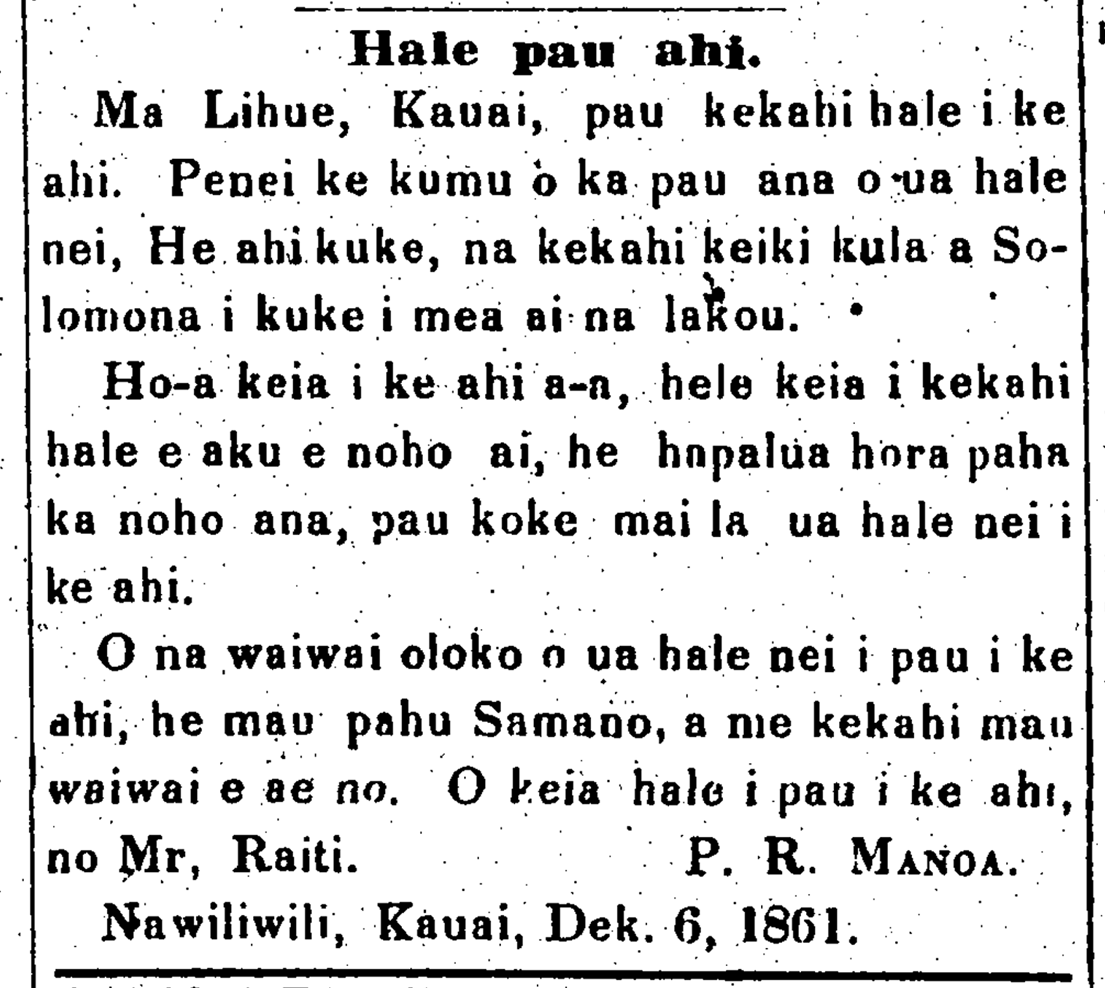
Don’t leave the kitchen while cooking—still good advice a hundred and fifty years later, 1861.

House consumed by fire.

At Lihue, Kauai, a house was consumed by fire. This is the reason for that house burning down: A kitchen fire of one of the children of Solomon’s school, who was cooking something for himself.

He lit the fire and went away to another house, and was there for perhaps half an hour, and the house was immediately destroyed.

The contents of the house lost to the fire was some barrels of Salmon, and some other valuables. This house that was destroyed by fire belonged to Mr. Rice.    P. R. Manoa.

Nawiliwili, Kauai, Dec. 6, 1861.

[The original images of Ka Hae Hawaii are available on microfilm, but are still as of yet not available online. *It is always important to check the original image against any available typescript, just to make sure what it is you see is indeed what was originally written!]

(Hae Hawaii, 12/25/1861, p. 4)

Hale pau ahi.

Ka Hae Hawaii, Buke 6, Helu 39, Aoao 156. Dekemaba 25, 1861.