David Kahalepouli Piikoi’s roots, 1878.

A Royal Scion has Died.

The other week we reported on the death of David Kahalepouli Piikoi at Kapaa, Kauai, on the 18th of October past, and this week, we are showing how he figures into the Royal line of Haloa gone by.

He is a man closely related by blood to Kamehameha IV and Kamehameha V, and Lunalilo I who recently passed on, and this is his relationship.

Kamehemeha IV and Kamehameha V,

Keawepoepoe (m) dwelt with Kumaiku (w), born was Keaumoku (m), Alapai (m), Kaulunae (f).

Keaumoku (m) dwelt with Namahana (f), born was Kuakini (m), Kaahumanu 1 (f), Kaheiheimalie (f), Kahekili (k), Kekuaipiia (k), Kuakini (lame) (m).

Kaheiheimalie (f) dwelt with Kamehameha I, born was Kinau (f).

Kinau (f) dwelt with Kekuanaoa (m), born were Kamehameha IV and V.

Pertaining to Lunalilo I.

Kaheiheimalie (f) dwelt with Kalaimamahu, born was Kekauluohi (f); Kekauluohi with Kanaina, born was Lunalilo I.

Pertaining to David Kahalepouli Piikoi.

Alapai (m) dwelt with Kamokuiki (f), born was Kekahili (f); Kekahili dwelt with Piikoi, born was Kahalepouli.

It is through Keawepoepoe that this man, Kahalepouli, is related to Kalakaua I and Keelikolani; and through Kumaiku, the wahine of Keawepoepoe, his blood is part of Keelikolani; and by way of his grandmother Kamokuiki, his blood is then part of the Royal Family currently on the throne.

His kanikau was sent to us, but because this issue is very full, we will put it aside temporarily until next week.

He has a royal wife, Kekaulike Kinoiki, the younger sister of the Queen, along with the three children, Davida Kawananakoa, Ed Keliiahonui, and Kuhio, who mourn over his remains.

We have published this because of our regret that all of the royal descendants are leaving, and our minds are somewhat relieved [kanahai] to know that he has children who are currently alive. Our deep felt aloha goes to those in mourning.

(Ko Hawaii Pae Aina, 11/2/1878, p. 3)

Kekahi Pua Alii i make.

Ko Hawaii Pae Aina, Buke I, Helu 44, Aoao 3. Novemaba 2, 1878.

Tragedy off Kalaupapa, 1888.

DEATH AT SEA.

Because of the kindness of our good friend, Mr. Kaoliko from up in Kauluwela, he showed us a written statement he got from Kalaupapa talking about sad news, and that is what we have below:

At night last Friday, Nov. 9, Kale Kahuakaiula Palohau, the child of Mr. G. B. Palohau of Kauai, tried to escape from Kalaupapa aboard a canoe along with Wailele. There are no witnesses to this escape of the two men. As they tried to leave the harbor of Kalaupapa and got a little ways out, the waa flipped. But they righted it and bailed out the bilge. They got back on and started to make their way but not much later, it flipped again. That is the way it went until they got right outside of Kalaeokailio, which they reached in the morning of Saturday. Palohau said to his partner that they should go ashore because the canoe was getting filled with water and was close to sinking. Then Kahuakaiula jumped into the ocean along with his friend and swam for shore. After getting perhaps a quarter mile from the waa, his friend started getting fatigued. Kahuakaiula told him to climb on him; the friend climbed on, and they started to swim towards the place where the waves break. There, the waves began to pound upon them and they were separated from each other. Kahuakaiula made his way to shore but as for his partner, he was not seen of again.

(Alakai o Hawaii Puka Pule, 11/24/1888, p. 3)

MAKE ILOKO O KE KAI

Ke Alakai o Hawaii Puka Pule, Buke 1, Helu 47, Aoao 3. Novemaba 24, 1888.

Report of Kalakaua’s death from the “San Francisco Chronicle,” 1891.

KALAKAUA DEAD

Last Hours of the Hawaiian Monarch.

Solemn Scenes at the Royal Bedside.

The Succession and the Political Situation.

Sketches of the Dead Sovereign and of the Heirs to the Throne.

Kalakaua I., King of the Hawaiian Islands, is dead. He expired at 2:33 o’clock yesterday afternoon in his room at the Palace Hotel, where for three days he had lain unconscious on his bed. Surrounding him at the moment of his death were Col. Macfarlane, the King’s Chamberlain; Col. Hoapili Baker, His Majesty’s Equerry-in-waiting; Hawaiian Consul McKinley, Admiral Brown, U. S. N. Rev. J. Sanders Reed, Rev. F. H. Church and a number of personal friends of the King. Immediately after the death, Admiral Brown notified the Secretary of the Navy of that fact, Mayor Sanderson was also notified, and he called a meeting of the Supervisors for 9 o’clock this morning to consider proper action in the matter. The remains were embalmed and this afternoon they will be removed to the mortuary chapel of Trinity Church, where they will be guarded by a detail of United States soldiers.

At the Deathbed.

The Scenes in the Chamber of the Dying Monarch.

It was a pitiful and most impressive scene. The dying monarch lay gasping upon his bed, his emaciated body heaving convulsively with each of his labored respirations. At the bedside stood two ministers of the Gospel, physicians of the body had given way when they had come to the sad conclusion that Kalakaua was beyond mortal aid. Seated at the head of the bed, clasping the left hand of his King was Col. Baker, Kalakaua’s Aid-de-camp, whose strong frame was bent with sorrow, and who with great difficulty kept back the flood of tears which trembled in his eyes. Bending over from the right side was Col. Macfarlane, Chamberlain of the King. The suspense of the last few days had almost prostrated him, and his face bore traces of weeping. Crouched upon the floor against the wall near the bedside were the King’s valet Kahikina, an Hawaiian youth, and Kalua, a young girl from the Gilbert islands, who had been a most devoted servant to Kalakaua. They formed part of his suite on his arrival here.

Only a light coverlet of rich brown design covered the body of the King. In his struggles to throw off the firm reaper who was gradually pressing more heavily upon him, Kalakaua had thrust his arms out upon the bed. During the forenoon his faithful servant Kalua, in an endeavor to make the King as comfortable as possible, had placed beneath his chin a wide soft scarf of blue silk. There it remained until the death, seeming as it rose and fell upon the bright red undershirt to be symbolical of the wavering between this and the great beyond of the spirit of the stricken King.

Kalakaua was possessed of great vitality, and to the last he resisted the destroyer with a persistence which excited the wonder of the medical men, who knew that the King’s time had come. Though for three days past he had been unconscious and life had apparently been kept in him merely by the stimulants applied internally through natural channels or hypodermically, his constitution seemed determined to keep the spirit with the trembling body. Even after the physicians had relinquished all hope and, knowing that he must die, had ceased to apply stimulants, he continued to struggle on.

During the morning Drs. Woods, Watts, Sanger and Taylor were in attendance.

They consulted and announced that in their opinion the King would not live more than a few hours. He had then been unconscious for nearly forty hours, with the exception of one brief moment in the early morning, when he recognized Admiral Brown and spoke to Colonel Baker saying:

“Well, I am a very sick man.” Continue reading

Last words of the King, 1891.

Kalakaua’s Last Words Preserved by Phonograph.

Outside the little circle of immediate friends and attendants upon the late King Kalakaua who were admitted into the sick chamber it is not known that for the ten days prior to the monarch’s death an Edison phonograph stood near the bedside. Many who saw the instrument daily never suspected its character or use, and during the excitable days preceeding the King’s death, during which every nerve was taxed to its greatest tension, the innocent-looking little machine reposed in its shaded corner unnoticed and unobserved by all except the King’s chamberlain and his secretary. Continue reading

Alexander Liholiho is proclaimed Kamehameha IV, 1854.

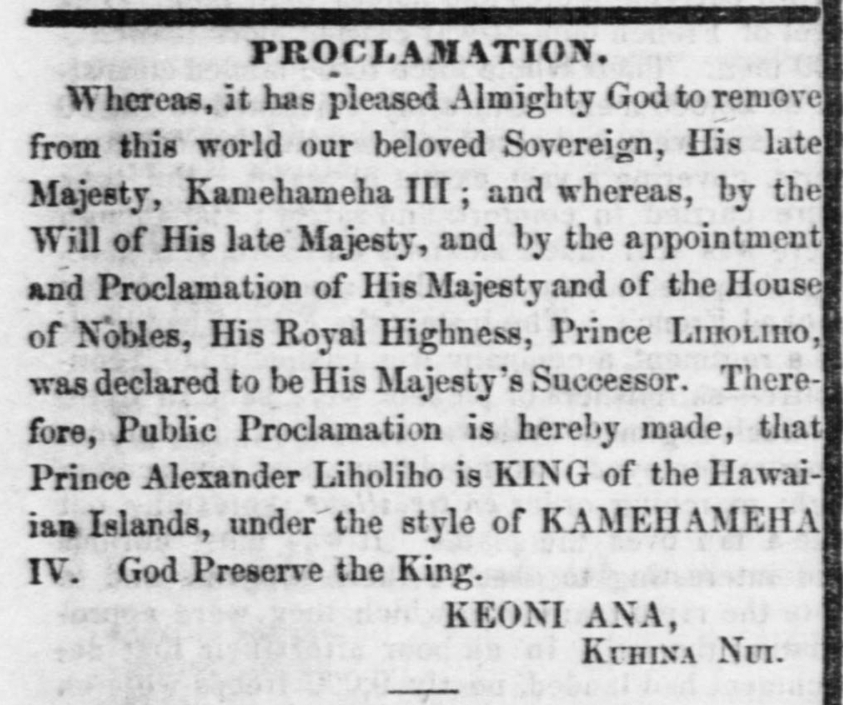
PROCLAMATION.

Whereas, it has pleased Almighty God to remove from this world our beloved Sovereign, His Late Majesty, Kamehameha III; and whereas, by the Will of His late Majesty, and by the appointment and Proclamation of His Majesty and of the House of Nobles, His Royal Highness, Prince Liholiho, was declared to be His Majesty’s Successor. Therefore, Public Proclamation is hereby made, that Prince Alexander Liholiho is KING of the Hawaiian Islands, under the style of KAMEHAMEHA IV. God Preserve the King.

KEONI ANA,

Kuhina Nui.

(Polynesian, 12/16/1854, p. 2)

PROCLAMATION.

The Polynesian, Volume XI, Number 32, Page 2. December 16, 1854.

Alexander Liholiho becomes Kamehameha IV, 1854.

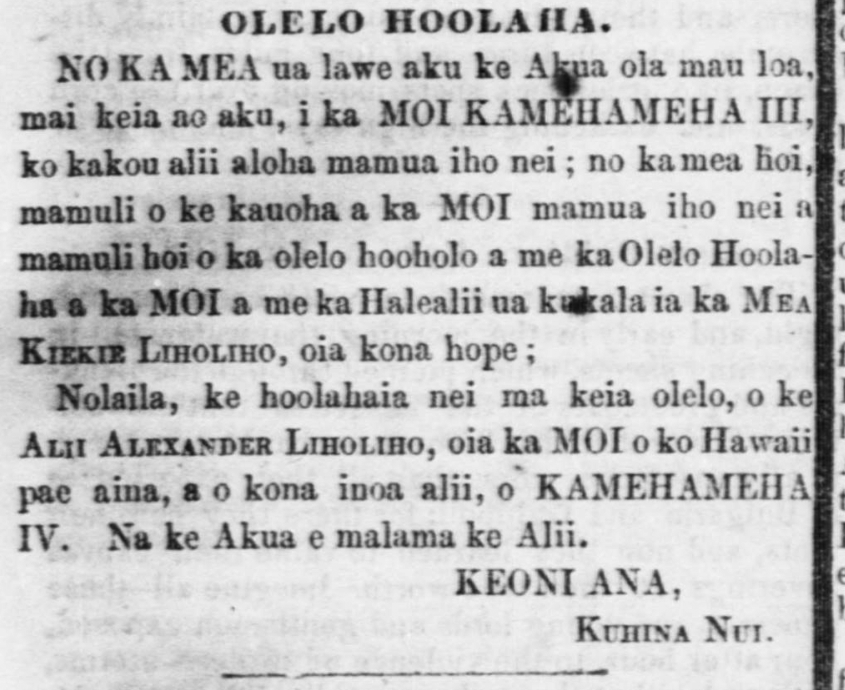
OLELO HOOLAHA.

NO KA MEA ua lawe aku ke Akua ola mau loa, mai keia ao aku, i ka MOI KAMEHAMEHA III, ko kakou alii aloha mamua iho nei; no ka mea hoi, mamuli o ke kauoha a ka MOI mamua iho nei a mamuli hoi o ka olelo hooholo a me ka Olelo Hoolaha a ka MOI a me ka Halealii ua kukala ia ka Mea Kiekie Liholiho, oia kona hope;

Nolaila, ke hoolahaia nei ma keia olelo, o ke Alii Alexander Liholiho, oia ka MOI o ko Hawaii pae aina, a o kona inoa alii, o KAMEHAMEHA IV. Na ke Akua e malama ke Alii.

KEONI ANA,

Kuhina Nui.

(Polynesian, 12/16/1854, p. 2)

OLELO HOOLAHA.

The Polynesian, Volume XI, Number 32, Page 2. December 16, 1854.

Kauikeaouli, Kamehameha III, dies a hundred and sixty years ago, 1854.

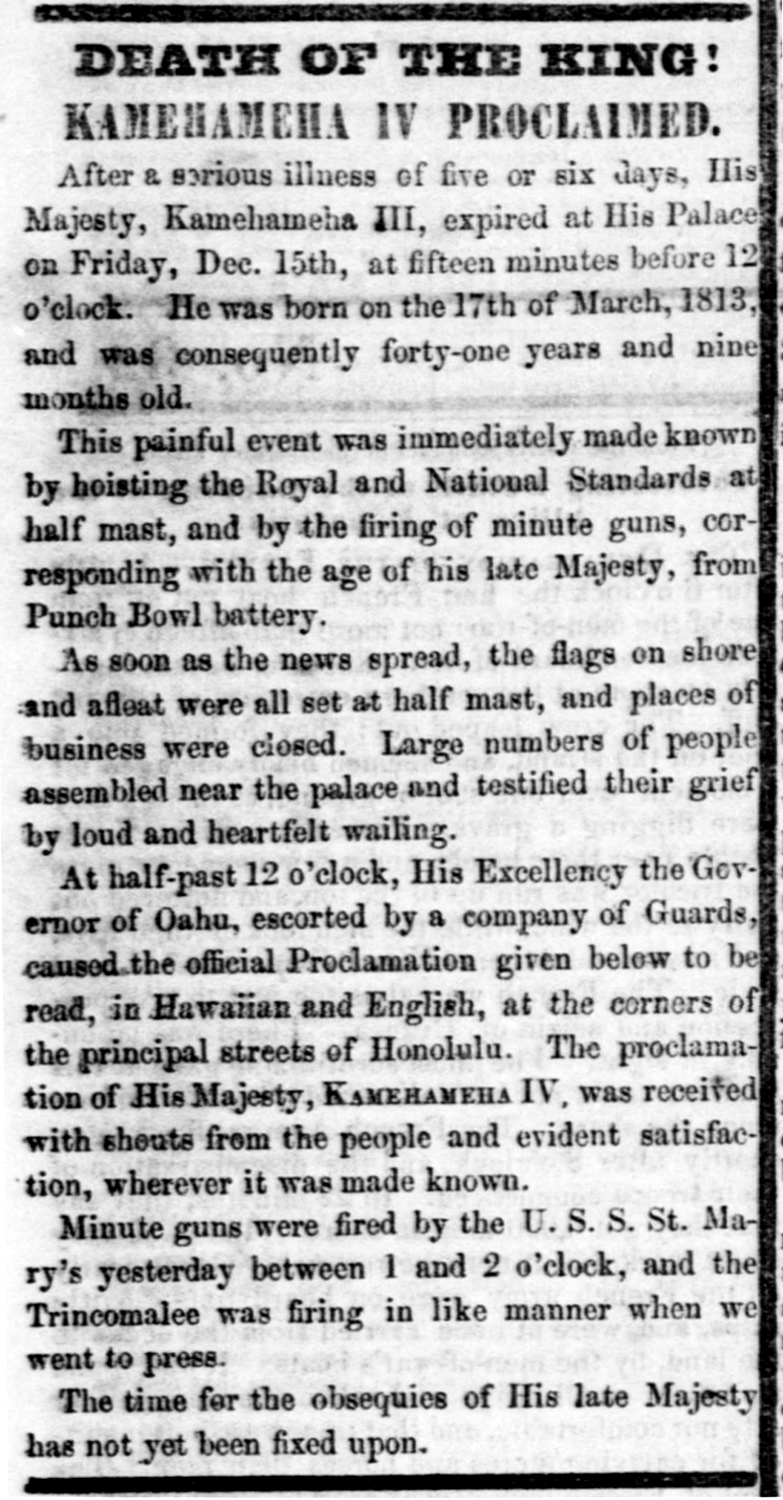
DEATH OF THE KING!

KAMEHAMEHA IV PROCLAIMED.

After a serious illness of five or six days, His Majesty, Kamehameha III, expired at His Palace on Friday, Dec. 15th, at fifteen minutes before 12 o’clock. He was born on the 17th of March, 1813, and was consequently forty-one years and nine months old.

This painful event was immediately made known by hoisting the Royal and National Standards at half mast, and by the firing of minute guns, corresponding with the age of his late Majesty, from Punch Bowl battery.

As soon as the news spread, the flags on shore and afloat were all set at half mast, and places of business were closed. Large numbers of people assembled near the palace and testified their grief by loud and heartfelt wailing.

At half-past 12 o’clock, His Excellency the Governor of Oahu, escorted by a company of Guards, caused the official Proclamation given below to be read, in Hawaiian and English, at the corners of the principal streets of Honolulu. The proclamation of His Majesty, Kamehameha IV, was received with shouts from the people and evident satisfaction, wherever it was made known.

Minute guns were fired by the U. S. S. St. Mary’s yesterday between 1 and 2 o’clock, and the Trincomalee was firing in like manner when we went to press.

The time for obsequies of His late Majesty has not yet been fixed upon.

[Unfortunately, the Hawaiian-Language Newspaper running at the time, Ka Nupepa Elele is not available digitally or on microfilm at this time.

The dark borders as seen here are found in newspapers when report of someone of import dies.]

(Polynesian, 12/16/1854, p. 2)

DEATH OF THE KING!

The Polynesian, Volume XI, Number 32, Page 2. December 16, 1854.

David K. White, Jr., passes away, 1910.

MY DEAR DAVID K. WHITE HAS GONE.

DAVID K. WHITE, JR.

To the editor of the Nupepa Kuokoa, The Pride of the Hawaiian Nation, Aloha oe:—Please give me some open space in your greatly cherished newspaper to insert some lines of reminiscences for my beloved lei that has gone on the road on which the whole world travels, so that his many classmates and big ohana from Hawaii of Keawe to Kauai of Manokalani will know.

My dear David was born in the coconut grove of Kaohai, Waikele, Ewa, Oahu on the 1st of March, 1889, and went to sleep the eternal sleep at 10:30 p. m. on the 4th of this July at Lahaina, Maui; therefore, he was 21 years old and some in this life.

My dear David was educated at the Kamehameha primary school when he was 8 years old, and he continued on in that same school, graduating as a well trusted student by his classmates and his teachers, and he was the president of the class of 1908. Continue reading

Vital Statistics, 1893.

Report of Deaths in October.

There were 52 deaths in Honolulu in the past month, 36 male and 16 female. By ethnicity, there were 24 Hawaiians, 9 Chinese, 5 Portuguese, 5 Japanese, 3 American, and 5 of other ethnicities. The majority were children. 14 were below the age of 1 years old, six between 1 and 5 years old, just as always. There was 1 below 20 years old, 7 below 30, 6 below 40, 5 below 50 and 60 each, and 4 each below and above 70 years old. In this month compared over five years, there were 46 in 1889, 40 in 1890, 49 in 1891, 51 in 1891, 51 in 1892, and 42 52 in this past October.

[Mahalo to Hoaohipua for catching the 42 where 52 was supposed to go! If anyone sees corrections or additions or comments that come to mind, please do comment in the area provided below the posts!]

(Lei Momi, 9/6/1893, p. 1)

Hoike Make no Okatoba.

Ka Lei Momi, Buke 1, Helu 14, Aoao 1. Novemaba 6, 1893.

On the passing Gabriel K. Keawehaku, Ka Anela o Mekiko, 1921.

GABRIEL K. KEAWEHAKU PASSES AWAY.

Gabriel K. Keawehaku.

After being ill for the past many months, Gabriel K. Keawehaku left this life at 9 a. m. on the 4th of this month, just outside of his home in Kaimuki, and in the afternoon of the following 5th, his remains were put to rest at the Kaimuki cemetery.

He was given birth to by his parents, Keawehaku (m) and Olaola (f), on the 31st of the month of May, 1867, here in Honolulu, and when he grew weary of this life, he was 54 years old, plus 7 months and 4 days.

He was educated in Honolulu nei during his childhood; he was a kamaaina of this town, performing many jobs, and it was the illness that came upon him that made him give up his different jobs.

He first was employed in his youth in the Metropolitan Meat Market of Waller [Wala] and company. During the monarchy, he lived with King Kalakaua, in the king’s private guards for six years. He served as the customs inspector when the government was transferred under America, being sent to Hilo, and he was customs inspector there for five years. Continue reading