Joe Kauwila captures shark in Hana, 1903.

TOWED UNDER WATER BY SHARK

UNUSUAL EXPERIENCE OF NATIVE SAILOR ON THE CLAUDINE WHILE AT HANA.

It is not often that any one is towed under water by a shark and lives to tell the tale, but this is precisely what happened last Thursday to Joe Kauwila a native sailor aboard the steamer Claudine. Not only did he survive the experience, but at last accounts he was shoving a truck at the Wilder wharf today helping to load the steamer Claudine with freight.

On Thursday at Hana while the Claudine was in the port, the sailors heard that a dead horse had been moored near one of the buoys, for the purpose of attracting a shark. A big shovel nose shark about 12 feet in length, came circling in the vicinity of the horse. Captain Parker took a boat crew and went over by the buoy. J. Welch a man from the shore, shot at the shark with a rifle and struck the shark in the head and evidently stunned it. The idea of Captain Parker and the men in the boat was to get a line on the shark and haul it aboard. There were two young natives in the boat one of them Joe Kauwila. Joe is about 18 years of age and the other man about 20.

The shark could be seen a few yards away lying on its back. Some thought the shark had been killed. The natives talked of going over with the line.

“I think he no make,” ejaculated one of the men.

“Oh! I think he make, all right,” declared Joe. “Any how, plenty more kanakas. I try get line on him.” Joe hauled off his shirt, seized the line and started swimming toward the shark. He caught hold of the shark’s tail and began to put the line over the tail. The instant that the shark felt the boy catch hold of its tail, the shark sprang into sudden life, and started to swim. Joe held onto the shark’s tail though. Down went the shark intending evidently to dive under the boat. Continue reading

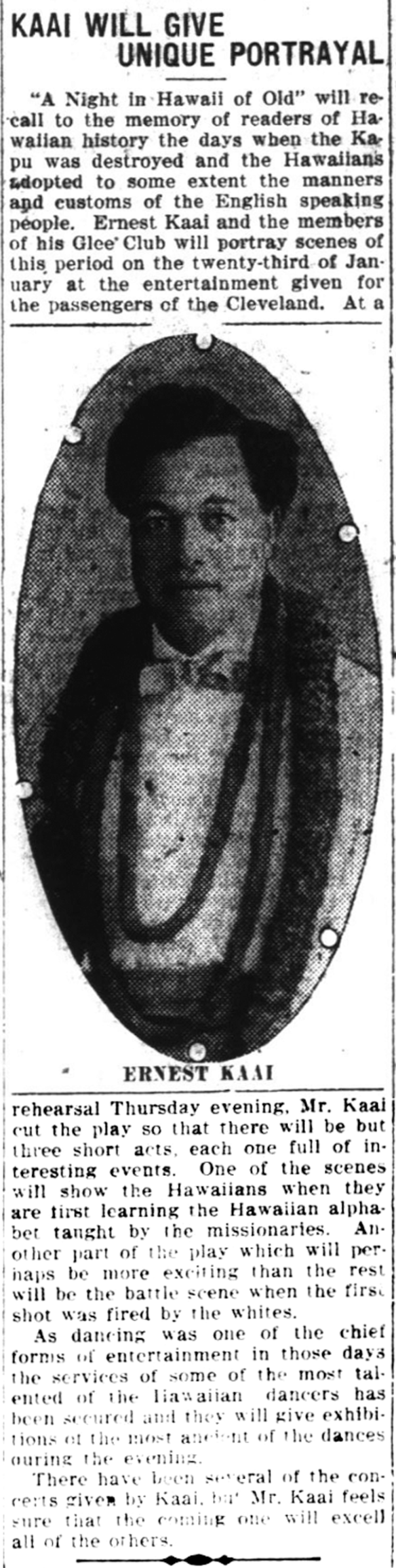
“A Night in Hawaii of Old,” by Kaai Glee Club, 1913.

KAAI WILL GIVE UNIQUE PORTRAYAL

“A Night in Hawaii of Old” will recall to the memory of readers of Hawaiian history the days when the Kapu was destroyed and the Hawaiians adopted to some extent the manners and customs of the English speaking people. Ernest Kaai and the members of his Glee Club will portray scenes of this period on the twenty-third of January at the entertainment given for the passengers of the Cleveland. At a…

ERNEST KAAI

…rehearsal Thursday evening, Mr. Kaai cut the play so that there will be but three short acts, each one full of interesting events. One of the scenes will show the Hawaiians alphabet taught by the missionaries. Another part of the play which will perhaps be more exciting than the rest will  be the battle scene when the first shot was fired by the whites.

As dancing was one of the chief forms of entertainment in those days the services of some of the most talented of the Hawaiian dancers has been secured and they will give exhibitions of the most ancient of the dances during the evening.

There have been several of the concerts given by Kaai, but Mr. Kaai feels sure that the coming one will excell all of the others.

(Star-Bulletin, 1/20/1913, p. 12)

StarBulletin_1_20_1913_12.png

Honolulu Star-Bulletin, Volume XX, Number 6489, Page 12. January 20, 1913.

Conclusion of Piilani’s Story, 1917.

The Story of Piilani

(Continued from last week.)

The next day they moved up the valley and found a place where it was good to stay as there was plenty of water and lots of wild bananas. On that day they heard for the first time the cannon roar and they saw shells strike their old hiding place. They found lots of shrimps and oopu in the river and also some wild taro. During all this time Piilani stood guard half of the time. About a week later the shooting stopped. They stayed in this place about one month and then moved further makai, where there was some kalo patches, lots of fruit and more fish and opae in the river and they stayed around there for nearly two years and often saw their friends, but their friends did not see them.

Always hiding in daytime and foraging in the night, nobody knew what had become of them, some thought they had been killed or were dead from hunger, thirst and exposure.

One day as Piilani was pulling some taro she heard some noise as from a man coming. She crawled up on a high place and saw Willie Kinney coming together with Kelau and George Titcomb. She ran back to where Koolau was hidden and told him. Koolau and family went into hiding further back in the valley, but when they saw who it was they came out and shook hands with them and had a long talk with them, and when they left Kinney told Koolau that he might shoot any bipi that he needed, however, Koolau never killed any of Kinney’s cattle.

A few days after Kinney’s visit Kelau and his wife brought some more clothes for them Continue reading

Continuation of Piilani’s story, 1916.

The Story of Piilani

(Continued from last week.)

Several days later they got the news that Mr. Stolz and some policemen all armed with revolvers and guns had arrived to get the lepers and particularly to capture Koolau. When Koolau heard this he said: “It may be their idea, but the man who tries to do that will do so at the peril of his life.”

This word was brought to Stolz, and he sent the word back that Koolau would repent it if he refused to obey the orders of the authorities. Koolau took his gun, kissed it and held it to his breast and talked to the gun as if it was a friend and charged it to stand by him and shoot straight, and from that time Koolau kept guard and shortly afterwards they saw a ten being put up on the beach, and he thought it was to watch him and some of his friends went down to find out for him.

One day Koolau, Piilani and the child went makai on the path by the stream, and there they found Mr. Stolz’s raincoat with some crackers in the pocket, also a blanket, and Koolau told Piilani to take these things along with her. Shortly afterwards they met Penikala, a policeman from Waimea, and Koolau asked him, where Louis Stoltz was, and Penikala said, he did not know, but thought that Louis Stoltz had gone to Hanalei. A little later they met Peter Nowlein, a policeman from Hanalei, and Nowlein told them that Louis Stoltz had gone further up the valley to catch Koolau by surprise. Koolau and family kept going till they reached Kaumeheiwa’s house and found there a lot of their friends. Koolau told them that he was in search of Louis Stoltz and if they were afraid told them to go somewhere else. Penikila was there and Koolau upbraided him for telling a falsehood and told him he ought to be shot, but told him he would forgive him, as he was after Louis Stoltz only. The most of the people went further down towards the beach. Continue reading

Piilani, the Wife of Kaluaikoolau, 1916.

The Story of Piilani

At the recent meeting of the Kauai Historical Society, Judge C. B. Hofgaard, of Waimea, read the following article on the above subject:

Mrs. Piilani Kaluaikoolau died at Waimea, Kauai, on Sept. 1, 1914, after a lingering sickness and was buried the next day.

Only a few of the kamaainas among the haoles knew that she was with us and none of the younger generation of foreigners knew who she was. Piilani was the wife of Kaluaikoolau, generally called Koolau, the leper. She was with Koolau when he shot L. H. Stolz, Deputy Sheriff of Waimea, she was with him, when he stood off successfully the soldiers of the Hawaiian army, that were sent to catch him dead or alive, and she was with him when he defended his hiding-place in the pali of Kalalau; she stayed with him after the army had left and was with him continually till his death, dug singlehanded his grave and singlehanded buried him. Her only child sickened and died in her arms while she was living in the wilderness and she and her husband buried the child.

Piilani was born at Kekaha in the year 1864. Her parents were Hoona, a man from Papaikou, Hawaii, and her mother was Kepola, a woman from Kekaha. In her childhood she lived with her parents at Kekaha and her house was on the Mana side of the church of Kekaha. She grew up a tall, straight girl resembling her father, who is still straight for a man between seventy and eighty. She was a very goodlooking woman i her younger days and had in a great measure the litheness of the young people of her race, and she kept youthful in appearance and actions till a few years before her death. She was sick a great part of the time during the last two years of her life.

She was married to Koolau in 1881, by Father Rowell, and she and her husband always lived happily together. They had only one child, a boy by the name of Kaleimanu, who was born in 1883 and contracted his father’s dreaded disease and died while they were living as an outlaw, in the mountains of Kalalau.

Her husband, Koolau, was born in Kekaha in 1862, his parents were Kaleimanu and Kukui. He went to school with Father Rowell in Waimea from 1868 and when he came out of school he worked first with Francis Gay and later for V. Knudsen. In 1891 and 1893 there was a great activity by the authorities to get all the lepers and send them to the leper settlement at Molokai. In the fall of 1889 and possibly before, we had noticed that my friend Koolau began to show slight signs of the dreaded disease on his cheeks. I said “my friend” Koolau, and the reason is, that he was often my companion on hunting trips in the Puukapele region. Koolau was a splendid hunter, a fine marksman and an excellent man with the lasso; besides this he was a pleasant companion. He knew all the country west of Waimea canyon and all the haunts of the wild cattle, and when we had Koolau in the party, we were sure to find game. In a couple of years the disease developed quite noticeably, and in 1891 and 1892 when the gathering of the lepers started, he was in a bad state, and Mr. Stolz, the deputy sheriff, told him to go to Doctor Campbell and be examined. He was pronounced a leper and Stolz told him to get ready to go to Molokai. Koolau did not object and asked Stolz to leave him a few days to settle his affairs and Stolz acquiesced, as he had confidence in Koolau’s good faith.

Some of the lepers in the Waimea and Makaweli valleys had armed themselves and showed some resistance to the authorities and others had escaped to Kalalau valley.

The horror of going to Molokai and be separated from his wife and child must have preyed on Koolau’s mind and succumbing to the entreaties not to leave his wife, Koolau consented to break his word with Sotlz and run away to the valley of Kalalau, where then several lepers were living in the hope that the authorities would leave them there alone, like what had been done on the island of Niihau, where they had a small colony of lepers at Kawaihoa on the western end of the island, which colony had been left alone for a number of years.

One dark night Piilani, her husband Koolau, their son Kaleimanu, Piilani’s mother Kepola and her sister Kinoulu’s daughter, Ida, started from Kekaha over the mountains to Kalalau. Kua Papiohuli went along to take back all the horses. I think no other man would have undertaken to go across the Kilohana of Kalalau in the middle of a dark night but Koolau. I found it a difficult place to find your way in in the day-time, as the place is practically flat and there were cattle-trails in all directions. The party struck the top of Kalalau valley just before daylight. They had some breakfast and Kua Papiohuli started back to Waimea with horses. It was a cold damp day. Piilani and the others started down the trail, Koolau carrying the child in a sling that he made from his shirt. To go up or down the old trail from Kilohana into Kalalau was a task of endurance for any mountain-climber and it speaks well for the endurance of Piilani and her mother to get down to the bottom unassisted. The old trail is impassible now. In Kalalau Koolau and family first stayed with some friends and he worked in their taro-patches as payment for the food he got for himself and his family.

Shortly after coming to Kalalau, Piilani’s boy, Kaleimanu began to show signs of leprosy.

They stayed quietly in Kalalau till one day in 1883, when Piilani was startled by meeting Louis Sotlz followed by Penikila, one of the police constables of Waimea. They had come down the pali to where Kolau and family lived at Nohoeiki’s house in Kalalau. She greeted them and had a long talk with them. After a while Stolz asked her where her husband was and she told them that Koolau had gone to work in the taro-patch. He then asked at what time she expected him back, to which Piilani answered that sometimes Koolau come home at noon and sometimes in the evening. Stolz told her that he was going makai and that he wanted to see Koolau and requested her to tell Koolau to come makai and see him.

Piilani had sad forebodings and began to cry and her son Kaleimanu asked her, why she cried. She lifted up the child and covered its face with kisses and could not answer the child’s question in regard to the reason for her weeping. Just then Koolau came and saw her crying with the child in her arms. He thought something had happened to the child. She said nothing had happened to the child, but threw her arms around Koolau’s neck and told him all about Stolz’s visit, and Koolau tried to comfort her.

On the second day after her meeting with Mr. Stolz the word was passed round that all the lepers were ordered by him to come makai and all the lepers and their friends went there, and they all agreed to go to the leper settlement, except Koolau, who stoo up before Mr. Stolz and said: “I ask you, if you agree to let my wife go with me. I will not leave her, as we are as one, and I shall not leave her, till death does us part.”

Mr. Stolz said: “No, your wife cannot go with you, only the lepers shall go  and nobody else.”

Koolau said: “Then I refuse to go to that strange place and leave the wife that I have vowed to stay with. My wife and I have sworn to be as one, when we married. I will not go alone.

Koolau was angry and deadly honest and maintained that the government had no right to separate a man from his wife and put him in a place like a prison.

Two days later, Mr. Stolz and party returned to Waimea, and all the lepers with exception of Koolau prepared to go to the leper settlement. Koolau and Piilani returned mauka and they had often visitors, and Koolau told them all to get ready, but for himself he had decided to stay with his wife and child.

(Concluded in next issue.)

(Garden Island, 12/19/1916, p. 6)
GardenIsland_12_19_1916_6.png

The Garden Island, Volume 12, Number 51, Page 6. December 19, 1916.

Our Museum, continued, 1900.

OUR MUSEUM

The Bishop Collection of Curios.

One of the Most Interesting Sights In Honolulu Pleasantly Described.

(Concluded.)

Death seems to have played an important part in the ancient regime, as the kings and chiefs had the power of life and death over their subjects. Then too, the priesthood, or kahunas, exercised what is termed the “tabu,” which prescribed certain rules and regulations for the natives, any violation of which was punishable by death; for instance a chief placed “tabu” sticks at the entrance to his hut; that meant to one and all, “Do not enter or pass within the shadow of the tabu sticks under pain of death;” if a Hawaiian subject, and even a petty chief, violated this tabu, he was instantly put to death; supplication was of no avail. The power of the kahunas in their exercise of the tabu, was so great and the superstitious awe of the common native so intense, that its effects have not died out even in this day and age. The common natives are yet prone to believe in their kahunas, and believe that they have the power to pray them to death; in olden days, if an enemy obtained any part of the body of another, a hair, a part of the finger nail, spittle, or anything of the body itself, he would give it to a kahuna and ask him to pray the other one to death; with great ceremony the kahuna would perform certain mysterious functions over the hair, say strange words, offer it before the poison god, and then announce that he was praying the native to death; this being told to the native so great his superstitious fear, he would go to his hut and in reality become sick over the thought of the dread summons made by the kahuna, and in many cases they actually died of the fright thus given them; and to this day many of the natives place more faith in their kahunas than in the “haole” or foreign physicians. If the praying did not perform the evil work, then a piece of the poison god was steeped and the fluid given the sufferer, it is said, which, acting upon his heart, killed him. On every hand in the museum are the evidences of kahunaism and death. There are stones, peculiarly shaped, (like a gourd,) with a small neck; these stones were suspended from the low door of a grass house in such a way that the person entering after the trap was set, would probably be crushed by the fall of the stone. They are made from lava rock. Continue reading

Still Our Museum Today! 1900.

OUR MUSEUM

The Bishop Collection of Curios.

One of the Most Interesting Sights In Honolulu Pleasantly Described.

HONOLULU, Feb. 8.—Above the inner entrance to the Museum of Hawaiian and Polynesian History is a tablet of polished mottled stone, in which is engraved in letters of gold the following inscription:

To the Memory of
BERNICE PAUAHI BISHOP,
FOUNDER OF THE KAMEHA-
MEHA SCHOOLS OF HO-
NOLULU.
A Bright Light Among Her Peo-
ple; Her Usefulness Survives
Her Earthly Life.

A Bernice Pauahi, she was related to the royal family of the Kamehameha dynasty, and the cousin of Queen Emma, two women who have indelibly inscribed their names upon the hearts of…

BERNICE PAUAHI BISHOP.

…all Hawaiians, whether by birth of association. She married the Hon. C. R. Bishop, and with her immense wealth and her kindly deeds through life, created a new life among the Hawaiians. Upon her death she left most of her wealth to endow the Kamehameha Schools, a separate school for boys and a separate one for girls. These schools are kept up entirely from the income of her estates, which have become so vast as to render it necessary to erect other buildings throughout the Islands in order to expend the revenue. In memory of his wife, the Hon. C. R. Bishop dedicated the museum in her name, laying aside a princely endowment. Collectors have scoured the Hawaiian Islands for curios of historical and intrinsic value and have succeeded by the most diligent effort and at great expense, in depositing in the museum an invaluable collection of ancient materials which would warm the cockles of the antiquarian’s heart beyond measure. Calabashes, large and small, ancient and modern, have come into the museum; some were in the possession of families, relics passed from one generation to another; others were found in the caves where in ancient times were buried kings and chiefs. Idols of grotesque shapes, dedicated to all the elements of nature, good and evil; some dedicated to Pele, the Goddess of Volcanoes; others to the poison god and to the fish god; some made of stone, others of the valuable koa and kou woods; one made of the trunk of the poison tree, its wood, upon being steeped in water, being a most powerful, yet undetectable poison which acts upon the heart, and which was used by the kahunas and chiefs. Beautiful feather cloaks of wonderful sheen and delicate texture, worn by Kamehameha the Great during his tour of conquest a century ago. Continue reading

Long live the Bernice Pauahi Bishop Museum! 1892.

A Visit to the Museum.

President Hosmer and the boarders of Oahu College paid a visit to the Bernice Pauahi Bishop Museum at the Kamehameha School last Saturday afternoon. Prof. W. T. Brigham, curator, showed the collegians almost every article on exhibit at the museum, and his visitors were very much impressed with the relics of the barbaric age of Hawaii nei, only one hundred years ago. Mr. Brigham knows the history of almost everything placed in the museum, and he entertained the students for over two hours with the pedigree of the various exhibits.

[I wonder if the students of Punahou are still visiting the museum today!]

(Advertiser, 10/17/1892, p. 3)

PCA_10_17_1892_3

The Pacific Commercial Advertiser, Volume XVI, Number 3203, Page 3. October 17, 1892.

Queen Emma in New York, 1866.

THE DISTINGUISHED VISITOR.

Emma, the Queen Dowager of the Sandwich Islands, Visits Brooklyn, the Navy Yard, and Sails Down the Bay—Callers at Her Hotel Yesterday, &c.

Her Majesty of the Sandwich Islands, Emma, is determined, it would appear, to see the lions of the famed city of New York while she has the opportunity, and yesterday she extended the pardonable curiosity, which it is not scandalum magnatum to say her Majesty shares with the rest of her sex, to the sister city of Brooklyn. At half-past nine in the morning Queen Emma left her hotel, accompanied by Miss Grinnell, Miss Spurgeon, Major Hopkins, and lady-in-waiting, and drove down Broadway, to the Fulton ferry, whence Her Majesty and suite crossed to Brooklyn. The first place visited was Greenwood cemetery, with the beautiful scenery around which the party was much delighted. On the way back, they stopped at the photographic gallery in Fulton street, where the Queen sat for her portrait.

VISIT TO THE BROOKLYN NAVY YARD.

Pursuant to the announcement made in yesterday’s Herald the entire party then paid a visit to the Brooklyn Navy Yard. The hour appointed for her arrival was half-past one o’clock, and for one hour an assemblage of the citizens of Brooklyn and elsewhere commenced collecting until the mass numbered upwards of three thousand persons. The gates of the yard were closed to all persons except those who had passes signed by the chief officers. Half-past one arrived, but no tidings were received of the Queen. The crowd commenced to get impatient, jokes were passed to and fro to the parties on both sides of the street, when at length, at twenty minutes to two, two open carriages appeared in sight, containing the Queen, suite and attendants. It was observed as the carriages entered the yard that the first one contained her Majesty, Miss Spurgen, maid of honor; Mr. and Miss Odell; and the second Major C. Gordon Hopkins, of the Hawaiian army, and Miss Grinnell, maid of honor. As the party entered the gates the marine guard were formed in line and received her Majesty at “present arms.” She returned the compliment with a polite bow, the carriages proceeding to Admiral Bell’s quarters, in the Lyceum building. Arriving at this point the honored guest was received and assisted from her carriage by Captain Alexander M. Pennock, chief executive officer of the Navy Yard, who in turn introduced her to Rear Admiral Charles H. Bell, the commandant. The Admiral tendered his arm to the Queen, who promptly accepted it, and the party proceeded to the portico on the second story of the Lyceum. When Queen Emma alighted, the Marine battalion, commanded by Captain Collier, were drawn up in line, presented arms, while the Navy Yard band played the air of “Hail Columbia.” A detachment of the crew of the United States ship Vermont fired a salute of twenty-one guns from the Cob deck battery, and the Hawaiian flag was displayed at the main topgallant masthead. Continue reading

Cannons from the Haaheo o Hawaii wreck, 1857.

Wreck of the “Pride of Hawaii.”

In the year 1824, the yacht of Kamehameha II, called “Ka Haaheo o Hawaii,” formerly the “Cleopatra’s Barge,” was wrecked at Waioli, in the Bay of Hanalei, Kauai. An unsuccessful attempt was made by the chiefs to haul her up on to the shore, but her masts broke off and she rolled back outside the reef, where she was abandoned and lost. We learn from a correspondent of the Hae Hawaii that two of her guns, of which she was provided with four, have been found by divers and brought ashore, together with some of her iron and copper work. What would appear strange in the account of Mr. Hunchback—for that is the name of the Hae‘s correspondent—is the statement that these guns are not in the last bit the worse for their thirty-three year’s submersion, but that, after removing the outside deposite of shells, &c., they were found bright and sound. They are stamped with the date of their manufacture, 1813.

(Polynesian, 5/23/1857, p. 5)

Polynesian_5_23_1857_5.png

The Polynesian, Volume XIV, Number 3, Page 5. May 23, 1857.