Another beached whale, 1901.

WHALE WASHED ASHORE AT KEEI

NATIVES WAX RICH FROM BIG FIND MADE ON HAWAII LAST WEEK.

Some of the natives living at Keei, Hawaii made a rich find last Saturday. They caught a 32 foot whale. The leviathan was not harpooned while in the deep water but was washed ashore and caught close to the beach.

Just how the whale came to be washed ashore is not certain. It was alive when it was first discovered in the shallow water early Saturday morning. It is not improbable that a drove of sharks attacked the monster and in desperation the whale swam madly in shore in the hopes of escaping from the attacks of the sharks. If such had been the desire, the attacks of the sharks were escaped but the surer attacks from the natives followed. Continue reading

Recollections of Kauai boy, William E. Rowell, 1916.

INTERVIEW WITH W. E. ROWELL
Dec. 6, 1915

The following interview with the late W. E. Rowell, who died recently in Honolulu, was read at the meeting of the Kauai Historical Society last week by J. M. Lydgate:

I was born at Hanalei in 1845. My father followed Alexander there for a couple of years. When I was about one year old were moved to Waimea. We came by canoe I believe, bag and baggage. No I don’t remember anything about it. Mr. Gulick I understand had built the house at Waimea. Mr. Whitney had died I think just before our arrival or soon after so that the whole work and responsibility of the station fell on my father. The Whitney house stood just about where the Hofgaard house is now, while ours stood near by. No, no, the Whitney house wasn’t built of adobie, but of stone coral sand stone. I remember very distinctly how it cracked because of imperfect foundation and the walls bulged out and had to be shoved up with heavy timber props. The house was demolished finally for the stone which was taken to build the Kekaha chimney. I think they paid $100 for it. Mother Whitney lived there for a good many years. In the division of the mission sands there was some difficulty about coming to an amicable decision, for, you know, these old missionaries were quite human in spite of the fact that they were missionaries. Mrs. Whitney wanted about everything that was any good.

We got a piece of pasture land on the east of the river called Mahai-hai: it was there we kept our stock, and in dry times they fairly grubbed up the roots of the manienie.

We had an old man who took the stock back and forth: he took them to the river and they swam across and when he wanted them he called them and they came across the river.

When Mrs. Whitney died she left her land to the native church. The minister was to live at the Whitney place, but that was inconvenient so an exchange was made for a kuleana in the valley, and I bought the balance of the land for $1800. That is the basis of the church fund to this day.

There was a grass church in those days down on the beach west of the river, where afterwards the school house stood and about where the Chinese church is now. There were two services on Sunday and a prayer meeting on Wednesday afternoon. No, the crowds were not very large and the church was not as big as the stone church built later. The church was built of pili grass, closed in, as I remember it, on the mauka and windward side, but open makai on the lee side. There were no windows, at least no glazed windows. The people sat on mats on the floor. The matter of windows, reminds me that I made quite a little money in my boyhood days, making window and door cases for Hawaiian grass houses. Yes, all the houses at that time were of grass. Continue reading

Hula fought against by the church, 1917.

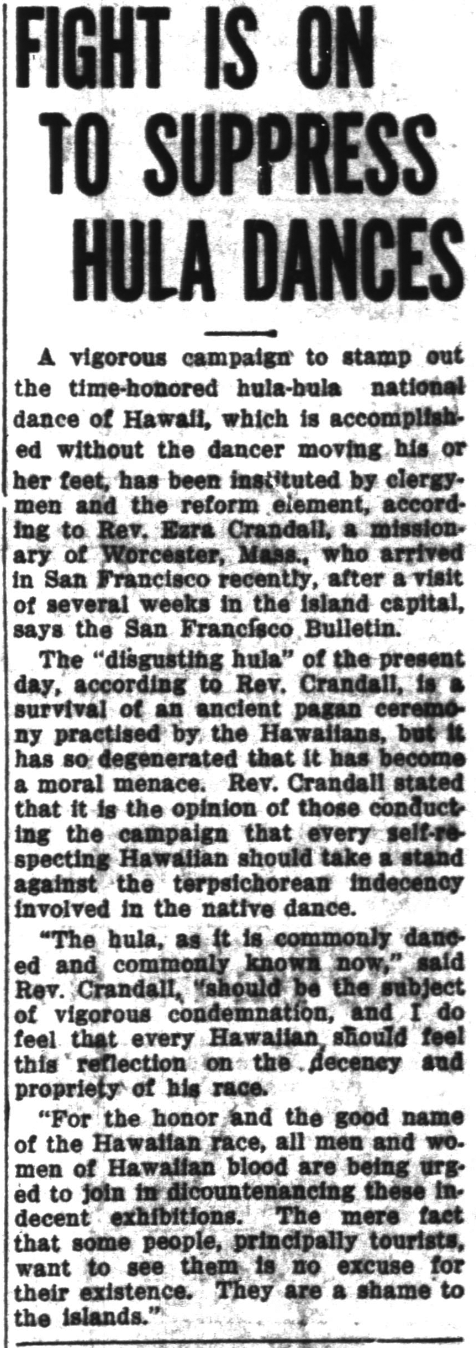
FIGHT IS ON TO SUPPRESS HULA DANCES

A vigorous campaign to stamp out the time-honored hula-hula national dance of Hawaii, which is accomplished without the dancer moving his or her feet, has been instituted by clergymen and the reform element, according to Rev. Ezra Crandall, a missionary of Worcester, Mass., who arrived in San Francisco recently, after a visit of several weeks in the island capital, says the San Francisco Bulletin.

The “disgusting hula” of the present day, according to Rev. Crandall, is a survival of an ancient pagan ceremony practiced by the Hawaiians, but is has so degenerated that it has become a moral menace. Rev. Crandall stated that it is the opinion of those conducting the campaign that every self-respecting Hawaiian should take a stand against the terpsichorean indecency involved in the native dance.

“The hula, as it is commonly danced and commonly know now,” said Rev. Crandall, “should be the subject of vigorous condemnation, and I do feel that every Hawaiian should feel this reflection on the decency and propriety of his race.

“For the honor and the good name of the Hawaiian race, all men and women of Hawaiian blood are being urged to join in discountenancing these indecent exhibitions. The mere fact that some people, principally tourists, want to see them is no excuse for their existence. They are a shame to the islands.”

(Star-Bulletin, 6/15/1917, p. 14)

StarBulletin_6_15_1917_14

Honolulu Star-Bulletin, Volume XXIV, Number 7854, Page 14. June 15, 1917.

The Pacific Commercial Advertiser ridicules the women of the Patriotic League, 1893.

PATRIOTIC WOMEN.

They Object to the Wording of a Memorial.

The Hawaiian Women’s Patriotic League held its third business meeting yesterday morning at Arion Hall. Mrs. F. W. Macfarlane, President, called the meeting to order promptly at 10 o’clock. After reading the minutes by the Secretary, Mrs. Grace Kahalewai, the proposed memorial to United States Commissioner Jas. H. Blount was taken up. The Secretary read it once in Hawaiian, but the ladies in the rear part of the building could not hear her. They requested her to again read the rather lengthy memorial, which was done. The memorial was briefly in this wise: Continue reading

Joseph Kapaeau Aea passes on, 1911.

JOSEPH AEA PASSES AWAY

Joseph Aea, agent of Her Majesty Liliuokalani, died last evening about ten o’clock at his home in Pauoa. He had been associated with the queen’s family for many years. He leaves a widow and two sons. One of them is the protege of Queen Liliuokalani and is also the stenographer and assistant clerk in the city clerk’s office.

Joseph Aea was for many years connected with the old Royal Hawaiian band. He was the solo viol player and was an excellent musician. He became attached to the household of Queen Liliuokalani, and attended Liliuokalani when she was one of the official guests at the jubilee of Queen Victoria in London. He also attended the queen when she visited Washington in 1903. His wife was also one of the queen’s closest personal attendants, and has been particularly attentive to her since the overthrow of the monarchy.

In 1907, upon the death of Hon. J. O. Carter, Liliuokalani appointed Mr. Aea as her business agent, but the Liliuokalani Trust, formed about two years ago, transferred this important office to Col. C. P. Iaukea, who is one of the trustees under the Liliuokalani Trust.

Aea was a delegate to the Democratic territorial convention in 1900, and was nominated for the legislature by the Home Rulers in 1902, and again in 1904, by the Democrats.

(Hawaiian Star, 1/26/1911, p. 7)

HawaiianStar_1_26_1911_7.png

Hawaiian Star, Volume XVIII, Number 5866, Page 7. January 26, 1911.

Francis Sinclair dies, 1916.

OWNER OF NIIHAU DIES IN ENGLAND

Francis Sinclair [? Gay], owner with his brother of the Island of Niihau, planter, rancher, author and poet, died on July 22, inst. in the Isle of Jersey, England, at the age of eighty-three. He was well-known in Hawaii to kamaainas of two and three decades ago.

 He was for many years a resident of Hawaii, coming here in 1863 with his brother, from New Zealand, in a small vessel which they had purchased and with which they cruised in the South Seas for some considerable time.

After residing in the Islands a short time Francis Sinclair and his brother purchased the Island of Niihau, northwest of Kauai. Ownership of the island is still held in the Sinclair family, which has quite a number of members in the Islands and particularly in Kauai.

During later years Mr. Sinclair resided in London, England, devoting his time to literary work. Among his works are “Ballads and Poems From the Pacific,” “Under Western Skies” and “From the Four Winds,” in addition to which he published a number of other short stories and poems, mostly dealing with the Pacific and Hawaii.

He is survived by a widow, a sister, one daughter, and many other relatives, both here and abroad. Three of his daughters married men who became prominent in the life and industries of the Islands—Mrs. Knudsen, mother of former Senator Eric A. Knudsen, mother of former Senator Eric A. Knudsen of Kauai, and the elder Mrs. Gay, and Mrs. Robinson.

(Hawaiian Gazette, 9/8/1916, p. 3)

HawaiianGazatte_9_8_1916_3.png

The Hawaiian Gazette, Volume IX, Number 74, Page 3. September 8, 1916.

More on Kalaniopuu’s ahuula and mahiole, 1887.

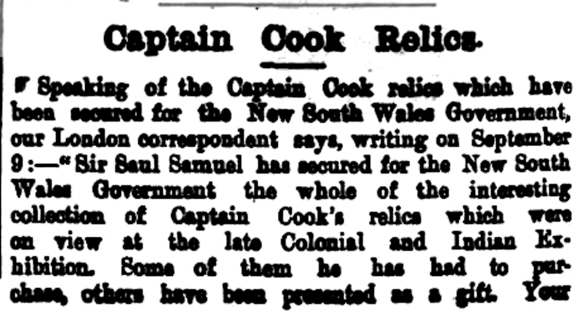
Captain Cook Relics.

Speaking of the Captain Cook relics which have been secured for the New South Wales Government, our London correspondent says, writing on September 9:—”Sir Saul Samuel has secured for the New South Wales Government the whole of the interesting collection of Captain Cook’s relics which were on view at the late Colonial and Indian Exhibition. Some of them he has had to purchase, others have been presented as gift. Your…

(Sydney Mail, 10/22/1887, p. 868)

SydneyMail_10_22_1887_868

The Sydney Mail, Volume XLIV, Number 1424, Page 868. October 22, 1887.

Continue reading

Lord St Oswald and the ahuula and mahiole of Kalaniopuu, 1912.

CAPTAIN COOK RELICS.

LORD ST. OSWALD’S GENEROUS GIFT TO NEW ZEALAND.

VALUABLE HAWAIIAN CLOAKS AND MAORI CARVINGS.

A visitor strolling into the dingy recesses of the Colonial Museum at Wellington (says the “Press”) might have noticed some peculiar looking feather cloaks and other curios of a dinginess in keeping with their worm-eaten domicile, and apparently of no great worth. In reality, however, they are articles of almost priceless value, genuine members of the great English circumnavigator, Captain Cook. Not only so, but they are connected intimately with his voyages and discoveries in the South Pacific and with the Hawaiian Islands and New Zealand in particular. They are the generous gift to New Zealand of Lord St. Oswald, whose forbears bought them at the sale of Bullock’s Museum on April 29, 1819. When Bullock died his famous collection was offered to the British Museum for £50,000, but refused, and it was subsequently disposed of at auction.

The main feature of Lord St. Oswald’s gift is the magnificent feather cloak and helmet presented to Captain Cook a short time before his death by the King of Owhyee. This robe is particularly described by Captain Cook in the account of his voyages. The cloak, which is in a remarkably fine state of preservation, is made mainly from countless small feathers of the Yellow Roo (Destia ral coxinia), a bird long since extinct. The feathers have, with inifinite patience, been woven one by one into a fibre base. The feather helmet is remarkable in that in shape it is almost a counterpart of the helmet in which our allegorical figure of Britannia is portrayed, with the crest of comb that was a characteristic of the Burgonet of the sixteenth and seventeenth centuries particularly prominent, which can be traced back to the early Roman times. How the Hawaiians had got this idea of the mediæval helmet before the discovery of the islands by Captain Cook is somewhat of a mystery, unless it be that the Spanish had previously visited the islands. This seems highly probable. There is also an Hawaiian hat of the time of Captain Cook, a very rare exhibit. It is round, crowned, and broad-rimmed. One has seen many modern hats made on exactly the same lines; indeed, if one were to put a few larger feathers on it, and some modern trimming, it might almost pass muster on a racecourse or at a garden party of the present day. Continue reading

Ahuimanu College exam information, 1871.

Ahuimanu College.

We had the pleasure of attending the public examination of Ahuimanu College last Wednesday, July 5. The location of the College is healthy and romantic, being situated on a plain at the foot of the mountains, and commanding a fine view of the ocean to the north and of the mountain range east and west.

The institution is under the charge of the Rev. Father Lievin, who is distinguished for his affability and kindness as much as for his many scholarly attainments. He has made improvements in the grounds and buildings during the past year: notably, in the students’ dormitory, each one having to himself a latticed apartment opening on a long corridor, all freely ventilated. The students are, even during the night, under his immediate supervision.

We were much pleased with the correct spelling and distinct reading of the primary classes. Young native boys who, a year ago, could not speak a word of English, read fluently and with a very good pronunciation. It occurred to us to ask ourselves how we could read French or German, after only one year’s study.

The examination of the classes in Grammar, Geography, Arithmetic, History, and Elementary Astronomy, was conducted by the President, and after him by the visitors. The questions asked by the latter were not the routine ones of textbooks. They were intended to draw forth the real knowledge of the students. This rather severe examination showed a proficiency in the various branches that is truly commendable. Our expectations were surpassed at the knowledge of English Grammar and Analysis evinced by that class. The study of Music and Oratory seems to be pursued con amore. The spcimens of Penmanship showed a marked improvement—those of the last and present year being side by side. It is only just to mention the Joseph Poepoe, Victor Kapule, Eddy Morgan, John K. Loio, Zachariah Kapule, and John Spencer, were the most distinguished in their several departments.

We learned that the school year commences on the 20th of August, and ends about the 4th of July. The fees for board, lodging and tuition are from $60 to $100 per year; some poor boys are received gratis. These figures are so low that the institution can not be self-sustaining. Bishop Maigret gives $300 a year towards its support. We hope that it will prosper, and continue to extend its usefulness.

(Hawaiian Gazette, 7/12/1871, p. 2)

HawaiianGazette_7_12_1871_2.png

Hawaiian Gazette, Volume VII, Number 26, Page 2. July 12, 1871.

Ahuimanu College and St. Louis College, 1882.

ST. LOUIS COLLEGE

Is our leading Roman Catholic educational institution for boys. It is an old institution called by a new name and located in a new place. The same institution long existed and prosecuted its mission at Koolau, on the other side of this island, and was there and then known as Ahuimanu College. Although delightfully situated, and having many advantages in its favor, it was felt to be too far from the centre of population, to answer fully the purpose of its existence. Consequently, it was decided, a short time ago, to remove the institution to the neighborhood of Honolulu.

For this purpose the church authorities purchased a splendid piece of property from Mr. Roth, at the north end of Beretania street, not far from Smith’s bridge, where they have erected suitable buildings, and established the old Ahuimanu College under the new name of St. Louis College.

The College grounds measure about two acres, allowing abundance of space for recreative exercise, and are planted with all kinds of tropical trees, some of which are fruit-producing, while others simply afford shade and ornamentation. It is truly a lovely spot, and being free from noisy surroundings, is peculiarly adapted to the purpose for which it is now used.

The College building is a substantial two storey brick structure, 60×20 feet in the clear. The ground floor is divided into three class rooms of equal size, by wooden partitions. Each of these rooms is nicely furnished with new school furniture of the most approved modern style. They are also well lighted and ventillated, ventillation being greatly assisted by the wooden partitions not extending the whole way to the ceiling, which latter is fourteen feet from the floor. Continue reading