The Hawaiian National Museum, 1876.

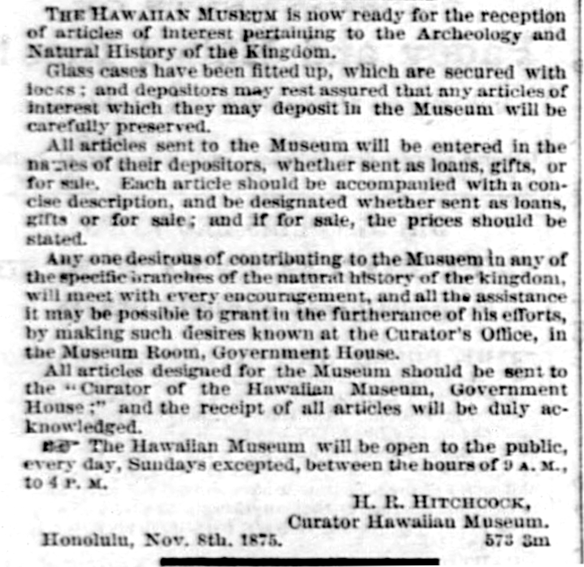
The Hawaiian Museum is now ready for the reception of articles of interest pertaining to the Archeology and Natural History of the Kingdom.

Glass cases have been fitted up, which are secured with locks: and depositors may rest assured that any articles of interest which they may deposit in the Museum will be carefully preserved.

All articles sent to the Museum will be entered in the names of their depositors, whether sent as loans, gifts, or for sale. Each article should be accompanied with a concise description, and be designated whether sent as loans, gifts or for sale; and if for sale, the prices should be stated.

Any one desirous of contributing to the Museum in any of the specific branches of the natural history of the kingdom, will meet with every encouragement, and all the assistance it may be possible to grant in the furtherance of his efforts, by making such desires known at the Curator’s Office, in the Museum Room, Government House.

All articles designed for the Museum should be sent to the “Curator of the Hawaiian Museum, Government House;” and the receipt of all articles will be duly acknowledged.

The Hawaiian Museum will be open to the public, every day, Sundays excepted, between the hours of 9 A. M., to 4 P. M.

H. R. Hitchcock,

Curator Hawaiian Museum.

Honolulu, Nov. 8th, 1875.

(Hawaiian Gazette, 3/8/1876, p. 2)
HawaiianGazette_3_8_1876_2.png

The Hawaiian Gazette, Volume XII, Number 10, Page 2. March 8, 1876.
J. E. Chamberlain, collector for the Hawaiian National Museum, 1876.

Curios for the Government Museum.

The Morning Star brought up for the Hawaiian Government the following curios, corals, &c. Two sets Gilbert Island armor complete with helmets; also shark teeth sword and spear, mats and native dresses; eel basket; common fish basket; umbrella coral, three feet six inches in diameter, perfect, from Apian by Mr. Randolph.

From Marshall Island: Spears, Male fringe petticoats and woman’s mat dress; carved figure-head; model of canoe fully rigged; paddles; red coral; black coral; platter coral, bone adzes from Strong’s Island. Continue reading

Unfortunately, some of Chamberlain’s mangrove seems to have survived, 1876.

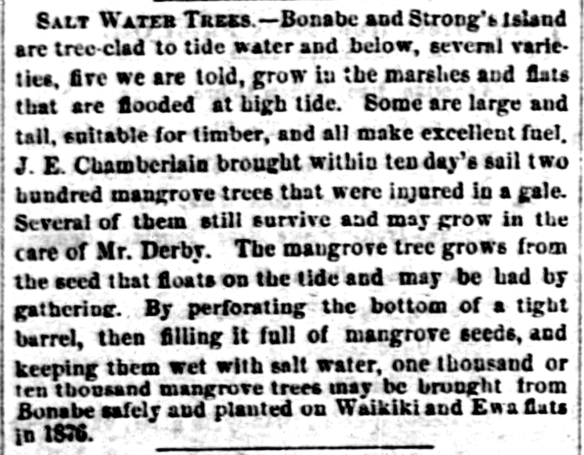
Salt Water Trees.—Bonabe and Strong’s Island are tree-clad to tide water and below, several varieties, five we are told, grow in the marshes and flats that are flooded at high tide. Some are large and tall, suitable for timber, and all make excellent fuel. J. E. Chamberlain brought within ten day’s sail two hundred mangrove trees that were injured in a gale. Several of them still survive and may grow in the care of Mr. Derby. The mangrove tree grows from the seed that floats on the tide and may be had by gathering. By perforating the bottom of a tight barrel, then filling it full of mangrove seeds, and keeping them wet with salt water, one thousand or then thousand mangrove trees may be brought from Bonabe safely and planted on Waikiki and Ewa flats in 1876.

(Hawaiian Gazette, 3/22/1876, p. 2)

HawaiianGazette_3_22_1876_2.png

The Hawaiian Gazette, Volume XII, Number 12, Page 2. March 22, 1876.

Chorus at Kamehameha, 1889.

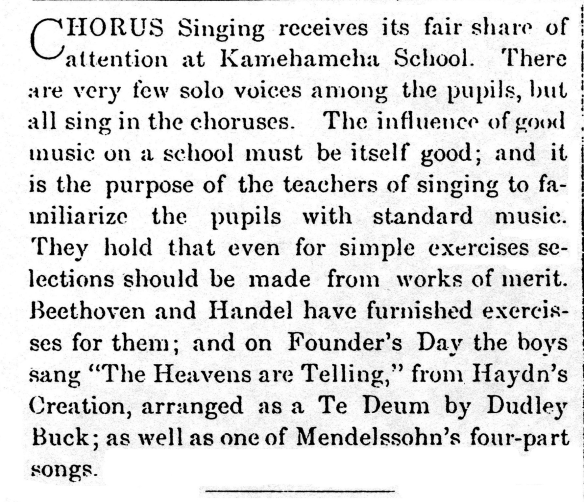
Chorus Singing receives its fair share of attention at Kamehameha School. There are very few solo voices among the pupils, but all sing in the choruses. The influence of good music on a school must be itself good; and it is the purpose of the teachers of singing to familiarize the pupils with standard music. They hold that even for simple exercises selections should be made from works of merit. Beethoven and Handel have furnished exercises for them; and on Founder’s Day the boys sand “The Heavens are Telling,” from Hayden’s Creation, arranged as a Te Deum by Dudley Buck; as well as one of Mendelssohn’s four-part songs.

(Handicraft, 1/1883, p. 3)

Handicraft_1_1889_3.png

Handicraft, Volume 1, Number 1, Page 3. January 1889.

Kaili Trio performing at Kauai’s Tip Top Theatre, 1922.

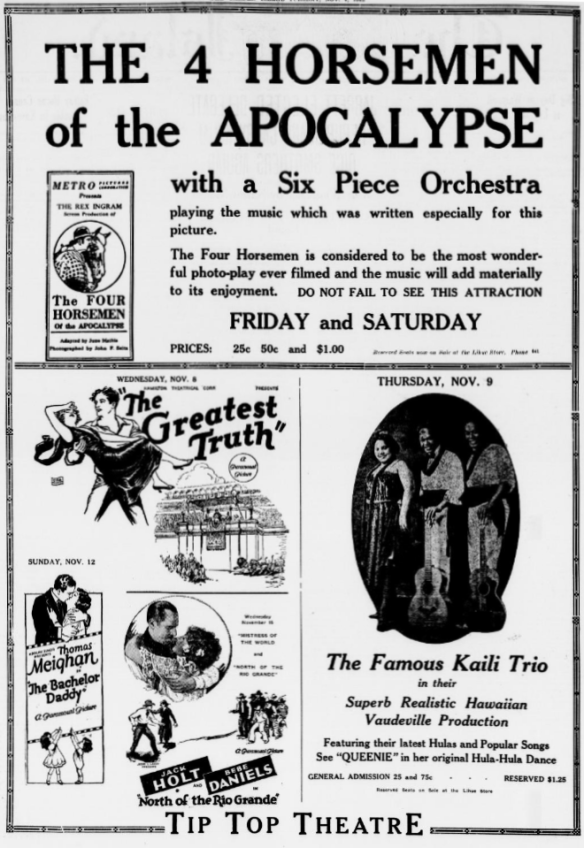
THE 4 HORSEMEN of the APOCALYPSE

with a Six Piece Orchestra

playing the music which was written especially for this picture.

The Four Horsemen is considered to be the most wonderful photo-play ever filmed and the music will add materially to its enjoyment. DO NOT FAIL TO SEE THIS ATTRACTION

FRIDAY and SATURDAY

PRICES: 25c 50c and $1.00 Reserved Seats now on Sale at the Lihue Store, Phone 641

WEDNESDAY, NOV. 8

HAMILTON THEATRICAL CORP. PRESENTS

“The Greatest Truth”

A Paramount Picture

SUNDAY, NOV. 12

ADOLPH ZUKOR PRESENTS

Thomas Meighan in “The Bachelor Daddy”

A Paramount Picture

Wednesday

November 15

“MISTRESS OF THE WORLD

and

“NORTH OF THE RIO GRANDE”

JACK HOLT AND BEBE DANIELS

in

“North of the Rio Grande”

THURSDAY, NOV. 9

The Famous Kaili Trio

in their

Superb Realistic Hawaiian
Vaudeville Production

Featuring their latest Hulas and Popular Songs
See “QUEENIE” in her original Hula-Hula Dance

GENERAL ADMISSION 25 and 75c – – – RESERVED $1.25

Reserved Seats on Sale at the Lihue Store

TIP TOP THEATRE

(Garden Island, 11/7/1922, p. 2)

GardenIsland_11_7_1922_2.png

The Garden Island, Volume 18, Number 45, Page 2. November 7, 1922.

Ernest Kaai’s Hawaiian Troubadours in New Zealand, 1925.

AMUSEMENTS.

“NIGHT IN HONOLULU.”

The ukulele, the hula-hula, and the steel guitar, as entertaining products of Hawaii, are known all over the civilised world that comes under the influence of vaudeville circuits, but such segregated examples as have hitherto been shown in Auckland are mere museum specimens compared with the living actuality of the performance given in His Majesty’s Theatre on Saturday night by Ernest Kaai’s Hawaiian troubadours. These minstrels exhibited ukulele and guitar with all the sweet setting of their native haunts, the strains of the strings enriched by vocal harmonising in which the Hawaiian exccels, and the harmonising enhanced by quaint falsetto and yodelling effects that thoroughly delighted a house packed to the doors.

The curtain rose on a pretty palm-fringed beach scene, when it could be seen, for the house was in darkness when a harmonious chorus of Hawaiian voices, with stringed instrument accompaniment, was lifted in song to welcome the doming dawn. It was a native harmonising chorus set to music by Queen Liliuokalani, and entitled “Aloha Oe,” which swells to a paean of joy as the rising sun lights up the expectant world—in this case quite an effective stage scene. A similar characteristic effort of voice, strings, and light, symbolising twilight, with the stage fading melodiously into darkness, marked the ending of the first part of the programme, while in between dawn and twilight came a series of novel, interesting and thoroughly entertaining items. An Island folk-song by eddie Kniley, a ballad by Frank Luiz, hula dances by Gertila Byrnes and Layley Leywood, and a steel  guitar selection by Thelma Kaai were given with effective voice and string accompaniments. It was the part-singing in trios, however that most captivated the audience. One such number by David Kaili, Thelma Kaai and Eddie Kinley was emphatically encored, but when Queenie and David Kaili and Thelma Kaai appeared in whimsical part songs in which Queenie appeared as a soubrette of talent with a quaint gift for vocal ornamentation, the house was so vastly entertained and amused that the party were recalled four or five times. Continue reading

Hawaiian Band and the parade for the Knights Templar, 1883.

THE SIR KNIGHTS IN CALIFORNIA.

A Splendid Reception.

San Francisco, 18.—The arrival of the St. Bernard commandery, of Chicago was the event of the day. A delegation from the San Francisco Commandery proceeded as far as Truckee, to welcome them to the Pacific coast. The special honors tendered them are in recognition of the welcome the latter gave to the Pacific coast Knights at the Chicago conclave. On their arrival this morning they were met at the ferry landing by the Knights of the city commanderies, accompanied by Knights from Illinois now here; all in full dress uniform, after the exchange of greetings the knights fell into line, led by the Hawaiian band, and followed by the California commandery mounted. The Presidio band, Golden Gate commandery, St. Bernard band and St. Bernard commandery bringing up the rear. In this order they reached the Baldwin Hotel selected as the headquarters of the Chicago commandery. As an evidence of the marked attention paid them, one detail may be mentioned. Each cigar purchased for their use was provided with a band on which was painted, in colors, the name of their commandery while each box, specially made, was emblazoned with the device, St. Bernard. Mrs. Moulton, wife of the commander, was presented with a flower piece, three fee long and two in breadth, representing every variety of the choicest flowers of California. Including knights from Oregon and Washington Territory, it is estimated that 3,000 persons arrived in this city within the last twenty-four hours.

(Salt Lake Daily Herald, 8/19/1883, p. 1)

SaltLakeHerald_8_19_1883_1

Salt Lake Daily Herald, Volume XIV, Number 64, Page 1. August 19, 1883.

Kamehameha School’s “Handicraft,” 1889.

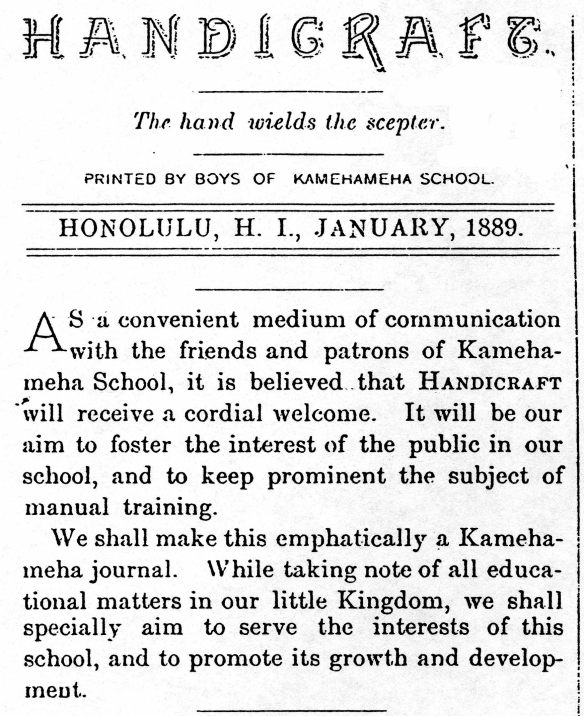
HANDICRAFT.

The hand wields the scepter.

PRINTED BY BOYS OF KAMEHAMEHA SCHOOL.

HONOLULU, H. I., JANUARY , 1889.

As a convenient medium of communication with the friends and patrons of Kamehameha School, it is believed that Handicraft will receive a cordial welcome. It will be our aim to foster the interest of the public in our school, and to keep prominent the subject of manual training.

We shall make this emphatically a Kamehameha journal. While taking note of all educational matters in our little Kingdom, we shall specially aim to serve the interests of this school, and to promote its growth and development.

[The priceless issues of the Handicraft are just one of the many cool items from Kamehameha Schools’ history found on their Archives page.]

(Handicraft, 1/1889, p. 2)

Handicraft_1_1889_2.png

Handicraft, Volume I, Number 1, Page 2. January 1889.

Kalihi fire, 1889.

The glowing fire on the Kalihi mountains Thursday night Feb. 21, was caused by workmen burning off the grass on the site of the new reservoir in the upper Nuuanu Valley. The fire could easily have been controlled in the first instance. As it was, it was allowed to run up a narrow ridge, and thence to spread along the flanks of the mountain until it became an extensive conflagration, destroying many vigorous young koa trees and persistently working itself down into the valley. On Friday morning, two teachers and about twenty of the largest boys in the Kamehameha School went up to the fire and after a vigorous battling with the dense smoke succeeded in hemming in the fire, and finally subdued it. The utmost care in such a dry season should be used in preventing the setting, much more the spreading, of fire in the grass and bushes above Honolulu. A few such fires would make it unnecessary to build extra reservoirs.

(Handicraft, 2/1889, p. 3)

Handicraft_2_1889_3.png

Handicraft, Volume I, Number 2, Page 3. February 1889.

Thrum’s Valentines ad, 1887.

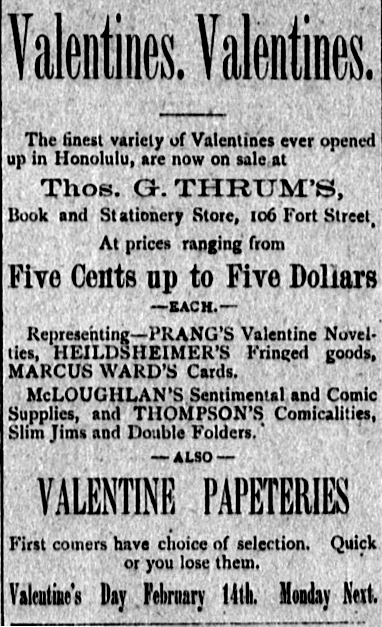
Valentines. Valentines.

The finest variety of Valentines ever opened up in Honolulu, are now on sale at

Thos. G. THRUM’S,
Book and Stationery Store, 106 Fort Street,
At prices ranging from

Five Cents up to Five Dollars

—EACH.—

Representing—PRANG’S Valentine Novelties, HEILDSHEIMER’S Fringed goods, MARCUS WARD’S Cards.

McLOUGHLAN’S Sentimental and Comic Supplies, and THOMPSON’S Comicalities, Slim Jims and Double Folders.

—ALSO—

VALENTINE PAPETERIES

First comers have choice of selection. Quick or you lose them.

Valentine’s Day February 14. Monday Next.

[Five dollars???]

(Daily Herald, 2/12/1887, p. 3)

DailyHerald_2_12_1887_3.png

The Daily Herald, Volume I, Number 140, Page 3. February 12, 1887.