More on Lady Franklin and ahuula and upcoming events, 1861 / 2015–2016.

While in Hawaii in 1861, Lady Franklin enjoyed the company often of King Kamehameha IV and Queen Emma. According to newspaper reports, the relationship between them was very cordial. She was given this treasured ahuula in commemoration of this bond.

If you find yourself in San Francisco at the end of this summer until the early part of next year (8/29/2015–2/28/2016), do make your way to the de Young Museum:

Lady Franklin cape

Lady Franklin cape (detail) (#5948). ‘apapane feathers, ‘ō‘ō feathers. Bernice Pauahi Bishop Museum, Ethnology Collection, 09670/1909.007

Royal Hawaiian Featherwork: Nā Hulu Ali‘i

August 29, 2015February 28, 2016

Explore the distinctive art, culture, and history of Hawai‘i with the first exhibition of Hawaiian featherwork on the U.S. mainland, developed in partnership with the Bernice Pauahi Bishop Museum, Honolulu. Presented in San Francisco, which is considered to be the gateway to the Pacific, the exhibition will feature approximately 75 rare and stunning examples of the finest featherwork capes and cloaks in existence, as well as royal staffs of feathers (kāhili), feather lei (lei hulu manu), helmets (mahiole), feathered god images (akua hulu manu), and related eighteenth- and nineteenth-century paintings and works on paper. Continue reading →

Lady Jane Franklin in Hawaii nei, 1861.

[Found under: “NOTES OF THE WEEK.”]

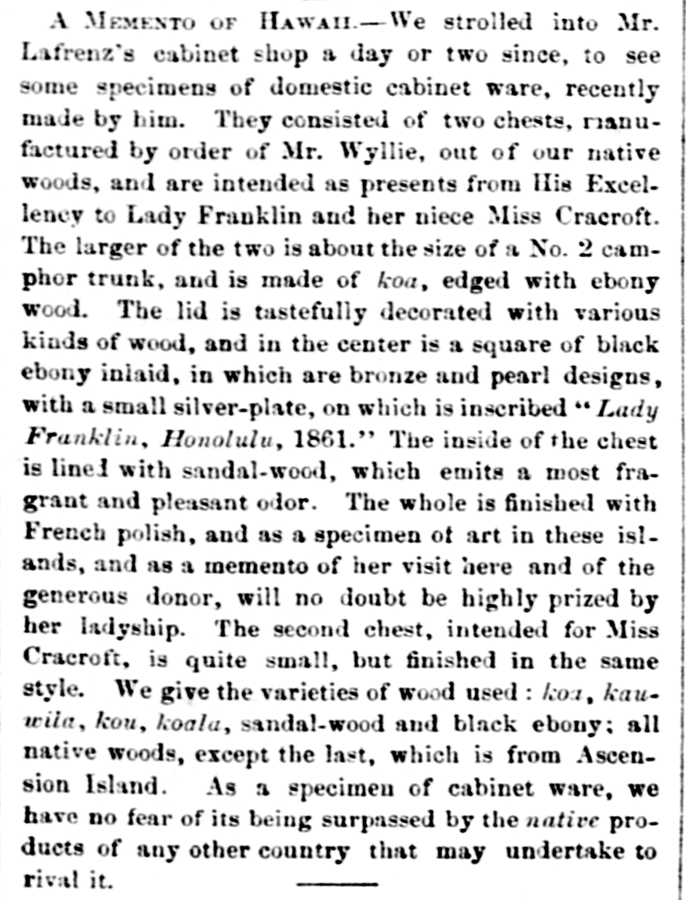
A Memento of Hawaii.—We strolled into Mr. Lafrenz’s cabinet shop a day or two since, to see some specimens of domestic cabinet ware, recently made by him. They consisted of two chests, manufactured by order of Mr. Wyllie, out of our native woods, and are intended as presents from His Excellency to lady Franklin and her niece Miss Cracroft. The larger of the two is made of koa, edged with ebony wood. The lid is tastefully decorated with various kinds of wood, and in the center is a square of black ebony inlaid, in which are bronze and pearl designs, with a small silver-plate, on which is inscribed “Lady Franklin, Honolulu, 1861.” The inside of the chest is lined with sandal-wood, which emits a most fragrant and pleasant odor. The whole is finished with French polish, and as a specimen of art in these islands, and as a memento of her visit here and of the generous donor, will no doubt be highly prized by her ladyship. The second chest, intended for Miss Cracroft, is quite small, but finished in the same style. We give the varieties of wood used: koa, kauwila, kou, koala, sandal-wood and black ebony; all native woods, except the last, which is from Ascension Island. As a specimen of cabinet ware, we have no fear of its being surpassed by the native products of any other country that may undertake to rival it.

(Pacific Commercial Advertiser, 5/16/1861, p. 2)

A Memento of Hawaii.

The Pacific Commercial Advertiser, Volume V, Number 46, Page 2. Mei 16, 1861.

Hawaii at the Paris International Exposition, 1867.

[Found under: “KA HOIKEIKE NUI MA PARISA.”]

Hawaiian things.

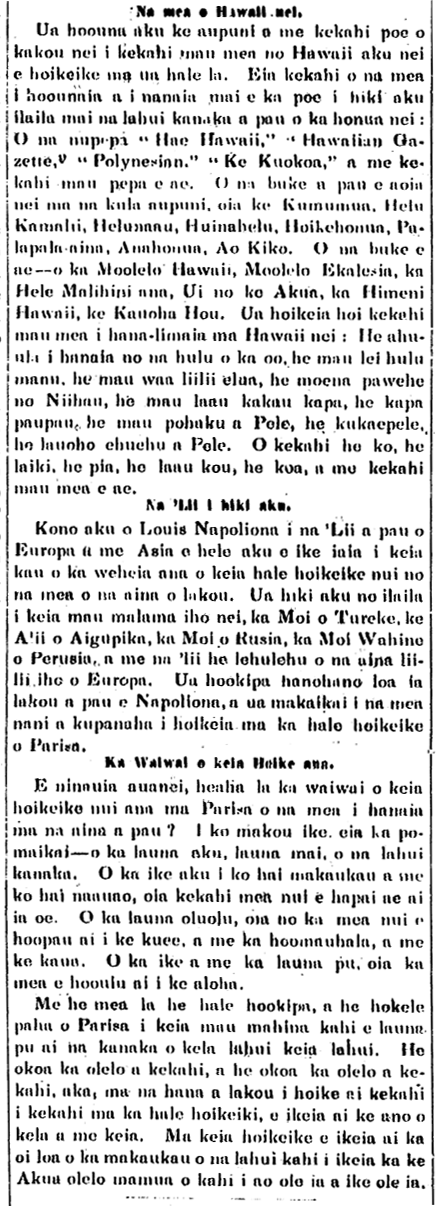
The government and some of our people have sent some items to display in that building from Hawaii. These are some of the things sent and that are being seen by those going there from all the different races of the world: The newspapers “Hae Hawaii,” “Hawaiian Gazette,” “Polynesian,” “Ke Kuokoa,” and some other papers. All of the books being taught in the public schools; those being the Kumumua, Helu Kamalii, Helunaau, Huinahelu, Hoikehonua, Palapala-aina, Anahonua, Ao Kiko. Other books—Ka Moolelo Hawaii, Moolelo Ekaleisa, Ka Hele Malihini ana, Ui no ke Akua, Ka Himeni Hawaii, Ke Kauoha Hou. There are items handcrafted in Hawaii nei: An ahuula made of oo feathers, some bird feather lei, two small canoes, a patterned mat [moena pawehe] from Niihau, some wooden kapa printers [? laau kakau kapa], a kapa paupau, some volcanic rocks, sulfur [kukae pele], and Pele’s hair. Other things are sugar, rice, pia, kou wood, koa, and some other items.

The Value of this Exhibition.

It may be asked, what is the value of this great exhibition in Paris of things made in all the lands? In our minds, this is the what is gained—the intermingling of the different lahui. Seeing the abilities and intelligence of others is something that will carry you higher. Meeting amicably is something that will end disputes and grudges and war. The getting together and associating with each other is something that will foster aloha.

It is as if Paris is a house of welcome or a hotel these past months, where people of all ethnicities meet. Their languages are different, but through the work they displayed to each other at the exhibition hall, the nature of each other will be seen. In this exhibition, it will be seen that the nations that know the word of God are much more advanced than those that do not.

(Alaula, 9/1867, p. 22)

Na mea o Hawaii nei.

Ke Alaula, Buke II, Helu 6, Aoao 22. Sepatemaba 1867.

Treasures spread across the four corners of the earth? 1906.

Auction Sale

Tourists! Collectors!

Thursday, Feb. 1, 1906,

10 O’CLOCK A. M.,

At my salesroom, 847 Kaahumanu Street, I will sell, under instruction from the Administrators of the Estate of

MARY AILAU

the eminent Hawaiian collector, the following ancient and other relics of

Ancient Chiefs

Pig Platters,

Calabashes,

Cocos (Calabash Nets),

Tapas,

Stone Adzes,

Stone Lamps,

Mike Stones,

Poi Pounders,

49 Fans,

2 Kauila Aumakuas (War Spears),

2 Hula Drums (Ancient),

1 Idol—Kukaili-iki—One of Kamehameha’s War Gods,

1 Ipu Hula (Gourd Drum),

1 Pawehe Calabash,

1 Pawehe Water Bottle,

1 Newa (War Club),

2 Bamboo Cushions,

1 Hinai Opae,

2 Samoan War Clubs,

1 Koko (Ancient),

1 Black Kapa (Burial),

1 Lauhala Hall Mat,

7 Samoan Cocoanut Bowls,

1 Lauhala Bag,

1 Case Stuffed Hawaiian Birds,

1 Aumakua,

1 Kauila Kahili Stick,

1 Kahili Stick (Tortoise) and Ivory (Ancient),

2 Emu Eggs,

1 Carved Coco Bank,

1 Large Show Case,

4 Lei Hulus (Native Birds),

1 Samoan War Club,

1 Moss Album.

JAMES F. MORGAN,

AUCTIONEER.

(Pacific Commercial Advertiser, 1/29/1906, p. 8)

Auction Sale

The Pacific Commercial Advertiser, XLIII, Number 7324, Page 8. January 29, 1906.

Feather capes, genealogies, and controversy, 1902.

LETTERS.

We do not accept the responsibility for the blame for ideas published under this heading, but it falls on those who write them.

HE IS NOT CORRECT.

O Aloha Aina Newspaper,

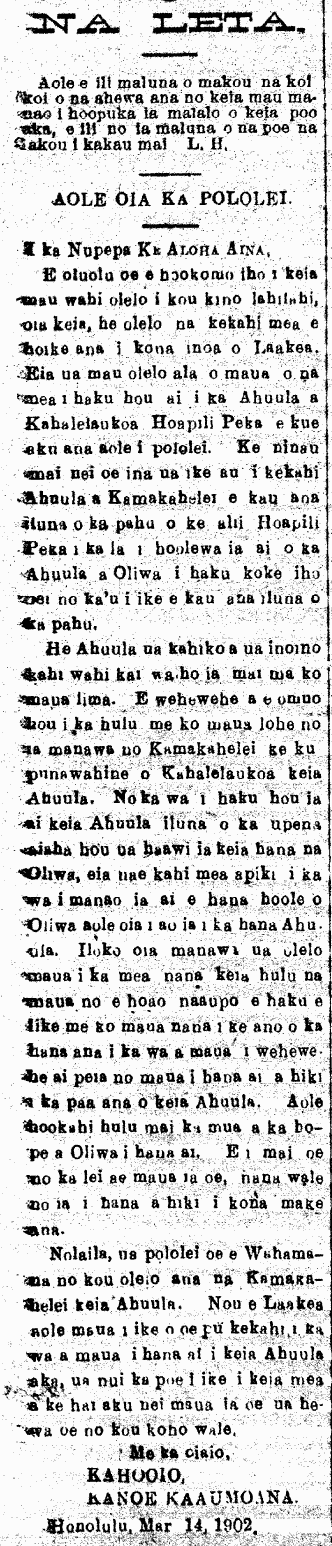
Please include these words in your delicate body, that being this, there is talk from someone calling himself Laakea. This is what we have to say, the two of us who redid the Ahuula of Kahalelaukoa Hoapili Baker [Kahalelaukoa Hoapili Peka], denying what he said is true. You asked if I had seen an Ahuula belonging to Kamakahelei upon the coffin of the alii Hoapili Baker on the day of his funeral, and if what I saw was the Ahuula that Oliwa quickly made on the coffin.

Put in our hands was an old Ahuula that was damaged in some places. We unfurled it and plucked off once again the feathers, hearing at that time that the Ahuula belonged to Kamakahelei, the grandmother of Kahalelaukoa.  When the time came to rework the feathers to the new net [? upena aiaha], this job was given to Oliwa, but strange enough, when it was thought that he was going to do it, Oliwa refused, saying that he was not taught the craft of the Ahuula. At this time, we told the one to whom the feathers belong that the two of us would blindly attempt to rework them like how we saw it was done when we took them off, and this is what we did until this Ahuula was completed. There was not a single feather from the first to the last that Oliwa did. You speak of the lei, and we two agree that it was just him that worked at it until his death [?? E i mai oe no ka lei ae maua ia oe, nana wale no ia i hana a hiki i kona make ana.]

So you, Wahamana, are correct in saying that this Ahuula is from Kamakahelei. As for you Laakea, we did not see you there when the two of us were putting together the Ahuula, but there were many who did witness it, and we say to you, you are wrong for making assumptions.

Sincerely,

KAHOOIO,

KANOE KAAUMOANA,

Honolulu, March 14, 1902.

(Aloha Aina, 3/15/1902, p. 5)

NA LETA.

Ke Aloha Aina, Buke VIII, HElu 11, Aoao 5. Maraki 15, 1902.

Kahili crafted for Governor Farrington, 1928.

FIVE KAHILI MADE FOR THE GOVERNOR

FIVE KAHILI FOR THE GOVERNOR

From the Workers Under Mokumaia

Yesterday evening, these kahili were shown in Waikiki.

The kahili will become the property of the territory.

According to Mokumaia, the workers are showing their congratulations to the governor as did the makaainana do for the alii in times past.

On May 2nd, the work on the kahili began, and it was completed on the 17th of May.

F. B. M. Kahea [Frederick Beckley Malulani Kahea] was the one who knew how to construct kahili.

J. K. Mokumaia was the great general of the chiefs.

[The beginning of the caption seems to be dropped out.] some Hawaiians are making five kahili to gift to Governor Farrington this coming 9th of June.

On the right of the picture is M. Keawe, J. Kapaiki, Mokumaia, Piko Kamahaa, Clara Kaaipua, Minnie Kakalia, Kahea, and Makekehau. The large kahili took 8,000 feathers each.

(Alakai o Hawaii, 5/24/1928, p. 1)

HANAIA ELIMA KAHILI NO KE KIAAINA.

Ke Alakai o Hawaii, Buke I, Helu 4, Aoao 1. Mei 24, 1928.

Birthday of the Queen, 1902.

THE BIRTHDAY OF OUR QUEEN

There Will be a Great Royal Audience on That Day

Eia Kalani ka omole niho oi,
Ke apu oi nana e hookala ka moku,
Nana e keehi ke kihi o ka malama,
Poele ka moku kaumaha i ke’lii,
Ike’a ka mano ka eleele,
O Kalani kui hono i ka moku,

“Kekuhooheiheipahu.”

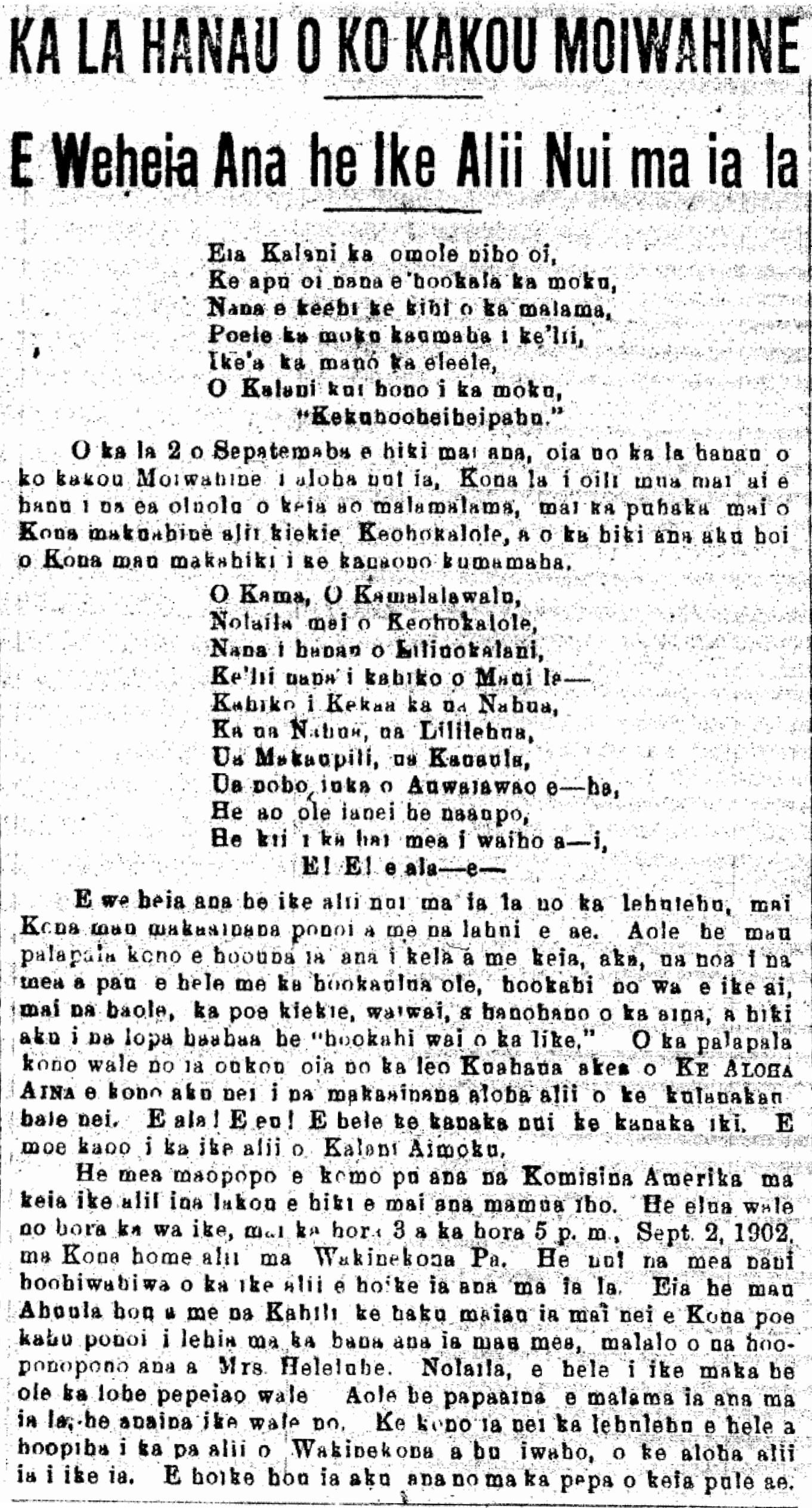
The coming 2nd of September is the birthday of our dearly beloved Queen, the day that She first arrived and breathed in the sweet air of this world of light, from the loins of Her mother, high chiefess Keohokalole, and She has now reached the age of sixty-four.

O Kama, O Kamalalawalu,
Nolaila mai o Keohokalole,
Nana i hanau o Liliuokalani,
Ke’lii nana i kahiko o Maui la—
Kahiko i Kekaa ka ua Nahua,
Ka ua Nahua, ua Lililehua,
Ua Makaupili, ua Kauaula,
Ua noho iuka o Auwaiawao e—ha,
He ao ole ianei he naaupo,
He kii i ka hai mea i waiho a—i,
E! E! e ala—e—

There will be a great royal audience for the people that day, from Her own makaainana to the people of other ethnicities. There will not be invitations sent out to each person, but it is open to all without hesitation, and there will be but one audience, from the haole, the rich and prestigious of the land all the way to the humble peasants; they are all the same. The only invitation to you all will be this public Announcement by the Aloha Aina inviting all those of this town who have aloha for the monarch. Rise! Get going! Go forth, big man and little man. File along to the royal audience with the Queen.

It is understood that the American Commissioners [the Subcommittee on Pacific Islands and Porto Rico] will be present at this royal audience if they arrive before then. The audience will only be for two hours, from 3 to 5 p. m., Sept. 2, 1902, and Her royal residence at the grounds of Washington Place [Wakinekona Pa]. There will be many beautiful adornments displayed that day at the royal audience. There are new Feather Capes [Ahuula] and Kahili being skillfully crafted by Her own attendants who are skilled at the making of such things, under the guidance of Mrs. Heleluhe. So go and see for yourself, and not just hear about it. There will  not be a meal presented that day, only an audience. The public is invited to go a fill the yard of Washington Palace until it overflows, showing the love for the alii.  This will be shown once more in the paper of this coming week.

(Aloha Aina, 8/23/1902, p. 1)

KA LA HANAU O KO KAKOU MOIWAHINE

Ke Aloha Aina, Buke VIII, Helu 34, Aoao 1. Augate 23, 1902.

Peleioholani’s home is destroyed by fire, 1901.

ANCIENT RELICS

WERE DESTROYED

Valuable Feather Cloak In Peleioholani’s Fire Claim.

BELONGED TO KEEAUMOKU

THE CLAIMANT’S ANCESTOR

While Husband and Wife Were Shut Out By Quarantine the Flames Swept Away Their Home.

Claims of native Hawaiians were resumed before the Fire Claims Commission yesterday morning. Two of these were called this morning, one of which is of more than ordinary interest.

S. L. Peleioholani presents a claim for $2000 and it appears to be a perfectly straight one. The claimant is a lineal descendant of high chiefs and among his household possessions were heirlooms of great value. Indeed, it is scarcely practicable to measure their value in money, the articles having both historical and ethnological—it might be added without joking, ornithological—interest.

Of the last-named class was a feather cloak, the only one existing of its class except the famous garment of Kamehameha treasured in the British Museum. This cloak descended to Peleioholani from his great-great-grandfather, Keeaumoku, a high chief whose name is given to one of the streets of Honolulu. Evidence was presented before the Commission showing that the claimant refused $500 from Mrs. Marry Ailau, the well-known dealer and connoisseur in Hawaiian relics, several years ago. Yes, and when she sent a relative to further sound the owner on his selling figure an offer of $700 for the cloak was declined by him.

Peleioholani had also a few calabashes of high value, besides other ancient objects of native art.

Why did not Mr. Peleoholani or his wife rescue all this archaeological wealth from the advancing flames? It is an easy question and its answer is not mysterious. The husband was working at his trade of a carpenter on the Castle house, while his wife was away from home on some errand, when the rigid quarantine came down suddenly as a Pali cloud. In consequence the couple could not gain access to their home and the tempest of flame came and swept it away.

Peleioholani lost sundry articles of latter day manufacture and utility, which went to make up his claim. An item was sixty fathoms of inch and a half rope at $47, this being the price he paid for it at an auction sale. He explained that he used the hawser in connection with building and house-moving operations. Scion of a noble house as he is, Peleioholani gave the Commissioners the impression of an honorable man.

[See what was said in an article from one of the Hawaiian-Language Newspapers here.]

(Evening Bulletin, 10/15/1901, p. 1)

ANCIENT RELICS WERE DESTROYED

Evening Bulletin, Volume XI, Number 1968, Page 1. October 15, 1901.

Keelikolani’s house and valuables destroyed by fire, 1873.

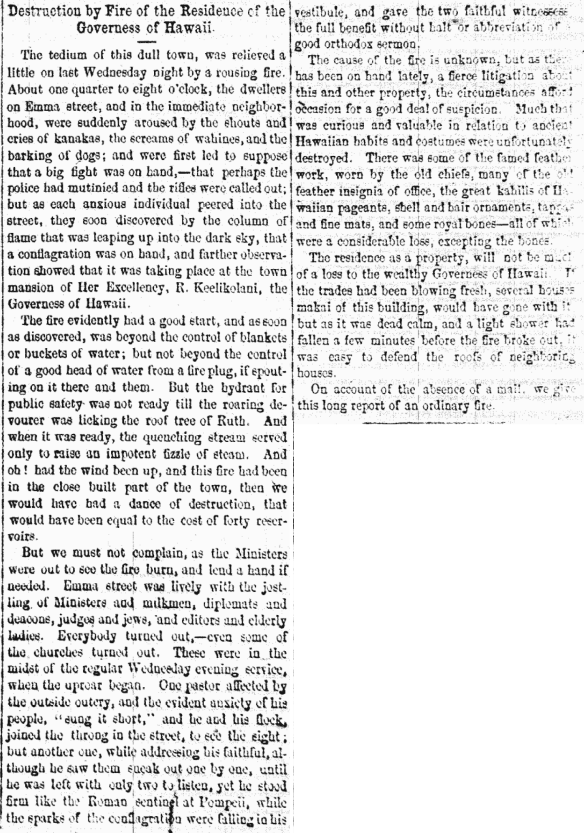
Destruction by Fire of the Residence of the Governess of Hawaii.

The tedium of this dull town, was relieved a little on last Wednesday night by a rousing fire. About one quarter to eight o’clock, the dwellers on Emma street, and in the immediate neighborhood, were suddenly aroused by the shouts and cries of kanakas, the screams of wahines, and the barking of dogs; and were first led to suppose that a big fight was on hand,—that perhaps the police had mutinied and the rifles were called out; but as each anxious individual peered into the street, they soon discovered by the column of flame that was leaping up into the dark sky, that a conflagration was on hand, and farther observation showed that it was taking place at the town mansion of Her Excellency, R. Keelikolani, the Governess of Hawaii.

The fire evidently had a good start, and as soon as discovered, was beyond the control of blankets or buckets of water; but not beyond the control of a good head of water from a fire plug, if spouting on it there and then. But the hydrant for public safety was not ready till the roaring devourer was licking the roof tree of Ruth. And when it was ready, the quenching stream served only to raise an impotent fizzle of stream. And oh! had the wind been up, and this fire had been in the close built part of the town, then we would have had a dance of destruction, that would have been equal to the cost of forty reservoirs.

But we must not complain, as the Ministers were out to see the fire burn, and lend a hand if needed. Emma street was lively with the jostling of Ministers and milkmen, diplomats and deacons, judges and jews, and editors and elderly ladies. Everybody turned out,—even some of the churches turned out. These were in the midst of the regular Wednesday evening service, when the uproar began. One pastor affected by the outside outcry, and the evident anxiety of his people, “sung it short,” and he and his flock, joined the throng in the street, to see the sight; but another one, while addressing his faithful, although he saw them speak out one by one, until he was left with only two to listen, yet he stood firm like the Roman sentinel at Pompeii, while the sparks of the conflagration were falling in his vestibule, and gave the two faithful witnesses the full benefit without halt or abbreviation of good orthodox sermon.

The cause of the fire is unknown, but as there had been on hand lately, a fierce litigation about this and other property, the circumstances afford occasion for a good deal of suspicion. Much that was curious and valuable in relation to ancient Hawaiian habits and costumes were unfortunately destroyed. There was some of the famed featherwork, worn by the old chiefs, many of the old feather insignia of office, the great kahilis of Hawaiian pageants, shell and hair ornaments, tappas and fine mats, and some royal bones—all of which were a considerable loss, excepting the bones.

The residence as a property, will not be much of a loss to the wealthy Governess of Hawaii. If the trades had been blowing fresh, several houses makai of this building, would have gone with it but as it was dead calm, and a light shower had fallen a few minutes before the fire broke out, it was easy to defend the roofs of neighboring houses.

On account of the absence of mail, we give this long report of an ordinary fire.

(Hoku o Hawaii, 1o/17/1873, p. 3)
Destruction by Fire of the Residence of the Governess of Hawaii.

Nuhou, Volume II, Number 24, Page 3. October 17, 1873.
Hilo feather lei maker Ida Akau, 1901.

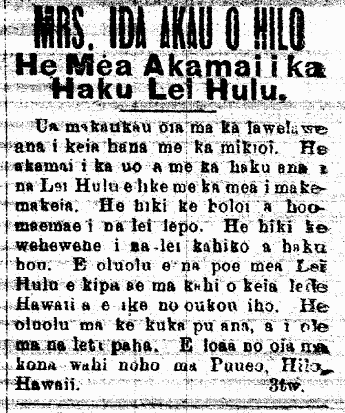
MRS. IDA AKAU OF HILO

A Person Skilled at Making Lei Hulu.

She is proficient at this work with fine workmanship. She is skilled at tying feathers [uo] and putting feather lei together [haku] as per one’s desires. She can clean soiled lei. She can undo old lei and remake them. Those who have Lei Hulu, pleace come and visit the place of this Hawaiian lady to see for yourselves.  Consultation by visit or by correspondence is welcomed. She can be found at her residence in Puueo, Hilo, Hawaii.

(Aloha Aina, 11/9/1901, p. 3)

MRS. IDA AKAU O HILO

Ke Aloha Aina, Buke VII, Helu 45, Aoao 3. Novemaba 9, 1901.