Carl Nakuina’s shark attack news spreads far to Utah, 1917.

SHARK IN AUTO BITES CAPTOR

HONOLULU, T. H., Aug. 30 (by mail).—Honolulu has probably the only man who was ever bitten by a shark in an automobile. If the sentence appears confused, it is nevertheless correct, for both the man and the shark were in the automobile at the time.

Carl Nakuina, an employee of a local poi factory, went to Nanakuli, on the shores of this island, last Sunday to fish. He had bigger luck than he anticipated in, for he hooked a twelve-foot shark. Continue reading

Shark attack on land, 1917.

[Found under: “Nuhou Kuloko”]

Bitten by a shark while it was being carried on a car to take to Honolulu to be sold was Carl Nakuina, a worker at the Kalihi Poi Factory.

(Aloha Aina, 8/24/1917, p. 4)

Nahu ia e ka mano...

Ke Aloha Aina, Buke XXII, Helu 34, Aoao 4. Augate 24, 1917.

Shark attack, 1874.

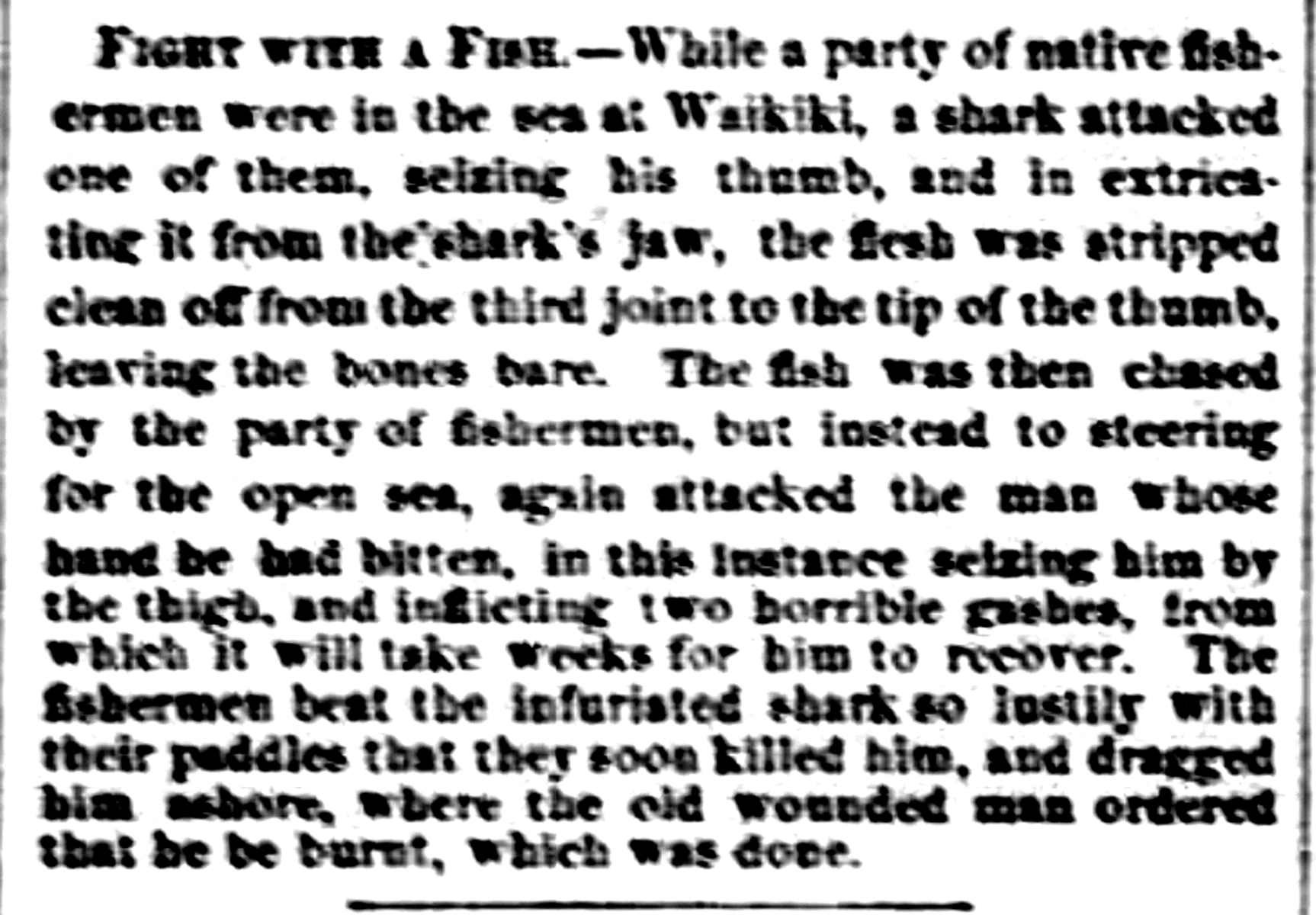
Fight with a Fish.—While a party of native fishermen were in the sea at Waikiki, a shark attacked one of them, seizing his thumb, and in extricating it from the shark’s jaw, the flesh was stripped clean off from the third joint to the tip of the thumb, leaving the bones bare. The fish was then chased by the party of fishermen, but instead to steering for the open sea, again attacked the man whose hand he had bitten, in this instance seizing him by the thigh, and inflicting two horrible gashes, from which it will take weeks for him to recover. The fishermen beat the infuriated shark so lustily with their paddles that they soon killed him, and dragged him ashore, where the old wonded man ordered that he be burnt, which was done.

(Hawaiian Gazette, 5/20/1874, p. 3)

Fight with a Fish.

The Hawaiian Gazette, Volume X, Number 20, Page 3. May 20, 1874.

Mrs. A. B. Palea reports on news from Kauai, 1939.

Various news from Kauai

Kekaha, Kauai

Dec. 18.

With Appreciation to the Editor of the Newspaper Ka Hoku o Hawaii.

Much aloha between us.

Please allow me some room on the deck of our beloved esteemed one. And it will be for you to carry the bits of news of the Flower garden famed for the Cherished Scent of Mokihana.

Kauaiomanookalanipo.

Kekaha, Kauai: The birthday of one of our granddaughters, Hildren Kawehionapuanani Palea, was celebrated at the home of our children, Mr. and Mrs. W. Palea, Jr.

The ohana who came were:

Mrs. A. B. Palea

Mr. & Mrs. Wailiula, Mrs. Dora Fellez, Miss Emily Niau, Mr. and Mrs. F. Furtado, W. Lalana Furtado, F. Kamakanaokalani Furtado, G. Keolamauloa Furtado, Oleiponimoi Furtado, D. Kealohaokalani Furtado, Mr. and Mrs. P. Palea, Miss Kananiokaohu Palea, and me, the one who is writing this reflection.

It was for our grandchild who is two years old, and we give our thanks to our Almighty Father for blessing his young servant, her parents, and entire family. With appreciation.

——— Continue reading

Fishing for oopu and wi in Puepaku, Hilo, 1878.

[Found under: “NA MEA HOU O PUEPAKU, HILO.” by J. Kanaeholo]

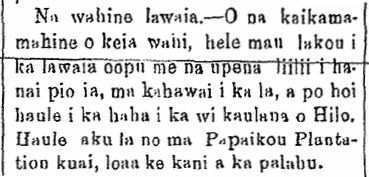
Fishing women.—The girls of this area [Pueopaku, Hilo], go fishing often for oopu with small arched nets at the river in the daytime, and at night they go down to pick the famous wi of Hilo. They head down to Papaikou Plantation to sell them, and they come into the cry of the turkey [palahu].¹

¹Whereas the cry of the nene, “unele, unele,” is associated with lacking, the cry of the turkey, “pokeokeo,” is associated with riches.

(Ko Hawaii Pae Aina, 10/26/1878, p. 1)

Na wahine lawaia.

Ko Hawaii Pae Aina, Buke I, Helu 43, Aoao 1. Okatoba 26, 1878.

Not a bad day fishing! 1929.

MRS. MAHI CAUGHT AN AWA WITH A DIAMOND RING

One day this past week, Mrs. Esther Mahi went fishing like she always does. She always makes out at fishing; the kind that we Hawaiians call an iwi paoa [lucky]. But she was never as blessed before at fishing as she was this day, for she caught a huge awa (maybe an awa kalamoho), and within it she found a diamond ring of great value.

This ring is in the possession of Officer Palakiko, and it is looking for its owner.

Perhaps this is one of the rings which was advertised in the newspapers and thought to be lost.

(Alakai o Hawaii, 8/8/1929, p. 1)

HEI HE AWA IA MRS. MAHI ME KE KOMO KAIMANA

Ke Alakai o Hawaii, Buke 1, Helu 15, Aoao 1. Aukake 8, 1929.

A mysterious story from Keaukaha, 1915.

A MYSTERIOUS RESTRAINT

Written in the English-language newspaper, Hawaii Herald of Hilo, was a truly strange story about some Hawaiian women here in Keaukaha, and here are some of what we translated.

On this past Christmas, Kawaikuhea and Elena, women who live in Keaukaha, went to pick opihi on a rocky island off of Keaukaha; they swam out for perhaps close to a hundred yards. Elena jumped into the water first and Waikuhea followed, but Waikuhea was the first to reach the rocky island and began to pick opihi, but while she was picking opihi, she heard the cry of Elena saying, “Auwe, I am dying. Aloha to [my] grandchildren.” Kawaikuhea¹ looked to where Elena was floating, and saw her floating easily upon the water. Seeing her friend floating there, Kawaikuhea spoke to Elena, “Hey you blundering woman, swim over here and I will help you”. Continue reading

Hui Makaainana o Makana and fishing rights, 2014.

Check out this story from one of the Hui Makaainana of today on Kauai! It is awesome to see we are thinking of not only today, but of yesterday and tomorrow as well!

Here is the link to coverage of the story found in the Garden Island¹ of today.

Hook, Line and Sinker

by Chirs D’Angelo, 10/25/2014.

¹We have posted much older stories from this Kauai newspaper which began a hundred and ten years ago (1904); it was nice to link to a story from today!

Changing values and the sad end to Kahaulelio’s Fishing Traditions, 1902.

With the death of David Kaukaha Kanewanui (Kamehameha class of ’94), editor of the Kuokoa and great advocate of traditions, and the rise of the young inexperienced editor, David Laanui A-i (Kamehameha class of ’93), the treatise on traditional fishing techniques by Daniela Kahaulelio was found no longer important. It came to an abrupt end without being completed. This short blurb was all that I could find explaining its demise.

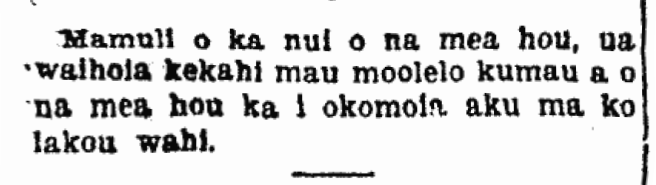
 Mamuli o ka nui o na mea hou, ua waihoia kekahi mau moolelo kumau a o na mea hou ka i okomoia aku ma ko lakou wahi.

Because of the great amount of news, several regular moolelo were put aside, and replaced with other new material.

[See more here from Nanea Armstrong-Wassel. See more here as well from a previous post on Kahaulelio’s fishing treatise.]

(Kuokoa, 7/11/1902, p. 6)

Mamuli o ka nui o na mea hou...

Ka Nupepa Kuokoa, Buke XL, Helu 28, Aoao 6. Iulai 11, 1902.