More stories about alalaua, 1873.

Alalauwa

Is a beautiful little fish, like the gold fish in form and hue, and now on a visit to our shores, and is attracting the attention of all the native islanders. It only pays occasional visits, at irregular periods, and Hawaiian superstition disaster, usually the demise of a chief of the land. The impressionable kanakas are a little excited over this marine stranger; and in talking about it, they use the expression, weliweli, meaning fearful or startling; and well they may use such expression, in view of the numbers, the schools, the myriads of the alalauwa that literally thicken the water of our harbor.

We went out in a boat with a party, on Friday night to angle for a few. The moon was gorgeous in the heavens, and lined the gently rippled surface of the sea, with silvery pathways; and by her soft effulgence, we beheld the hosts of eager people, with pole and line in hand, that crowded along the edge of wharf and shore, and who in their varied attitudes formed beautiful silhouetts on the sweet calm evening sky.

The pretty little golden and silver tinted carps swarmed around us, and were eager to devour whatever was thrown to them. As quick as the hook and bait could be cast into the water they would bite and be hauled in. Perhaps two thousand busy hands were holding rods and lines over the stream; and along the whole line of wharf and shore, near which we moored our boat, we could observe the numerous burthened hooks, lifting the little captives into the air, and the shimmer of their bright scales, as they danced in the moonlight, pendant on the line, made them seem like a long line of fire flies hovering over the shore.

There were at least two thousand people out with hook and line that night. Some said three thousand, lined the wharves of the harbor and as each caught with unvarying success, it might not be much out of the way to say that the night’s catch was equal to one hundred thousand fishes. But they are mostly very small, varying from an ounce or two in weight, to perhaps half a pound. They make very palatable fry, and what the natives cannot eat fresh, they salt for future use. The arrival of the alalauwa affords great diversion to the natives, but probably affects the meat and fish market a trifle. The superstition about its arrival is spoken of with a great deal of earnestness: and even foreigners like to tell, as confirmatory of the native superstition, how this fish arrived when “the princess” died, and on other occasions. In fact the foreigner is inclined to be just as superstitious as the native, and none of us could get along very well without our credulity. Very likely the alalauwa has slipped into these waters many a time, when no chief died, but it is enough to support our faith to know that they came at times when somebody did die. Some want to satisfy the national credulity at this time without waiting for any especial victim, by saying that the death of the chiefess Jane Loeau accounts for the event; but that won’t do; as the arrival of the fish was not officially announced by anybody on the day of her demise. Some of the kanakas said, as we sat quietly and patiently angling for fish and ideas, that the arrival of the alalauwa forbode the loss of Puuloa,¹ but a more numerous party said no; it was a warning to the parricides, who would try to sell a portion of their native country.

¹Pearl Harbor

(Nuhou, 8/12/1873, p. 1)
Ke Alalauwa

Nuhou, Volume II, Number 9, Page 1. August 12, 1873.
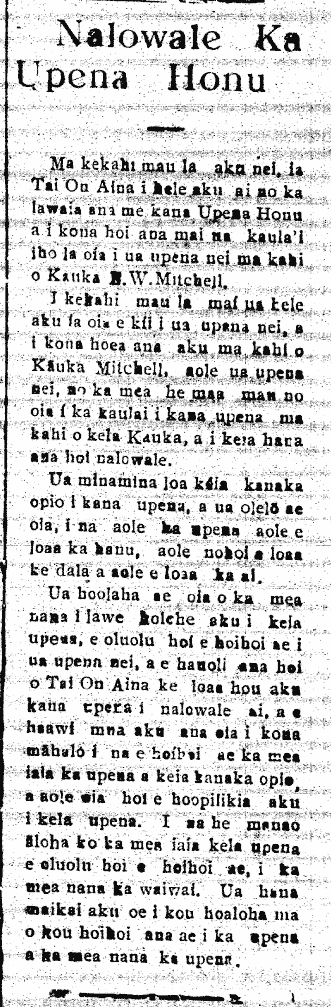
Stolen turtle net of Tai On Aina, 1933.

Turtle Net is Lost

Several days ago, Tai On Aina went to fish with his Turtle Net, and upon his return, he left his net to dry by Dr. E. W. Mitchell’s [the first initial is not clear] place.

Some days later, he went to fetch the net, but when he arrived at Dr. Mitchell’s, there was no net; he was accustomed to drying his net by that doctor’s place, but this time it disappeared.

This young man is at a lost over his net, and he said that without his net, he can’t catch turtles, and thus can’t make money and then can’t get food.

He announced to the one who mischievously took the net, if he could kindly return this net, which would make Tai On Aina happy to get his lost net back; and he offers his thanks in advance should that person who has the net of this young man returns it without damaging it. Should that person who has the net has some aloha, please return it to whom the property belongs. You will be doing a good deed to your friend by returning the net to the one it belongs to.

(Hoku o Hawaii, 2/14/1933, p. 3)

Nalowale Ka Upena Honu

Ka Hoku o Hawaii, Buke XXVI, Helu 37, Aoao 3. Feberuari 14, 1933.

James Pauahi Alohikea and the alalaua, 1917.

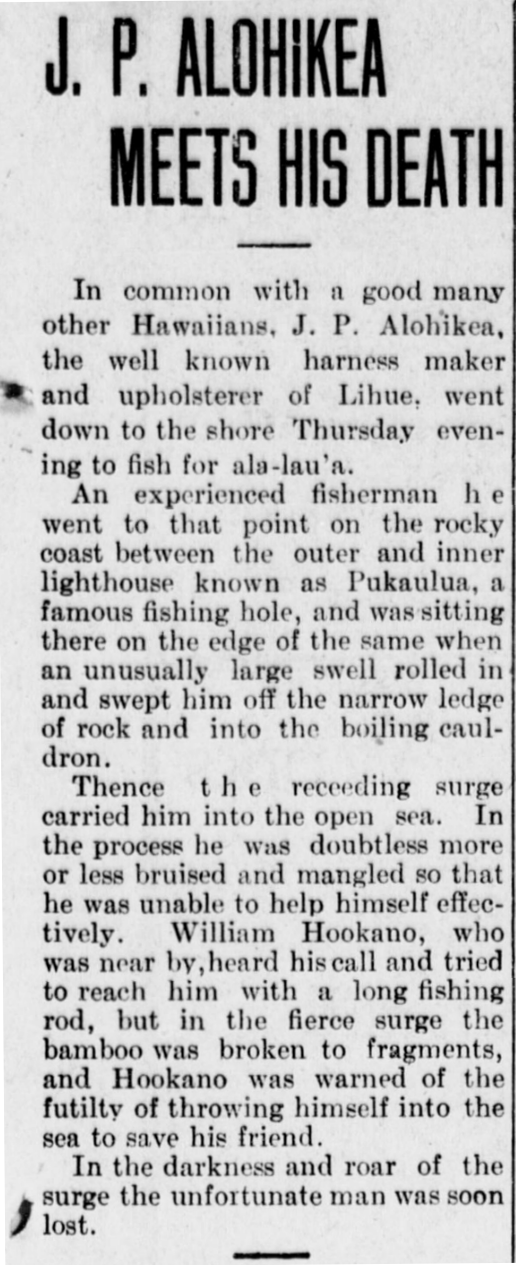
J. P. ALOHIKEA MEETS HIS DEATH

In common with a good many other Hawaiians, J. P. Alohikea, the well known harness maker and upholsterer of Lihue, went down to the shore Thursday evening to fish for ala-lau’a.

An experienced fisherman he went to that point on the rocky coast between the outer and inner lighthouse known as Pukaulua, a famous fishing hole, and was sitting there on the edge of the same when an unusually large swell rolled in and swept him off the narrow ledge of rock and into the boiling cauldron.

Thence the receeding surge carried him into the open sea. In the process he was doubtless more or less bruised and mangled so that he was unable to help himself effectively. William Hookano, who was near by, heard his call and tried to reach him with a long fishing rod, but in the fierce surge the bamboo was broken to fragments, and Hookano was warned of the futility of throwing himself into the sea to save his friend.

In the darkness and roar of the surge the unfortunate man was soon lost.

(Garden Island, 9/11/1917, p. 1)

J. P. ALOHIKEA MEETS HIS DEATH

The Garden Island, Volume 13, Number 37, Page 1. September 11, 1917.

More on the alalaua, 1917.

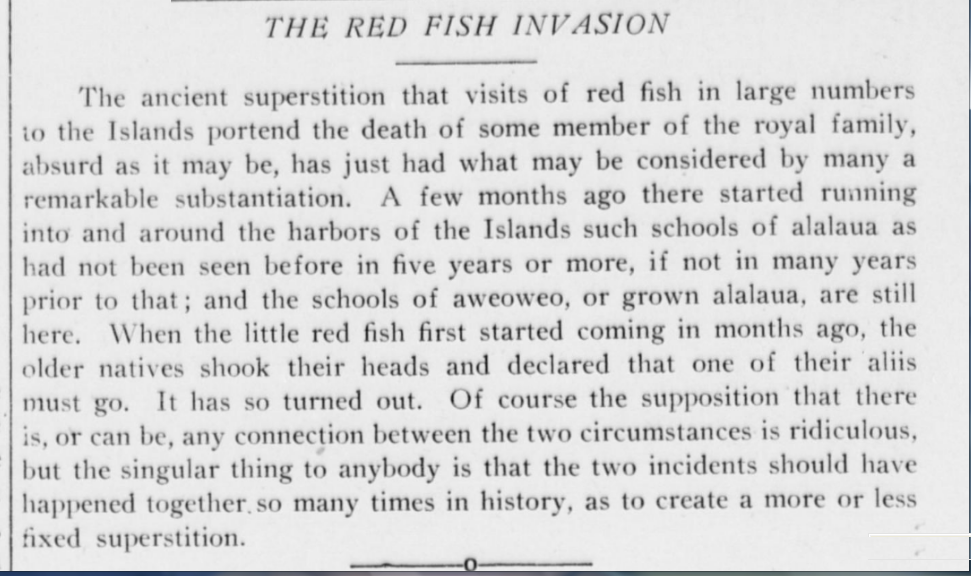
THE RED FISH INVASION

The ancient superstition that visits of red fish in large numbers to the Islands portend the death of some member of the royal family, absurd as it may be, has just had what may be considered by many a remarkable substantiation. A few months ago there started running into and around the harbors of the Islands such schools of alalaua as had not been seen before in five years or more, if not in many years prior to that; and the schools of aweoweo, or grown alalaua, are still here. When the little red fish first started coming in months ago, the older natives shook their heads and declared that one of their aliis must go. It has so turned out. Of course the supposition that there is, or can be, any connection between the two circumstances is ridiculous, but the singular thing to anybody is that the two incidents should have happened together so many times in history, as to create a more or less fixed superstition.

(Maui News, 11/16/1917, p. 4)

THE RED FISH INVASION

The Maui News, Eighteenth Year, Number 923, Page 4. November 16, 1917.

The Queen and the alalaua, 1917.

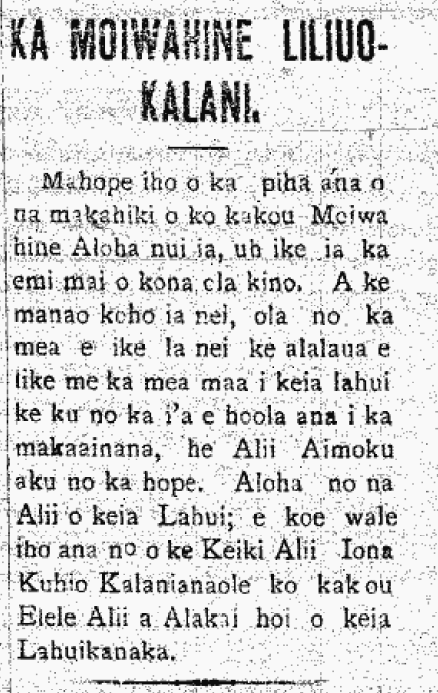
QUEEN LILIUOKALANI.

Following the birthdays of our dearly Beloved Queen, her weakening health was noticed. And we guess that this is the reason for the appearance of the alalaua, like what is usual for this lahui, that when this fish to save the people runs, the Ruler will follow. Aloha for the Chiefs of this Lahui; left is Prince Jonah Kuhio Kalanianaole, our Chiefly Representative and the Leader of this People.

(Puuhonua, 9/28/1917, p. 4)

KA MOIWAHINE LILIUOKALANI.

Ka Puuhonua, Buke IV, Helu 39, Aoao 4. Sepatemaba 28, 1917.

Big run of alalaua, 1917.

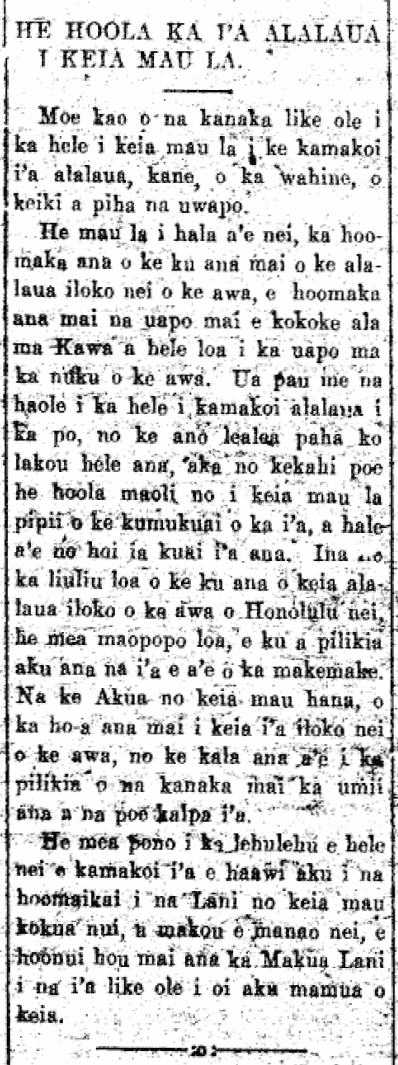
THE ALALAUA¹ FISH IS A LIFE SAVER THESE DAYS.

All sorts of people are heading together these days to go pole fishing for alalaua: the piers are full of men, women, and children.

A few days ago is when the run of alalaua began by the piers near the prison of Kawa all the way until those by the mouth of the harbor. Even the haole went alalaua fishing at night, probably just for fun; however, for some, it is a true lifesaver, with the high cost of fish, where they can escape from buying fish [??]. If the alalaua keeps running in Honolulu Harbor, it is clear that the other desired fishes will be in trouble. God is the one who is controlling this, the prodding of this fish into the harbor; it is to alleviate the troubles of the people from the vise of the fish mongers.

All those going pole fishing should give their thanks to the Heavens for this great assistance, and we believe that the Heavenly Father will increase all kinds of fish more than this.

¹Alalaua (also seen as Alalauwa) is the juvenile stage of the Aweoweo.

(Aloha Aina, 9/14/1917, p. 4)

HE HOOLA KA I'A ALALAUA I KEIA MAU LA.

Ke Aloha Aina, Buke XXII, Helu 37, Aoao 4. Sepatemaba 14, 1917.

Fish market affected by weather, 1929.

DECREASE IN THE CATCH OF OCEAN FISH

Hilo, Dec. 22—According to a report by the fish market association of Hilo, they said that there is a marked decrease in the amount of fish brought in to the fish markets of Hilo nei, and this is a result of the difficulty brought on by the very stormy seas these days. The pull of the currents is very strong, and this occurs in the fishing waters, so the fishing boats cannot head straight for them; the only fish caught by the large fishing vessels of Hilo are Ahi and other fish from far outside of the normal fishing areas of Hilo.

Here however are the Japanese, still persevering these stormy conditions of the sea by carrying out their regular work. And the determined fishermen are reaping the benefits of their persistence.

If those who eat fish are without fresh fish, here are nicely-salted opelu being sold at the pastor’s residence of Haili and it is being sold for a good price; it is fish salted well by the expert fish salters of Kapalaoa. Ring the Telephone Number 168, and the dried opelu in forties [kaau] will be delivered to your house.

(Hoku o Hawaii, 12/24/1929, p. 2)

EMI MAI KA LOAA ANA O NA IA O KA Moana

Ka Hoku o Hawaii, Buke XXIII, Helu 28, Aoao 2. Dekemaba 24, 1929.

If everyone took care of their kuleana instead of looking for the easiest way out of it… 1899/2012.

THE OLD FARMING MEN

AND THE

OLD FISHERMEN

In times long ago, there lived in Kapalilua, South Kona, Hawaii, four old men; two of them were farmers and the other two were fishermen; the farmers would always supply the fishermen with their vegetable foods, and so too the fishermen would provide for the farmers, and so they shared for a long time.

One day when the fishermen were returning and almost ready to land, they saw the farmers coming down to the plains with a basket of sweet potato; one fisherman said to the other, there are those farmers who gorge on fish. It would be good if we acted cunningly to those old farmers so that those old men don’t get our fish.

So let’s hide the fish under the fish trap [ie] and place the leftover bait [poo maunu] on top, and when they approach the canoe, we’ll say, “O Farmers, we’ve got a problem, we’ve no fish, only the leftover bait;” the two fishermen decided to carry out this treacherous idea.

When they got to the beach, there stood the elderly farmers. The fishermen said in a smooth [nalali ?] voice, “O Farmers, we’ve got a problem, there’s no fish on this canoe, we’ve just turned back for today, with just the leftover bait for this day;” the fishermen opened the cover of the trap [hinai] and said to the farmers, “this is the remaining bait, and so it that,” and so forth, and the farmers were left disappointed.

It was a rule for fishermen not to give away the leftover bait to others; it was something that the fishermen ate. And so that day, the farmers went without fish and ate only some taro [kuala] without any fish, while the fishermen had their vegetable food and fish as they laughed; so it went the next day; the farmers were left without fish because of the actions of the fishermen.

On another day, while the farmers were headed up to their fields, they arrived at a resting point where they took a break, and one said to the other, “Hey, listen to this, we are being troubled by the fishermen.” “Yes, the fishermen are troublesome.”

“Today, let us act wisely; let’s go upland for sweet potato for us to eat, and when we descend, let’s stick in the vines growing from broken pieces of sweet potato [ohulu] and when we get to the shore, and the fishermen return, let’s say, ‘You fishermen have a problem; we only have broken bits of potato [ku-oo] to eat;’ then they’ll eat their fish without vegetable, and we’ll have our vegetable without fish; we will not die, it is they that will die.”

The two of them went into the uplands and got their food, and commenced breaking and crumbling up the uala; they then walked down and when they came to the harbor where the fishermen came ashore, they landed and said, “You two are in a bind again, O Farmers; we only have leftover bait.”  The Farmers replied, “Yeah, should you two fishermen have nothing, that is a problem for us, and we have nothing.”

Then, the old farmers said, “That goes for us as well, we kept searching our patch, and there was no whole potatoes, just pieces. So you fishermen are in trouble, there are only pieces;” showing them, “Look, these are only pieces, those are pieces,” and so forth.

So the fishermen went home and ate their fish without vegetable, and the farmers ate their vegetable without fish, but the farmers were satisfied.

That night, the fishermen went fishing for aweoweo, and while they fished, one said to the other, “We are being troubled by the farmers; it is certain that we cannot live if we just have fish to eat;” the other agreed, “Yes, those old men are so crafty, yes, they are so clever.”

“So the right thing for us to do is to fish, and when we’re done, we come back and kill those old men.”

The place these fishermen were talking was outside of Olelomoana, and while these old fishermen were talking, the plot of the fishermen was heard by the farmers in the upland. At that, the farmers crawled that night from Olelomoana until Kolo, and that is why those places are called Olelomoana [Ocean Talking] and Kolo [Crawl], being that there was talking at Olelomoana and there was crawling to Kolo.

Kapalilua was the only name before, but because of these old men, those places are named these names until this day, and the Honorable W. C. Achi is the owner of those amazing land sections [Ahupuaa]. And so it is said that the fishermen were troubled by the farmers because of the mischief they did to the other.

Kailua Baka Ona

(Lahui Hawaii, 9/16/1899, p. 2)

NA ELEMAKULE MAHIAI a me na ELEMAKULE LAWAIA.

Ka Lahui Hawaii, Buke 1, Helu 34, Aoao 2. Sepatemaba 16, 1899.

An awesome follow up to a great fishing story, 2012.

I had the great honor the other day speaking first hand to Keoni Honl, the little boy who in 1937 caught a huge ahi in Makaweli using his throw net! If you did not see this post, one of my earliest on this blog, find it here:

A great fishing story from Makaweli, 1937.

John Honl is now 83 years young. He indeed threw net in his childhood, and remembered that there was a newspaper article written when he caught the famous fish. He says he spent his younger years spear fishing around Oahu, then moved to Kona, Hawaii in 1957, and ran a charter fishing boat named the Kakina for around 20 years! He is now retired and collecting Hawaiian memorabilia.

Talking to him was one of the most exciting things to happen to me in my twenty years or so of dabbling in the Hawaiian-Language Newspapers.

Mahalo to you, Mr. Honl!

Harrowing octopus encounter, 1896.

Fierce Battle with a Hee.

Outside of Waikiki, in the afternoon of Sunday, the 16th, while the haole children of Arthur Harris [Ata Harisa] and some Portuguese children were swimming in the ocean, full of joy on the day of the Lord, a great octopus from the deep, dark sea, rose up and wrapped its tentacles tightly about the legs of the Portuguese boy. The haole boy saw this trouble faced by his friend, and sped over to help; that is when one of the tentacles of the hee swung and grabbed on to his leg and arm while one of the tentacles pummeled his chest and ear, while he was pulled down under for a time. With much effort, he kept on fighting with the hee until he was free, being that it had previously released the Portuguese boy. The head of the hee was stomped full on so that it released the haole boy, or he would have been in trouble. The haole boy was left with scars on him from the hee. This is the first time in a long time that a hee was seen fighting with a person. That place will be feared from here forth. This is as it should be.

(Makaainana, 2/24/1896, p. 2)

Paio Hahana me ka Hee.

Ka Makaainana, Buke V—-Ano Hou, Helu 8, Aoao 2. Feberuari 24, 1896.