Consul General from Japan, S. Shimizu, found, 1895 / 2014.

With the kind help of Bishop Museum volunteer Mr. K. Suzuki, the mystery is solved. The Consul General Representative for 1895 from Japan here in Hawaii nei who appears in “Hawaii’s Story by Hawaii’s Queen” was Seizaburō Shimizu.

[As per a listing of the Japanese consul generals stationed in Honolulu, which is printed in Sōga, Yasutarō. 1953. Gojūnenkan no Hawai Kaiko. Tokyo: Kankōkai.]

More on Consul-General Shimizu, 1895.

[Found under: “KELA A ME KEIA.”]

Some well to do Japanese of Honolulu nei gave a large party outside of Sans Souci [Sana Susi], Waikiki, on the afternoon of this past Friday for the former Japanese Consul, and his secretary, Goro Narita. Also present was the new Consul-General (H. Shimamura) from Japan and his secretary.

[It seems Shimizu replaces Saburō Fujii as the Consul-General in November 1894 (although Gorō Narita was temporary Consul-General during the short period from November 1894 to January 1895), and Shimizu’s own term came to an end sometime in early November of 1895. In the 12/2/1895 issue of the same paper, there is a short three-line mention of the former Consul, Shimizu, returning to Japan on the Coptic of the past Thursday (11/28/1895).]

(Makaainana, 11/18/1895, p. 8)

Ua haawi ae kekahi mau Kepani...

Ka Makaainana, Buke IV—Ano Hou, Helu 21, Aoao 8. Novemaba 18, 1895.

On the search for the Japanese consul, F. Schmibu, 1895 / 2014.

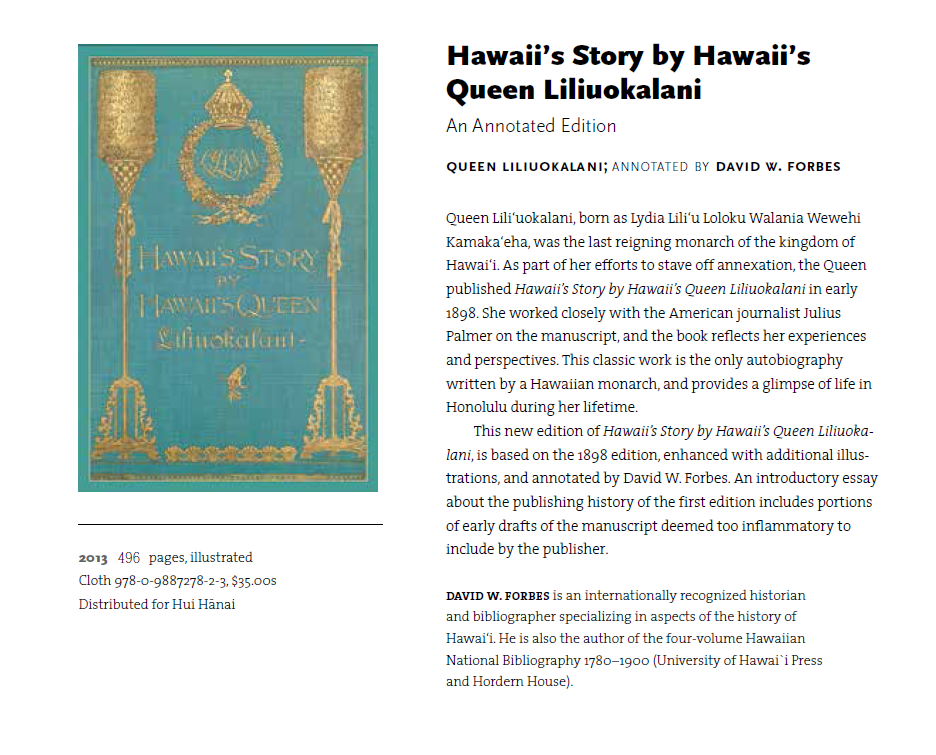
We see in “Hawaii’s Story,” some of those present at the Queen’s trial were:

“The diplomatic corps, Mr. Albert F. Willis, minister of the United States, A. G. S. Hawes, British commissioner, Monsieur De Verlet, French commissioner, Senior Canavarro, Portuguese commissioner, and Mr. F. Schmibu, the Japanese consul…”

[According to Thrum’s Hawaiian Annual of 1895, Japan’s diplomatic representative was “F. Schimiczu, Eleve-Consul.”

In the Hawaii newspapers of the day, both English and Hawaiian-Language, there are also references to Consul-General Shimizu (Kanikela Kenerala Shimizu). But i still have yet to find any specific information on this man.

The four others are: Albert S. Willis, Albert G. S. Hawes, Henri L. Verleye, and Antonio de Souza Canavarro.]

Thrum

Thrum’s Hawaiian Annual for 1895, p. 156.

The Queen’s Protest, 1893.

KUKALA KUE A KE ALIIAIMOKU.

“O wau, Liliuokalani, ma ka lokomaikai o ke Akua, malalo o ke Kumukanawai o ke Aupuni Hawaii, Moiwahine, ma keia ke hoike paa nei i Ko’u kue i kekahi hana a mau hana paha a pau i lawelawe ia e kue ana Ia’u iho a me ke Aupuni Kumukanawai o ke Aupuni Hawaii e kekahi poe e koi ana ua kukulu lakou he Aupuni Kuikawa no ka manawa no keia Aupuni.

“Ke ae wale nei no Au mamuli o ka mana oi ikaika o Amerika Huipuia nona hoi ke Kuhina Elele Nui, ka Meamahaloia John L. Stevens, ua kauoha aku i na koa o Amerika Huipuia e hoopae ia mai ma Honolulu, a ua kukala ae e kokua no oia i ua Aupuni Kuikawa ʼla no ka Manawa i oleloia.

“Nolaila, i mea e kaupale aku ai i na hookuia ana o na puali i hoolawa ia me na lako kaua, a malia paha o hoopoino ia ke ola; nolaila, malalo o keia Kuahaua Kue a i kauhola ia hoi e ua mana ikaika ʼla, ke ae wale nei no Au e panee aku i Ko’u Mana a hiki i ka manawa a ke Aupuni o Amerika Huipuia, mamuli o na mea oiaio e waiho ia aku ai imua ona, e hoololi ai i na hana a kona Luna Aupuni a e hoonoho hou Ia’u maluna o ka mana A’u e koi nei ma ke ano Aliiaimoku o ka Paeaina Hawaii.”

“Hanaia ma Honolulu, i keia la 17 o Ianuari, M. H. 1893.”

“[Kakauinoaia:]

LILIUOKALANI, R.

Samuel Parker,
Kuhina o ko na Aina E.

Wm. H. Cornwell,
Kuhina Waiwai.

Jno. F. Colburn,
Kuhina Kalaiaina.

A. P. Peterson,
Loio Kuhina.

“Ia S. B. Dole a me kekahi poe e ae o ke Aupuni Kuikawa no ka Manawa o ka Paeaina Hawaii.”

[The Queen’s protest was printed in entirety the very next day in the Hawaiian-Language Newspaper, Hawaii Holomua. Images of this paper are unfortunately not available online, and it is only word searchable at nupepa.org, and not at papakilodatabase.com, but click the link below for an image of the page in which the protest was printed.

For English, see for instance: p. 120 of Report of Commissioner to the Hawaiian Islands, 1893.]

(Hawaii Holomua, 1/18/1893, p. 2)

HawaiiHolomua_1_18_1893_2

Why Crown Lands are not public lands, 1909.

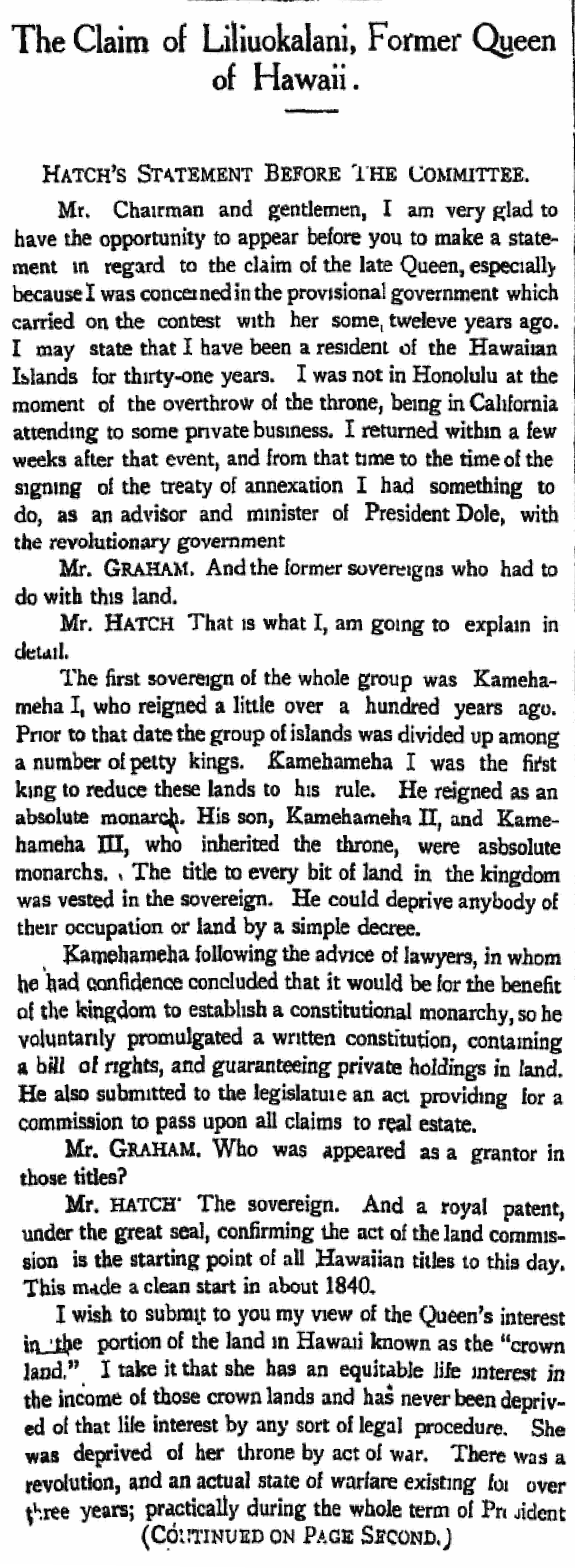
The Claim of Liliuokalani, Former Queen of Hawaii.

HATCH’S STATEMENT BEFORE THE COMMITTEE.

Mr. Chairman and gentlemen, I am very glad to have the opportunity to appear before you to make a statement in regard to the claim of the late Queen, especially because I was concerned in the provisional government which carried on the contest with her some twelve years ago. I may state that I have been a resident of the Hawaiian Islands for thirty-one years. I was not in Honolulu at the moment of the overthrow of the throne, being in California attending to some private business. I returned within a few weeks after that event, and from that time to the time of the signing of the treaty of annexation I had something to do, as an advisor and minister of President Dole, with the revolutionary government.

Mr. Graham. And the former sovereigns who had to do with this land.

Mr. Hatch. That is what I, am going to explain in detail.

The first sovereign of the whole group was Kamehameha I, who reigned a little over a hundred years ago. Prior to that date the group of islands was divided up among a number of petty kings. Kamehameha I was the first king to reduce these lands to his rule. He reigned as an absolute monarch. His son, Kamehameha II, and Kamehameha III, who inherited the throne, were absolute monarchs. The title to every bit of land in the kingdom was vested in the sovereign. He could deprive anybody of their occupation or land by a simple decree.

Kamehameha following the advice of lawyers, in whom he had confidence concluded that it would be for the benefit of the kingdom to establish a constitutional monarchy, so he voluntarily promulgated a written constitution, containing a bill of rights, and guaranteeing private holdings in land. He also submitted to the legislature an act providing for a commission to pass upon all claims to real estate.

Mr. Graham. Who was appeared as a grantor in those titles?

Mr. Hatch. The sovereign. And a royal patent under the great seal, confirming the act of the land commission is the starting point of all Hawaiian titles to this day. This made a clean start in about 1840.

I wish to submit to you my view of the Queen’s interest in the portion of the land in Hawaii known as the “crown land.” I take it that she has an equitable life interest in the income of those crown lands and has never been deprived of that life interest by any sort of legal procedure. She was deprived of her throne by act of war. There was a revolution, and an actual state of warfare existing for over three years; practically during the whole term of President…

(Kuokoa Home Rula, 5/21/1909, p. 1)

The Claim of Liliuokalani, Former Queen of Hawaii.

Kuokoa Home Rula, Buke VII, Helu 21, Aoao 1. Mei 21, 1909.

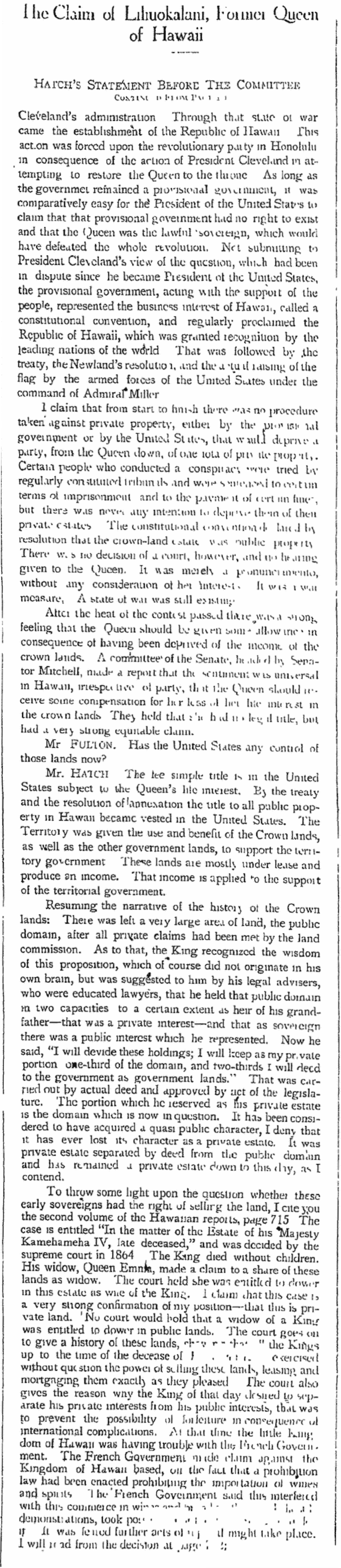
…Cleveland’s administration. Through that state of war came the establishment of the Republic of Hawaii. This action was forced upon the revolutionary party in Honolulu in consequence of the action of President Cleveland in attempting to restore the Queen to the throne. As long as the government remained a provisional government, it was comparatively easy for the President of the United States to claim that the provisional government had no right to exist and that the Queen was the lawful sovereign, which would have defeated the whole revolution. Not submitting to President Cleveland’s view of the question, which had been in dispute since he became President of the United States, the provisional government, acting with the support of the people, represented the business interest of Hawaii, called a constitutional convention, and regularly proclaimed the Republic of Hawaii, which was granted recognition by the leading nations of the world. That was followed by the treaty, the Newland’s resolution, and the actual raising of the flag by the armed forces of the United States under the command of Admiral Miller.

I claim that from start of finish there was no procedure taken against private property, either by the provisional government or by the United States, that would deprive a party, from the Queen down, of one iota of private property. Certain people who conducted a conspiracy were tried by regularly constituted tribunals and were sentenced to [unclear] but there was never any intention to deprived them of their private estates. The constitutional convention declared by resolution that the crown-land estate was public property. There was no decision of a court, however, and no hearing given to the Queen. It was merely a [unclear] without any consideration of her interests. It was a [unclear] measure. A state of war was still existing.

After the heat of the contest passed there was a strong feeling that the Queen should be given some allowance in consequence of having been deprived of the income of the crown lands. A committee of the Senate, headed by Senator Mitchell, made a report that the sentiment was universal in Hawaii, irrespective of party, that the Queen should received some compensation for her loss of her life interest in the crown lands. They held that she had no legal title, but had a very strong equitable claim.

Mr. Fulton. Has the United States any control of those lands now?

Mr. Hatch. The fee simple title is in the United States subject to the Queen’s life interest. By the treaty and the resolution of annexation the title to all public property in Hawaii became vested in the United States. The Territory was given the use and benefit of the Crown lands, as well as the other government lands, to support the territory government. These lands are mostly under lease and produce an income. That income is applied to the support of the territorial government.

Resuming the narrative of the history of the Crown lands: There was left a very large area of land, the public domain, after all private claims had been met by the land commission. As to that, the King recognized the wisdom of this proposition, which of course did not originate in his own brain, but was suggested to him by his legal advisers, who were educated lawyers, that he held that public domain in two capacities to a certain extent as heir of his grandfather—that was a private interest—and that as a sovereign there was a public interest which he represented. Now he said, “I will divide these holdings; I will keep as my private portion one0third of the domain, and two-thirds I will deed to the government as government lands.” That was carried out by actual deed and approved by net of the legislature. The portion which he reserved as his private estate is the domain which is now in question. It has been considered to have acquired a quasi public character, I deny that it has ever lost its character as a private estate. It was and has remained a private estate down to this day, as I contend.

To throw some light upon the question whether these early sovereigns had the right of selling the land, I cite you the second volume of the Hawaiian reports, page 715. The case is entitled “In the matter of the Estate of his Majesty Kamehameha IV, late deceased,” and was decided by the supreme court in 1864. The King died without children. His widow, Queen Emma, made a claim to a share of these lands as a widow. The court held she was entitled to dower in this estate as wife of the King. I claim that this case is a very strong confirmation of m position—that this is private land. No court would hold that a widow of a King was entitled to dower in public lands. The court goes on to give a history of these lands, [partially unclear from here on down].

[This is also translated and printed in Hawaiian in Kuokoa Home Rula. “KOI A LILIUOKALANI, MOIWAHINE MUA O HAWAII.”

Although this document should be easily found elsewhere, there are other stories in newspapers like Kuokoa Home Rula that are not legible online. They need to be rescanned clearly, so that they can be read as they were written, for what good is information if it cannot be read?]

(Kuokoa Home Rula, 5/21/1909, p. 2)

The Claim of Liliuokalani, Former Queen of Hawaii

Kuokoa Home Rula, Buke VII, Helu 21, Aoao 2. Mei 21, 1909.

Kahili from Washington Place to go to Hanaiakamalama, 1918.

KAHILI TO BE RETURNED TO THE HOME OF EMMA.

Because Washington Place [Wakinekona Hale] will be placed under the care of Governor McCarthy, as a home for him to live in with his family, twenty-six feather standards were returned from Washington Place to the old home of Queen Emma, in the uplands of Nuuanu, under the care of the Association, the Daughters of Hawaii [Na Kaikamahine o Hawaii].

During the funeral of Queen Liliuokalani, and while her body lay in state at Kawaiahao Church and in the throne room of the palace, those kahili were something the public could visit, however, as the result of an agreement between the trustees of Queen Liliuokalani’s estate and the Association of the Daughters of Hawaii, the caring for the kahili has been transferred to the association. As has been the custom from ancient times, it was during the night that kahili of those types were moved from one place to another, and so it was that the kahili were returned in the dark of night on Sunday two weeks ago.

However, because there were not enough people to carry the kahili and march on the roads to its new home where it is hoped to be cared for, the kahili were put on cars and it was on these cars which the people who held the kahili stood.

When the cars and the kahili arrived at the entrance to the yard of the home of Queen Emma in the uplands of Nuuanu, the kahili were taken by the leaders of the Association of the Daughters of Hawaii, and its care was transferred to them.

(Kuokoa, 10/18/1918, p. 2)

HOIHOIIA NA KAHILI MA KA HOME O EMA.

Ka Nupepa Kuokoa, Buke LVI, Helu 42, Aoao 2. Okatoba 18, 1918.

More fishes, more prices, 1918.

FISH PRICES SET ONCE AGAIN.

For the benefit of the public, printed below is the chart of the prices of the many fishes being sold, by the orders of the Food Administrator [Lunahooponopono o na Meaai], Child, whether it be at the market or somewhere else; each home is invited to keep this chart, so that they will not be fooled by the fish mongers.

With this establishing by the commission of this price chart of the fishes, it is acceptable to sell fish below the price, being that this is the top price when the fish is scarce; if there is an abundance, the prices will be decreased.

This chart of fish prices was decided through discussion of the Food Administration [komisina o na meaai] along with the people who sell fish and the fishermen; these prices will continue until the coming month of October.

Here below is the new chart of the price of fishes, compared with the old prices.

Old Price New Price
Aalaihi  $      0.12 lb.            0.11 c
Aawa  $           0.12  $            0.11
Aha  $           0.12  $            0.11
Ahi  $           0.14  $            0.14
Aholehole  $           0.15  $            0.14
Aku  $           0.08  $            0.06
Akule  $           0.18  $            0.18
Amaama  $           0.20  $            0.20
Alalauwa  $           0.05  $            0.05
Awa  $           0.17  $            0.16
Awakalamoho  $           0.15  $            0.15
Awaaua  $           0.20  $            0.20
Aweoweo  $           0.12  $            0.12
Hahalalu  $           0.18  $            0.18
Hapuupuu  $           0.16  $            0.15
Hauliuli  $           0.12  $            0.12
Hee  $           0.20  $            0.20
Hihimanu  $           0.14  $            0.08
Hilu  $           0.12  $            0.12
Hinalea  $           0.09  $            0.10
Honu  $           0.05  $            0.05
Humuhumu  $           0.07  $            0.07
Iheihe  $           0.16  $            0.16
Ina  $           0.10  $            0.10
Kahala  $           0.16  $            0.15
Kaku  $           0.17  $            0.17
Kala  $           0.10  $            0.10
Kalikali  $           0.16  $            0.17
Kawakawa  $           0.16  $            0.16
Kawelea  $           0.17  $            0.16
Kihikihi  $           0.05  $            0.05
Kole  $           0.16  $            0.15
Kumu  $           0.23  $            0.23
Kupoupou  $           0.17  $            0.16
Kupipi  $           0.16  $            0.15
Lauhau  $           0.05  $            0.05
Laenihi  $           0.10  $            0.16
Iai  $           0.17  $            0.16
Mahimahi  $           0.15  $            0.14
Maiii  $           0.16  $            0.14
Maiko  $           0.16  $            0.15
Maka-a  $           0.05  $            0.05
Malamalama  $           0.05  $            0.05
Malolo  $           0.16  $            0.15
Mamamo  $           0.16  $            0.15
Manini  $           0.15  $            0.15
Mano  $           0.03  $            0.03
Mikiawa  $           0.08  $            0.08
Moano  $           0.20  $            0.20
Moi  $           0.26  $            0.26
Mu  $           0.15  $            0.15
Naia  $           0.05  $            0.05
Naenae  $           0.05  $            0.05
Nenue  $           0.15  $            0.14
Nohu  $           0.05  $            0.05
Nunu  $           1.00  $            1.00
Oama  $           0.15  $            0.15
Oio  $           0.17  $            0.16
Olali  $           0.05  $            0.05
Omaka  $           0.15  $            0.14
Omilu  $           0.17  $            0.16
Ono  $           0.15  $            0.14
Oopu  $           0.20  $            0.18
Opakapaka  $           0.18  $            0.14
Opelu  $           0.17  $            0.14
Opule  $           0.17  $            0.14
Opelu Palahu  $           0.17  $            0.14
Pakaii  $           0.15  $            0.15
Papai  $           0.07  $            0.07
Palani  $           0.10  $            0.10
Panuhunuhu  $           0.17  $            0.16
Papiopio  $           0.10  $            0.10
Pauu  $           0.10  $            0.10
Poopaa  $           0.10  $            0.10
Pualu  $           0.10  $            0.05
Puhi  $           0.06  $            0.15
Puhikii  $           0.15  $            0.15
Uhu  $           0.17  $            0.16
Uku  $           0.16  $            0.15
Ulae  $           0.10  $            0.09
Ulaula  $           0.19  $            0.19
Ulua  $           0.17  $            0.16
Ula  $           0.20  $            0.20
Upapalu  $           0.16  $            0.18
Uu  $           0.23  $            0.23
Walu  $           0.25  $            0.20
Wana  $           0.10  $            0.10
Weke  $           0.10  $            0.10
Ehu  $           0.19  $            0.18
Lehi  $           0.18  $            0.17
Kamano  $           0.18  $            0.17
A-u  $           0.15  $            0.15

(Kuokoa, 5/3/1918, p. 2)

KAU HOU IA KE KUMUKUAI O NA I'A.

Ka Nupepa Kuokoa, Buke LVI, Helu 18, Aoao 2. Mei 3, 1918.

Fish prices, 1918.

NEW PRICES SET FOR FISH UNTIL APRIL 30

Here following is the new prices for fish set by the food commission upon the various fishes; and this will be the only prices announced on fishes big to small, until April 30th when it will end.

 Per Lb.
Aalaihi  $           0.12
Aawa  $           0.12
Aha  $           0.12
Ahi  $           0.14
Aholehole  $           0.15
Aku  $           0.08
Akule  $           0.15
Amaama  $           0.20
Alalauwa  $           0.05
Awa  $           0.17
Awakulamoho  $           0.15
Awaaua  $           0.20
Aweoweo  $           0.12
Hahalalu  $           0.20
Hapuupuu  $           0.16
Hauliuli  $           0.12
Hee (squid)  $           0.20
Hihimanu  $           0.14
Hilu  $           0.12
Hinalea  $           0.10
Honu (turtle)  $           0.05
Humuhumu  $           0.07
Iheihe  $           0.16
Kahala  $           0.16
Kaku ?  $           0.17
Kala  $           0.10
Kalikali [?]  $           0.16
Kawakawa  $           0.16
Kawelea  $           0.17
Kihiihi  $           0.05
Kole  $           0.16
Kumu  $           0.23
Kupoupou  $           0.17
Kupipi  $           0.16
Lauhau  $           0.05
Laenihi  $           0.10
Lai  $           0.17
Mahimahi  $           0.15
Maiii  $           0.16
Maiko  $           0.16
Maka-a  $           0.05
Malamalama  $           0.05
Malolo (flying fish)  $           0.16
Mamami  $           0.16
Manini  $           0.16
Mano (shark)  $           0.03
Mikiawa  $           0.10
Moano  $           0.25
Moi  $           0.26
Mu  $           0.15
Muhee  $           1.50
Naia  $           0.05
Naenae  $           0.05
Nenue  $           0.15
Nohu  $           0.05
Nunu  $           1.00
Oama  $           0.15
Oio  $           0.17
Olali  $           0.05
Omaka  $           0.15
Omilu  $           0.17
Ono  $           0.15
Oopu  $           0.20
Opakapaka  $           0.18
Opelu  $           0.17
Opule  $           0.17
Opelu Palahu  $           0.17
Pakii  $           0.15
Papai  $           0.07
Palani  $           0.10
Panuhunuhu  $           0.17
Papiopio  $           0.10
Pauu  $           0.10
Poopaa  $           0.10
Pualu  $           0.10
Puhi  $           0.15
Puhikii  $           0.15
Uhu  $           0.17
Uku  $           0.16
Ulae  $           0.10
Ulaula  $           0.19

[This list is very interesting for many reasons! Just seeing what fishes are listed is informative.]

(Aloha Aina, 3/1/1918, p. 1)

KAU IA KE KUMUKUAI HOU O KA I'A A HIKI I APERILA 30

Ke Aloha Aina, Buke XXIII, Helu 9, Aoao 1. Maraki 1, 1918.

Those afflicted with leprosy forsaken by the church? 1873.

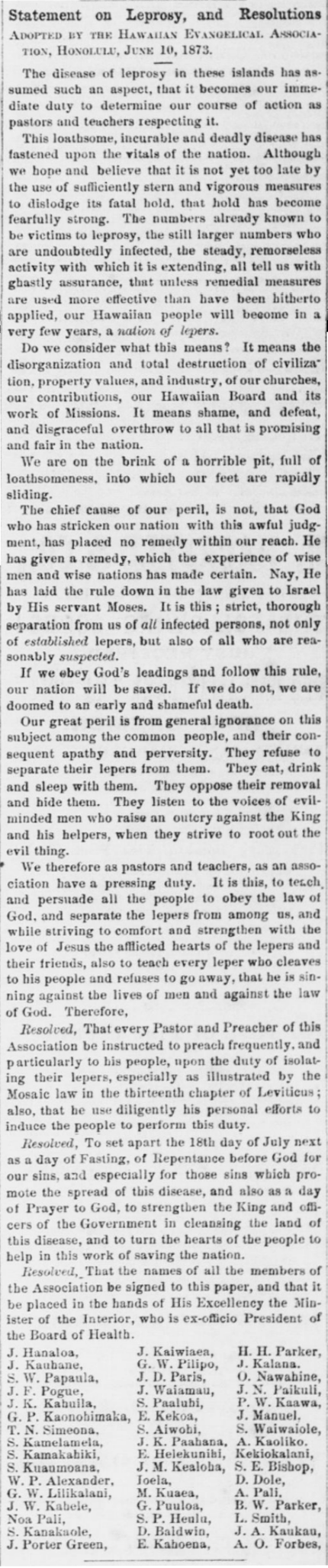
Statement on Leprosy, and Resolutions

Adopted by the Hawaiian Evangelical Association, Honolulu, June 10, 1873.

The disease of leprosy in these islands has assumed such an aspect, that it becomes our immediate duty to determine our course of action as pastors and teachers respecting it.

This loathsome, incurable and deadly disease has fastened upon the vitals of the nation. Although we hope and believe that it is not yet too late by the use of sufficiently stern and vigorous measures to dislodge its fatal hold, that hold has become fearfully strong. The numbers already known to be victims to leprosy, the still larger numbers who are undoubtedly infected, the steady, remorseless activity with which it is extending, all tell us with ghastly assurance, that unless remedial measures are used more effective than have been hitherto applied, our Hawaiian people will become in a very few years, a nation of lepers.

Do we consider what this means? It means the disorganization and total destruction of civilization, property values, and industry, of our churches, our contributions, our Hawaiian Board and its work of Missions. It means shame, and defeat, and disgraceful overthrow to all that is promising and fair in the nation.

We are on the brink of a horrible pit, full of loathsomeness, into which our feet are rapidly sliding.

The chief cause of our peril, is not, that God who has stricken our nation with this awful judgment, has placed no remedy within our reach. He has given a remedy, which the experience of wise men and wise nations has made certain. Nay, He has laid the rule down in the law given to Israel by His servant Moses. It is this; strict, thorough separation from us of all infected persons, not only of established lepers, but also of all who are reasonably suspected.

If we obey God’s leadings and follow this rule, our nation will be saved. If we do not, we are doomed to an early and shameful death.

Our great peril is from general ignorance on this subject among the common people, and their consequent apathy and perversity. They refuse to separate their lepers from them. They eat, drink and sleep with them. They oppose their removal and hide them. They listen to the voices of evil-minded men who raise an outcry against the King and his helpers, when they strive to root out the evil thing.

We therefore as pastors and teachers, as an association have a pressing duty. It is this, to teach and persuade all the people to obey the law of God, and separate the lepers from among us, and while striving to comfort and strengthen with the love of Jesus the afflicted hearts of the lepers and their friends, also to teach every leper who cleaves to his people and refuses to go away, that he is sinning against the lives of men and against the law of God. Therefore,

Resolved, That every Pastor and Preacher of this Association be instructed to preach frequently, and particularly to his people, upon the duty of isolating their lepers, especially as illustrated by the Mosaic law in the thirteenth chapter of Leviticus; also, that he use diligently his personal efforts to induce the people to perform this duty.

Resolved, To set apart the 18th day of July next as a day of Fasting, of Repentance before God for our sins, and especially for those sins which promote the spread of this disease, and also as a day of Prayer to God, to strengthen the King and officers of the Government in cleansing the land of this disease, and to turn the hearts of the people to help in this work of saving the nation.

Resolved, That the names of all the members of the Association be signed to this paper, and that it be placed in the hands of His Excellency the Minister of the Interior, who is ex-officio President of the Board of Health.

J. Hanaloa,  J. Kaiwiaea, H. H. Parker,
J. Kauhane,  G. W. Pilipo,  J. Kalana,
S. W. Papaula,  J. D. Paris,  O. Nawahine,
J. F. Pogue,  J. Waiamau,  J. N. Paikuli,
J. K. Kahuila,  S. Paaluhi,  P. W. Kaawa,
G. P. Kaonohimaka,  E. Kekoa,  J. Manuel,
T. N. Simeona,  S. Aiwohi,  S. Waiwaiole,
S. Kamelamela,  J. K. Paahana,  A. Kaoliko,
S. Kamakahiki,  E. Helekunihi,  Kekiokalani,
S. Kuaumoana,  J. M. Kealoha,  S. E. Bishop,
W. P. Alexander,  Ioela,  D. Dole,
G. W. Lilikalani,  M. Kuaea,  A. Pali,
J. W. Kahele,  G. Puuloa,  B. W. Parker,
Noa Pali,  S. P. Heulu,  L. Smith,
S. Kanakaole,  D. Baldwin,  J. A. Kaukau,
J. Porter Green,  E. Kahoena,  A. O. Forbes.

[How have things changed today? How have things remained the same? Find the Hawaiian-Language version printed in the Kuokoa, 6/18/1873, p. 3, here.]

(Pacific Commercial Advertiser, 6/14/1873, p. 3)
Statement on Leprosy, and Resolutions

The Pacific Commercial Advertiser, Volume XVII, Number 50, Page 3. June 14, 1873.