Hawaiian boys casualties of WWI, 1917.

FIVE HAWAIIAN BOYS DIED.

Washington, April 3—There are five Hawaiian boys thought to have been killed along with 16 Americans when the American steamer the Aztec was sunk. This ship was sunk outside of the seas of France by the German submarine without being given prior time for the captain and his sailors to prepare themselves on the previous Sabbath. Amongst the Americans  who are thought to have died are some sailors of the navy which the government placed aboard the ship when it left Newtown of Brest, the place of the shipwrecks of past [?? New York for Brest]. These are the first sailors of the navy to become victims of the Prussians as they attacked without giving time for them to distance themselves from the calamity of the sea placed upon them, and it is believed that Germany is at fault for breaking the pact with America by Germany starting its massacre with its submarines. This is the Brests where some of the shipwrecked of some of the skiffs landed [??] here below are the names of the Hawaiian boys:

Julian R. Masomber [Julian R. Macomber], Honolulu.

Charles Pinapolo, Honolulu.

Ekila Kaohi [Ekila Kaoki], Hawaii.

Tota Davisfi [Tato Davis], Hawaii.

H. K. Price, Hawaii. Continue reading

Kamehameha boys off to war, 1917.

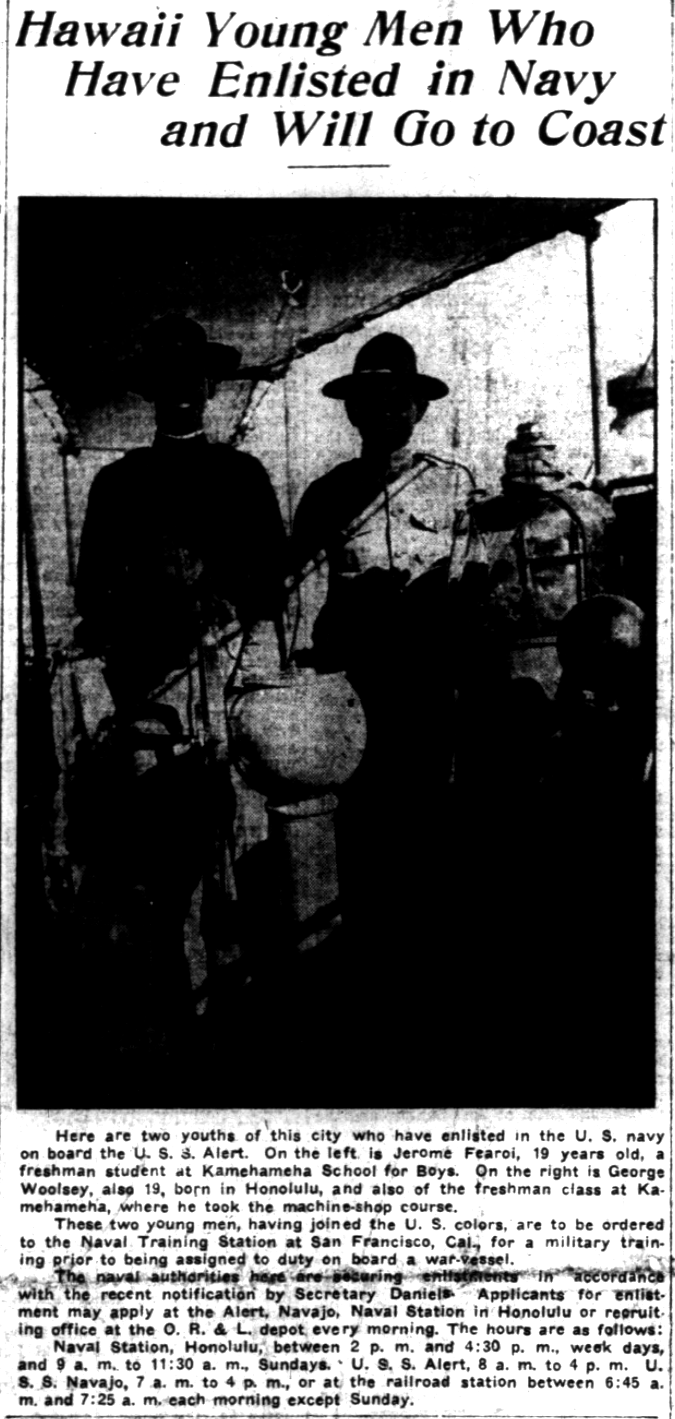
Hawaii Young Men Who Have Enlisted in Navy and Will Go to Coast

Here are two youths of this city who have enlisted in the U. S. navy on board the U. S. S. Alert. On the left is Jerome Fearoi, 19 years old, a freshman student at Kamehameha School for Boys. On the right is George Woolsey, also 19, born in Honolulu, and also of the freshman class at Kamehameha, where he took the machine-shop course.

These two young men, having joined the U. S. colors, are to be ordered to the Naval Training Station at San Francisco, Cal., for a military training prior to being assigned to duty on board a war vessel.

The naval authorities here are securing enlistments in accordance with the recent notification by Secretary Daniels. Applicants for enlistment may apply at the Alert, Navajo, Naval Station in Honolulu or recruiting office at the O. R. & L. depot every morning. The hours are as follows:

Naval Station, Honolulu, between 2 p. m. and 4:30 p. m., week days, and 9 a. m. to 11:30 a. m., Sundays. U. S. S. Alert, 8 a. m. to 4 p. m. U. S. S. Navajo, 7 a. m. to 4 p. m., or at the railroad station between 6:45 a. m. and 7:25 a. m. each morning except Sunday.

(Honolulu Star-Bulletin, 4/17/1917, p. 9)

Hawaii Young Men Who Have Enlisted in Navy and Will Go to Coast

Honolulu Star-Bulletin, Volume XXIV, Number 7803, p. 9. April 17, 1917.


More on the Hokulea, 1980.

Editorial

We should not look upon the voyage of Hokuleʻa with the thought that out ethnic pride and awareness will be re-vitalized. This type of pride we search for should emulate [emanate] from within ourselves and should be a constant part of our daily lives. We must not rely wholly upon occasional events to stir up reminders of our dignity and abilities lest we become fleeting images for display; pieces in a show case.

The importance of the upcoming voyage of Hokuleʻa lies in a different discovery: the opportunity we have to discover how our ancestors conceptualized their world, how they responded to the challenges after leaving their homelands and how they attempted to survive in this new land, today our homeland. Grasping this knowledge we too can be committed to accept the challenges before us with the same determination of our ancestors.

[Some thoughts from thirty-four years ago. How have things changed? How have things stayed the same?]

(Alahou, 2-3/1980, p. 12)

Ka ʻOlelo a Na Luna hoʻoponopono

Ke Alahou, Helu 4, Aoao 12. February/March 1980.

Kau ka pea, holo ka waa, 1980.

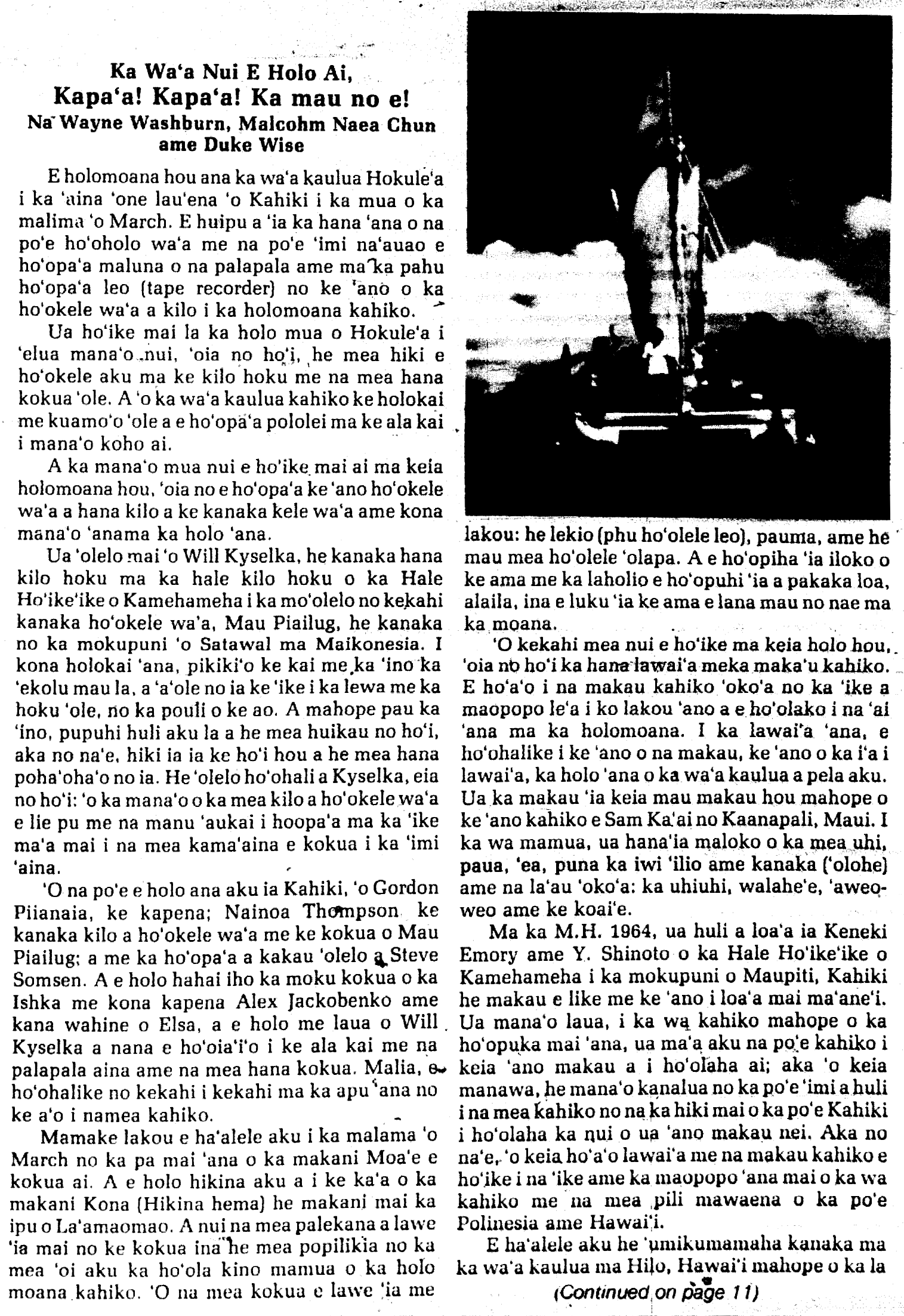
HOKULEʻA SAILS AGAIN

Hold on to the course! Hold on to the course! Continue On!

by Wayne Washburn, Malcolm Naea Chun and Duke Wise

In early March the Hokuleʻa will again set sail in hopes of reaching first landfall somewhere near Tahiti. Crewmen and scientists will concentrate efforts on documenting the thinking process, and methods, which may have been used by the ancient Polynesian navigators.

Without first voyage demonstration to the modern world two important findings. First, was that navigation by the stars without use of modern navigational instruments can be successfully used when travelling between Tahiti and Hawaii. Second, a Polynesian double-hulled canoe without keels or deep centerboards is able to sail to windward, and thus maintain planned course. For the present voyage celestial navigation will once again be of primary importance. Where the first voyage showed that celestial navigation was possible, the presēnt will pay particular attention to the recording of the thought process of the navigator.

Dr. Will Kyselka of the Bishop Museum Planetarium, and an assistant to the project, cited an incident involving a highly skilled non-instrument navigator from Satawal, Mau Piailug. Once caught in a storm for three days, Mau was unable to sail or use celestial markers for assistance. After the storm, though his course direction had been turned around many times, Mau miraculously found his way home to his tiny atoll of Satawal. Dr. Kyselka suggested that maybe there are maps within some of the more skilled navigators’ minds. He mentioned that pigeons are said to find their bearings in flight by being able to sense the difference magnetic fields given off by certain structures. Using the changes in magnetic fields the pigeons are able to draw a mental map and find their way home. Did the Polynesians possess this ability or something which would enable them to find Tahiti and Hawaii with regularity?

Captaining the voyage down will be Gordon Piianaia. Navigating for the trip will be Nainoa Thompson. There to assist Thompson will be Mau Piailug, the navigator from the 1976 voyage. Crew member Steve Somsen will be documenting the navigation process. This will be done by conferring with Nainoa and Mau and then orally recording it through the use of a tape recorder. Hopefully this will shed more light on the Polynesians’ navigational thought process.

The Ishka, a sailing vessel captained by Alex Jackobenko with assistance from his wife Elsa will follow some distance behind Hokuleʻa. Dr. Kyselka will be on board to study and document the route of the Hokuleʻa using modern navigational instruments and charts. On completion of the voyage the two styles of navigation will be compared for scientific value.

March has been designed for departure because it is the season that tends to favor the northeast tradewinds which are important for the first half of the voyage. Like the 1976 voyage the canoe will travel southeasterly for about 1000 miles. Once “easting” is accomplished winds blowing from the southeast will be used to rēach first landfall or Tahiti from a windward approach. This “easting” is important in that not enough movement in that direction might cause them to sail west of Tahiti and miss the islands completely. Certain safety features have been added to the canoe in order to avoid swamping problems encountered in previous inter-island trips. The gunwales and hatches have been raised to help prevent water seepage into the hulls. Also on board will be six hand pumps, a radio and flares. The radio will be used to notify the Hokuleʻa’s escort boat in case of an emergency. Certain sections of the hulls will contain inflated rubber. In the event that the hulls are accidentally smashed these will enable the canoe to remain afloat. Although non-instrumental navigation is the paramount research project of this voyage, other projects are being encouraged on a smaller scale. One of these is to fish using traditional types of fishhooks to learn how they were used. This hopefully will also provide a supplement to the crew’s diet by adding fresh fish. While conducting the fishing experiments crew members will record how the differences of fishhooks: design, material and size; the speed of the canoe; the types of fish caught and other factors affect fishing in the deep sea. These fishhooks are being faithfully copied from authentic fishhooks under the supervision of Sam Ka’ai of Kaanapali, Maui. Ancient fishhooks were made from materials such as shell, coral, turtle shell, dog and human bones and even hard woods.

In 1964, Drs. Kenneth Emory and Y. Sinoto of the Bernice Pauahi Bishop Museum, found a Tahitian one-piece fishhook at Maupiti in the Society Islands. They proposed a theory that this type of fishhook is the same as found in various sites in Hawaii. After its initial introduction they believe it became a major type used by the ancient Hawaiians, Today, other anthropologists are not as certain if Tahitian migrations caused the popularity of this fishhook, but nonetheless, the experiments conducted by crew members of the Hokuleʻa should provide some information that may help the on going research in finding common links between the ancient Hawaiian society and the Southern Polynesians.

With a crew of fourteen, the Hokuleʻa is scheduled to depart from Hilo on…

(Ke Alahou, 2-3/1980, p. 1)

Ka Waʻa Nui E Holo Ai...

Ke Alahou, Helu 4, Aoao 1. February/March 1980.

…the first favorable day after March 2.

Editor’s comment: The projects conducted by the crew of the Hokuleʻa remind us of the legend of Hema, a pan-Polynesian legend about a great super chief.

Hema was the son of Aikanaka and his wife Hinaaimalama of Hana, Maui. Hema’s wife was called Hina-polipoli and they lived at Kipahulu, East Maui. When she was pregnant with their second child, Hina craved for the eyeball of a large fish of the open, deep sea. This fish had a tail like that of the shark, Ahiale and was called Kekukaipaoa.

Hema prepared all his fishing gear and made ready the double-hulled canoe by loading enough food and water for several days. He covered his canoes with many mats, lashing them down with cords so that sea water could not seep in. When the canoe was covered securely, he hung his fishing line, Pupuwaiakolea, above the top of the poles that were between the hulls of the canoes. He put the end of the line through a knot he had tied and then he set up his cord calabash, which was called Kumaaiku. He took out the fishhook and tied the end of the fish line tightly around it fastening it to the pole.

Hema’s fishhook was not made of human bone like some of those found in the Bishop Museum, nor was it made of whale bone or turtle shell like Manaiakalani. It was made of a branch of wood whose name is not known today. The kikala or the intersection of the barbs, is found at the branch closest to the trunk of the tree. When this branch is laid flat, three other branches project from it. These branches are broken so they are short and sharp. This joint is called lehua, perhaps after the flower. The shank knob of the fishhook is called muʻo and this is where the fish line is tied. The name of Hema’s fishhook is Papalahoʻomau and still survives today as the name of the Congregational Church in Kipahulu.

It was later on in the story that Hema was blown off course and his voyage to Kahiki or Holani-ku began.

(Alahou, 2-3/1980, p. 11)
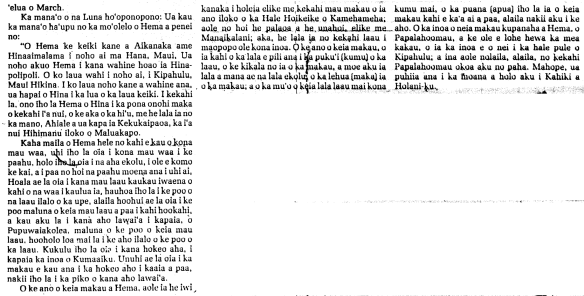
ʻelua o March.

Ke Alahou, Helu 4, Aoao 11. February/March 1980.

Letter from a son away serving in the armed forces to his mother, 1918.

PETER K. MORSE

A SON WRITES TO HIS MOTHER.

The picture above is of a Hawaiian boy who left Hawaii nei to join the armed forces in England, and he is currently a corporal in the cavalry for the British cavalry in Canada.

This is the son of Mrs. Kainana Hiram of Kapahulu, Waikiki, whose name is Peter Kalanikuhookahi Morse, and his letter was penned to his mother on the 24th of November. Continue reading

Secret Societies in Hawaii, 1914.

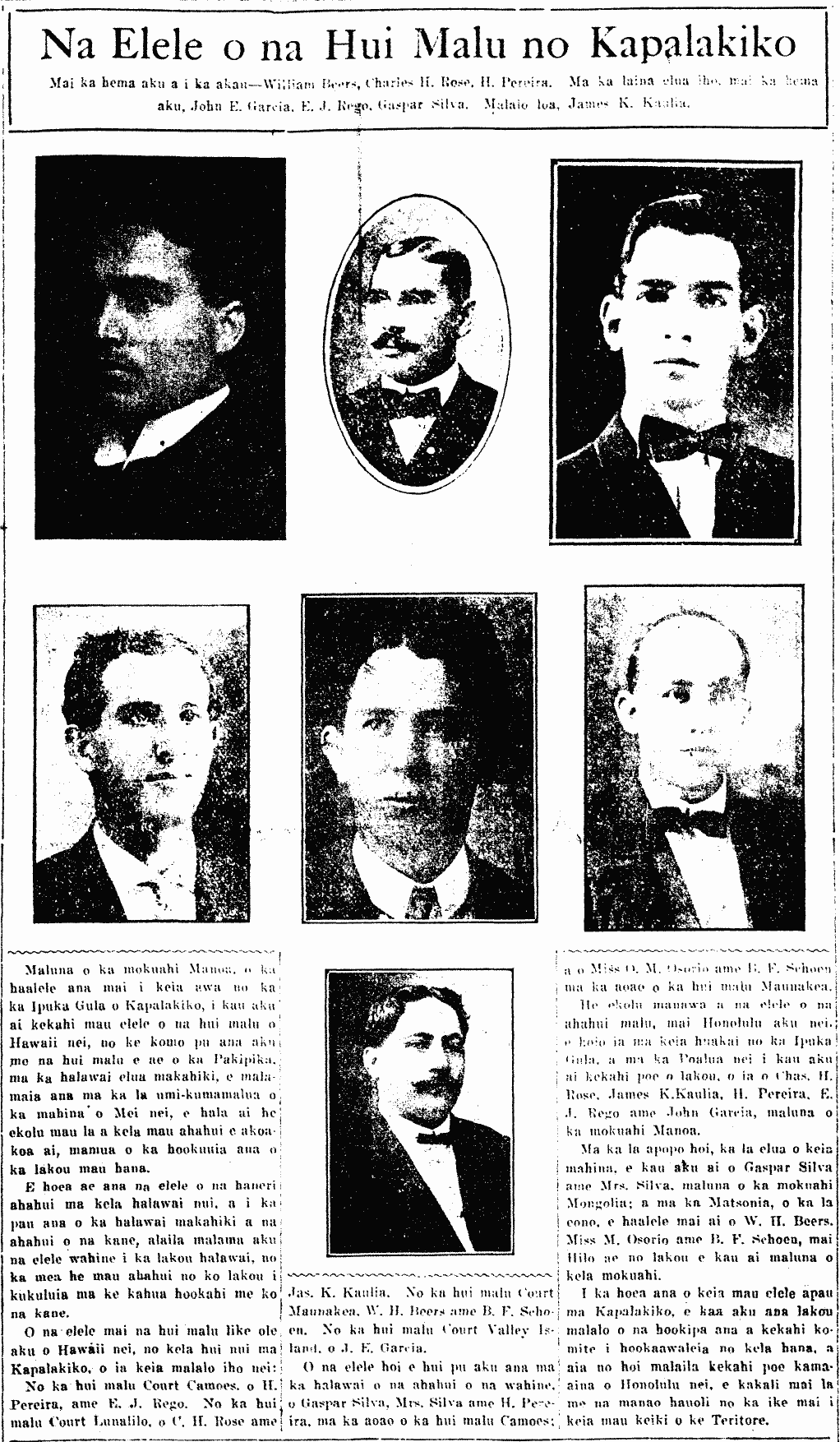
The Representatives of the Secret Societies Off To San Francisco

From the left to right—William Beers, Charles H. Rose, H. Pereira. On the second line below, from the left, John E. Garcia, E. J. Rego, Gaspar Silva. On the very bottom, James K. Kaulia.

Aboard the steamship Manoa leaving this port for the Golden Gate of San Francisco, rode some representatives of secret societies [hui malu] of Hawaii to join with other secret societies of the Pacific in their biennial meeting being held on the twelveth of this May, spending three days in meetings with these societies before their activities are let out.

The representatives of hundreds of secret societies will attend this great meeting, and at the conclusion of the annual men’s gathering, then the women will hold their meeting for they have established societies on the same foundation as the men.

The representatives from the various secret societies of Hawaii nei headed for this huge gathering in San Francisco are:

From the secret society of Court Camoes, H. Pereira and E. J. Rego. From the secret society Court Lunalilo, C. H. Rose and James Kaulia. From the secret society Court Maunakea, W. H. Beers and B. F. Shoen. From the secret society Court Valley Island, J. E. Garcia.

The representatives meeting at the women’s gathering are: Gaspar Silva, Mrs. Silva, and H. Pereira from the Camoes; and Miss D. M. Osorio and B. F. Shoen from the secret society of Maunakea.

The secret society representatives from Honolulu will be travelling to the Golden Gate in three trips; this Tuesday, some of them, Charles H. Rose, James K. Kaulia, H. Pereira, E. J. Rego, and John Garcia, boarded the steamship Manoa.

Tomorrow, the second of this month, Gaspar Silva and Mrs. Silva will board the Mongolia; and on the Matsonia of The sixth, W. H. Beers, Miss M. Osorio, and B. F. Shoen will leave, and it is from Hilo that they will board that steamship.

When all of the representatives reach San Fransico, they will come under the care of a committee set aside for that purpose, and there are people there who are kamaaina of Honolulu who await happily to see these keiki of the Territory.

[These all fall under the Ancient Order of Foresters.]

(Kuokoa, 5/1/1914, p. 1)

Na Elele o na Hui Malu no Kapalakiko

Ka Nupepa Kuokoa, Buke LII, Helu 18, Aoao 1. Mei 1, 1914.

Alsoberry Kaumu Hanchett, Kauai boy, becomes a doctor, 1914.

ANOTHER KAUAI BOY MAKES GOOD

A. H. Hanchett who is a Lihue boy, born in a house on the site of the present bowling alley, will graduate from the medical department of Harvard at the end of this month and will, on July 1, enter upon his duties as interne of a great hospital at Providence, R. I. He stood an examination, with 56 others, for that place and came out first best.

Young Hanchett’s father still lives on Kauai, at Waimea; and he is a half brother of W. O. Crowell, of Waimea. Prior to leaving the Islands, he graduated from both Kamehameha school and Oahu College. He next took a four-years course in Harvard, graduating A. B.; after which he took up the medical course, which he is now about to complete.

It is Dr. Hanchett’s hope and present intention to return to the Islands as soon as his two-year term with the Providence hospital is completed.

(Garden Island, 6/9/1914, p. 2)

ANOTHER KAUAI BOY MAKES GOOD

The Garden Island, Volume 10, Number 22, Page 2. June 9, 1914.

A. Kaumu Hanchett studying at Harvard, 1914.

HAWAII IS PROUD OF THIS NATIVE HAWAIIAN

At the Medical School of Harvard University, a Hawaiian named A. Kaumu Hanchett is learning Medicine; in an examination of the medical students in Boston, in order to enter one of the Hospitals of the City, and from amongst a 100 students, the Hawaiian boy ranked 3rd, and because this Hawaiian Boy wanted to once again test his competence, his Medical abilities were tested once again at a big Hospital in Providence in the State of Rhode Island, and what was revealed in that examination was that amongst 50  students who took the test, to the Hawaii boy went “Number One.” He is a brother [hoahanau] of the Deputy Sheriff [Crowell] of the District of Waimea on Kauai, and he was a Classmate of the children of S. L. Desha at Kamehameha School and Punahou School, and he entered Harvard University with a son of Desha’s. This Hawaiian boy will graduate in this coming June, and will intern for two years at one of the Famous Hospitals of America to advance his abilities in the medical field, and at the completion of his stay at the  Hospital, then he will select where he will practice his calling.

We hope that he will come back to Hawaii nei to practice this greatest of occupations in which he trained, and be the first Hawaiian to practice medicine in here in Hawaii.

[On page 295 of the Harvard Alumni Directory for 1910, you will find Alsoberry Kaumu Hanchett [c 1907–10, A.B. 1911(10).] Waimea, Kauai, Hawaii.]

(Hoku o Hawaii, 5/21/1914, p. 2)

HAAHEO O HAWAII I KEIA OIWI HAWAII

Ka Hoku o Hawaii, Buke 8, Helu 50, Aoao 2. Mei 21, 1914.

Bonin Islands and Hawaiians abroad, 1830 / 2014.

ADVENTURERS IN HAWAII WENT TO SETTLE BONIN ISLANDS IN 1830

Historical Work Soon to Be Published Will Contain Letters From Honolulans

New and interesting facts concerning the conditions and history of the Hawaiian Islands during the first few decades of last century are promised in a history of the Bonin Islands which will be published in October by Constable London.

One feature is the tale of how the British consul in Honolulu in 1830 sent out a band of colonists to settle the Bonin Islands an attempt at colonizing the tiny archipelago for the British Empire which was destined to failure, for the islands now belong to Japan.

The book is by Rev. L. B. Cholmondeley, honorary chaplain of the British embassy at Tokio, who was for many years in charge of the mission at the Bonin group, and has since made frequent visits there. Continue reading

Mary Mahiai, the original story, in English, 1901.

ROMANTIC HISTORY OF MARY MAHIAI

PROBABLY the most interesting woman in all Hawaii is the white-haired old wahine of four-score and ten, or thereabouts, who answers to the name of Mary Mahiai.

Last week an intricate land case came up in Judge Gear’s court and Mary Mahiai was summoned to appear as a witness, her testimony being relied upon to establish the validity of certain patents to extensive and valuable lands, the ancient boundaries of which were in dispute.

The old lady scorned the services of the interpreter on the witness stand and proceeded with her own story in good English astonishing the court and silencing the lawyers as, with Hawaiian freedom of gesture and animated features, she related the details of a most remarkable career.

It developed that she was born on the Island of Kauai before the coming of the first missionary, the arrival of Rev. Hiram Bingham being distinctly within her memory; at the age of seven years, little Mahiai, whose name (meaning “Working in the taro”) had been given her by her mother, went out in a rowboat with her uncle and five other men, starting for Molokai, to “go look see.” A storm came up and the boat was driven out of sight of land, its occupants having no food or drink with them, and suffering terribly from the pangs of hunger and thirst: for ten days and nights they drifted, becoming crazed and unable to cry out, and at last, when all hopes had been abandoned, and it was certain that the frail boat would go to pieces before the end of another day, a sail appeared upon the horizon and the faint outcries and feeble signals of the seven unfortunates attracted the attention of a sailor on board the ship, which was a sailing vessel bound for China. The six men and the little girl were taken on board and treated kindly. When the little girl was able to be about she was given the task of taking care of the captain’s little daughter, and the men were put to work on the ship; the vessel put in at Ladrone Islands, and by their own desire, the five men who had set out with little Mahiai and her uncle, were put ashore. It was afterwards learned that they were eaten by cannibals. Continue reading