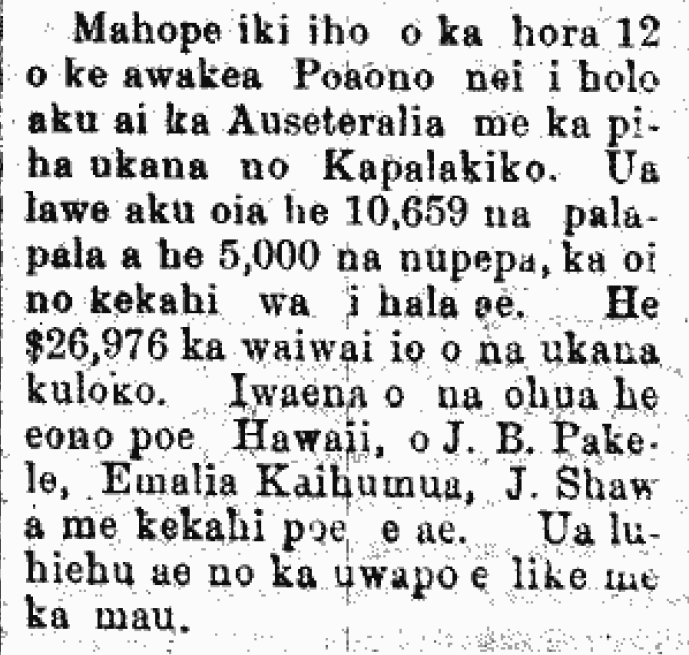
Six Hawaiians, including Emalia Kaihumua, headed for San Francisco 1894.

[Found under: “THIS AND THAT.”]

A little after 12 noon, this Saturday, the Australia left full of cargo for San Francisco. It carried 10,659 letters and 5,000 newspapers, and this was the most by far. The value of the domestic cargo is $26,976. Amongst the passengers were six Hawaiians: J. B. Pakele, Emalia Kaihumua, J. Shaw, and some others. The wharf was festooned as it always is.

(Makaainana, 2/5/1894, p. 8)

Mahope iki iho o ka hora 12...

Ka Makaainana, Buke I—-Ano Hou, Helu 6, Aoao 8. Feberuari 5, 1894.

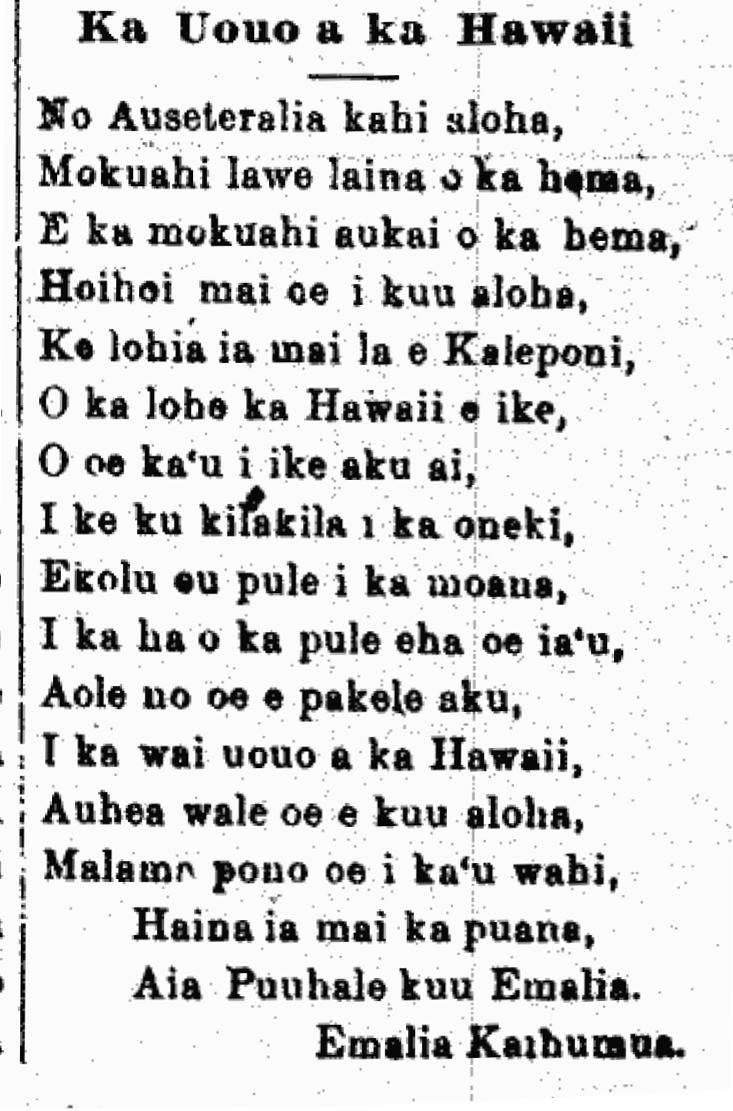
Another mele by Emalia Kaihumua, 1894.

Ka Uouo a ka Hawaii

No Auseteralia kahi aloha,
Mokuahi lawe laina o ka hema,
E ka mokuahi aukai o ka hema,
Hoihoi mai oe i kuu aloha,
Ke lohia ia mai la e Kaleponi,
O ka lohe ka Hawaii e ike,
O oe ka’u i ike aku ai,
I ke ku kilakila i ka oneki,
Ekolu ou pule i ka moana,
I ka ha o ka pule eha oe ia’u,
Aole no oe e pakele aku,
I ka wai uouo a ka Hawaii,
Auhea wale oe e kuu aloha,
Malama pono oe i ka’u wahi,
Haina ia mai ka puana,
Aia i Puuhale kuu Emalia.

Emalia Kaihumua.

(Makaainana, 1/8/1894, p. 3)

Ka Uouo a ka Hawaii

Ka Makaainana, Buke I—-Ano Hou, Helu 2, Aoao 3. Ianuari 8, 1894.

Probably the earliest known version of a song well known today, 1894.

ALOHA O HAWAII.

He aloha Hawaii moku o Keawe
Aina a ka nani me ka maluhia
Hookuku au me Kaleponi
Hawaii ka oi o na Ailana
Na Ausekulia i kono mai ia’u
E naue i ka aina malihini
Aina kamahao i ka’u ike
Ua uhi paapu ia e ka noe
Ike i ka hau hookuakea i ka ili
Hoopumehana i ke ahi kapuahi
Ka iniki a ke anu me he ipo ala
E koi mai ana ia’u e hoi
Ilaila hoi hope ko’u manao
He kaukani mile ko’u mamao
Hu mai ke aloha no ka aina
No ka poi uouo kaohi puu
Haina ia mai ana ka puana
Ke aloha aina ko’u lei ia

Emalia Kaihumua.

Hale Hoikeike Hawaii. Kapalakiko

[This was written while Emalia Kaihumua was performing at the Hawaiian Exhibit [Hale Hoikeike Hawaii] at the California Midwinter International Exposition held in San Francisco. Looking back at was happening at the time in her homeland while she was “a thousand miles away”, it is very heart wrenching to see the many references to home and returning and finally the haina: “Let the refrain be told, Patriotism is my lei.”]

(Leo o ka Lahui, 4/27/1894, p. 3)

ALOHA O HAWAII.

Ka Leo o ka Lahui, Buke II, Helu 929, Aoao 3. Aperila 27, 1894.

More Hawaiians in the military, 1917.

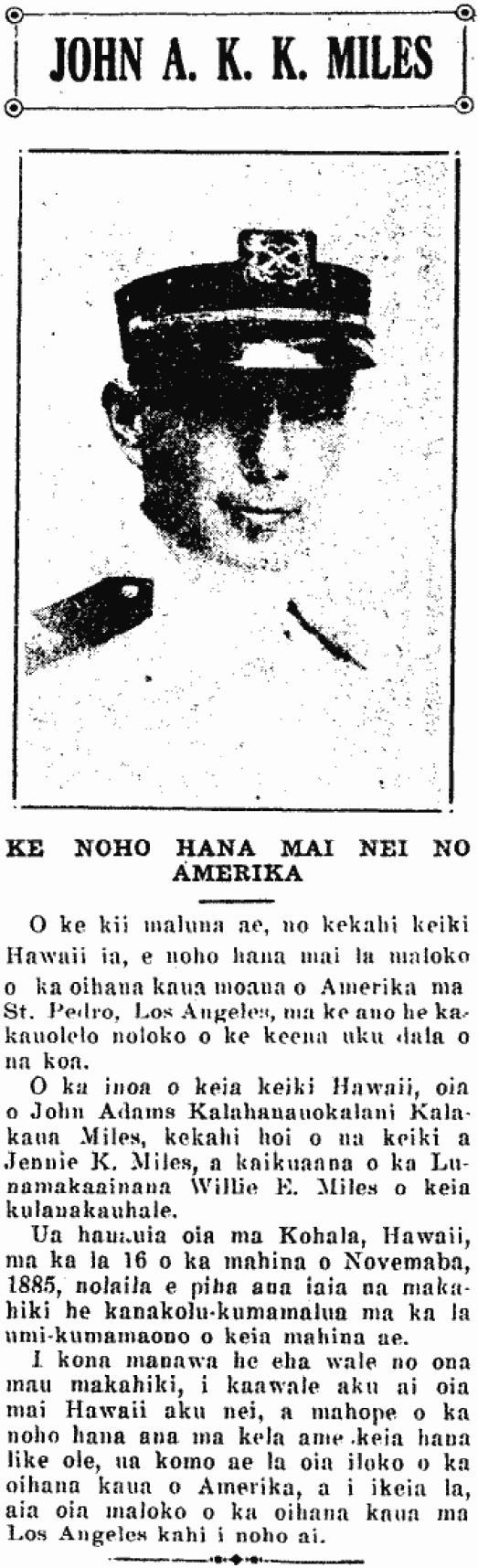
JOHN A. K. K. MILES

WORKING IN THE SERVICE OF AMERICA

The picture above is of a Hawaiian boy who is working in the navy of America at St. Pedro, Los Angeles, as a secretary in the department of the payroll of the military.

The name of this Hawaiian youth is John Adams Kalahanauokalani Kalakaua¹ Miles, a child of Jennie K. Miles and the older brother of Legislator Willie E. Miles of this city.

He was born in Kohala, Hawaii, on the 16th of November, 1885, and therefore he will make 32 on the 16th of next month.

When he was but four years old, he was taken from Hawaii nei, and after working at various jobs, he joined the military of America. And today, we see that he is in the service in Los Angeles, where he resides.

¹One way names were given traditionally was after important events, whether happy or sad. This is a nice and clear example of a commemorative name. John A. K. K. Miles was born on November 16, 1885, on the birthday of King Kalakaua. He was therefore named literally “The birthday of the royal one Kalakaua”.

(Kuokoa, 10/19/1917, p. 4)

JOHN A. K. K. MILES

Ka Nupepa Kuokoa, Buke LV, Helu 42, Aoao 4. Okatoba 19, 1917.

Hawaiian dies at war, 1917.

ALLY PAMA KUA

HAWAIIAN BOY IS TORPEDOED AND DIES.

The picture [above] is of a Hawaiian sailor, named Ally Pama Kua, who just died at sea when the steamship Kansas was sunk by a torpedo from a German submarine. This, according to a telegraph sent to this town from New York, on the 11th of this month.

The Kansas was torpedoed while it was carrying a full load to France from New York. When the steamship was sunk, A. P. Kua drowned, along with him was a American haole, and two others. As for the captain and the rest of the sailors, they all were all saved.

Because of this sad news received in town, it caused the family of Mr. Kua to be heartbroken. However, there is one thing that made it better, and that was the knowledge that the death of this Hawaiian boy was because he sacrificed his life for his country.

Ally Pama Kua was twenty-seven years old when he met with this tragedy at sea. He is the child of Fritz Wilhelm Kua of the corner of Makiki Street and Beritania Avenue. Aside from his father, he has three sisters and two cousins who are left behind grieving for him.

Ally Pama Kua was employed for a long time as a sailor aboard the steamship Kansas, from when it was sailing Hawaiian waters. And when it became a ship transporting food and other goods for France, he continued working aboard it, all the way until he met with his death on the ocean.

The last word that his family here heard from him was when they received his letter from Philadelphia written last February, and within the letter, he spoke of his marriage to a French woman.

(Kuokoa, 7/20/1917, p. 2)

ALLY PAMA KUA

Ka Nupepa Kuokoa, Buke LV, Helu 29, Aoao 2. Iulai 20, 1917.

Hawaiians away at war, 1917.

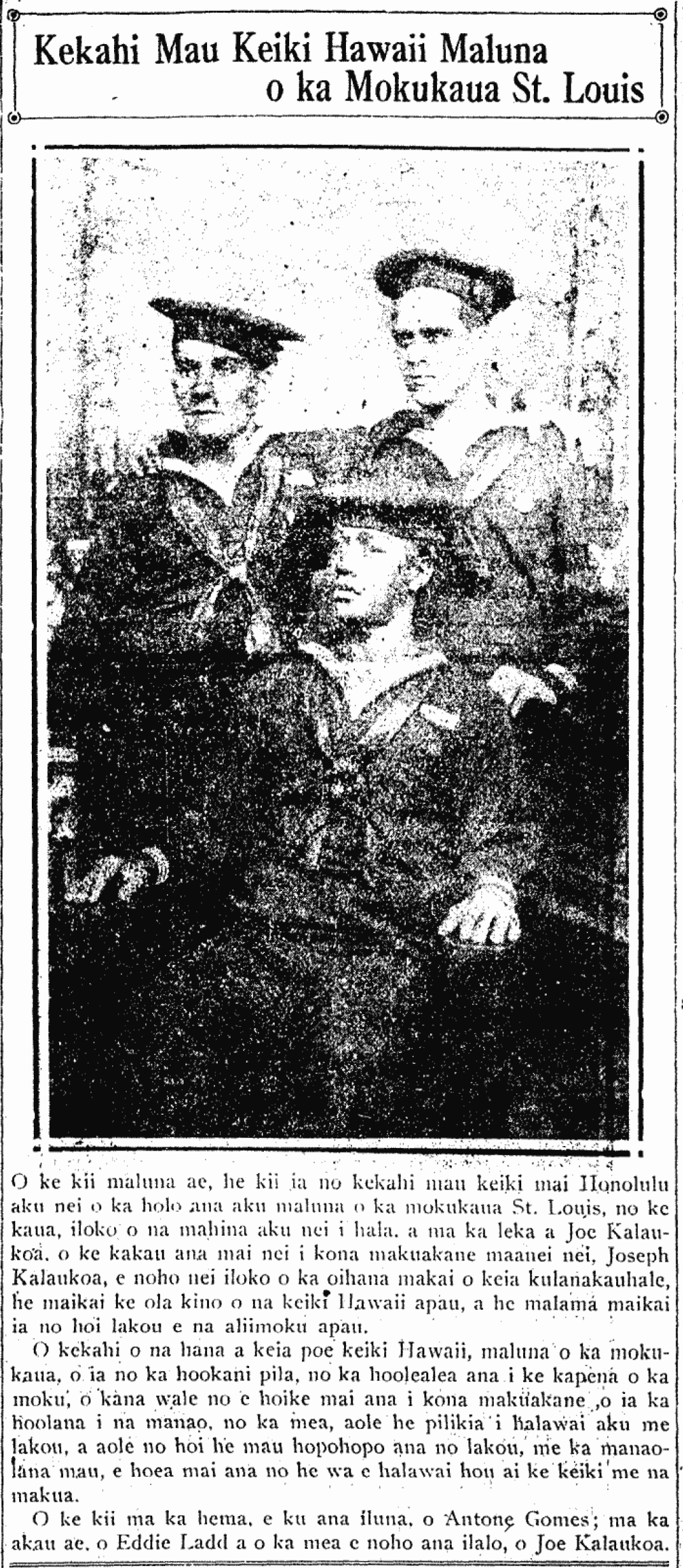
Some Hawaiian Boys Aboard the Warship St. Louis

The picture above is of some boys, who left from Honolulu on the warship St. Louis in the past months for the war. And according to the letter written by Joe Kalaukoa to his father Joseph Kalaukoa, who is in the police force of this city, all of the Hawaiian youths are doing well and are all being well taken care of by the officers.

One of the activities of these Hawaiian boys aboard the warship is playing music to entertain the ship’s captain; everything he wrote to his father was uplifting, because there has been no difficulties faced, and he has no fear for them and is forevermore hopeful that there will come a time that the child will again see his parents.

In the picture, standing to the left is Antone Gomes; to the right is Eddie Ladd, and the one seated is Joe Kalaukoa.

(Kuokoa, 7/13/1917, p. 2)

Kekahi Mau Keiki Hawaii Maluna o ka Mokukaua St. Louis

Ka Nupepa Kuokoa, Buke LV, Helu 28, Aoao 2. Iulai 13, 1917.

A composition for Hawaiians boys going away to war, 1918

Mele for the Hawaiian Boys

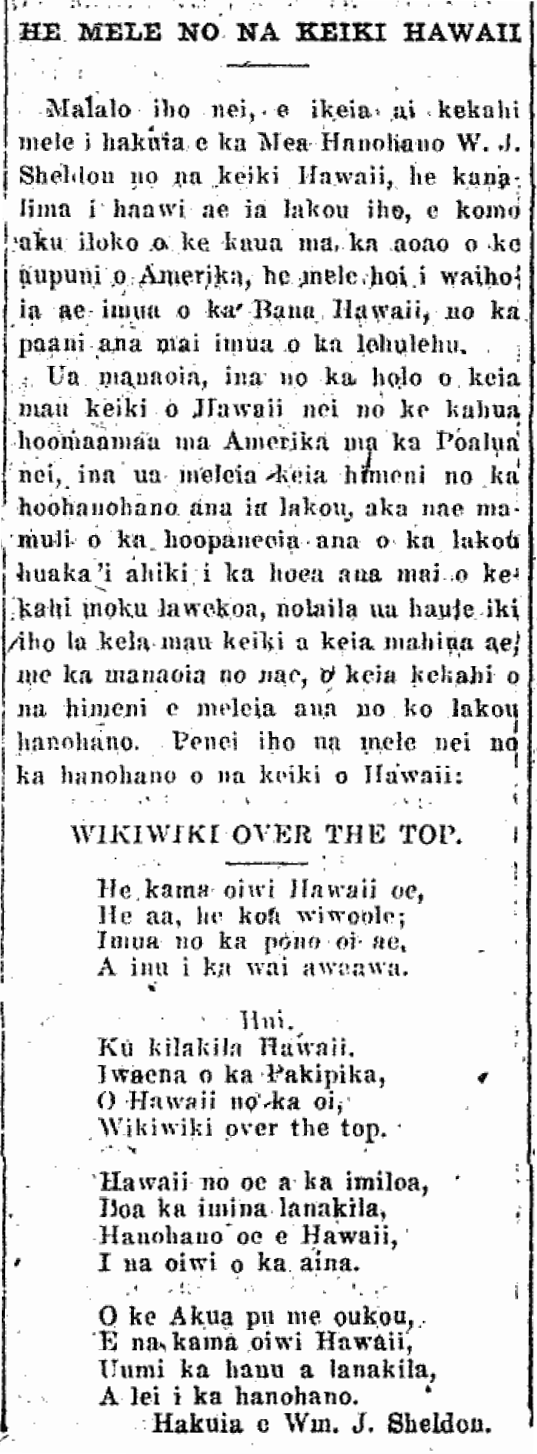
Seen below is a mele composed by the Honorable W. J. Sheldon for the fifty Hawaiian boys who gave themselves to join the war on the side of the nation of America. It is a song put before the Royal Hawaiian Band, to be played before the public.

It is believed that if these Hawaiian boys head out to the training camp in America on Tuesday, this song would have been sung for them in their honor. But as their trip is postponed until the arrival of a military ship, therefore the boys have been set back until next month. It is still believed that this will be one of the songs that will be sung to honor them. Here is this mele to glorify these Hawaiian youths:

WIKIWIKI OVER THE TOP

He kama oiwi Hawaii oe,
He aa,  he koa wiwoole;
Imua no ka pono oi ae,
A inu i ka wai awaawa.

Hui.

Ku kilakila Hawaii,
Iwaena o ka Pakipika,
O Hawaii no ka oi,
Wikiwiki over the top.

Hawaii no oe a ka imiloa,
Loa ka imina lanakila,
Hanohano oe e Hawaii,
I na oiwi o ka aina.

O ke Akua pu me oukou,
E na kama oiwi Hawaii,
Uumi ka hanu a lanakila,
A lei i ka hanohano.

Hakuia e Wm. J. Sheldon.

[Which went something like this:

QUICKLY OVER THE TOP.

You are a native son,
Daring, a fearless warrior;
Forward for the greater good,
And drink of the bitter waters.

Chorus.

Hawaii stands tall,
Amidst the Pacific,
Hawaii is the foremost,
Quickly, over the top.

You are Hawaii, of explorers,
Far reaching is your search for victory,
Proud is Hawaii,
For the oiwi of the land.

God be with you,
O Native sons of Hawaii,
Be patient until victorious,
And wear the honor like a lei.

Composed by William J. Sheldon.]

(Kuokoa, 5/17/1918, p. 3)

HE MELE NO NA KEIKI HAWAII

Ka Nupepa Kuokoa, Buke LVI, Helu 20, Aoao 3. Mei 17, 1918.

Another mele composed by Mary Jane Montano, 1919.

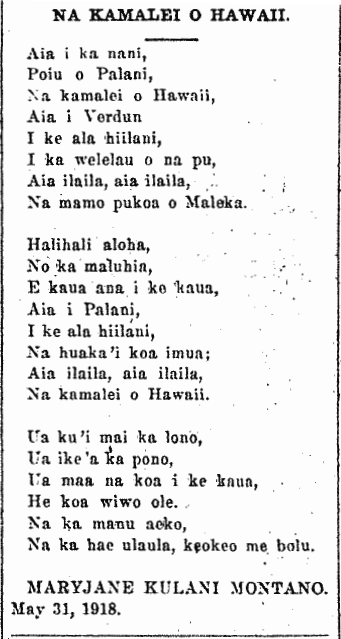
NA KAMALEI O HAWAII.

Aia i ka nani,
Poiu o Palani,
Na kamalei o Hawaii,
Aia i Verdun,
I ke ala hiilani,
I ka welelau o na pu,
Aia ilaila, aia ilaila,
Na mamo pukoa o Maleka.

Halihali aloha,
No ka maluhia,
E kaua ana i ke kaua,
Aia i Palani,
I ke ala hiilani,
Na huaka’i koa imua;
Aia ilaila, aia ilaila,
Na kamalei o Hawaii.

Ua ku’i mai ka lono,
Ua ike’a ka pono,
Ua maa na koa i ke kaua,
He koa wiwo ole.
Na ka manu aeko,
Na ka hae ulaula, keokeo me bolu.

MARYJANE KULANI MONTANO.

May 31, 1918.

[This is yet another composition by Mary Jane Montano, although not widely known today. This was composed in honor of the Hawaiian boys who were fighting in World War I, and alludes to the Battle of Verdun.

In the Hawaiian-Language Newspapers, you can find countless examples of Hawaiian boys going off to war outside of Hawaii nei, starting with America’s Civil War, and on down to the present.

The mele goes somewhat like:

THE BELOVED YOUTH OF HAWAII.

There in the beauty,
The glory of France,
Are the beloved youth of Hawaii,
There at Verdun,
On the exalted trail,
At the point of the artillery,
They are there, they are there,
The young fighters of America.

Carrying aloha,
For peace,
Fighting the fight,
There in France,
On the exalted trail,
The marching soldiers go forth,
They are there, they are there,
The beloved youth of Hawaii.

The news has spread,
The good has been seen,
The soldiers are seasoned,
Fearless warriors.
For the eagle,
For the red, white, and blue flag.

MARYJANE KULANI MONTANO.

May 31, 1918.]

(Kuokoa, 1/3/1919, p. 8)
NA KAMALEI O HAWAII

Ka Nupepa Kuokoa, Buke LVII, Helu 1, Aoao 8. Ianuari 3, 1919.

Ninipo Hoonipo Song in Australia, 1927.

AMUSEMENTS

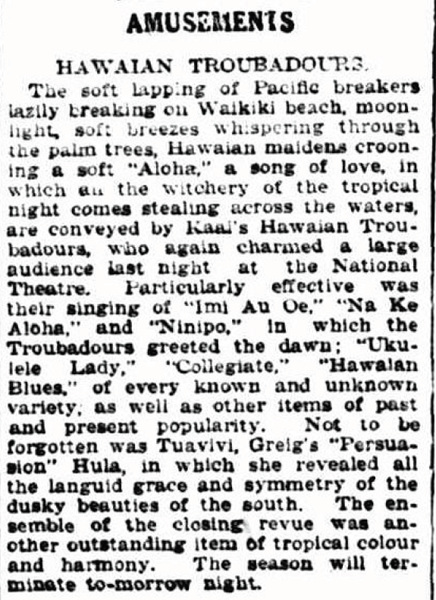
THE HAWAIIAN TROUBADOURS. The soft lapping of Pacific breakers lazily breaking on Waikiki beach, moon light, soft breezes whispering through the palm trees, Hawaian maidens crooning a soft “Aloha,” a song of love, in which all the witchery of the tropical night comes stealing across the waters, are conveyed by Kaai’s Hawaian Troubadours, who again charmed a large audience last night at the National Theatre. Particularly effective was their singing of “Imi Au Oe,”¹ “Na Ke Aloha,” and “Ninipo,” In which the Troubadours greeted the dawn; “Ukulele Lady,” “Collegiate,” “Hawaian Blues.” of every known and unknown variety; as well as other items of past and present popularity. Not to be forgotten was Tuavivi, Greig’s “Persuasion” Hula, in which she revealed all the languid grace and symmetry of the dusky beauties of the south. The ensemble of the closing revue was another outstanding item of tropical colour and harmony. The season will terminate to-morrow night.

[Earlier, i posted Liliuokalani’s “Ninipo Hoonipo Song”, and strangely enough, i ran across this reference to it being sung all the way in Australia in 1928!]

¹”Imi Au Ia Oe”

(Examiner, 4/22/1927, p. 6)

AMUSEMENTS.

The Examiner, Volume LXXXV, Number 95, Page 6. April 22, 1927.

“Kaai’s Hawaiians” on TROVE, 1928.

KAAI’S HAWAIIANS.

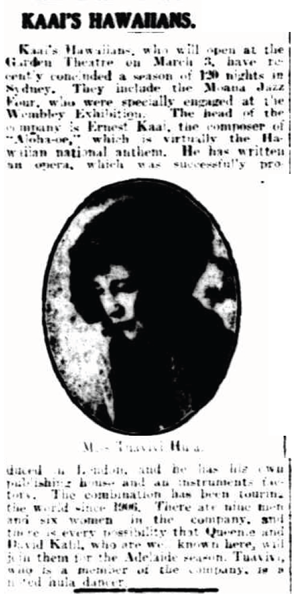
Kaaiʻs Hawaiians, who will open at the Garden Theatre on March 3, have recently concluded a season of 120 nights in Sydney. They include the Moana Jazz Four, who were specially engaged at the Wembley Exhibition. The head of the company is Ernest Kaai, the composer of   “Aloha oe,” which is virtally the Hawaiiian national anthem. He has written and opera, which was successfully pro…

Miss Tuavivi Greig

…duced in London, and he has his own publishing house and an intsruments factory. The combination has been touring the world since 1906. There are nine men   and six women in the company, and there is every possibility that Queenie and   David Kaili, who are we know here, will join them for the Adelaide season. Tuavivi,   who is a member of the company, is a noted hula dancer.

[This comes from an Adelaide, South Australia newspaper, found on the National Library of Australia webside, TROVE. It seems unclear newspaper images is not something limited to Hawaii nei. However, at least the text on that site is correctable.]

(Advertiser, 2/23/1923, p. 11)

KAAI'S HAWAIIANS.

The Advertiser, Volume LXX, Number 21645, Page 11. February 23, 1928.