Commission carrying the anti-annexation petitions, 1897.

THE APPEARANCES OF THE REPRESENTATIVES ARE FINE.

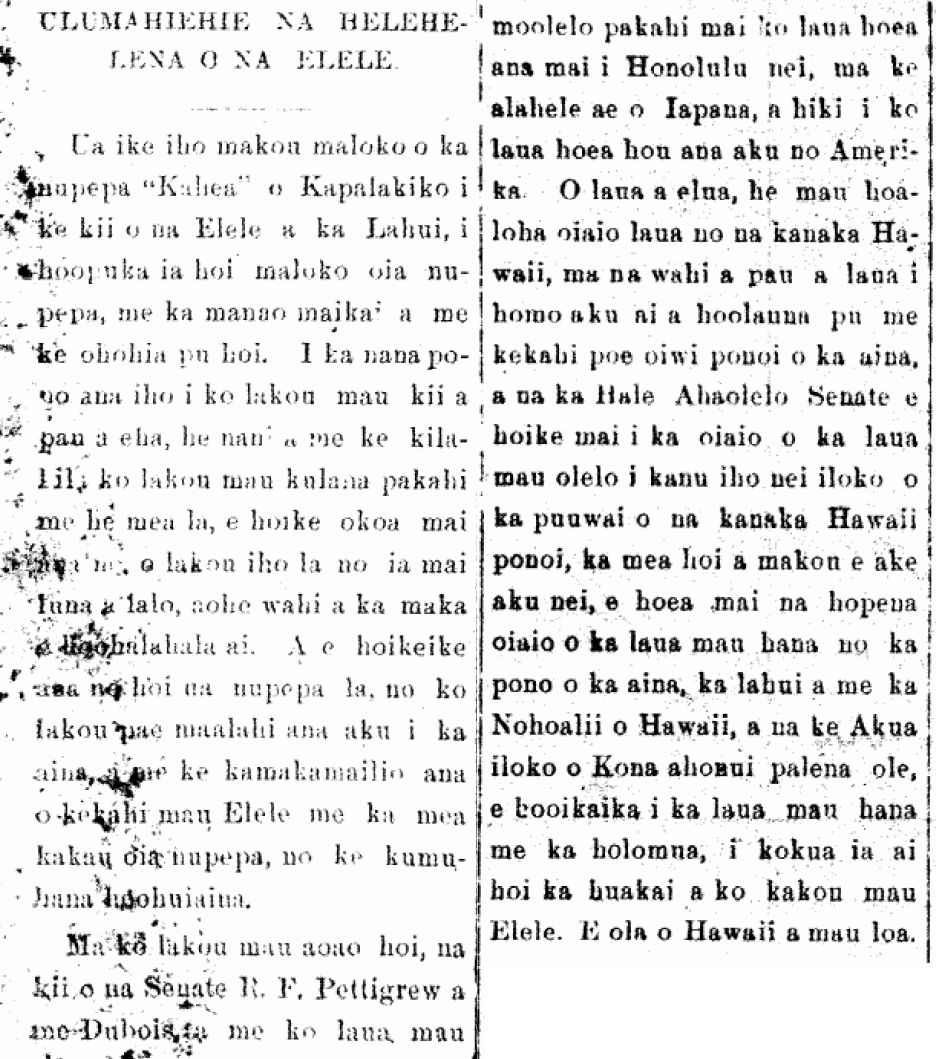
We have just seen in the newspaper the “Call” of San Francisco, portraits of the Representatives of the Lahui which were published in that newspaper, with appreciation and delight. Looking closely at all four of their portraits, they each appear fine and dignified, as if those are truly them from top to bottom; there is nothing for the eye to criticize. Also, that newspaper reports of their safe arrival, as well as a conversation of some of the Representatives with a reporter of the newspaper about annexation.

On their sides are portraits of Senators R. F. Pettigrew and Dubois, and both of their stories, from their arrival in Honolulu on the way to Japan, all the way to their return to America. Both of them are true friends to the Hawaiian, wherever they went and came in contact with our native people, but it will be the Senate that will confirm the truth of the words they planted in the hearts of the true Hawaiian people; we hope that the true outcome of their efforts for the good of the land, the people, and the Monarchy arises, and may God in His endless patience bolster their endeavors and progress, so that the journey of our Representatives is helped along. Let Hawaii live forever.

[See the issue of the San Francisco Call (11/28/1897, pp. 1 & 2) referred to in this article here.]

(Aloha Aina, 12/11/1897, p. 2)

ULUMAHIEHIE NA HELEHELENA O NA ELELE.

Ke Aloha Aina, Buke III, Helu 50, Aoao 2. Dekemaba 11, 1897.

William G. Kahuakaipia is killed in California, 1868.

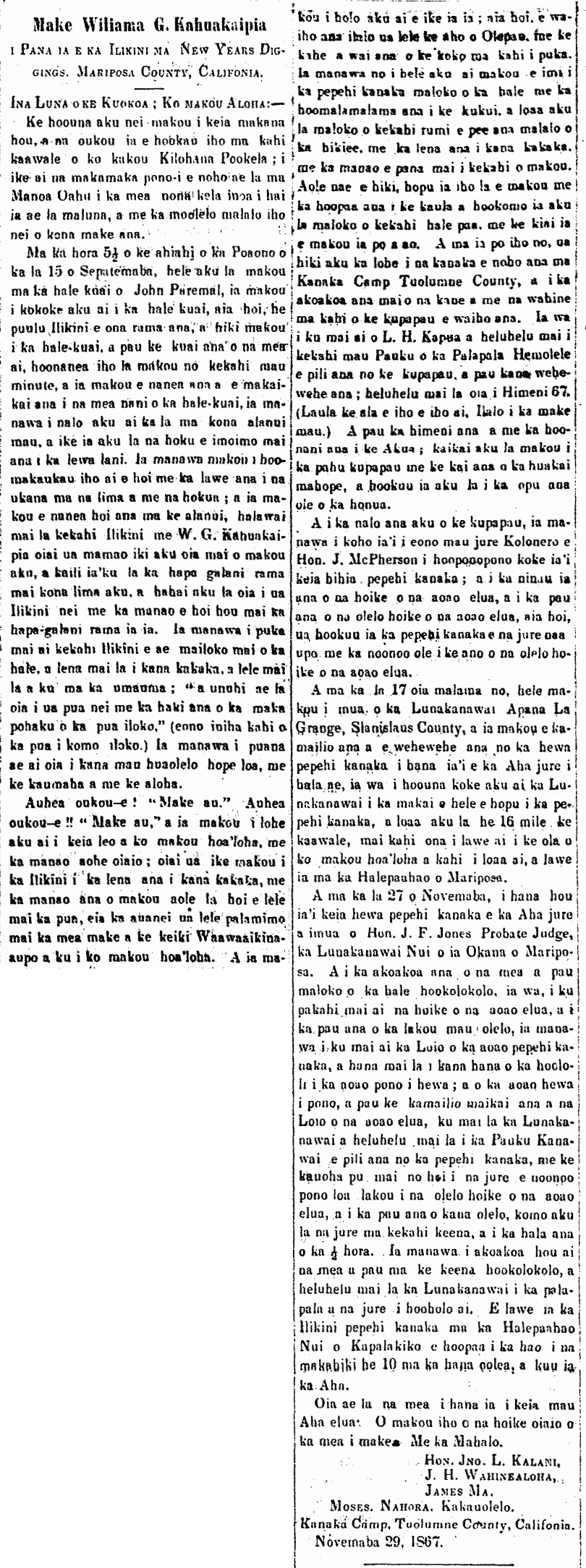
Wiliama G. Kahuakaipia is Dead

Shot by an Indian with a Bow and Arrow at New Year’s Diggings, Mariposa County, California.

To the Heads of the Kuokoa; Our Aloha:—

We are sending you this new gift, and it is for you to place it in some open space of our Greatest Prize (the newspaper Kuokoa) so that the personal friends living in Manoa, Oahu, of the person mentioned above, may see, along with the story below of his death.

At 5:30 in the evening of Saturday, the 15th of September, we went to the shop of John Paremal, and as we got closer to the store, there was a group of Indians getting drunk; and we got to the store, and finished our food shopping, then we hung around for a few minutes; and as we looked around at the nice items in the shop, the sun left on its usual path and the stars were seen twinkling in the heavens. That was when we got ready to leave, carrying our good by hand and on our shoulders; and while we were enjoying our way back, an Indian met up with W. G. Kahuakaipia while he was a bit away from us, and a half gallon jug of alcohol was taken from his hand, and he went after that Indian, thinking to retrieve the half gallon jug. Right then, another Indian came out from the shop and drew back his bow and the [arrow] flew and struck the chest; “and Kahuakaipia pulled out the arrow breaking the stone head off within,” (the arrow entered six inches). That was when he spoke his last words, with sadness and aloha.

O You guys! I am dead. Hey you guys!! and when we heard this call by our friend, we didn’t believe it was true, for when we saw the Indian pull back his bow, we thought that he wouldn’t let the arrow fly, but no, the weapon of the Ignorant [Waawaaikinaaupo] youth flew swiftly and struck our friend. And when we approached to see him, he already lay there, his last breath gone with blood flowing profusely from the wound. Right then we went to look for the murderer in the store aided by the light of a lamp and we found him in a room hiding under a couch; he was pulling back his bow, thinking to shoot one of us. But he was not able to because he was grabbed by us and tied up with rope and thrown into a secured building which we guarded all night until day. And on the next night, the news reached those living at Kanaka Camp, Tuolumne County, and when the men and women had gathered by where the body lay, then L. H. Kapua stood and read some passages from the Holy Book about the dead one, and after his talk, he read Hymn 67 (Wide is the path to go down, Down to eternal death). And after the hymn was over and the glorification of God, we carried the coffin with the procession following behind, and let it down into the depths of the bowels of the earth.

After the body was gone, a coroner’s jury of six was chosen by Hon. J. McPherson so that this murder case would be resolved quickly. With the questioning of the witnesses of both sides, and after the presentations by both sides were finished, come to find out, the murderer was set free by the stupid jury without them considering the testimony of both sides.

And on the 17th of that same month, we went before the district judge of La Grange, Stanislaus County, and when we were speaking of and explaining what was done by the past jury in the crime of murder, the judge immediately sent an officer to arrest the murderer, and he was found 16 miles away from where he took the life of our friend, and was taken to the jail of Mariposa.

Then on the 27th of November, this murderer was retried by a jury before Hon. J. F. Jones Probate judge, the head judge of Mariposa County. When everyone was gathered in the courthouse, each witness for both sides stood one by one, and after they were done with their statements, then the lawyer for the murderer stood and did his job of twisting right into wrong and wrong into right; and when the eloquent speeches by the lawyers of both sides were completed, the judge stood up and read the law dealing with murder and instructed the jury to carefully consider the testimony by both sides, and when he was done the jury went into a room. After half an hour, everyone gathered again in the courthouse and the judge read the decision of the jury. The murdering Indian will be taken to the great prison of San Francisco where he will be incarcerated for 10 years with hard labor; and the court was adjourned.

The is what was done in the two trials. We are true witnesses of the deceased. With appreciation.

Hon. John L. Kalani,

J. H. Wahinealoha,

James Ma,

Moses Nahora, Secretary.

Kanaka Camp, Tuolumne County, California.

November 29, 1867.

[I am not sure if this Moses Nahora and the Moses Naehola of the earlier post are the same person or not…

And how awesome is this, Mariposa County History page has a sponsor!]

(Kuokoa, 2/1/1868, p. 4)

Make Wiliama G. Kahuakaipia

Ka Nupepa Kuokoa, Buke VII, Helu 6, Aoao 4. Feberuari 1, 1868.

Hawaiians abroad and the Hawaiian-Language Newspapers, 1867.

“Let’s subscribe to the Newspaper

Kuokoa, the Greatest Prize of the
Hawaiian Nation.”

VALLECITO, CALAVERAS COUNTY,

CALIFORNIA, March 25, 1867.

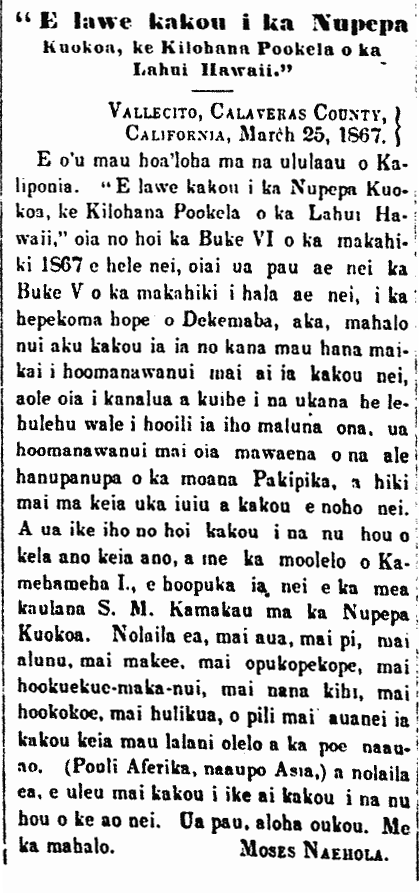
O My friends of the forests of California, “Let’s subscribe to the Newspaper Kuokoa, the Greatest Prize of the Hawaiian Nation,” that is the ongoing Volume VI of the year 1867, being that Volume V of this past year, is over, with the last week of December; we are grateful for its patient work done for us; it was not uncertain or hesitant of all the parcels sent upon it, but it persevered upon the surging billows of the Pacific Ocean until reaching this towering lands upon which we live. And thus we see the news of this sort and that, and the history of Kamehameha I., that is being published by the famed S. M. Kamakau in the Kuokoa. Therefore, don’t hold back, don’t scrimp, don’t be greedy, don’t be covetous, don’t surly, don’t scowl, don’t look to the side, don’t look away, don’t turn you back; lest these lines by the enlightened by applied to us. (Dark Africa, ignorant Asia), and so, let’s act quickly so that we can see the news of the world. I am done, aloha to you all. With thanks.

MOSES NAEHOLA.

[For more on the serial by S. M. Kamakau, see: Ruling Chiefs of Hawaii, Tales and Traditions of the People of Old, Ka Po’e Kahiko: The People of Old, The Works of the People of Old, Ke Kumu Aupuni, and Ke Aupuni Mō‘ī.

As for Moses Naehola, does anyone know if this is the same person as Moses Nahora, who is also living in California during the same period?

One more thing… This article has an awesome listing of negative attributes (which by no means are adequately translated here). ]

(Kuokoa, 6/1/1867, p. 4)

"E lawe kakou i ka Nupepa...

Ka Nupepa Kuokoa, Buke VI, Helu 22, Aoao 4. Iune 1, 1867.

Hawaiian returns home from Pacific Northwest, 1859.

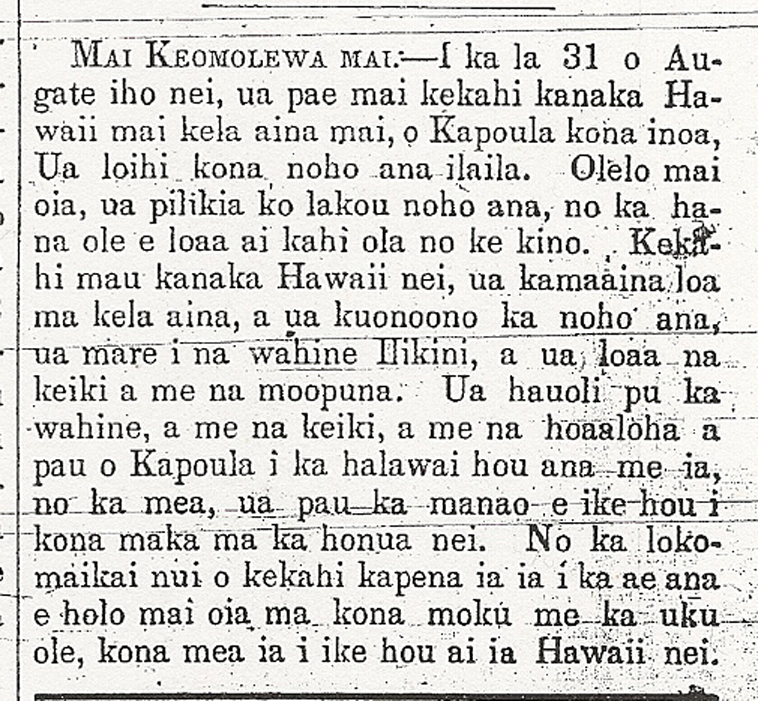
From Keomolewa [Columbia River? Vancouver?]:—On this past 31st of August, a Hawaiian arrived from that land, his name being Kapoula. He lived there for a long time. He stated that their lives were difficult, because they did not have jobs to make a living. Some Hawaiians are long-time residents there, are well off, married Indian women, and had children and grandchildren. The wife, children, and friends of Kapoula are also thrilled at seeing him again, for they thought they’d never see his face again on this earth. It is because of the generosity of a certain captain who allowed him to ride his ship without paying, that he could see Hawaii once again.

[Keomolewa also seen as “Keamolewa”]

(Hoku Loa, 9/1859, p. 12)

Mai Keomolewa mai...

Ka Hoku Loa, Buke I, Helu 3, Aoao 12. Sepatemaba, 1859.

Francis Brown and William Noble honored in France, 1919.

The Song “Aloha Oe” is Heard in the Lands of France When Hawaiian Sons are Decorated with Honorary Medals.

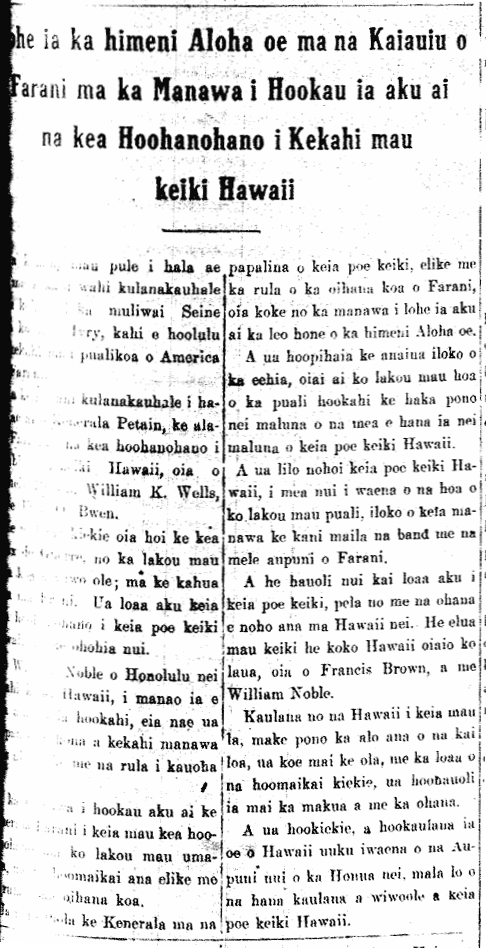
[This is one of the articles from the page shown in the previous post, and you can see that the left column is mostly illegible. I can make out phrases like “the river Seine,” “gathered,” “American troops,” “General Petain,” “William K. Wells,” “Bwen,” “for their bravery,” “Noble of Honolulu”…]

…the cheeks of these boys, like what is customary of the French military; and that is when you immediately heard the song “Aloha Oe.”

And the crowd was awestruck as their fellow platoon members were watching attentively at what was being performed upon these Hawaiian boys.

And these Hawaiians became something great amongst their platoon, and then the band played French nationalistic songs.

These boys received much happiness, and so too did their families living here in Hawaii. Two youths, both native Hawaiians, they being Francis Brown and William Noble.

Hawaii is truly famous these days, and their great sea journey was worthwhile, they are still alive, received great honors, and made their parents and families happy.

And you, tiny Hawaii, amongst the great nations of the Earth, are elevated and made famous through the celebrated and fearless deeds of these Hawaiian boys.

(Aloha Aina, 3/28/1919, p. 1)

Lohe ia ka himeni Aloha oe ma na Kaiaulu o Farani ma ka Manawa i Hookau ia aku ai na kea Hoohanohano i Kekahi mau keiki Hawaii

Ke Aloha Aina, Buke XXXIV, Helu 12, Aoao 1. Maraki 28, 1919.

Woah. This is some story! Hawaiian living abroad comes home to visit… after 38 years. 1915.

THAT HAWAIIAN RETURNS TO SEE HIS HOMELAND ONCE MORE.

JOHN BELL WILSON

After leaving Honolulu thirty-eight years ago, that Hawaiian, John Bell Wilson is his name, returned to see once again his family and homeland while he was still in good health, on the steamship Matsonia this past Wednesday, filled with shock at how the places he was familiar with in his childhood had changed.

John Bell Wilson left Honolulu nei when he was a youngster of twenty-three years in age on a sailboat, because there were few steamships in his day, but it was upon a beautiful steamship that he returned to see the land of his birth and his friends, as he was shocked at the change of Honolulu from an almost nothing town which he left to a beautiful town which one admires.

His eyes met up with new sights of Honolulu and ethnicities which were unfamiliar to him; and as he travelled here and there, there were no friends who he knew in his youth, except for but a few who were still living which he met up with, those friends who he went around with in those days gone by.

Heard of the Death of His Mother

When John Bell Wilson returned to see his homeland, he had one big thing on his mind, that was meeting affectionately with his mother, who he thought was still living, but she was not, and this left him heartbroken.

Mr. Wilson was depressed at the death of his mother, being that from the time he left this land until his return, he did not write his mother; and when he asked his friends when he landed ashore about his mother, this was when he was told she had passed long ago to the other side, three years ago.

He went immediately to find the grave where his mother was laid to rest, and he planned to build a memorial to her, as a show of remembrance from a thoughtless child for his beloved mother.

Not Recognizing Honolulu

According to the words of Mr. Wilson after he saw the scenery unfamiliar to him, he could not recall the old Honolulu, because the town had changed so much from when he left, however he did have recollections of the major streets of town.

When he travelled about looking here and there, those scenes were not familiar to him, except for just a few people who went around with him and played with him in the days of his childhood. The small children he left behind were now very elderly and some of them had white hair.

Some of the familiar people who he saw on the first day he

(See page four.)

(Kuokoa, 2/5/1915, p. 1)

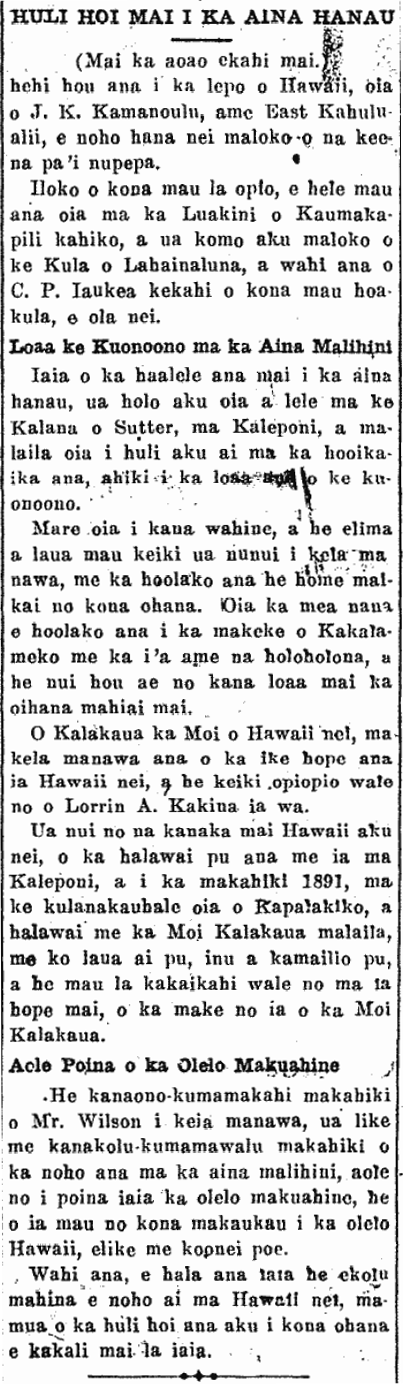
HULI HOI MAI IA KANAKA HAWAII E IKE HOU I KA AINA HANAU

Ka Nupepa Kuokoa, Buke LIII, Helu 6, Aoao 1. Feberuari 5, 1915.

RETURNED TO THE HOMELAND

(From page one.)

stepped once again on the soil of Hawaii, were J. K. Kamanoulu and East Kahulualii who work at the newspaper printing office.

In the days of his childhood, he went often to the old Kaumakapili Church, and he was enrolled at Lahainaluna School, and according to him, C. P. Iaukea is one of his friends who is still living.

Became Wealthy in a Foreign Land

When he left the land of his birth, he got off at Sutter County, California, and there he sought very hard until he became well off.

He married his wife, and they currently have five grown children, and he provided a good home for his family. He is the one who supplies the market of Sacramento with fish and meat, and he also makes profits from the farming industry.

Kalakaua was the King of Hawaii nei at the time he last saw Hawaii, and Lorrin A. Thurston was but a child.

There are many people from Hawaii who have met up with him in California, and in the year 1891, in the town of San Francisco, he met with King Kalakaua there, and they dined together, drank and talked, and just a few days after that was when King Kalakaua died.

Did Not Forget His Mother Tongue

Mr. Wilson is now sixty-one years old, so he was living thirty-eight years abroad, and he has not forgotten his native language, he is still fluent in Hawaiian, just as the people here are.

According to him, he will spend three months staying in Hawaii before returning to his family who await him.

(Kuokoa 2/5/1915, p. 4)

HULI HOI MAI I KA AINA HANAU

Ka Nupepa Kuokoa, Buke LIII, Helu 6, Aoao 4. Feberuari 5, 1915.
James Keau writes from Apia, Upolu, Samoa, 1887.

[Found under: “Correspondences from Friends”]

From Samoa.

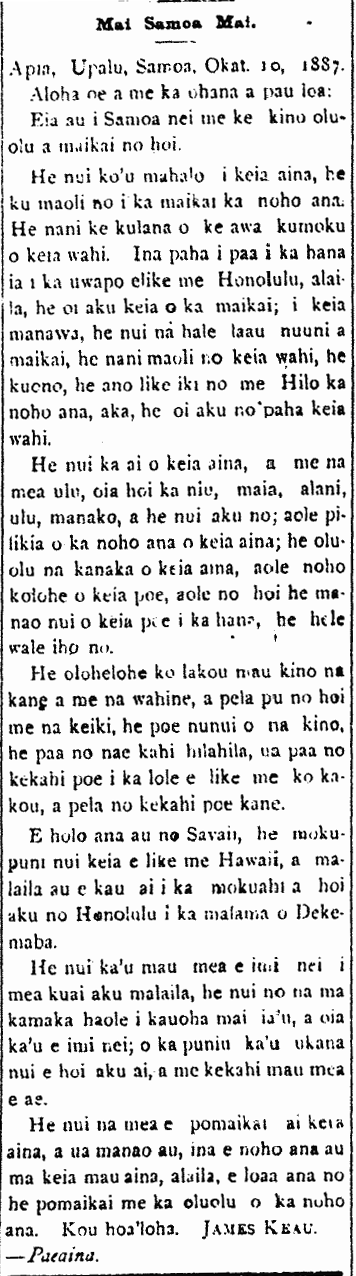
Apia, Upolu, Samoa, Oct. 19, 1887.

Aloha to you and your whole family:

Here I am in Samoa in good health.

I am very taken by this land; life is good. The lay of the harbor is fine. If it was built well like the harbor of Honolulu, then this one would be better; currently, there are many lovely huge wooden houses and life here is somewhat like that in Hilo, but perhaps it is better here.

There is much food in this land, and fruits like coconuts, bananas, oranges, breadfruit, mango, and much more; life is easy here; the people are pleasant, people do not make trouble, they do not think much of work, they just go about their way.

Their bodies are bare: the men, women, and children as well; they have big bodies, and they cover their privates; some of them wear clothes as we do, and so do some men [?]

I will be going to Savaii, a large island like Hawaii, and there I will board a steamship and return to Honolulu in the month of December.

I am looking for all sorts of things to sell there; many haole acquaintances put in orders, and that is what I look for; coconut bowls are mainly the goods that I bring back, as well as some other things.

There are many things which this place is blessed with, and I feel that if I were to live here, I will have a blissful existence. Your friend, JAMES KEAU.

Paeaina [probably from the newspaper Ko Hawaii Paeaina (of which the May to December 1887 issues are missing…)]

(Kuokoa, 11/5/1887, p. 4)

Mai Samoa Mai.

Ka Nupepa Kuokoa, Buke XXVI, Helu 45, Aoao 4. Novemaba 5, 1887.