Queen Liliuokalani’s gift to the leprosy patients, 1891.

GIFT OF ALOHA TO THE LEPROSY PATIENTS AT KALIHI.

We each all are going without a companion at our side, and no child before us or at our back, it is just our lone bodies going naked to the Colony of Kalawao, and there is no way out of it for us for there is the law of our beloved land upon our shoulders.

These red silk kerchiefs which you see on our necks, and your sums of money in our hands this day, it is a memorial for us during the days of our lives in this dejected world, until the dust of that unfamiliar land is spread upon our bodies, and this decaying body returns to the earth, and the spirit returns to God.

Therefore, may your majesty take our great thanks for you. And that is when the Queen replied:

I take your thanks with me, and you will go and you will see my children, those are your seniors living upon that great flat lands, and perhaps we will all be there, but we do not know.

This was the touching statement, and the close to the conversation with the Queen.

Here are the names of the patients taken and their place of residence.

Miss Helina Kaiwaokalani Maikai, Miss Kaehuokalani, Miss M. Kalama [? Miss M. Kalaina], they are from Honolulu; Napoliona Keawe (m), from Manoa, Oahu; Miss Mapo (f), Kahaku (m), from Waialua, Oahu; Ah Ping from Hanalei, Kauai; Henry Keku, Akoi, from Wailuku; Alualu (f), Ulunui (f) from Waikapu; Maraea Kaluna from Olowalu; Liwai Haalelea from Kukuihaele, Hawaii.

These are the patients left at the receiving station of Kalihi:

W. K. Makakoa, G. K. Kepoikai, from Waiehu, Maui; Josiah Kaina from Lihue, Kauai; William Kalani Kalua from Puako, Waimea, Hawaii.

These are the patients who have not been examined by the Doctors:

Keopuhiwa from Hana; Keoahu (f), and Huliwaa (f), and Lutiana Keliikaapuni (f), from Kaupo, Maui; and Joe, a Portuguese boy from Honolulu.

On the 17th of July, Mrs. Kaikioewa Ulukou gave gifts once again to the patients at Kalihi.

Aloha one and all.

WILLIE KALIKOKALANI.

Kalihi Hospital, July 20, 1891.

[Might anyone know how/if Liwai Haalelea and Levi Haalelea (d. 1864) are related?]

(Leo o ka Lahui, 7/29/1891, p. 2)

HE MAKANA ALOHA I NA MA'I LEPERA MA KALIHI.

Ka Leo o ka Lahui, Buke II, Helu 247, Aoao 2. Iulai 29, 1891.
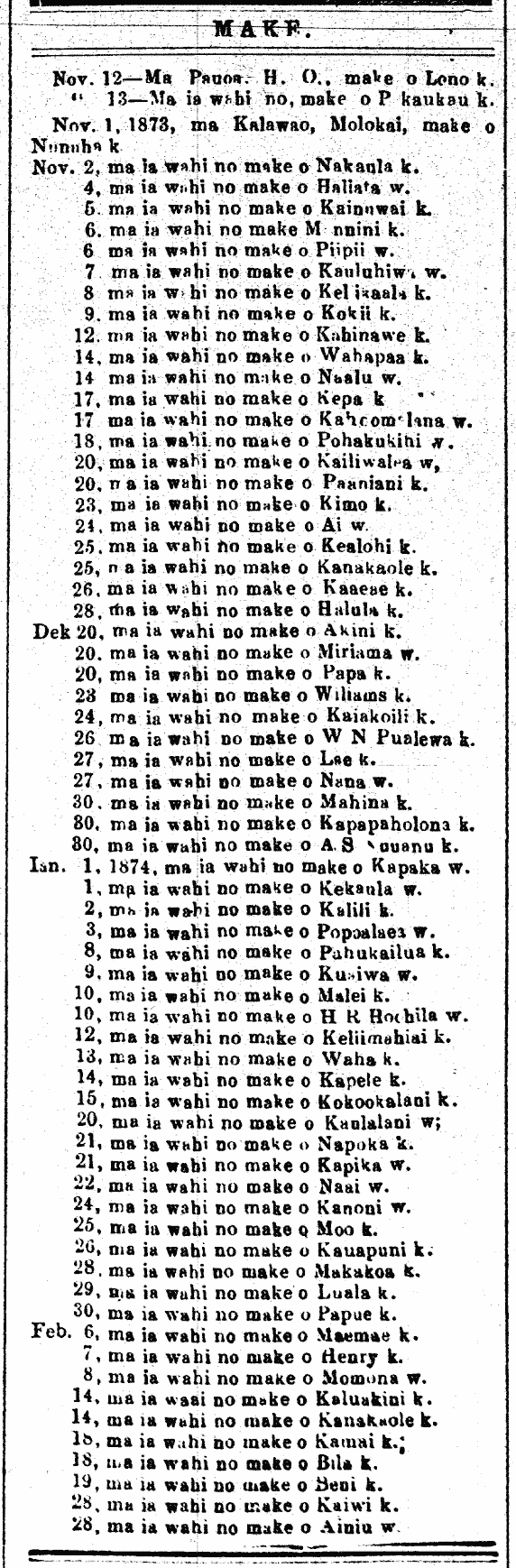
Almost a death everyday… 1873.

DEATHS.

Nov. 12 [1875]—At Pauoa. Honolulu Oahu, Lono (m) died.
” 13—At the same location, P kaukau [? Pakaukau] (m) died.

Nov. 1, 1873, at Kalawao, Molokai, Nunuha (m) died.
Nov. 2, at the same location, Nakaula (m) died.
4, at the same location, Haliata (f) died.
5, at the same location, Kainuwai (m) died.
6, at the same location, M nnini [? Manini] (m) died.
6, at the same location, Piipii (f) died.
7, at the same location, Kauluhiwa (f) died.
8, at the same location, Kel ikaala (m) died.
9, at the same location, Kokii (m) died.
12, at the same location, Kahinawe (m) died.
14, at the same location, Wahapaa (m) died.
14, at the same location, Naalu (f) died.
17, at the same location, Kepa (m) died.
17, at the same location, Kahoomalana (f) died.
18, at the same location, Pohakukihi (f) died.
20, at the same location, Kailiwalea (f) died.
20, at the same location, Paaniani (m) died.
23, at the same location, Kimo (m) died.
24, at the same location, Ai (f) died.
25, at the same location, Kealohi (m) died.
25, at the same location, Kanakaole (m) died.
26, at the same location, Kaaeae (m) died.
28, at the same location, Halula (m) died.
Dec. 20, at the same location, Akini (m) died.
20, at the same location, Miriama (f) died.
20, at the same location, Papa (m) died.
23, at the same location, Wiliams [? Williams] (m) died.
24, at the same location, Kaiakoili (m) died.
26, at the same location, W. N. Pualewa (m) died.
27, at the same location, Lae (m) died.
27, at the same location, Nana (f) died.
30, at the same location, Mahina (m) died.
30, at the same location, Kapapaholona (m) died.
30, at the same location, A. S. Nuuanu (m) died.
Jan. 1, 1874, at the same location, Kapaka (f) died.
1, at the same location, Kekaula (f) died.
2, at the same location, Kalili (m) died.
3, at the same location, Popoalaea (f) died.
8, at the same location, Pahukailua (m) died.
9, at the same location, Kuaiwa (f) died.
10, at the same location, Malei (m) died.
10, at the same location, H. R. Hoohila (f) died.
12, at the same location, Keliimahiai (m) died.
13, at the same location, Waha (m) died.
14, at the same location, Kapele (m) died.
15, at the same location, Kokookalani (m) died.
20, at the same location, Kaulalani (f) died.
21, at the same location, Napoka (m) died.
21, at the same location, Kapika (f) died.
22, at the same location, Naai (f) died.
24, at the same location, Kanoni (f) died.
25, at the same location, Moo (m) died.
26, at the same location, Kauapuni (m) died.
28, at the same location, Makakoa (m) died.
29, at the same location, Luala (m) died.
30, at the same location, Papue (m) died.
Feb. 6, at the same location, Maemae (m) died.
7, at the same location, Henry (m) died.
8, at the same location, Momona (f) died.
14, at the same location, Kaluakini (m) died.
14, at the same location, Kanakaole (m) died.
18, at the same location, Kamai (m) died.
18, at the same location, Bila (m) died.
19, at the same location, Beni (m) died.
28, at the same location, Kaiwi (m) died.
28, at the same location, Ainiu (f) died.

 (Lahui Hawaii, 11/25/1875, p. 4)

MAKE.

Ka Lahui Hawaii, Buke I, Helu 48, Aoao 4. Novemaba 25, 1875.


The 1874 speech of Leleiohoku at Kalaupapa, 1891.

THE SPEECH OF THE REGENT, PRINCE LELEIOHOKU, AT THE COLONY OF KALAUPAPA, MOLOKAI.

November 28, 1874.

O Citizens of the Alii, King Kalakaua I., a fraction of his people, aloha to you.

This was the day that we gained the independence of this our mother country, and it is a day for you, Hawaiian people, to rejoice.

In this rejoicing however, there is also something to be anguished and mournful about, for if you turn and look back, there is not your wife, or children, or your family, or the rest, if you are a man who was separated here by the government to come to Kalaupapa; auwe, this is something that pains his heart for his companion, his wife; and so too for the woman who grieves for her husband; and the parent who grieves for his child, and the child for his parent, and so forth.

O Makaainana of King Kalakaua I., living in this friendless land, you have but one friend, that being the protection of the government.

This painful burden that you have been stricken with does not come through the control of the child of man, but comes from God.

Therefore, all you makaainana who have aloha for your alii, I am one of your parents, but I am powerless to divert the power of the law, for I am but a student of the law; yet it pains me to see you, O Beloved makaainana; I first saw some of you turning your faces away from mine.

But should there be a time in the future, when the rule falls totally upon me, then that will be the time when I will search out and put my efforts into finding relief for all of us, but that lies in the hands of the one who created us.

Therefore, O Beloved makaainana, do forgive me, and may the power of the Lord help us all.

[You never know where you will find information. I have not been able to find mention of this speech by Leleiohoku in 1874, but 17 years later…]

(Leo o ka Lahui, 9/25/1891, p. 2)

KA HAIOLELO A KE KAHU AUPUNI, KE KEIKI ALII LELEIOHOKU...

Ka Leo o ka Lahui, Buke II, Helu 289, Aoao 2. Sepatemaba 25, 1891.

Report of deaths in Japan, 1900.

By the Hongkong Maru.

Word was received by the Hongkong Maru from the Orient that Rev. David Keaweamahi, who left here about twelve years ago for Japan to undergo treatment for leprosy, died in Tokyo on the 29th of July last of consumption. No signs of the disease was visible on his face. He was buried that same evening, a large concourse of friends following his remains to the grave

W. H. Cummings died on July 15th at the Kusatsu springs and was buried there.

(Independent, 8/14/1900, p. 3)

By the Hongkong Maru.

The Independent, Volume XI, Number 1584, Page 3. August 14, 1900.

Queen Liliuokalani travels to Kalawao, 1891.

Journey of the Alii, Queen Liliuokalani, to the Colony of Kalawao.

To the Editor of the “Daily Ko Hawaii Pae Aina,”

J. U. Kawainui,

Aloha oe:

At 10 at night on this past Sunday, April 26, 1891, the steamship Likelike left the wharf of Ainahou, taking upon her deck beloved Hawaii’s favorite, to see the group of the lahui who are in pain and great suffering. There were three hundred or so people on this tour. Here are the  dignitaries who went:

Queen Liliuokalani, Prince Keliianaole [Kalanianaole], Prime Minister Sam Parker, President D. Dayton, Agent of the Board of Health, Lalana, Hon. J. Nawahi, Hon. L. W. P. Kanealii, Hon. D. W. Pua, Hon. J. K. Hookano, E. Lilikalani, Hon. J. G. Hoapili, French Commissioner, Portuguese Commissioner, Mr. and Mrs. C. Clarke, Joseph Heleluhe, Mrs. Limaheihei, Mrs. Pamahoa Kalauli, Mr. and Mrs. S. M. Kaaukai, Mrs. L. Keohokalole, A. Mahaulu, Bishop Wills, Father Leolono, J. N. K. Keola, G. W. Kualaku, Tamara Meekapu, Mr. and Mrs. Auld and daughters, Mr. and Mrs. Ailau, Band Master Berger and 31 band members, two haole women, Mrs. Makanoe and father, Mrs. Kuihelani, Mahoe, Malaea Kaaipeelua, Lula Kahelemauna, Mrs. Akau and the many others for whom I have don’t have their names.

The ocean was fine, there wasn’t much wind, but there was enough wind to carry the favorite one, landing before her makaainana who suffer in pain. The light of the queen of the night shown down beautifully; the wheel of the princess, the younger sister, Likelike [referring to the ship], pushed against the sea of Kaiwi, the beloved sea, like a child carried before the friends in misfortune; eyes searching the tips of the waves for land, with sorrowful tears for their birth land. At 6 in the morning, on Monday, April 27, 1891 they landed at the harbor of Kalaupapa.

The mast in the aft of the Likelike flew the crown flag, announcing here I am with a heavy heart for all of you. The town of Kalaupapa was spread out before us, from the seaside to the uplands, with cliffs surrounding, lined up on the west side of the town.

The land was astir with people at the harbor wanting to embrace with tears the Queen and her people; and likewise the alii, the Queen, and her people wanted to do the same. Continue reading

More on the pidgin in Kalaupapa article, 1882 / 2015.

Before getting to the pidgin phrase in question, I had a question in the last paragraph which in the original read: “ke hele la a mauakea i ka la.” And thankfully there was a response.

Puakea says:

Aloha – the last line might be missing an “o” – Ke hele la a moauakea i ka la – making a haughty display- like white-feathered chickens – in the sun. (moa uakea – often a reference for Maunaloa/Maunakea when snow-covered)

That would fit in nicely, considering there were typos in the newspapers even back then. The last paragraph would then read something like:

The white-haired old men of Kalaupapa are out surfing these days, resembling white-feathered chickens under the sun.

As for the pidgin phrase: “Kokami iu palali kanaka! Iu anu faita, ai am solon, mi kivi iu kut polo, mi inilis man,”

There was one suggestion.

Robert Ikuwa says:

“Go come you bloody kanaka. You wanna fight. I am strong. Me give you good blow, me is invisible [? invincible] man.”

Another suggestion I have is maybe:

“Goddam you bloody kanaka. You wanna fight? I am strong. Me give you good blow. Me Englishman.”

Also there was another comment just a few minutes ago!

Michael Newtson says:

In our Cummings Ohana I have written of many of our ancestors exploits. But these long overdue articles brings to mind an early story of our Patriarch Thomas Booth Cummings who was so inspired by a hapa Hawaiian who served alongside of him in the jury pools of Edwin Miner’s court in Lahaina (1848-50) that he named his first born son after him. The young man who had such a promising will to help the needy was William Humphreys, who often went by the name Ulawalea as a pen name when writing the countless articles in Hawaiian Nupepa about the injustices of the peninsula. Kalaupapa has received much of the attention, in part from Father Damien. However, there was a second smaller colony at the eastern end of the peninsula at Kalawao. Most patients here were Chinese, and this is where Humphreys concentrated his efforts in the early until his untimely death from a prescribed medicine in the mid 1860’s. He might have been one of the first to use the media of his day to educate those in the islands that were unaware of the seriousness of the conditions. At Kalawao he organized voting blocks, book clubs and taught many years for no expense. He served two terms as Sheriff and was imprisoned twice, once for refusing to arrest patients for victimless crimes and another for butchering beef on a nearby ranch to provide fresh meat for the starving. He like many others, worked under the radar and was but a small foot print in Hawaii’s history, but when passed the patients of Kalawao lost their dearest friend.

Mahalo to everyone that gave responses, they put much more meaning into this post!

Pidgin from down in Kalaupapa, 1882.

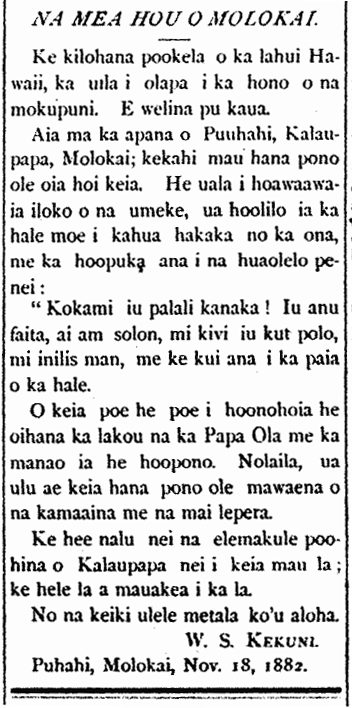
NEWS OF MOLOKAI.

O Greatest Prize of the Hawaiian Nation, the lightning that flashes over the cliff brows of the islands. Greeting between us.

In the area of Puuhahi, Kalaupapa, Molokai, there were deplorable incidences, and those where these. There was sweet potato being fermented in pots, and this made the dormitory into a place of fighting because of drunkenness, along with the speaking of these words:

“Kokami iu palali kanaka! Iu anu faita, ai am solon, mi kivi iu kut polo, mi inilis man,” while he punched the wall of the building.

These are people who were appointed with positions from the Board of Health [Papa Ola] with the thought that it would be of help. Then this reprehensible thing happened between the locals [kamaaina] and the leprosy patients.

The gray-haired old men of Kalaupapa are surfing these days, and the land is being left fallow in the sun [??? ke hele la a mauakea (?? mahakea) i ka la.]

To the metal type-setting boys goes my aloha.

W. S. Kekuni.

Puhahi, Molokai, Nov. 18, 1882.

[Any ideas what is being said in pidgin? I will post what I think it says tomorrow morning.]

(Kuokoa, 12/9/1882, p. 3)

NA MEA HOU O MOLOKAI.

Ka Nupepa Kuokoa, Buke XXI, Helu 49, Aoao 3. Dekemaba 9, 1882.

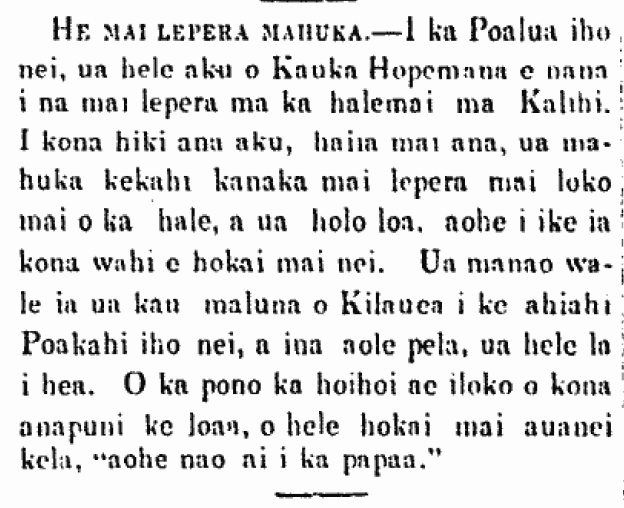
Leprosy patient escaped, 1867.

[Found under: “NU HOU KULOKO.”]

Leprosy patient escaped.—This past Tuesday, Dr. Hoffman [Kauka Hopemana] went to see the leprosy patients at the hospital in Kalihi. When he arrived, he was told that one of the patients escaped, and ran away, and it is not known where he is hiding. It is thought that he boarded the Kilauea on Monday evening, but if that is not the case, where could he have gone. It would be best if he is returned within his confines should he be found, or he will be lost, and that will be very dangerous.

(Kuokoa, 4/13/1867, p. 2)

He mai lepera mahuka...

Ka Nupepa Kuokoa, Buke VI, Helu 15, Aoao 2. Aperila 13, 1867.

Tragedy off Kalaupapa, 1888.

DEATH AT SEA.

Because of the kindness of our good friend, Mr. Kaoliko from up in Kauluwela, he showed us a written statement he got from Kalaupapa talking about sad news, and that is what we have below:

At night last Friday, Nov. 9, Kale Kahuakaiula Palohau, the child of Mr. G. B. Palohau of Kauai, tried to escape from Kalaupapa aboard a canoe along with Wailele. There are no witnesses to this escape of the two men. As they tried to leave the harbor of Kalaupapa and got a little ways out, the waa flipped. But they righted it and bailed out the bilge. They got back on and started to make their way but not much later, it flipped again. That is the way it went until they got right outside of Kalaeokailio, which they reached in the morning of Saturday. Palohau said to his partner that they should go ashore because the canoe was getting filled with water and was close to sinking. Then Kahuakaiula jumped into the ocean along with his friend and swam for shore. After getting perhaps a quarter mile from the waa, his friend started getting fatigued. Kahuakaiula told him to climb on him; the friend climbed on, and they started to swim towards the place where the waves break. There, the waves began to pound upon them and they were separated from each other. Kahuakaiula made his way to shore but as for his partner, he was not seen of again.

(Alakai o Hawaii Puka Pule, 11/24/1888, p. 3)

MAKE ILOKO O KE KAI

Ke Alakai o Hawaii Puka Pule, Buke 1, Helu 47, Aoao 3. Novemaba 24, 1888.