Clarice B. Taylor on Koihala, part IV, 1949.

LITTLE TALES

All About Hawaii

By Clarice B. Taylor

THE KAU MEN ARE SENT INTO MOUNTAINS

The Hawaiian people who inhabited the Kau district on the Big Island were accustomed to a dry, hot climate.

The nature of the district led the men to seek their food in the ocean where there was a wealth of fine fish. For that reason, the Kau people loved their fresh fish.

When the high chief Koihala ordered the Kau men to construct the great heiau at Makanau, the men worked cheerfully as long as the food supplies lasted.

#     #     #

They grumbled continuously while they fetched the little pebbles from Punaluu to pave the inner heiau courtyard. They endured this work, for they believed the end of the project was in sight. Continue reading

Clarice B. Taylor on Koihala, part III, 1949.

LITTLE TALES

All About Hawaii

By Clarice B. Taylor

THE TRIALS OF HEIAU CONSTRUCTION

Koihala, the high chief of the Kau district who constructed the immense heiau on the heights at Makanau, allowed his ambitions to still his conscience as an alii.

#     #     #

The high chief who kept the love and devotion of his people made provision for their needs when he called upon the manpower of the district to work upon a public project such as the construction of a heiau.

#     #     #

The alii who destroyed the regular rhythm of planting and fishing by employing all his men upon a construction job was certain to bring starvation upon his people and trouble for himself.

Koihala was such a chief. Continue reading

Clarice B. Taylor on Koihala, part II, 1949.

LITTLE TALES

All About Hawaii

By Clarice B. Taylor

KOIHALA ORDERS POHAKU HANAU PAVING

The construction of Koihala’s heiau (temple) on top of the hill at Makanau in the Kau district progressed very well at first.

Food supplies were sufficient to sustain the men at the first heavy labor of quarrying the great rocks needed to build the heiau walls and to haul them to the site.

#     #     #

It was a tremendous undertaking, for Koihala wished his heiau to be the biggest and best in the Kau district.

Once the great walls were in place, Koihala issued an order which brought the first grumblings. Continue reading

Clarice B. Taylor retells Kawena Pukui’s Koihala story, 1949.

LITTLE TALES

All About Hawaii

By Clarice B. Taylor

KOIHALA, A CHIEF OF GREAT AMBITION

This is an ancient and true story of a chief of old Hawaii whose overweening ambition was the cause of his downfall.

It is one of the many stories of the people of the district of Kau on the Big Island told by Mrs. Mary Kawena Pukui of the Bishop museum staff. Continue reading

How bad leaders and their advisers were dealt with in Kaʻū, 1890.

INCIDENTS IN HAWAIIAN HISTORY.

Before Kamehameha the First had reduced the island of Hawaii to his subjection the various districts were ruled over by petty kings or high chiefs. Anecdotes of three of these aliis who successively ruled over the large district of Kau, are still current among the natives. They are not mythical, but actual events.

Koihala the alii of Kau was about making a voyage from Kona to Kau in his fleet of canoes. He sent word to his people of Kau to meet him with supplies of food on a certain day at Kapua.

The people cooked hogs, dogs and potatoes and prepared poi, water in calabashes and other supplies in sufficient quantities for the chief and his retainers, and started afoot with their burdens to meet him. On arriving at Kapua the fleet came along but did not stop. The alii called to the people ashore to go back to the next landing towards South Point. They resumed their burdens and retraced their steps to this place, the king proceeding by sea. At this place they were told to go on still further to another landing. This was repeated several times and they were finally told to climb the steep pali and meet the king at Kaalualu around and east of South Point. The people were tired, foot sore and hungry from their wearisome travel over the lava and determined upon a different reception to their alii from what he expected. They said “we will teach these chiefs a lesson not to wear us out with their capricious whims. We are hungry and we will eat the food and give him another article of diet instead.” So they sat down and ate up the food and filled the ti-leaf containers with stones and proceeded to near the coast and sat on a slight hill to await the coming of the chief and his party. He landed and proceeded up the ascent to receive his hookupu (tribute of food). When near, the people stood up and, taking the stones from the containers, threw them at the king and his retainers saying, “Here is your pig,” “Here is your dog,” “Here are your potatoes,” etc., and Koihala was killed. The stone, a short way on the road from Kaalualu to Waiohinu is still pointed out as the exact spot where Koihala—the exacting tyrant—met his death. Continue reading

On Kepelino’s “Traditions of Hawaii,” 1870.

Ka Moolelo Hawaii.

O Kuokoa Newspaper; Aloha oe:—

Please carry before all of the experts this bit of the “Moolelo Hawaii” which I saw from the selections of John Zibilina Kahoalii. All of the the classes of the Chiefly Histories have been laid out properly from top to bottom, with  the lineages of each class.

Class 1. Ihu Hai [? Iku Hai] is the name of the class.
Ihu Nua [? Iku Nuu] is the second name.
Both names describe this one class; the line of this Class is shown by its Lineage.

Class 2. Ihu Laa [? Iku Laa] is the name, with its Lineage.

Class 3. Ihu Lani [? Iku Lani] is the name, with its Lineage.

Class 4. The Alii Laa is the name of that Class, the lowest Class, according to just what I think. Continue reading

Who is this wahine? (conclusion), 1909.

…Kamehameha asked: “Which Kawaihae are you going to?”

“To Kawaihae Kai, near the capital where the alii lives,” answered the woman.

“So what is that bundle you hold in your hand?” Kamehameha questioned.

The woman responded, “A bundle of Lipalu seaweed.”

With that Kamehameha said: “Say woman, I am one of the alii’s men, and my occupation is one of the messengers for the alii. And being that I have clearly heard your fine words, I am hopeful that should the alii hear me about the words of appreciation of yours for him, then you will be given some land for yourself. Continue reading

Who is this wahine? 1909.

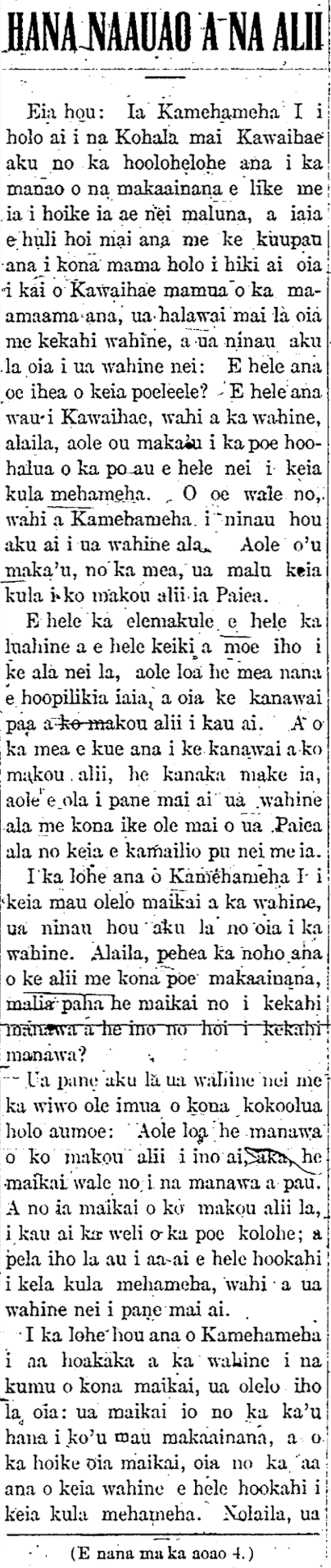
ENLIGHTENED DEEDS OF THE CHIEFS.

And here is something else: When Kamehameha I went to the Kohala districts from Kawaihae to hear the thoughts of the makaainana like those shown earlier, as he turned back with haste so that he would reach the seaside of Kawaihae before it was light, he came upon an old woman and asked her: “Where are you going in the darkness?” “I am going to Kawaihae,” replied the woman. “Aren’t you afraid of being ambushed at night while you walk this desolate field. Just by yourself?” Kamehameha then asked of the woman. “I have no fear, for this plain is protected because of our alii, Paiea.”

“The old men go, the old women go, and the children go and sleep on these pathways, and there is no one at all who will bother them, for that is a strict law that our alii has placed. And the person who disobeys the law of our alii is a dead man; he will not live,”  answered the woman, not knowing that it was Paiea who was talking with her.

When Kamehameha heard these fine words of the woman, he further asked the woman. “So how is the way of life of the alii with his makaainana? Is it good sometimes and bad sometimes?”

The woman answered with no fear before her late night travelling companion, “There has been no time in which our alii has been bad to us, but he has always been good. And it is because of this goodness of our alii that wrongdoers are fearful, and it is thus that I can dare to walk alone across the desolate field,” the woman replied.

When Kamehameha heard once again the woman expounding on why he was good, he said [to himself], “I am indeed beneficent to my people, and the proof of this good is that this woman dares to travel this lonely field alone.” Therefore,…

[To be continued.]

(Hoku o Hawaii, 7/1/1909, p 1)
HokuoHawaii_7_1_1909_1.png

Ka Hoku o Hawaii, Buke IV, Helu 9, Aoao 1. Iulai 1, 1909.

Great granddaughter born to Samuel K. Kekoowai, 1922.

ANOTHER DESCENDANT BORN TO THE WRITER OF THE MAKALEI

A letter arrived from my granddaughter informing her tutu that she brought forth into this world of light, a daughter from her loins, on Thursday, the 12th of this October, 1922, at 9:30 a.m.

She asked also for me to name that great-grandchild of mine, and so I followed through and gave the ancestral name, Miss May Kaaoliko Kahalakupumaikai-o-Aina-manuhaaipo Manouluae. Continue reading