Waikiki Wedding and Bing Crosby, 1936.

A FITTING HAWAIIAN SOUGHT

FOR WORKING ON HAWAIIAN STORY FOR A MOVIE

HOLLYWOOD, Sept. 1.—Mr. Bing Crosby will be landing in Honolulu next Thursday aboard the steamship Lurline, one of those who are writing the script of a movie called “Waikiki Wedding.” The news was heard from his studio that on this trip he is searching for a very famous woman in ancient Hawaiian hula, that understands the hand motion and the foot movements, as in ancient Hawaiian history; the hula of Hawaii that made it famous and was seen as one of the things that were taught to all women of Hawaii during those days. Also they are on the search for famous young musicians of Hawaii nei that know the proper mele for the hula foot movements of women, who know the string instruments and drums of the Hawaiians, and are not just handsome to look at, but true to the history that is written about: the ti-leaf whistle, the kilu drum, the puhenehene flute, the jew’s harp and bamboo ukeke. Continue reading

A new Hawaiian hymnal at press, 1914.

HAWAIIAN HYMNAL

This book is being printed at the office of the “New Freedom,” where “Ke Aloha Aina” is being printed, and if you want to have a copy of this beautiful book, put in your order before the 1st of December. The cost is $2.50, and your name will be inscribed on the cover of the book. What was advertised earlier, that the cost was two dollars along with inscribing your name on the cover was a mistake. That (two dollars) is the cost if you don’t want the owner’s name printed.

[Does anyone know what book this is referring to?]

(Aloha Aina, 12/3/1914, p. 1)

Wallace Kuakapu Naope passes away, 1939.

GREW WEARY

Wallace K. Naope

In the evening of this past Friday, Wallace Kuakapu Naope grew weary of this world after being taken to the Hilo Memorial Hospital [Halemai Hoomanao o Hilo] after contracting Pneumonia [Numonia]. It was but a few hours after he was taken to the hospital that he passed away.

With his passing, lost is one of the icons in politics. He ran for the position of senator in the Democratic party a number of times, but he lost and the victory of the other candidates for senator was difficult and only by a slim margin.

Wallace Kuakapu Naope was born in South Kona, and was educated at Lahainaluna School. After leaving the school, he came to live in Hilo nei with his older brother Harry K. Naope who died earlier a little over a year ago, who was the great one amongst the choir leaders of all the choirs across the Archipelago. Continue reading

One of the biggest early influences on Hawaiian music in Japan starts here, 1909.

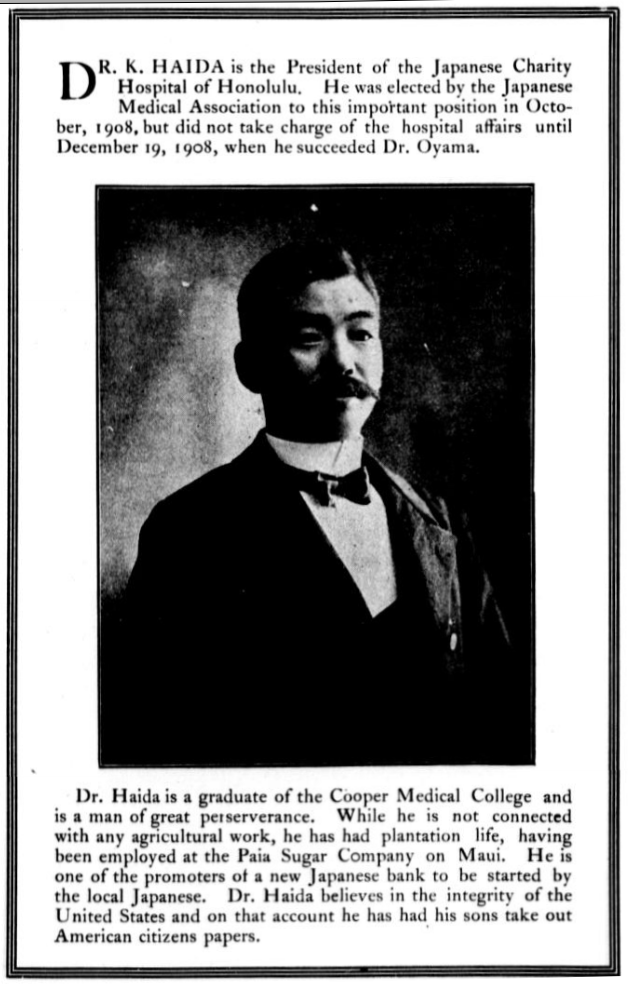
DR. K. HAIDA [Katsugorō Haida] is the President of the Japanese Charity Hospital of Honolulu. He was elected by the Japanese Medical Association to this important position in October, 1908, but did not take charge of the hospital affairs until December 19, 1908, when he succeeded Dr. Oyama.

Dr. Haida is a graduate of the Cooper Medical College and is a man of great perseverance. While he is not connected with any agricultural work, he has had plantation life, having been employed at the Paia Sugar Company on Maui. He is one of the promoters of a new Japanese bank to be started by the local Japanese. Dr. Haida believes in the integrity of the United States and on that account he has had his sons take out American citizen papers.

[See also this article on Yukihiko Haida returning to Hawaii in 1933 from Japan to study Hawaiian music.

And also see this article put up by the Nihon Ukulele Association on Yukihiko (Harry) Haida.]

(Evening Bulletin, 3/25/1909, p. 44)

DR. K. HAIDA...

Evening Bulletin Industrial Edition, 1909, p. 44.

Hawaiian boys headed to China to play music, 1916.

[Found under: “LOCAL AND GENERAL”]

Five Hawaiian musicians will leave Honolulu May 26 in the steamer China for Shanghai, China, to fill a lengthy engagement at the Carleton Cafe in that city. They are Robert Akeo, William Smith, Valentine Kawai, John Nieper and Joseph K. Kauila.

(Honolulu Star-Bulletin, 5/9/1916, p. 3)

Five Hawaiian musicians...

Honolulu Star-Bulletin, Volume XXIII, Number 7511, Page 3. May 9, 1916.

Hawaiian Music, an editorial, 1911.

How Hawaiian Music is Being Misconstrued!

Perhaps the thoughts of the Kuokoa may not be the same as those of others about the way Hawaiian music is being sung these days, but because we hold dear listening to the beauty and the sweet sounds along with the joy of the voices, therefore the Kuokoa takes up this matter.

It is not something that we Hawaiians should criticize, that singing is something we are proud of, and something that makes this race famous all around the world, by tourists who visit Hawaii nei and hear us singing our enjoyable and entertaining songs, as well as by singing groups being seen travelling about America.

If we were to turn back in time, to many years past, when the Kawaihau Glee Club and many other groups were famous for singing, we will see when comparing them to those performing today, the differences between them; our admiration will be taken by the singing of the old days, which many groups in some places around Hawaii nei still practice that way of singing Hawaiian songs.

Our Hawaiian mele are composed with their many kaona, and it is by how they are sung, if it is not made clear by the lyrics, that give appreciation and admiration to the listener, from Hawaiians to those that don’t know our language, because it is only through the melody of the song that that listener is entertained.

These days however, our singers are following haole style singing; and when songs that we are used to hearing along with their tunes which fill us with energy and enthrallment are changed, when listening to that it is like ridicule, for we are not used to hearing that kind of melody, and Hawaiian songs are not famous for that style of singing.

Our people, from the men to the women are talented with fine singing voices; it is a talent not widely spread amongst other people of the world, but it is not by the the way some people now are singing, but by singing songs as they were sung in years past.

Perhaps the vibrato and the slow and drawn out of singing matches haole songs of this age, but by changing the way Hawaiian songs are sung in this way, we at the Kuokoa are not mistaken when we say that it is insulting to the listener.

We don’t wish to call this person or that one not a good singers, but should we want our goal to be to preserve this fame through song, there is only one arena for us to stand before the other races, that is through expressing what God has given to every Hawaiian man and woman, without mimicking or emulating what other people are doing; lest what is seen by us as good becomes something that is not good.

We have nothing to say to those who are studying music in books; that will be a great benefit to some, but the good seen in one aspect will not get better by changing another aspect; so it is with our Hawaiian music, by changing how they are sung, it will not make them better.

Each and every Hawaiian is the true witness, and they are the perfect judge to weigh what we now discuss, not to criticize or to assail upon someone with words of persecution, but for our affection of the grandeur and true beauty of Hawaiian mele which each and every one of us all love and cherish.

[On a somewhat related topic about tradition and kuleana and mele, there is a very thought-provoking essay for composers and non-composers alike, by Kainani Kahaunaele, printed in The Value of Hawaii 2: Ancestral Roots, Oceanic Visions, just recently out. In fact, if you haven’t got your copy yet, there are many stories by a wide range of writers in there that we should look at, and perhaps the many moolelo within the collection will then push us into thinking what we ourselves feel the value of Hawaii nei is and where we should be headed and what it is we need to do to get us there.]

(Kuokoa, 9/8/1911, p. 4)

PEHEA E HOOHEPAIA MAI NEI NA HIMENI HAWAII!

Ka Nupepa Kuokoa, Buke XLVII, Helu 36, Aoao 4. Sepatemaba 8, 1911.

Hula, mele, and tradition, 1928.

IN SEARCH OF HULA, OLIOLI HOAEAE, AND HAWAIIAN SONGS

There are some people here trying to find once more the hula, chants, and songs of old Hawaii.

Some people believe that it would be good to perpetuate the hula and olioli hoaeae of the the old. Some believe strongly that it is a waste of time or that type of endeavor would be old fashioned [olopaikini].

Some people think that it is very good for Hawaiian things to be fostered, and they are attempting to put an end to improper things like the kind of hula olapa of some people done in public. Continue reading

Bella Luana and Annie Lana Bohling, 1940.

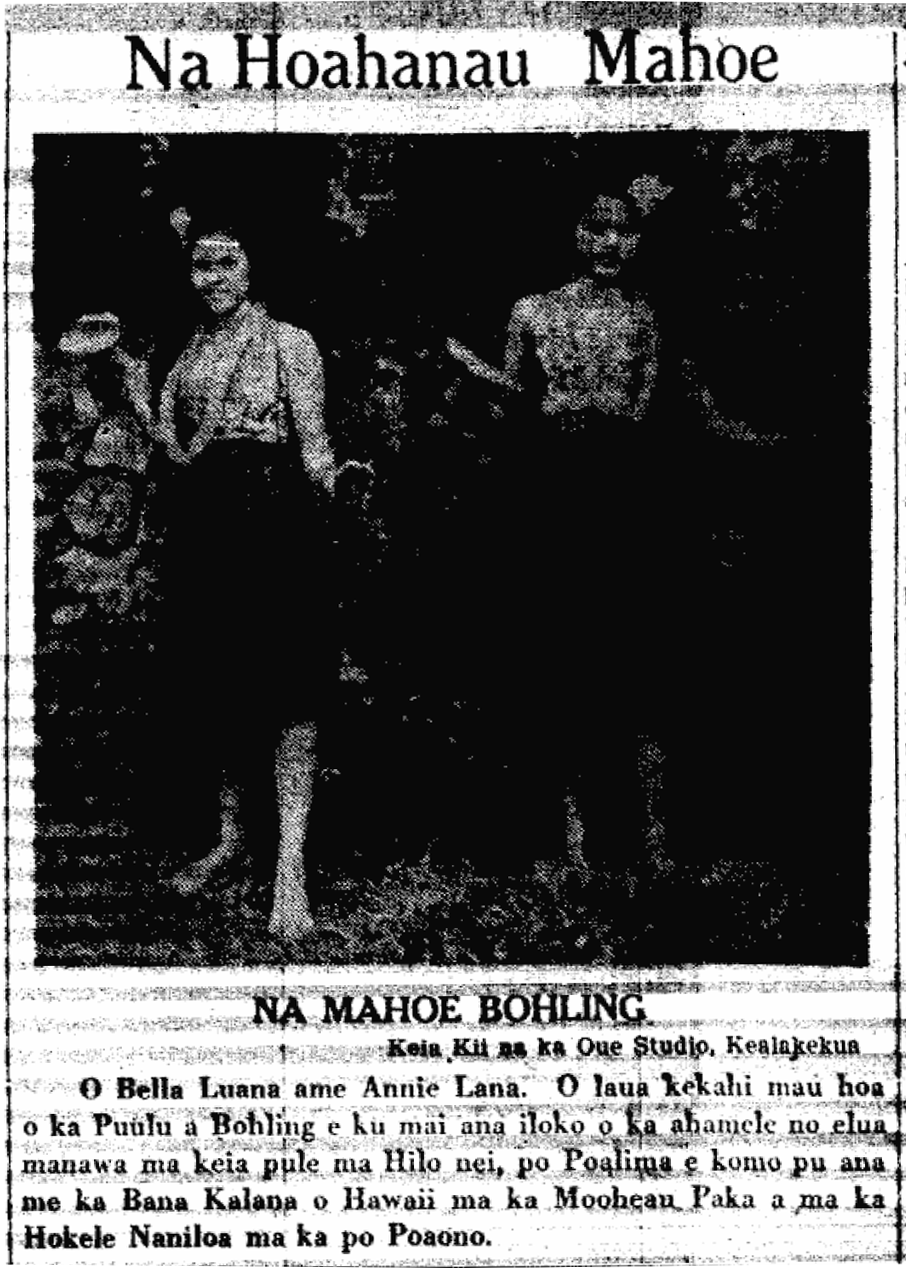
The Bohling Sisters

THE BOHLING TWINS

This Picture is by Oue Studio, Kealakekua

Bella Luana and Annie Lana. They are some of the members of the Bohling Group who will perform twice in the concert this week here in Hilo, on Friday night, along with the Hawaii County Band [ka Bana Kalana o Hawaii] at Mooheau Park and at the Naniloa Hotel on Saturday night.

(Hoku o Hawaii, 12/18/1940, p. 1)

Na Hoahanau Mahoe

Ka Hoku o Hawaii, Volume XXXV, Number 34, Aoao 1. Dekemaba 18, 1940.


More on music with Joseph Kalima and Albert Nahale-a, 1935.

Some people of Hilo are starting a Glee Club from amongst the members of the Executive Committee of Hilo nei, from church members to other friends who are coming together for the purpose of singing here in Hilo.

Others from the Churches of Haili have been asked and some expert singers also have been asked to join with these people who have given themselves for this activity. Joseph Kalima and Albert Nahale-a have come aboard.

(Hoku o Hawaii, 10/22/1935, p. 2)

Ke hoala mai nei...

Ka Hoku o Hawaii, Buke XXVII, Helu 17, Aoao 2. Okatoba 22, 1935.