Mongoose, “a general destroyer,” 1883.

[Found under: “EDITORIALS.”]

The Planters’ Monthly has lately been proposing the introduction of a little animals from India called the mongoose, as a destroyer of rats. He is a famous ratter, surpassing the cat or the ferret. He is described as a lively little urchin, about the size of a weasel, as having a snaky body, vicious looking claws, a sharp nose, a villanous eye and looks like “murder incarnate.” In speaking of his action in capturing rats, it is said that he crawls sinuously up to his victim until within easy distance for a rush, and then strikes with unerring aim, snapping the rat just at the base of the brain. The rat has not time even to squeak, so sudden and deadly is the onslaught. Wherever the rat can enter the mongoose can follow. Thus as a ratter this lively little Indian is incomparable, but the trouble is he will not confine his operations to what is deemed his legitimate business. Some writers have endeavored to save his credit as a poultry destroyer, but a naturalist, who has carefully observed his characteristics, says that he is a general destroyer, not only of everything under, but of many creatures over his size. When in a cage that sight of a small living creature made him frantic and whenever he escaped, as he sometimes did, he made a sensation in the poultry house. The mongoose is not content with maurauding forays in the yard, but he seems to pervade the house when domesticated. His manner for getting into objectionable nooks and holes is most perplexing, as for instance the leg of a pair of trousers or a skirt with the owner in them, quite come up to his views, as a desirable place for a roost or forage. The rat is unquestionably a great pest of the cane and rice planter and grain cultivator in all parts of the world. The rat pest was deemed so serious here some fifty years ago that an enlightened and enterprising Commisioner of the Hawaiian Government, sent in quest of Chinese coolies, deemed it a judicious venture in behalf of the agricultural interests of the Islands to procure a species of sanke famed as a destroyer of rats; but the Hawaiian people, whose sacred soil has been kept free from snakes and toads by some patron saint in influence to St. Patrick, conceived a holy terror of the snake, notwithstanding his possible utilities, and passed a decree that Hawaii would have no snake in her plantations. The destruction of rats in the cane-fields was hardly deemed a sufficient compensation to the Hawaiian mind for the probable presence every now and then of his snakeship in the thatch of the Hawaiian hale-pili. And we think that if the mongoose be as well understood as the snake, he will be as objectionable as the tempter of our first parents to the popular mind. This terrible Indian ferret is said to take a fancy to fasten on to lambs and suck away their very life-blood; and who knows if he may not ake a fancy once in a while to a baby in its cradle. Continue reading

Mongoose, where it all began, 1883.

[Found under: “NEWS OF THE WEEK.”]

Mr. W. H. Purvis, proprietor of the Pacific Sugar Mill and Plantation at Kukuihaele, Hawaii, who arrived in this city per Zealandia, after having completed a tour around the world, brings seven mongooses from India and Africa, and will introduce them on his place on Hawaii. Mr. Purvis has had an opportunity of observing just what the mongoose will do in its native home, and says that it will not molest poultry or come about the premises where people live to disturb anything, but has a perfectly insatiable appetite for killing rats. These are the first mongooses ever brought to these Islands and in all probability they will increase rapidly and prove very useful in destroying all kinds of small vermin.

(PCA, 9/29/1883, p. 5)

Mr. W. H. Purvis...

The Pacific Commercial Advertiser, Volume XXVIII, Number 14, Page 5.

Death of Miriam Kaaikala Pereira, 1915.

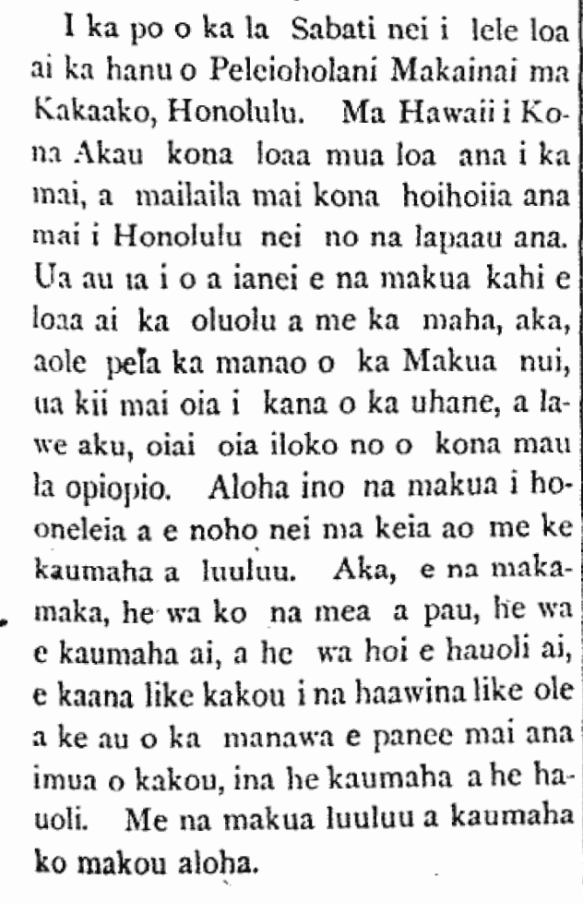
MRS. MIRIAM KAAIKALA PEREIRA PASSED ON

Mr. Editor of the Kuokoa, Aloha oe:—Please insert in an open space of our pride, the topic placed above so that all of the family and friends of my elder sister living from the rising of the sun at Kumukahi to the setting of the sun at the pleasant foundation of Lehua Island.

At 6 o’clock in the morning, December 2, 1915, my dearly beloved older sister, Mrs. Miriam Kaaikala Pereira, grew weary of this life at her home on Kaumualii Street, and she left behind a sorrowful bundle of love for me, her younger sibling, and her beloved husband, and her children who are without a mother, and her whole family, who grieve for her. Aloha, aloha for my dear older sister who has gone afar!

Her sight before us is no more, is gone. How sad!

My beloved older sister was born on the 22nd of December, 1889, and she was 26 years old when she moved swiftly and silently on to sleep the eternal sleep of summer and winter.

Aloha to my patient older sister; she was a helping hand for all the good works of the Church and the Sunday School of Kalihi and Moanalua this past seasons.

She was a Sunday School student for the district of Kalihi Kai; she was industrious in the work for her beloved Lord in this unfamiliar land. She was a member of the Puula Church in Puna, Hawaii; she was a mother with a loving heart, she was welcoming and a parent for everyone who showed up before her.

Her work in this world is over, and she has gone to the bosom of her loving Lord. It is He who giveth and He who taketh away; blessed be his name.

She married her new husband, Vincent D. Pereira, on the 26th of December 1914, by Abraham Fernandez; therefore they were not married for a whole year before she left her beloved, a husband who is mourning after her.

With her first husband she has four children who are now living, and with her new husband she has one child. These children are bereft of a mother; these children without a parent have therefore gone under the care of the family of the deceased.

O Puna of the fragrant bowers of hala, where my beloved older sister found pleasure in her youth; no more will she smell your deep fragrance; no more will you drench her with your cool frangrances; She has gone; you will no more see her form; you will no more hear her voice; her toil is over; her grief is over; she has found relief in the loving bosom of her Lord.

O Kauai of Manokalanipo, where my dear older sister found enjoyment, this is the sad package of aloha, a bundle for tears, that you, my two elder siblings and I, your later born, grieve, for our loved one who has gone. How regretful for my dear older sister who has travelled afar. We will no more see her form and no more will we hear her voice.

She was sick for only four days; a doctor was sought out to make her better, but she did not find any relief and left us. According to the findings of the doctor, she had heart problems.

In the capital of Honolulu nei is where the light of the bodily house of my beloved older sister went out, and the earth returned to earth. Man’s life is a vapour that appeareth for a little time, and then vanisheth away, and that is how my dear older sister grew and blossomed beautifully, and the stealthy hand of the angel fetched her like a thief in the night and took her spirit, leaving her earthly body for us, the family, to grieve over.

So with these loving thoughts dedicated to my beloved older sister, the words of my prayer to the Heavenly Father ask that He lighten our heavy hearts.

My unending esteem goes to Mr. Editor and the metal typesetting boys of your press.

Her younger sibling in sadness and grief,

MRS. ALICE M. K. KAEHA.

Kalihi Kai, Dec. 21, 1915.

(Kuokoa, 12/24/1915, p. 3)

MRS. MIRIAM KAAIKALA PEREIRA UA HALA

Ka Nupepa Kuokoa, Buke LIII, Helu 52, Aoao 3. Dekemaba 24, 1915.

Real gentlemen from a hundred years ago, 1915.

THE WORDS OF A HAWAIIAN

A while ago while some Hawaiian Youths were in Washington and riding an electric car, some haole women boarded the car, and not one of haole men near where those haole women were gave their seat to any of the women. When the Keiki Hawaii saw these Ladies standing, that is when these Hawaiian Youths stood and gave their seats to these white women. The women accepted the kindness of the Hawaiians. These Hawaiian Boys then heard one of the Haole reading a newspaper ridicule them, saying:

“They are probably some foreigners, giving their seats to those women.” It was like he was calling them “country bumpkins.” When S. L. Desha Jr., heard these words of the Haole reading the paper, as he spoke disparagingly of this action by the Hawaiian Boys, that was when he spoke without hesitation to that Haole, perhaps because he was with his fellow Hawaiians. Continue reading

The birthday of Pauahi, 1901.

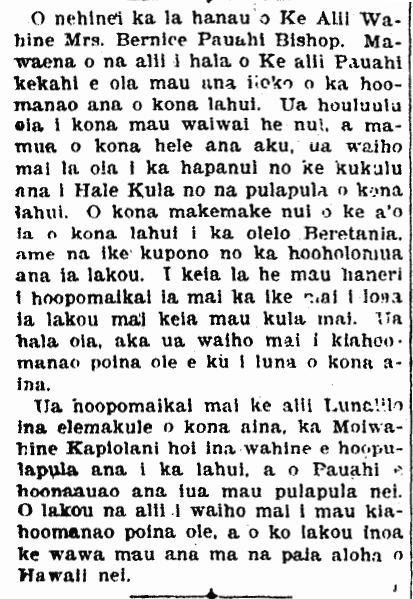
Yesterday was the birthday of The Chiefess Mrs. Bernice Pauahi Bishop. Amongst the alii who passed on, Ke alii Pauahi is one who lives on in the minds of her lahui. She accumulated her great wealth and before her passing, she left most of it to build a School for the children of her people. Her strong desire was that her lahui be taught English and the proper knowledge for them to progress. Today there has been hundreds who have benefited from the knowledge they gained from these schools. She has gone on but left an unforgettable monument standing upon her land.

Lunalilo blessed the old people of his aina; Queen Kapiolani, the women who are increasing the race; Pauahi, educates those children. Those are the alii who left enduring monuments; and their names shall forever reverberate against the beloved walls of Hawaii nei.

(Kuokoa, 12/20/1901, p. 2)

O nehinei ka la hanau o Ke Alii Wahine Mrs. Bernice Pauahi Bishop...

Ka Nupepa Kuokoa, Buke XXXIX, Helu 25, Aoao 2. Dekemaba 20, 1901.

Birthday of Mrs. A. Pauahi Bishop, 1869.

[Found under: “NU HOU KULOKO: Oahu.”]

Birthday of the Alii Pauahi.—On the 20th of December, a party was held at Koholaloa, to celebrate the birthday of one of our young chiefs, that being the Honorable Mrs. A. Pauahi Bishop, recognizing her reaching thirty-eight years old. This past 19th was a Sunday and was her actual birthday, but because it fell on a Sunday, it was not observed. It was left until the following Monday. The lanai where the party was held was honored by the arrival of the Governess of Hawaii [Keelikolani], the Hon. Mrs. L. Kamakaeha, Mrs. L. Kaaniau [Kekaaniau], and the other dignitary women of this town. Later that night, the chiefess whose birthday it was was entertained at her home, relying on Pauli, Malo, Kapoli, and Wakeki, who sang some name songs for that alii. They were appreciated for their singing.

(Kuokoa, 12/25/1869, p. 2)

La Hanau o Pauahi Alii.

Ka Nupepa Kuokoa, Buke VIII, Helu 51, Aoao 2. Dekemaba 25, 1869.

Death of Abner Kuhooheiheipahu Paki, 1855.

The death of A. Paki, on the 13th of this June.

The chief A. Paki. He appears in the genealogy of the Chiefs of this Nation, from ancient times, and he is a high Chief of this land descended from Haloa, that being the one father of the children living in this world, and the father of our people.

Part of his genealogy is taken from the High Chiefs of the land, and he is part of Kamehameha’s, and he is part of Kiwalao’s, and he is a hereditary chief of a single line from ancient times; and he was a father who rescued from trouble his people of this nation from Hawaii to Kauai.

His accomplishments during his life. When he promised to stop drinking and to become a Christian, from that time on he did not drink alcohol again until the day he died.

He was a Chief who was steadfast in his work for the nation, and he was an Alii who would be furious when he heard his deceased child being spoken ill of, as well as of his children who survive him.

From what I have seen of this Alii while he was alive. In the year 1837, he began his governmental work, and at one point he was appointed Chief Justice [L. K. Kiekie] of the country, and at another point he served as Governor, and another time he was included in the Privy Council, and still another time he was the steward for his child, this during his lifetime. Continue reading

Konia’s kanikau for Paki, 1855.

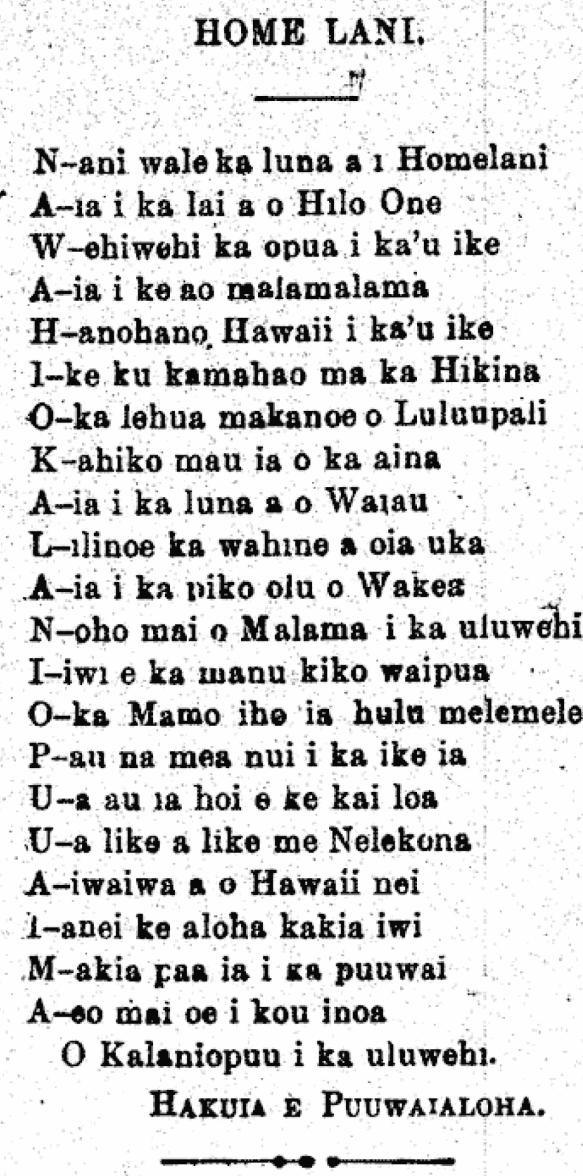
HE KANIKAU NO A. PAKI.

Kuu kane kaikunane ke aloha,
Mai ko maua wa uuku ka noho ana a hiki i keia manawa,
Aole hoi a’u kane, aole ana wahine,
Oia ko kaua noho ana a hele aku la oe,
Ke kanikau nei au me na keiki a kaua i ko aloha,
He aloha ia oe, e Kuhooheiheipahu,
Auwe no hoi kuu kaikunane mai ka makani o Lele he Maaa,
Mai na ale hulilua o Pailolo,
Ua hele o Kalanihelemailuna i ka hora eha i ka wanaao,
Ua haalele mai nei i ka pili a maua,
Kuu hoa no hoi o ka aina pilikia a kakou i ike ai,
Oia hoi ke Kaona nui ma Honolulu nei,
Ua hele hoi oe me ka makaukau,
Noho au me ka hemahema,
He kaumaha he luuluu he pilikia keia e noho nei,
Noho aku la oe i ka nani mau loa,
A kaua i huli ai me na keiki a kaua,
Uwe helu mai kana kaikamahine o Kalohelani,
Auwe no hoi kuu Makuakane leo ole—a,
Na’u ka olelo malaila wale mai no ia,
Aole no e pau ko’u kanikau ana ia oe no ko makou makua ole—a,
Ua paumako makou i ke aloha ia oe e ka Makua,
I ka make koke ana’ku nei—a,—
Aka o ka ne a ke Keiki Makua, aole ia L.

L. Konia.

(Elele E, 6/16/1855, p. 20)

HE KANIKAU NO A. PAKI.

Ka Elele E, Buke 10, Aoao 20. Iune 16, 1855.

Funeral of Konia, 1857.

The Funeral of Konia.

The obsequies of the late chiefess Konia were performed on Tuesday, and notwithstanding the sickness which has been so general prevented numbers of persons from attending, the aggregate of those collected to show their respect on the occasion was very large, whilst the crowd that thronged both sides of the streets, as the procession moved along, was so great as to require a strong force to preserve the line of march from the late residence of the deceased lady to the Royal cemetery, in which the coffin was placed. The religious services were performed by the Rev. Mr. Clark, and the ceremony was conducted throughout with a decorum and feeling which was remarked by all present.

(Polynesian, 8/8/1857, p. 108)

The Funeral of Konia.

The Polynesian, Volume XIV, Number 14, Page 108. August 8, 1857.