Maybe this one is just a little closer to the original. Does anyone know of a font that looks the same as the original?
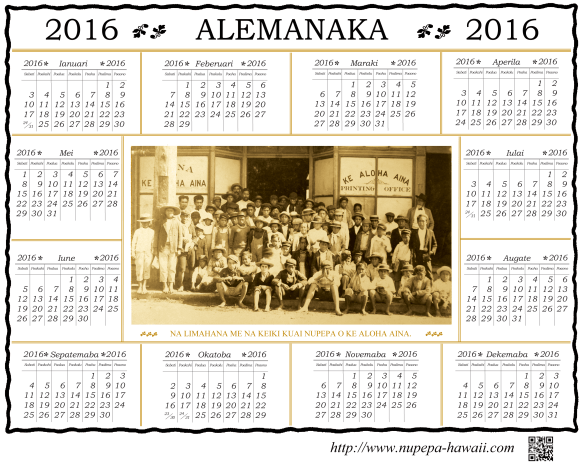
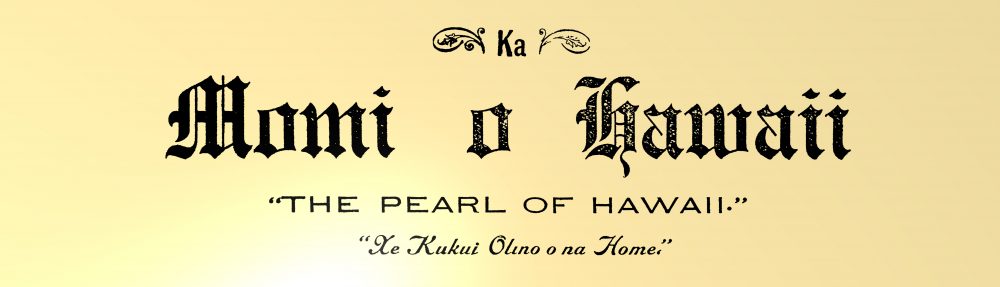
Maybe this one is just a little closer to the original. Does anyone know of a font that looks the same as the original?
Here is the 2016 nupepa-hawaii.com calendar fashioned after the one given away a 110 years ago by Ke Aloha Aina newspaper in 1906! Feel free to print it out for yourself or to share it with friends. To get to the PDF image (from which you can print or download), simply click on the image below:
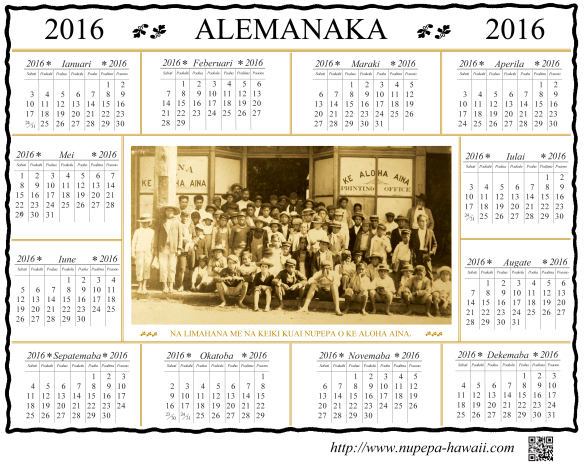
See you all again in January. Let’s all have a hauʻoli makahiki hou!!
The death of Kapena A. Adamu.—On this past Friday, Oct. 27, here in the town of Honolulu, Captain Alexander Adams [Alekanadero Adamu] died at 91 years and 10 month of age on this earth. He was born in Scotland in 1780, and he died on the sands of Kakuhihewa [Oahu]. He first came to Hawaii nei in the year 1810. Not long after, he was soon under the employment of Kamehameha the great. He was the Captain who sailed the double-masted ship Kamehameha to China with a cargo of sandalwood [iliahi], and that wood from Hawaii was heavily taxed. That was the first haole and pilot who entered the port of Kou [Honolulu]. He lived in Hawaii for 61 years becoming a local.
(Kuokoa, 11/4/1871, p. 2)
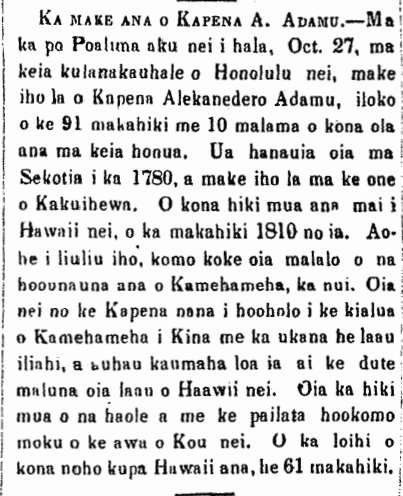
Ka Nupepa Kuokoa, Buke X, Helu 44, Aoao 2. Novemaba 4, 1871.
Mr. Editor of the Hoku o Hawaii;
Aloha oe:—O honorable one of the Hoku o Hawaii, please allow me an open space of our pride, for my dear husband who was greatly loved, my parent and companion of my body, my my companion to talk with in the cold dewy nights, my companion of our young days, my lei which I never removed in the famous land of Puna with the fragrant bowers of pandanus; in Puna dwells beauty and goodness, a dwelling visited always by fragrance and perfume. My dear kane has gone, gone too my desire, auwe my unending aloha for my man.
My dearly beloved husband was born from the loins of Hopeole (m) and Keliioniu (f) in the year 1876, at Opihikao, Puna, Hawaii, and she spent 39 years breathing of the air of hardship of this worldly life. Auwe, my endless regret for my dear husband. We were joined in the holy bond of matrimony on the 10th of October 1905 by the Father J. L. Kalawe, and we were married for 10 years and 1 month when he left me, the his wife and companion. Auwe the pain of my thoughts. He first became sick in the month of April until November when he left me, and the family, and our hanai children. The Doctor was called twice, but the ailment was beyond treatment, and loosened our loving bond at 2 o’clock in the morning, Thursday the 11th, when the rain came down with a clatter and the love-snatching wind blew with force, and the spirit of my husband glided silently away leaving behind his cold body for me to grieve after. Auwe, my dear kane. No more will I hear his loving voice calling out to me, “O Mama,” that is how he always called me until his last hour, and he spoke these words: “O Mama, I am leaving you; perhaps you will be cared for by our children, perhaps not.” Auwe, my grief for my dear kane, my companion in the works of the Lord. We were lovingly together in all places, from the Kanilehua rains of Hilo, to Waiohinu with its Haao rain, and so too Kona with its puffy clouds on the horizon of its calm seas and the Kukalahale rain of Honolulu. Auwe my never ending remorse for my dear husband. Continue reading
Kapalama, July 7, 1848.
O Elele Hawaii, aloha oe. Tell the people and the other Islands of this Nation of the great devastation that happened here in Honolulu last night.
On the 6th of July, at perhaps 1 o’clock at night, three houses went up in flames at the North East corner of town, near the North side of Kaumakapili Church [not where it is located now]. One adobe house and two pili grass houses. The adobe house belonged to Kahehenanui, a member of the church and a widower. One of the pili houses belonged to Kauhema, a church member, and that new pili house was only completed some months ago. The other pili house belonged to Lio and was about three years old.
The fire started at the new pili house of Kauhema on the south side of the structure in the lanai. A candle was burning there and the flame caught on to the wall of the lanai. The fire leaped from the house of Kauhema and caught the adobe house of Kahehenanui on fire, and then the fire jumped to the house of Lio, and those houses were all consumed leaving the house of Uilani located makai of those houses to escape from being burned down; the Church escaped the fire as well. Continue reading
According to many of this town who went to go see a moo found in the ocean one of the days last week for themselves, it was indeed a moo and not an eel, for it looked like a snake [moo nahesa], but the only difference was that it was a moo that lived in the ocean.
The length of this moo was thirty inches long; it had a colorful body with stripes near its tail; its head was like a snake seen in foreign lands on shore. Continue reading
Because of the benevolence of the Board of Health [Papa Ola], by them taking up the building of a Movie and Entertainment House for the Patient Colony [Kahua Ma’i] here, we therefore revoke our Requests put out by us to the Fundraising Committees which were approved by us. As for the Committees that collected money for this endeavor, please send it to the Secretary of the Committee, Mr. Joseph Aiona, or to the Superintendent [Lunanui] of this Patient Colony, Mr. J. D. McVeigh.
By way of the Committee, the people of the Patient Colony send their boundless thanks to the Fundraising Committees [Komite Ohi Dala] for this work, and to all those who gave their donation. May God bless us all in the Name of Jesus, Amen. JOSEPH AIONA,
Secretary.
(Hoku o Hawaii, 12/30/1915, p. 3)
Ka Hoku o Hawaii, Buke 10, Helu 30, Aoao 3. Dekemaba 30, 1915.
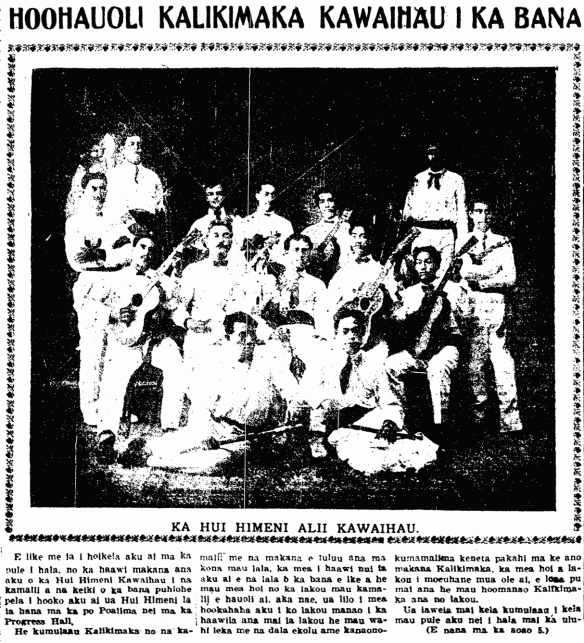
KA HUI HIMENI ALII KAWAIHAU
Just as was announced last week that the Kawaihau Glee Club would give presents to the children of the band boys, that Glee Club did indeed do so on this past Friday night at Progress Hall.
There was a Christmas tree for the children with presents weighing down on its branches, which were given generously [for] the band members to see, things to give joy to their children; however, they were shocked by being each given envelopes with three dollars and sixty-five cents as a Christmas gift, something they did not bef0re dream of, that they too would receive Christmas presents.
This tree was brought some weeks ago from the…
(Kuokoa, 12/28/1906, p. 1)
Ka Nupepa Kuokoa, Buke XLV, Helu 52, Aoao 1. Dekemaba 28, 1906.
…forests of Oregon, and it was right in the middle of the room where the tree was stood, with strings of tinsel glistening and candles shining on the branches swaying with snowballs filled with candy; and because of the low light in the room, the beauty of the festooned tree was clearly seen.
The Kawaihau Glee Club took their place atop the stage [awai], and there they opened with the song “Aloha oe,” and after they were done with that song, they played the “Kawaihau Waltz,” and that was when Santa Claus came in, that being O. Swain, and said that his sleigh was broken which was why the presents didn’t comewith him, but they were at the door, and some young singers brought the presents over to Santa Claus and he distributed them to the children and the room was just like a musical instrument shop with all the noise coming from the instruments of the children. Each of the children played trumpets like the Hawaiian Band (of Children).
The most amazing thing that night was the handing over of envelops to each of the band members with a present within, and after the presents were done being handed out, Mr. Naone stood representing the members of the Hawaiian Band [Bana Hawaii] and gave their thanks to Sam Nainoa and his fellow members of the Glee Club for their honoring them; it wasn’t just something surprising for them, but something that gave them joy.
Sam K. Nainoa responded from the Glee Club and was appreciative that what was planned went smoothly, and for him were given cheers of joy.
There was also a light meal set out for the families of the band members, and they ate their fill of that food, and those that desired to dance, they went at it; were it not for the sleepy children the activities of the night would not have let out so quickly.
Let it be recalled that the money used for this gift giving, that being the money that Mr. Nainoa and his Glee Club worked for by holding a dance at the Young Hotel to help the Hawaiian Band who was at Nevada. The profit from that activity was two hundred and thirty-one (231) dollars.
(Kuokoa, 12/28/1906, p. 5)
Ka Nupepa Kuokoa, Buke XLV, Helu 52, Aoao 5. Dekemaba 28, 1906.
This past week, death came and took away this old Kamaaina of Hilo, and his nature is well known to all the old timers of Hilo nei. He died at almost 95 years old. He was born at Pahoehoe near Paukaa, and moved and lived on the banks of the far side of Honolii; when there was no bridges on this stream, and when they first opened up the road, he took up the occupation of escorting people by Honolii Stream and escorting passengers by canoe, and after there were goats to transport people he at times helped pulling the passenger goats. When the many bridges of Honolii were built, he carried on his farming on the banks of that stream, and in his strong days, he sometimes worked in the sugar plantations while still living in the same place, and he was known by those who were familiar with him by the name “Alapai of Honolii” [Alapai o Honolii]. Continue reading
While Jordan A. Silva and Medeiro were fishing at the surf break behind the Elks Club building in Waikiki, Silva caught a 42 inch long eel, that is three feet and six inches long. This eel was huge, and it was worth going fishing. It was this Monday when he caught the eel, that being Labor Day [la o na limahana].
(Alakai o Hawaii, 9/17/1931, p. 3)
Ke Alakai o Hawaii, Buke 3, Helu 20, Aoao 3. Sepatemaba 17, 1931.
 nupepa