King Kalakaua’s birthday to become a new holiday? 1916.

CELEBRATED WAS THE BIRTHDAY OF KING KALAKAUA YESTERDAY

THE DAY WAS CELEBRATED BY HAWAIIANS, THE HAOLE, THE LOCALS, AND THE NEWCOMERS, WITH THE THOUGHT THAT IT WOULD BECOME A NATIONAL HOLIDAY IN THE FUTURE.

1836—1891

[Williams Photo]

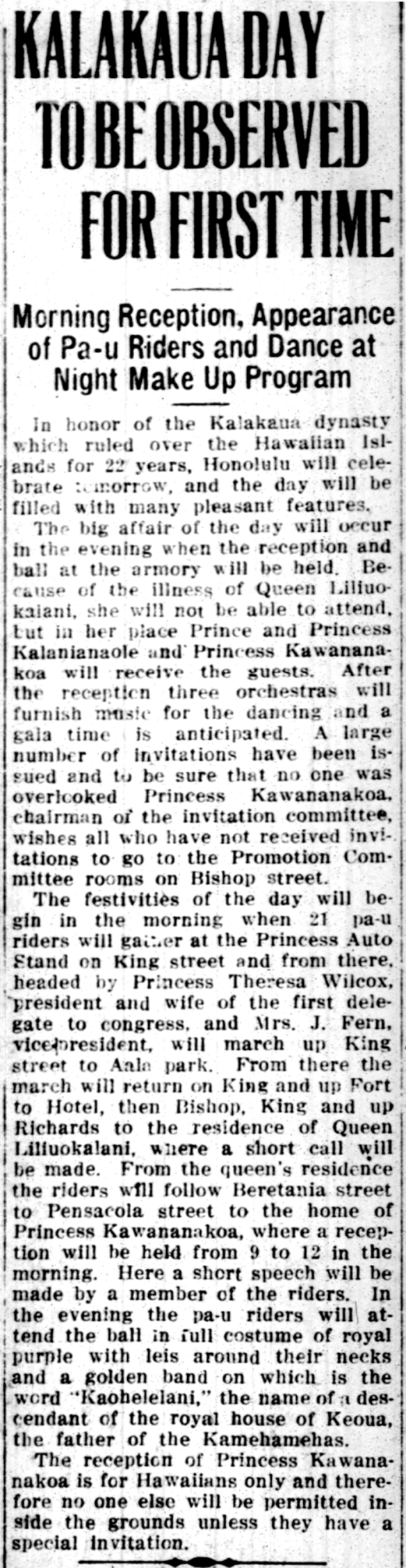
KALAKAUA’S BIRTHDAY CELEBRATED.

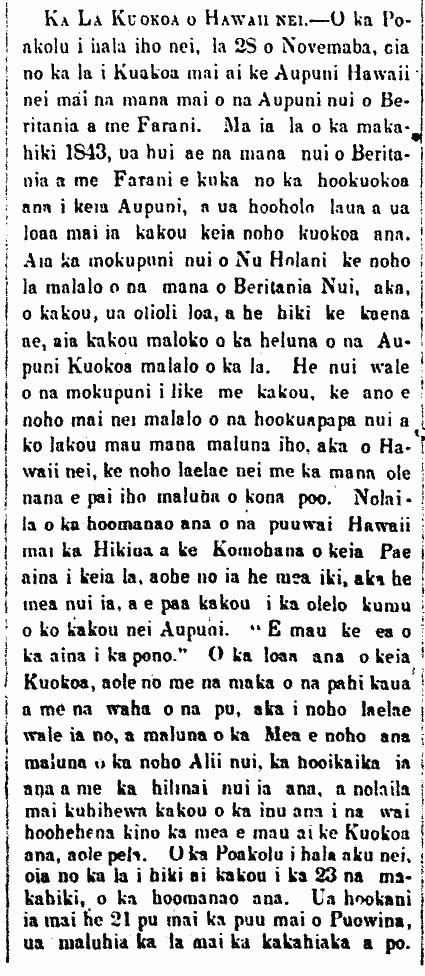
For the first time, a commemoration of the birthday of King Kalakaua held extensively here in this city yesterday; this day will be celebrated in the future as is the birthday of the Conqueror of the Nation, Kamehameha.

In years past, there were but a very few people who celebrated this day, but from now on, the birthday of Kalakaua will be a day that is important in the history of Hawaii nei.

The activity taking place on the first celebration was the pa-u riding of twenty-one women of the Kaohelelani Pa-u Riders presided over by Mrs. Theresa Wilcox Belliveau. Continue reading

Life stages 15. Haumakaʻiole, 16. Palalauhala, and 17. Kāikōkō.1905.

[Found under: “KA MAKUAHINE PALEKA.”]

The famous saying of the Hawaiians said always in prayers of the old kahuna—”Haumakaiole, palalauhala a kaikoko;” it was those words that showed how long lived the ancient Hawaiians were. Because from the actual meaning of the word “haumakaiole,” it is the shriveling of a person’s eyes that is all wrinkly, which is why they are tiny like that of a rat’s, and that is the stage after gray-haired [poohina]; and elderly [elemakule] comes before gray-haired, but elemakule is the general stage for when a person becomes frail [palupalu].

And after an old and frail person passes the stage of “haumakaiole,” then that person enters into the stage “palalauhala,”and the idea behind that it is the very old age of a person if he continue to live, he cannot walk around by himself, should he not perhaps receive assistance; that is when the person lies constantly atop a mat, and sometimes the person is rolled up in a mat. Continue reading

One more from the Deshas, 1944.

Our Day

THE CALM SEAS OF KONA

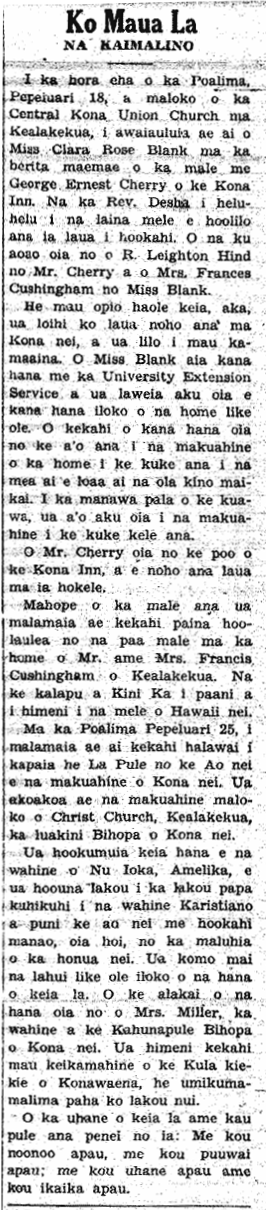
At four o’clock on Friday, February 18, and in the Central Kona Union Church, Miss Clara Rose Blank was joined in holy covenant of matrimony with George Ernest Cherry of Kona Inn. Rev. Desha read the lines of the mele which made the two of them into one. The attendants [ku aoao] were R. Leighton Hind for Mr. Cherry and Mrs. Frances Cushingham for Miss Blank.

These are haole youths, but they lived here in Kona for a long time, and have become kamaaina. Miss blank is working for the University Extension Service, and her work takes her into the different homes. One of her duties is to teach housewives how to cook nutritious foods. When guava is ripe, she taught the mothers how to make jelly.

Mr. Cherry is the head of Kona Inn, and they will live at the hotel.

 After the wedding a celebratory party was held for the married couple at the home of Mr. and Mrs. Francis Cushingham of Kealakekua. The club of Kini Ka played and sang the songs of Hawaii nei.

On Friday, February 25, a meeting was held called a Day of Prayer for the World by the mothers of Kona. The mothers gathered in Christ Church, Kealakekua, the Episcopal church of Kona nei.

This endeavor was begun by the women of New York, America, and they sent their program to Christian women all over the world who have the same thought, that is peace on earth. All the various ethnicities participated in the activities of the day. The leader of this exercise was Mrs. Miller the wife of the Episcopal pastor of Kona. Some girls of Kona Waena High School sang; there were perhaps eleven of them.

The spirit of the day and the prayer went like this: With all of your though, with all your heart, with all your soul, and with all your strength.

(Hoku o Hawaii, 3/8/1944, p. 2)

Ko Maua La

Ka Hoku o Hawaii, Volume XXXVIII, Number 46, Aoao 2. Maraki 8, 1944.

Even more from the Deshas, 1944.

Our Day

THE CALM SEAS OF KONA

These past days, the Rev. Desha went to Hilo for a conference of pastors held there. He went with Rev. Paul Morimoto and Rev. and Mrs. James Upchurch. Rev. Desha said that this was one of the finest Conferences.

Rev. Desha planned to go to Honolulu once the Conference in Hilo was over for the birthday of his Aunty, Mrs. Bella [Isabella] Desha, and those who know her as Mother Desha. But he gave up this idea to go when he hear that his cousin, Alika Desha, left this life, the youngest son of Mother Desha. How regretful for these young Hawaiians.

Alika [Alexander] Desha was born in Honolulu, and he was forty-nine years old. He was educated at the government schools of Honolulu and Hilo. He married Emma Ukauka of Honolulu and from this union they had five children. For over twenty-five years he worked for the store of P. C. Beamer, his brother-in-law, in Hilo.

The family from Honolulu who came for the funeral was Mother Desha [Isabella Desha], mother of the deceased; Mrs. Ida Becker, sister; David Desha, older brother, Mr. and Mrs. John R. Desha, cousins; and the children, Capt. Adolph Desha, Alec Jr. and Vivian. The funeral was held in the afternoon of Thursday, January 13, 1944. The first funeral congregation was held Elmore Funeral Home for the family and friends. Rev. Moses Moku and Rev. Desha performed the service. The final funeral congregation was held at the Masonic Hall under the direction of the Masons, and there were many friends who came.

The celebration of the birthday of Mother Desha was not neglected, but the children and grandchildren of the one whose day it was gathered in the morning of the Sabbath and honored her with a very nice party. She is eighty years old.

(Hoku o Hawaii, 1/26/1944, p. 1)

Ko Maua La

Ka Hoku o Hawaii, Volume XXXVIII, Number 40, Aoao 1. Ianuari 26, 1944.

Veterans’ Day in Hilo Town, 1943.

The 11th of November

Twenty-five years ago, on a Sunday, there was heard the ringing of the church bells here in Hilo. People asked one another, “What are these bells ringing?”

Calls to the telephone operator [kikowaena] rushed in, “Why are the bells sounding?”

The operator replied, “THE WAR IS OVER IN EUROPE. The opposing nations surrendered, and the Treaty was signed.”

That is when people began shouting, and those of the Chinese shops were woken up. Firecrackers were purchased and set off, and cars began going through the streets tooting their horns and dragging cans behind them. This did not cease until the hours of dawn came.

The following Monday became a great day in Hawaii nei and all of those victorious countries of the first world war. There were no bars in those days, because of the prohibition. Continue reading

And more from the Deshas, 1944.

Our Day

THE CALM SEAS OF KONA

Kealakekua, Friday, May 12, 1944—This is the birthday of our firstborn, Stephen Luluhiwalani Desha, III. Today he is twenty-two years old. This afternoon the Rev. Desha will go down to Milolii because he will hold prayer there this Sunday. He is going to Milolii at once because he wants to go fishing. He wants some fish to take to Honolulu. The kamaaina sends you off, O malihini, with a bundle for your hand.

I will not get to Milolii this week, and our Aunty, Mrs. Annie Au of Napoopoo and her grandchild, will go down with Rev. Desha. She will stay with Mrs. Sarah Kalua, the teacher of Milolii, and Rev. Desha will stay at the home of his friends, Mr.and Mrs. Eugene Kaupiko.

 Saturday, May 13, 1944—By way of telephone from Honolulu, I heard the sad news of Mrs. Kaulani Woodward, that she left this world of life. Aloha ino no. Mrs. Woodward was the actual Aunty Judge R. Desha of Honolulu, Mrs. Eliza Desha Brown of Hilo and the Rev. Desha of Kona, and she was the actual younger sister of their mother, Mary Kaakopua Desha. Mrs. Kaulani Woodward was born in Napoopoo, Kona, and she was raised there until she was grown up. She married David Bent, and had two sons by this marriage, David Kaonohi Bent and Henry Kuuhaealoha Bent. Mrs. Pearl Nye and Samuel Kekumano are children of her brother, Samuel L. Kekumano who passed on earlier. She was married again to the Rev. Joseph Woodward perhaps twenty years ago or more. The first resided in Kohala, during the time when Rev. Woodward was assigned as Kahu for the Kalahikiola Church. They moved to Waimea when Woodward became Kahu for Imiola Church. They moved once more to Napoopoo when Rev. Woodward was called to be the Kahu for Kahikolu Church. There they lived until Woodward retired. They then returned to Honolulu this past year. From what I heard, the funeral will be held on Monday, May 15. The kamaaina of our beloved land are going little by little.

[This is a nice genealogy centered around Kaulani Woodward. Genealogy can be found anywhere!]

(Hoku o Hawaii, 5/24/1944, p. 1)

Ko Maua La

Ka Hoku o Hawaii, Volume XXXIX, Number 5, Aoao 1. Mei 24, 1944.

Names for the stages of life, 1909.

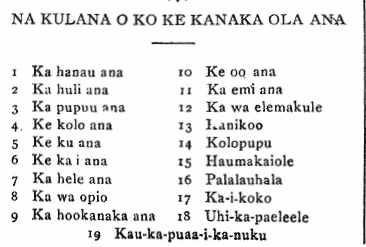
NA KULANA O KO KE KANAKA OLA ANA

1  Ka hanau ana

2  Ka huli ana

3  Ka pupuu ana

4  Ke kolo ana

5  Ke ku ana

6  Ke ka i ana

7  Ka hele ana

8  Ka wa opio

9  Ka hookanaka ana

10  Ke oo ana

11  Ka emi ana

12  Ka wa elemakule

13  Kanikoo

14  Kolopupu

15  Haumakaiole

16  Palalauhala

17  Ka-i-koko

18 Uhi-ka-paeleele

19  Kau-ka-puaa-i-ka-nuku

(Lanakila, 9/23/1909, p. 26)

KE KULANA O KO KE KANAKA OLA ANA

Ka Lanakila, Buke 1, Helu 11, Aoao 26. Sepatemaba 23, 1909.

Kona Inn ad in Hawaiian, 1947

HOKELE KONA

MOKUPUNI O HAWAII

E hoomohala aku no ka Hokele Kona i na mea e Hoohauoli ai i ka olioli o ka Uhane

HUI MOKU HOLO PILI-AINA,

Kaupalenaia

Na Agena No Ka Hokele Kona

(INTER-ISLAND STEAM NAV. CO., LTD.

Agents for Kona Inn

(Hoku o Hawaii, 8/6/1947, p. 1)

HOKELE KONA

Ka Hoku o Hawaii, Volume XLI, Number 11, Aoao 1. Augate 6, 1947.

More from the Deshas, 1944.

Our Day

THE CALM SEAS OF KONA

Kealakekua, Thursday, April 27, 1944. This morning the Rev. Desha went down to Kailua, to the Kona Inn, to fetch his namesake grandchild, Winona Beamer. She had a friend with her. The Rev. Desha went with our first child, Stephen Desha III, to take Winona Beamer and her friend to Hale o Keawe at Honaunau. They saw the Stone of Keoua [Pohaku a Keoua], the stone konane board, the stone with holes to bury the umbilical cord of babies of those days, the stone that Kaahumanu used to hide from Kamehameha with, and the stone god figures.

After their tour was over they returned to Napoopoo and saw the Monument to Opukahaia and the bay of Kealakekua. And after that was done, they came back to our home to eat lunch. After lunch, we had an enjoyable time with Winona Beamer with the piano and all of us singing.

At 2:00 p. m., a haole arrived, Mr. Lester, a friend of these girls, and we all went to Huehue, to the home of those friends, Mr. and Mrs. Theodore Vredenberg [Vredenburg]. We spent a pleasant time with Mrs. Vredenberg and saw her drawings of all sorts of flowers. One of her pictures was of the flower of the Hawaiian ape. These drawings were not small, they were big indeed. The length of this drawing is around three feet while the width is about two feet and a half. If you look at this drawing, it looks as if it is growing in the picture. After enjoying our time, we turned back and the visitors returned to the Kona Inn.

Friday, April 28, 1944. At 9:00 this morning, the two of us went to the Dentist [Hale Kauka huki niho] and had a checkup. My tooth was chipped from eating the charred skin from a kalua pig. I ate it because it was tasty, and alas my tooth became chipped. I was so lucky, the doctor said it was not a big thing to insert a new tooth, and that is what he will do.

[This was a fun account, perhaps mostly because I know the awesome daughter of Theodore and Beatrice Vredenburg!]

(Hoku o Hawaii, 5/10/1944, p. 1)

Ko Maua La

Ka Hoku o Hawaii, Volume XXXIX, Number 3, Aoao 1. Mei 10, 1944.