Leleiohoku appointed Prince Regent, 1874.

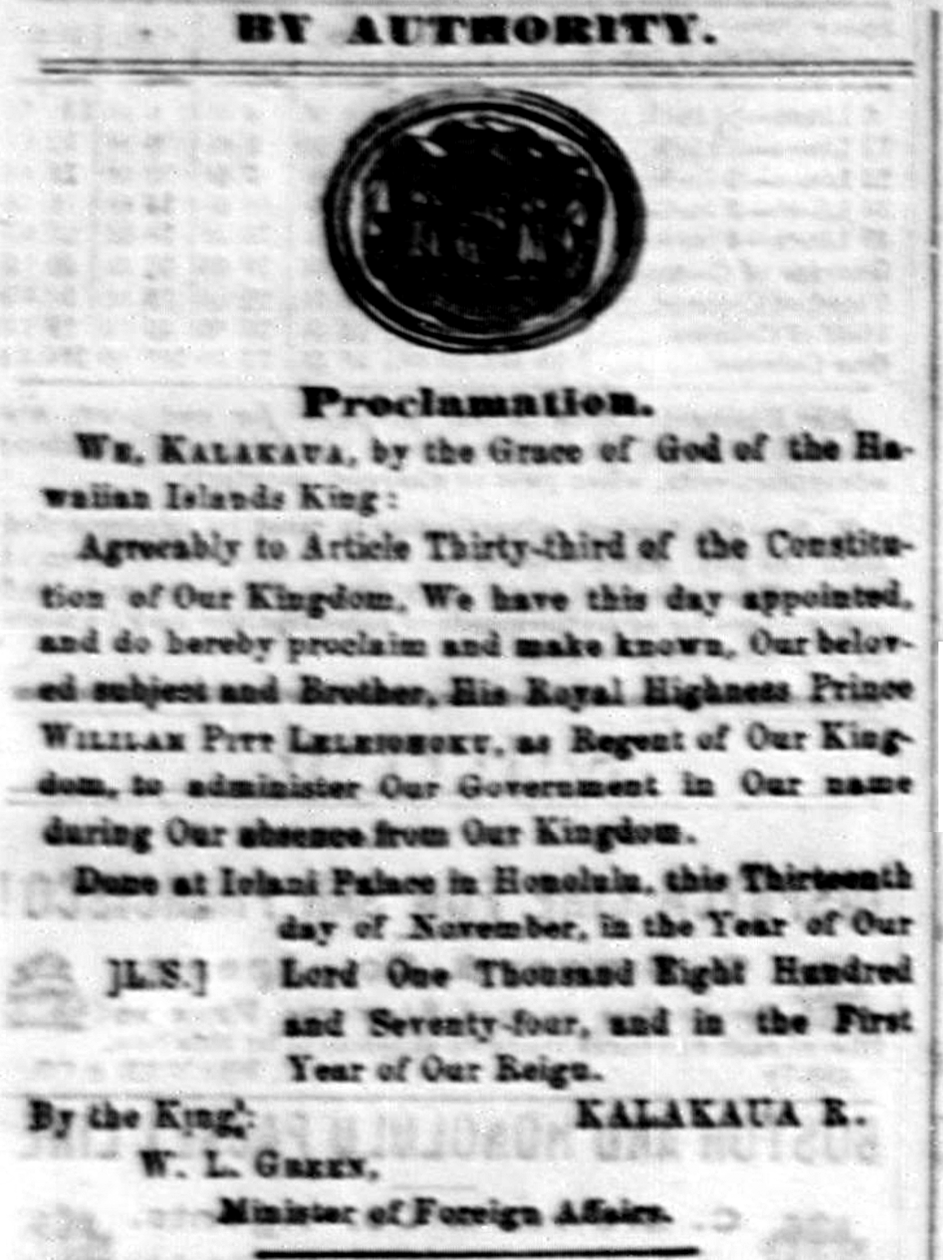
BY AUTHORITY.

Proclamation.

We, Kalakaua, by the Grace of God of the Hawaiian Islands King:

Agreeably to Article Thirty-third of the Constitution of Our Kingdom, We have this day appointed, and do hereby proclaim and make known, Our beloved subject and Brother, His Royal Highness Prince William Pitt Leleiohoku, as Regent of Our Kingdom, to administer Our Government in Our name during Our absence from Our Kingdom.

]L. S.]

Done at Iolani Palace in Honolulu, this Thirteenth day of November, in the Year of Our Lord One Thousand Eight Hundred and Seventy-four, and in the First Year of Our Reign.

KALAKAUA R.

By the King

W. L. Green,

Minister of Foreign Affairs.

(Hawaiian Gazette, 11/18/1874, p. 2)

BY AUTHORITY.

Hawaiian Gazette, Volume X, Number 46, Page 2. November 18, 1874.

O Leleiohoku ke Kahu Aupuni, 1874.

MA KE KAUOHA.

O MAKOU O KALAKAUA, ma ka Lokomaikai o ke Akua, Moi o ko Hawaii Pae Aina:

I kulike ai me ka Pauku Kanakolu kumamakolu o ka Kumukanawai o ko Makou Aupuni, ke hookohu aku nei Makou, a ke kuahaua aku nei me ka hoikeike aku i ko Makou makaainana a kaikaina aloha, Ka Mea Kiekie ke Alii ke Keiki Alii WILLIAM PITT LELEIOHOKU i Kahu Aupuni no ko Makou Aupuni, e lawelawe i na hana o ke Aupuni ma ko Makou inoa, oiai ko Makou kaawale ana mai keia aupuni aku.

Hanaia ma Halealii Iolani, ma Honolulu, i keia la Umi-kumamakolu o Novemaba, Makahiki o ko Kakou Haku, Hookahi Tausani Ewalu Haneri a me Kanahiku Kumamaha, a i ka mua o na makahiki o ko Makou noho Alii ana.

Na ka Moi     KALAKAUA R.

W. L. Green, Kuhina o ko na Aina e.

(Kuokoa, 11/21/1874, p. 2)

MA KE KAUOHA.

Ka Nupepa Kuokoa, Buke XIII, Helu 47, Aoao 2. Novemaba 21, 1874.

Birthday of the Prince Regent, Leleiohoku, 1875.

Birthday of the Heir to the Throne.

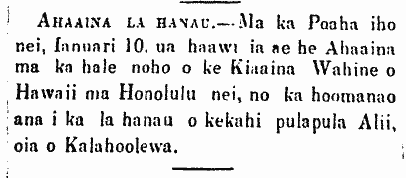
This coming Sunday, the 10th of January, is the birthday of Prince W. P. Leleiohoku, and he will be twenty years old. He was born on the 10th of January, 1855, on the day of King Kauikeaouli’s funeral, and for that reason, he is called Kalahoolewa. According to what we have heard, the day will be held as a holiday [la hoomanao kulaia]; however, because the day falls on a Sunday, the commemoration will be postponed until Monday, that being the 11th of January this year; and this will be the first time that his birthday will be widely celebrated, for us to give high tribute to the one who is Prince Regent in place of his Brother the King who has left for lands afar. With stirrings of expectation, we are hopeful that this will be a day set aside as a holiday that will be celebrated all over the kingdom appropriately.

[King Kalakaua was away from the Kingdom, travelling to Washington, DC, to secure a reciprocity treaty with the United States. Leleiohoku served as Prince Regent during this period from the Kalakaua’s departure on the morning of 11/17/1874 until his return on the morning of 2/15/1875.

For more, check out Nanea Armstrong Wassel’s Instagram page!]

(Lahui Hawaii, 1/1/1875, p. 2)

La Hanau o ka Hooilina Moi.

Ka Lahui Hawaii, Buke I, Helu 1, Aoao 2. Ianuari 1, 1875.

Leleiohoku’s birthday, 1868.

A Birthday Feast.—At 3 o’clock on this past Friday, a birthday party was held at Kaakopua, the home of the Royal Governess of the big island, to celebrate the day of birth of her hanai, the one who is named after the day of the funeral [hoolewa] of the departed King Kamehameha III, that is Kalahoolewa.

“Heia ka mano o ka ua i Alakai,
Nahae ka mauna weluwelu e ka noe,
Kau liilii i ke kiu wai ahulu,
Kapa ia mai e Waimea, he kiu
Ke komikomi la i ka wai pao—e.” Continue reading

A birthday celebration for Leleiohoku, 1867.

[Found under: “NUHOU KULOKO: Honolulu.”]

Birthday Banquet.—This past Thursday, January 10, a Banquet was held at the residence of the Governess [Kiaaina Wahine] of Hawaii island, here in Honolulu, to celebrate the birthday of this Chiefly offspring, that being Kalahoolewa.

[If you did a name search using Keelikolani or William Pitt Leleiohoku, this article would not have been found. People are often referred to by their rank or office, or by one of their many names. It would be an invaluable resource is there was one place that showed this kind of information.]

(Kuokoa, 1/12/1867, p. 2)

Ahaaina La Hanau.

Ka Nupepa Kuokoa, Buke VI, Helu 2, Aoao 2. Ianuari 12, 1867.

Not a bad day fishing! 1929.

MRS. MAHI CAUGHT AN AWA WITH A DIAMOND RING

One day this past week, Mrs. Esther Mahi went fishing like she always does. She always makes out at fishing; the kind that we Hawaiians call an iwi paoa [lucky]. But she was never as blessed before at fishing as she was this day, for she caught a huge awa (maybe an awa kalamoho), and within it she found a diamond ring of great value.

This ring is in the possession of Officer Palakiko, and it is looking for its owner.

Perhaps this is one of the rings which was advertised in the newspapers and thought to be lost.

(Alakai o Hawaii, 8/8/1929, p. 1)

HEI HE AWA IA MRS. MAHI ME KE KOMO KAIMANA

Ke Alakai o Hawaii, Buke 1, Helu 15, Aoao 1. Aukake 8, 1929.

Still lost? 1876 / 2015.

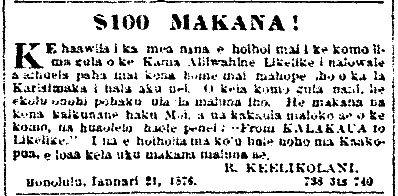
$100 REWARD!

Will be given to the one who returns Princess Likelike’s gold bracelet which was lost or stolen perhaps from her home soon after this past Christmas. This beautiful gold bracelet was set with three rubies. It was a gift from her lord brother, the King, and inscribed inside of the bracelet were the words in English as follows: “From KALAKAUA to Likelike.” If it is returned to my residence at Kaakopua, received will be the reward above.

R. KEELIKOLANI.

Honolulu, January 21, 1876.

[Might anyone know where this is located today? Let’s bring it back!!]

(Kuokoa, 1/22/1876, p. 3)

$100 MAKANA!

Ka Nupepa Kuokoa, Buke XV, Helu 4, Aoao 3. Ianuari 22, 1876.

First issue of “Ka Lahui Hawaii,” 1899.

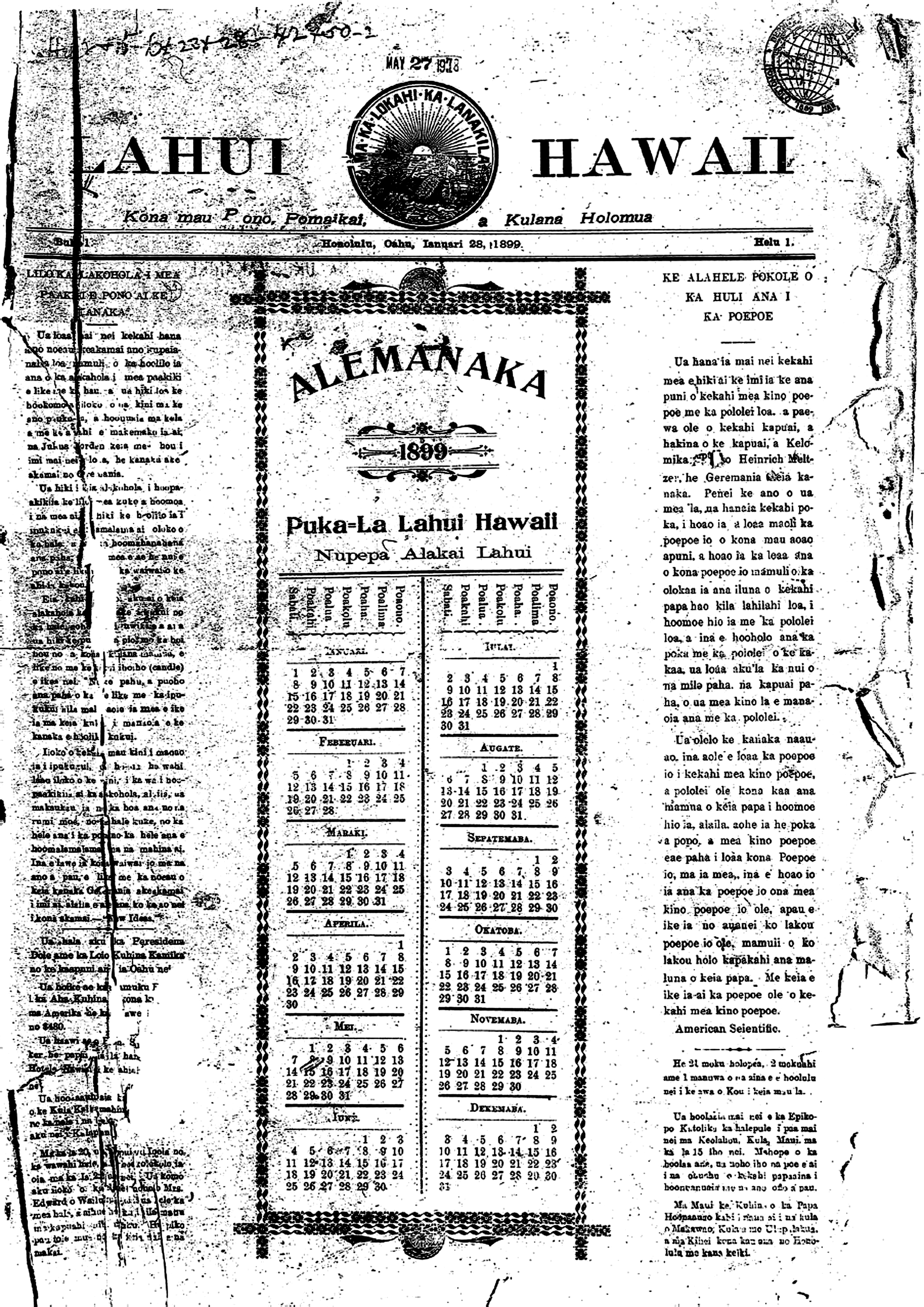
Here is an image of the first page of the first issue of a daily paper called Ka Lahui Hawaii (1/28/1899). It was printed in Honolulu, and its editor was Charles L. Hopkins [Kale Hapakini].

The seal on the masthead reads, “MA KA LOKAHI KA LANAKILA” [IN UNITY IS VICTORY]. And the main part of the masthead reads “LAHUI HAWAII Kona mau Pono, Pomaikai, a Kulana Holomua.” [THE HAWAIIAN PEOPLE, Their Welfare, Prosperity, and Progress].

[Unfortunately this newspaper that runs from 1/28/1899 to 1905 is still not available digitally online.]

Lahui Hawaii

Ka Lahui Hawaii, Buke 1, Helu 1, Aoao 1. Ianuari 28, 1899.


William Hyde Rice’s Hawaiian Legends in English, 1923.

[From the Preface of “Hawaiian Legends by William Hyde Rice”]

The collection of Hawaiian legends of which a translation is given in the following pages represents the work of many years by William Hyde Rice of Kauai. However, it is only within the last few years that Mr. Rice has translated the legends from his Hawaiian manuscripts. He has tried to make his version as literal as possible, preserving at the same time the spirit of the original Hawaiian, its flavor, rhythm, and phrasing. He has avoided adding modern embroidery of fancy, as well as figures of speech foreign to the Hawaiian language and to its thought and expression.

….

Mr. Rice has been exceptionally well prepared for this work, as he has been familiar with the Hawaiian language from his earliest childhood. In fact until he was twenty, he never thought in English but always in Hawaiian, translating mentally into his mother tongue. In 1870 when he became a member of the House of Representatives, during the reign of Kamehameha V, Governor Paul Kanoa and S. M. Kamakau, the historian, both well-known Hawaiian scholars, gave Mr. Rice much help with his Hawaiian, especially teaching him the proper use of various complicated grammatical constructions, and explaining obscure variations in pronunciation and meaning.

The sources of the legends in this collection are varied. A number of the stories Mr. Rice remembers having heard as a child, and now rare ones were gathered in later years. Many are from more than one source, but have corresponded even in details, and almost word for word. The legend of Kamapuaa, for instance, is one of the first which Mr. Rice remembers hearing. When a boy, the places mentioned in this story were pointed out to him: the spot where the demi-god landed, where he found the hidden spring, and where he rooted up the natives’ sugar-cane and sweet potatoes. The story of “The Small Wise Boy and the Little Fool” he has also been familiar with since childhood. The places mentioned in this tale can likewise be pointed out.

Most of the legends are from Kauai sources, but a number have been gathered from the other islands of the group. Whenever Mr. Rice heard of an old Hawaiian who knew any legends, he went to him, sometimes going to several to trace a special story, as for instance, the “Jonah and the Whale” story, “Makuakaumana”, which after a long search he finally procured from Mr. Westervelt. This curious story seem to be more modern than the others of the collection. While hunting for a reliable version of this story, Mr. Rice incidentally heard the story of “Manuwahi” at Heeia from an old Hawaiian.

“The Bird Man”, “Holuamanu”, “The Destruction of Niihau’s Akua”, and “The Girl and the Mo-o”, were obtained from Mr. Francis Gay, who is one of the best living scholars of the Hawaiian language. The Niihau legend was heard from several other sources as well. Mr. Gay also gave the legends of the “Rainbow Princess” and the “Shrimp’s Eyes”; the ti plants mentioned in the latter legend can still be pointed out, growing at the mouth of a little valley near Holuamanu. The Hawaiian manuscript of part of the Menehune story was obtained from J. A. Akina, while the story of the “Rain Heiau” was told to him in 1912 by a man named Naialau, who has since died at Kalaupapa. “How Lizards Came to Molokai” and Paakaa and Ku-a-paakaa” were told Mr. Rice by a man from Hawaii named Wiu, while the Rev. S. K. Kaulili, who is still living at Koloa, Kauai, gave him the most complete version of the “Rolling Island”.

During Mr. George Carter’s term as Governor, a reception was given in his honor, at Hanalei, where Mr. Rice was much interested in the very fine oli (chanting) of an old Hawaiian, named Kaululua. From him he obtained a number of legends, including that of “Ulukaa” from corresponding versions of other already in his collection. Other legends have been lost forever on account of ill-timed ridiculing by some chance companion, for Mr. Rice has found that the old people who know the legends are very sensitive, and when they find an unsympathetic auditor, refuse to continue their stories.

[It is often just as important to read the front matter and the back matter of a book than simply heading straight to the main text itself. Many times you can learn a lot of important information.

The stories credited to W. H. Rice found in the Hoku o Hawaii are probably the ones Rice collected over the years.]

(Rice, William Hyde. “Hawaiian Legends. Bernice P. Bishop Museum Bulletin 3.” Honolulu: The Museum, 1923.)
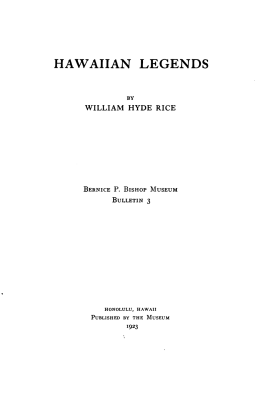
Hawaiian Legends

Hawaiian Legends by William Hyde Rice
The story of Kana, from William Hyde Rice, 1908.

A STORY

ABOUT

KANA, THE ROPE GRANDSON OF ULI

THE EXPERT OF HAWAII, AND THE MYSTERIOUS ONE WHO LOWERED THE FAMOUS PEAK OF HAUPU WHICH REACHED INTO THE HEAVENS—THE ONE WHO ALSO FETCHED THE SUN AT KUKULU O KAHIKI.

Hookaakaa ka Lani
Kakaa ka Iloli
Wehiwehi ka Mauna
Palamoa ka Opua

E Kana—e
Hina ia i o Uli ala
Ko Kupunawahine.
* ∗ * ∗ * ∗

[The Heavens Turn
Rolling are the pangs of pregnancy
Bedecked are the mountains
Dense are the clouds

O Kana
It is Hina and Uli is there
Your Grandmother.
* ∗ * ∗ * ∗]

(By the kindness of Hon. W. H. Rice of the Island Sun-Snatching Island.)

Uli (f) dwelt with Ku (m), born was Hakalani-leo (f), and she was called another name, Kuahuula. Kuahuula (f) dwelt with Haka (m), born was Kukahikapo (m), Halekamakamaole (m), Kuluakapo (m), Kukolukapo (m), Hanalolo (m), Ouwaikaaha (m), Paukukaula (m), Awepumaia (m), Kaeekowali (m), Pinawelewele (m), Niheu (m) and Kana. Uli (f) was born in Hilo, Hawaii, and she had a number of siblings. Manu (m) is from below in Milu, and Wakea (m) is from below in Papanuihanaumoku. They were high chiefs. Uli’s work was planting all growing things and making kapa. Continue reading