This could be interesting! Check out the description and schedule on their website here:
Hawaiian with leprosy sent back from California? 1906.
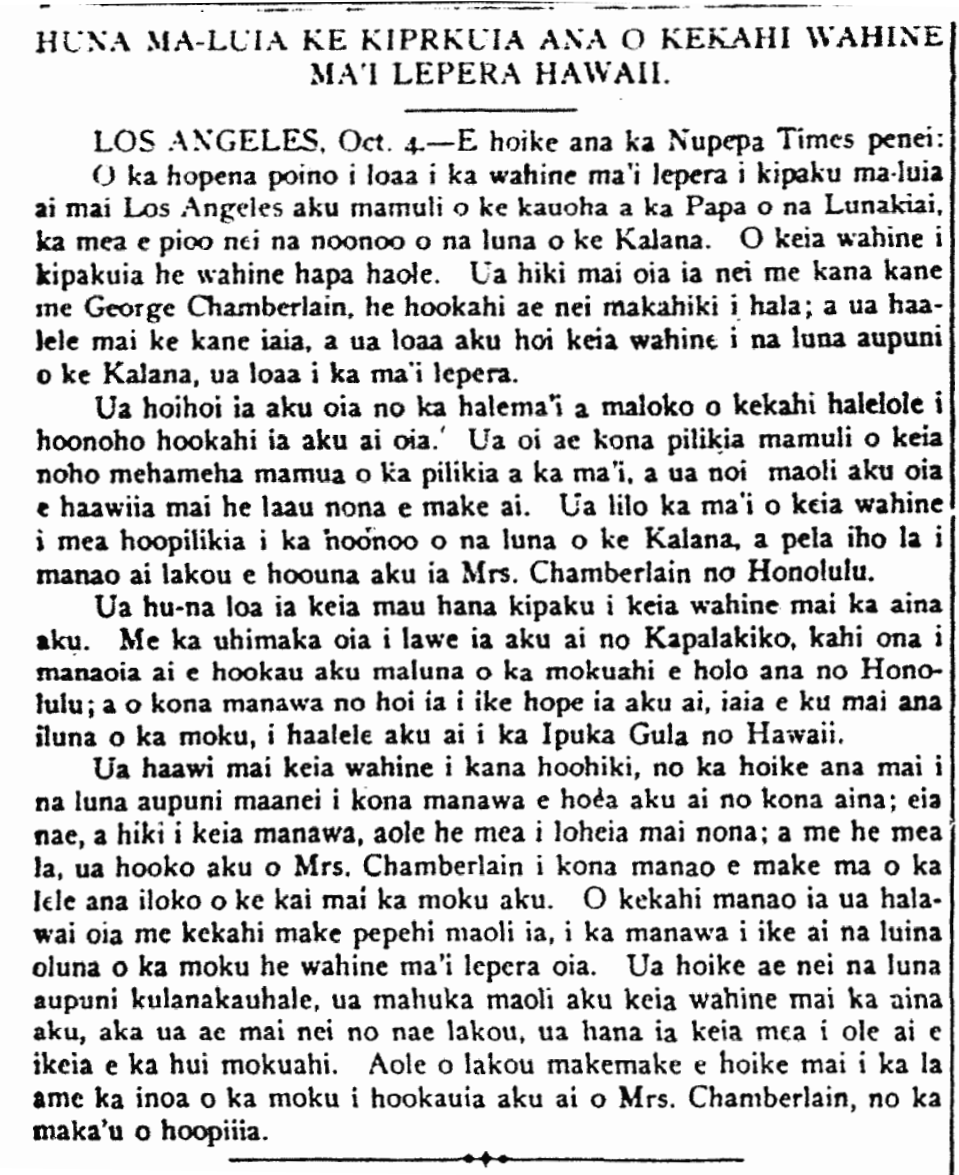
THE DEPORTATION OF A HAWAIIAN WOMAN WITH LEPROSY IS KEPT SECRET.
LOS ANGELES, Oct. 4.—The Times Newspaper reported thus:
The sad fate of a woman with leprosy deported secretly from Los Angeles because of an order by the Board of Supervisors [Papa Lunakiai] is what has gotten the heads of the County perturbed. This woman that was sent away is a hapa haole. She arrived with her husband, George Chamberlain, one year ago; her husband left her, and this woman was found with leprosy by the government officials of the County.
She was sent to the hospital and she was kept alone in a laundry room. She was more troubled by being kept in solitary more than by the disease, and she pleaded them to give her a medicine to kill her. This woman’s ailment was something that was problematic for the heads of the County, and so they decided to send Mrs. Chamberlain to Honolulu.
This deportation from the land was kept a strict secret. She was sent blindfolded to San Francisco, where she was to be put aboard a steamship for Honolulu; and that was the last time she was seen, as she stood atop the ship leaving the Golden Gate for Hawaii.
She gave her word that she would present herself to the government officials here when she arrived in her land; however, until this moment, there has been nothing heard from her; and it would seem that Mrs. Chamberlain carried out her thought to die by jumping off the ship into the sea. One thought is that she was murdered when the sailors aboard the ship found out that she was afflicted by leprosy. The town officials said that she escaped, but however they admit that this was done so that the ship company would not find out. They do not want to say what day and the name of the ship which Mrs. Chamberlain was placed upon, because they are afraid of being sued.
(Kuokoa, 10/26/1906, p. 6)
Polynesian Voyaging Society—News from today, 2012.
Check out the Polynesian Voyaging Society’s new website!
Polynesian Voyaging Society
Vital Statistics, 1912.
MARRIAGES.
Henry Mahoe to Lydia K. Kealohapauole, Oct. 2.
Ah Chong to Libbie Kaiewe, Oct. 3.
Ah Mau to Haliaka Kelio, Oct. 3.
Alexander Craig to Rahela Kaulaokalani, Oct. 7.
Sam K. Pinao to Rebecca Kaauwai, Oct. 7.
Ho Ah Wo to Elsie Kaululaau, Oct. 7.
David Ka-li Jr. to Halulu Maui, Oct. 7.
BIRTHS.
To Samuel N. Kaeo and Rose Kimona, a daughter, Sept. 19.
To George C. Beckley and Mary Beatrice Campbell, a daughter, Sept. 25.
To Georke [George] Kikila and Sarah Kualaku, a son, Oct. 6.
To William K. Keahi and Eunice K. Holi, a daughter, Oct. 7.
To John Kekai Naki and Lei Moke Kipi, a son, Sept. 30.
DEATHS.
W. K. Kaula Maikai, on Liliha Street, Oct. 1.
W. K. Kaula Waikai, on School Street, Oct. 2.
Mrs. Kealoha Kapiko, on King Street, Oct. 3.
John Paalua, Jr., on Waikahalulu Lane, Oct. 3.
Lusiana Kalani, on School Street, Oct. 4.
Loulu Mokiau, on Ward Avenue, Oct. 4.
Charles Kumukahi, on Wyllie Street, Oct. 5.
Mrs. Mary Kamauoha, on Marmion Street, Oct. 6.
Mrs. Annie Phillips, on Richards Street, Oct. 6.
Olokai, at Kalihi Hospital, Oct. 6.
John Kaholokula, on Marmion Street, Oct. 7.
Haili Mahuka, on Ilaniwai Street, Oct. 7.
[The first two deaths are interesting, and i am not sure what to say about them…]
(Kuokoa, 10/11/1912, p. 8)
Aftermath, 2012.
The other day, i needed to go back to find an article that was not online and not even microfilmed. This is what i found afterwards—it’s generally what happens when handling the original Hawaiian-Language Newspapers… You find flakes of newspaper left behind. No matter how carefully they are handled, most of the newspapers are now brittle, and it will inevitably happen. The worst thing i’ve seen, however, are pieces left behind with a letter or two or them.
They should be rescanned soon, so that clear images of each page can be easily accessible. After the pages crumble away like this, it will be too late. Or, are you satisfied with just knowing what a portion of the articles said…
What organizations can facilitate and help to fund this important project?
Alika, South Kona, 1886.
The story of how Alika was named.
Alika was a man and Hina was his wahine, and their occupation was farming. Before they would begin farming, they would vow that should their crops mature, they would consume it along with Pele, the god. But when the crops reached maturity, the two of them didn’t carry out their promise, and the day that they ate of their crops, that was when they soon died.
This is how it happened: Hina urged Alika to eat sweet potato, and so Alika went to dig up some, and after finding some, he baked it in the umu¹ until done and then they ate it all; then the forest began to speak as if it were a man, echoing all about them. During which time, the man soon thought of their vow. Alika said to Hina, “We will die because of you,” and before he was done speaking, lava soon flamed forth and they perished.
And it is for this man that this land is called by that name until this day; if you look at the aftermath of the lava, in this area, the burnt homes of Kaupo stand jagged because of the spreading flames²; the land is horrid in appearance in every way; but the kamaaina love it here, and it is only the malihini who disparage it.
Pohakuekaha was the aikane of Alika and Ko-aka; Kiapea was the woman of all of them; they died and their bodies transformed into rocks; Pohakuekaha is a stone that is visited often by malihini who are in the area.
The amazing thing about this rock is that if the visitor climbs atop of the rock and throws pebbles into the sea, the sea will turn rough, but not in any other area, just right there.
As for Ko-aka, if the sea is calm right above it, during low tide, this is a sign that will be rough seas; this rock is now located in down in the deep, while Pohakuekaha is on the sand.
These things above deal with the story of this land as was heard by Kahinalua, the kamaaina of this place.
Yours truly,
M. K. KIAMOKU
Alika, S. Kona, Hawaii.
¹Umu is another word for imu, the underground oven (as in the name, Kaumualii).
²I am not sure if this is a reference to the actual place called Kaupo in South Kona, or to the famous saying “Kū ke ʻā i ka hale o Kaupō” from the story of Pāmano…
(Kuokoa, 8/7/1886, p. 3)
Speaking of pictures, here are the only two known pictures of Joseph Mokuohai Poepoe, 1913/2012.
Here is a group picture of the seventh legislature of the Territory in 1913. Poepoe is in the back row, forth from the left.
The caption reads:
The Seventh Legislature of the Territory of Hawaii Nei Opens
Top from the left to right—E. J. McCandless, D. Kupihea, J. K. Paele, J. M. Poepoe, J. S. Kalakiela, Dr. A. Irwin, H. L. Kawewehi, E. K. Kaaua, John Wilcox, P. J. Goodness, C. K. Makekau, E. da Silva, C. H. Cooke, N. Watkins, S. S. Paxson, D. K. Kaupiko, W. R. Kinslea, A. Robertson, J. W. Asch, R. P. Spalding, J. K. Lota, G. P. Cooke, H. M. Kaniho, W. J. Sheldon, Vice-Speaker J. H. Coney, Speaker H. L. Holstein, E. Waiaholo, Dr. G. D. Huddy. Not pictured—A. F. Tavares and N. K. Lyman.
(Kuokoa, 2/21/1913, p. 1)
And this one is published upon his passing.
(Kuokoa, 4/18/1913, p. 1)
[Anyone know of any other pictures of Joseph M. Poepoe?]