Just came from an informative day at the Aha Moolelo presentations. There is some exciting research going on. It would be beneficial perhaps if there was a site where people can describe their research so if others find related material, it could be pointed out…
Board of Health and leprosy, 1906.
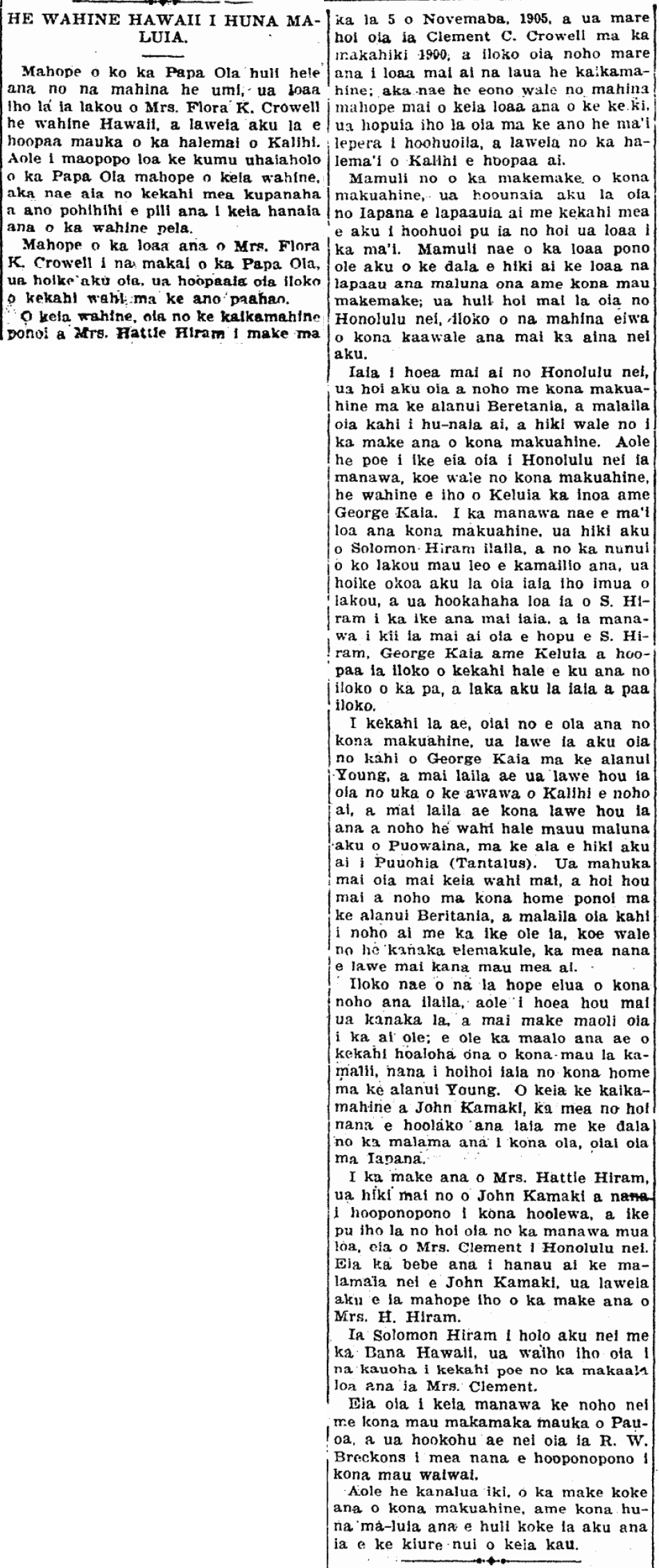
A HAWAIIAN WOMAN HIDDEN AWAY.
After the Board of Health [Papa Ola] searched for ten months, they found Mrs. Flora K. Crowell, a Hawaiian woman, and she was taken and detained mauka of the Kalihi Hospital. It is not clear why the Board of Health chased after that woman, but there is something astonishing and unclear about what was done to this woman.
After Mrs. Flora K. Crowell was found by the officers of the Board of Health, she said she was locked away like a prisoner.
This wahine is the birth daughter of Mrs. Hattie Hiram who died on the 5th of November 1905, and she married Clement C. Crowell in the year 1900, and by this marriage the two of them had a daughter; but just six months after they had the girl, she [Flora Crowell] was suspected of having leprosy and taken away to be held at the Kalihi Hospital.
According to the wishes of her mother [Hattie Hiram], she was sent to Japan to be treated along with others who were suspected of having the illness. Being that she did not have the funds to be treated and per her wishes, she came back to Honolulu nei after nine months of being away from here.
When she arrived in Honolulu, she went to live with her mother on Beritania Street, and she was hidden there until the death of her mother. There was no one who knew she was here in Honolulu at the time, except her mother along with another woman named Keluia and George Kaia. However, when her mother was extremely ill, Solomon Hiram came, and because they were speaking so loudly, he showed himself before them; S. Hiram was shocked at seeing her; and it was then that she was subdued by S. Hiram along with George Kaia and Keluia and detained in a building on the grounds, and she was locked inside.
A few days later, while her mother was still alive, she [Flora Crowell] was taken to the place of George Kaia on Young Street, and from there she was then taken to the uplands of Kalihi Valley to live, and from there she was taken to a grass house atop Puowaina, on the road that goes up to Puuohia (Tantalus). She escaped from this place and returned to live at her own home on Beritania Street, and it was there she lived unbeknownst to others, all except an old man who brought her food.
But during her last two days there, that man did not come back, and she almost starved for lack of food; it was only because of the passing by of one of her friends from her youth, that she was brought to that friend’s home on Young Street. This was the daughter of John Kamaki, the one who gave Flora Crowell money to care for herself while in Japan.
At the death of Mrs. Hattie Hiram, John Kamaki came and took care of her funeral, and saw for the first time that here was Mrs. Clement in Honolulu nei. Her baby was being cared for by John Kamaki, who took her after the death of Mrs. H. Hiram.
When Solomon Hiram just left with the Royal Hawaiian Band [Bana Hawaii], he left instructions for some people to keep good watch over Mrs. Clement.
She is now living with her friends mauka of Pauoa, and she has chosen R. W. Breckons as the executor of her estate.
There is no doubt, the quick death of her mother and her being hidden away, will be investigated immediately by the grand jury of this session.
(Kuokoa, 11/2/1906, p. 8)
I scream, you scream? 1867.
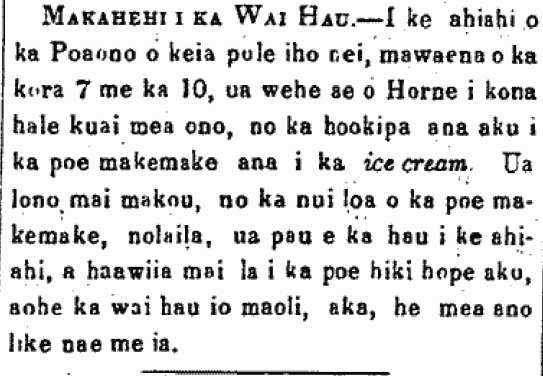
Amazement at the Wai Hau.—On the evening of this past Saturday, between the hours of 7 and 10, Horne [Horn] opened up his sweets shop to welcome those who wanted ice cream. We hear that because of the great number of people interested, all the ice cream was gone that evening and those that came after were given something that was not actually ice cream, but something similar.
[Here’s an advertisement for this shop much later in Thrum’s Annual for 1886, but we see that the establishment was opened in 1863!]
(Au Okoa, 9/26/1867, p. 2)
Independence Day, 1867.
In the Announcements Column of the Government’s English newspaper [Hawaiian Gazette] of yesterday, we saw an announcement calling all those who want to celebrate the coming 28th of November, to all come down to the reading room of the Hotel of Kaopuaua to discuss it tomorrow night, Friday. This is what the haole are doing; where are the Hawaiians for whom this day is truly for?
(Au Okoa, 9/26/1867, p. 2)
More on Ninito and John Sumner, 1867.
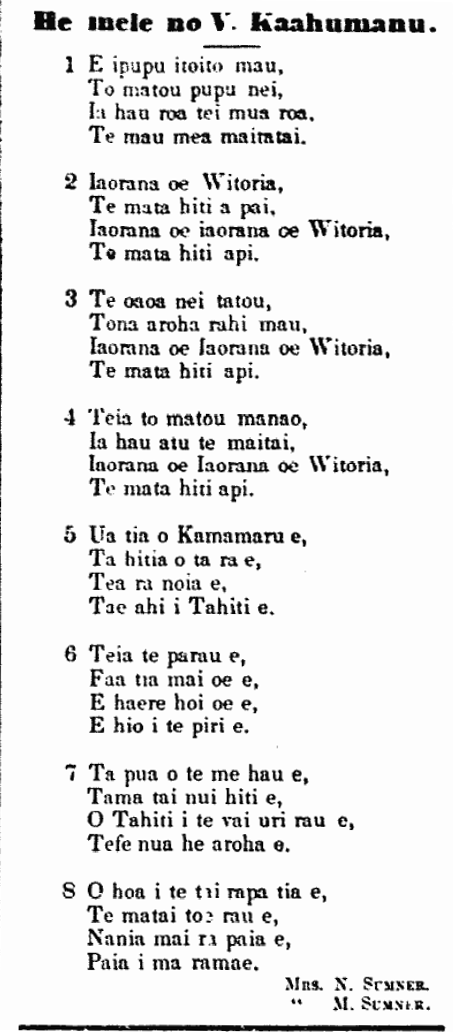
Left for Bolabola.—With the departure of the schooner Aorai to Bolabola, on last Sunday, on board was John Sumner (Kapilikea) and his queen, Niniko, from foreign lands, “Palau mai oe e hoa e [“Talk to me O Friend” in Tahitian?].” Kapilikea’s queen is a relative of Pomare, and at her behest, Ninito is returning to see the land of her birth and to be embraced.
(Au Okoa, 9/26/1867, p. 2)
The “Chinese Disease,” 1865.
Leprosy [Mai Pake]—As this is greatly spreading about Town and in the country of this island, the Sheriff [Ilamuku ?] has requested that all of the District Sheriffs [Luna Makai ?] to report the number of people inflicted with this horrible sickness that is spreading in our homeland. We have taken the List showing the number of “Chinese Disease,” as we call it, in each district; and we say here that this is probably not accurate, because there is no one in the country who knows for certain what the symptoms are.
” of Kau, . . . 4 ”
” of Puna, . . . 3 ”
” of Hilo, . . . 3 ”
” of Hamakua, . . . 8 ”
” of S. Kohala, . . . 2 ”
Maui—District of Lahaina, . . . 36 ”
” of Honuaula & Waihee, . . . 12 ”
” of Wailuku, . . . 7 ”
” of Makawao, . . . 19 ”
” of Kaanapali, . . . 3 ”
Molokai & Lanai— . . . 9 ”
Oahu—District of Honolulu, . . . 78 ”
” of Ewa & Waianae, . . . 10 ”
” of Waialua & Koolauloa, . . . 18 ”
” of Koolaupoko, . . . 21 ”
Kauai—District of Nawiliwili, . . . 7 ”
” of Waimea, . . . 1 ”
” of Koloa, . . . 1 ”
” of Anahola, . . . 1 ”
” of Hanalei, . . . 3 ”
Total of sick . . . 261
Anticipation, 1899.
Here is a pretty love song likening the object of one’s affection to a miulana flower, 1913.
HOOHENO NO KA PUA MIULANA.
Auhea wale oe pua Miulana,
E lana malie ko’u manao.
Huli mai ko alo owau ke hoa,
A o wau ko hoa pono ka nohona.
Noho ana kaua puuwai like,
Lokahi ka manao me ka makemake.
Mai puni hei aku oe ilaila,
I ka nani mae o ka Awapuhi.
Huli mai e maliu lono i ka leo.
Na ole i ka nui me ka lehulehu.
A o wau hookahi kau mea nui,
O ka lei hemo ole i ko puuwai.
Hainaia mai ana ka puana,
No ka pua Miulana a e o mai.
[“Don’t be captivated by that over there, At the fading beauty of the Ginger blossom…”
For more on the miulana plant, check out this article by Heidi Bornhorst in the Honolulu Advertiser, 6/10/2001.]
(Kuokoa, 12/19/1913, p. 2)
The latest from Kalawao, 1909.
News From the Land of the Suffering.
To the Editor of the Aloha Aina Newspaper, Aloha:
Please allow my small parcel a space in your newspaper which is greatly enjoyed, and that is what is down below; let the paper take it proudly around so that our multitudes of friends may see.
Movies come regularly every Wednesday, and are shown on the evenings of Wednesday, Thursday, and Friday; and every Saturday in Honolulu. There has been a building erected for the patients to watch the movies. The patients are thrilled. They donated money to buy a first-class phonograph [pahu olelo]. They are very happy with singing, the sweet sound of the strings and the blare of the brass instruments.
There was an announcement made to the ones without the sickness or those partially afflicted that wanted to be examined by the Doctors who are coming into the settlement.
Some went to sign up, and some just looked on because they did not want to go back to where they came from, being there might be difficulties waiting ahead for them. And because of the small number of those going to sign up, the Superintendent of the settlement ordered someone to go to the houses to sign people up; the total of those people number 58, but I don’t have their names; the only names I have are those who went to sign up, and they number 55, along with their doctor.
THE PEOPLE WHOSE DOCTOR IS DR. WAYSON
[Names difficult to make out.]
THE PEOPLE WHOSE DOCTOR IS DR. GOODHUE.
The Men
[Names difficult to make out.]
The Women
[Names difficult to make out.]
The total number told to the writer is 108. This includes the people chosen by the Legislature [?]
With much aloha for my Lahui.
Sincerely,
S. K. MAIALOHA.
Kalawao, Molokai, Aug. 2, 1909
[Here is just another example of why the original newspapers need to be reshot clearly before the acid in the paper consumes all of the words, leaving us with crumbs…]
(Aloha Aina, 9/4/1909, p. 3)
On the perpetuation of the Hawaiian Language, 1911.
THE HAWAIIAN LANGUAGE
Before the Legislature is a bill put forth by the Honorable W. J. Sheldon of Waimea, Kauai, which seeks to perpetuate the mother tongue of this land; but the committee announced that the bill will be tabled; to which the father of the bill asked that they wait for a bit until the following Saturday, April 1.
The intent of the bill is to allow for time in some schools to teach the Hawaiian language. “Here are the Japanese,” said the Honorable One, “they are caring for their mother tongue, and so too of the Chinese; but we, the native children of this land, our native language is disappearing from our own land. It is imperative that we try to perpetuate our beautiful language even just a little longer. I feel remorse in letting the beautiful language of our ancestors go. The government pays for travelling instructors to teach singing and lace making [hana lihilihi ?] in public schools, so why not choose people like that to go and teach for one hour every school day? It will not be a great expense like what is imagined by the committee.”
We believe that these are very wise responses by the Honorable One of Waimea, and if indeed means are not sought to perpetuate the beloved language of our birth land, then it will not be long before the Hawaiian language will disappear completely.
The Hoku gives its mahalo to the Honorable One of the Waiula Iliahi¹ of Waimea for his consideration and aloha for the beautiful language of the Paradise of the Pacific Ocean.
¹Waiula Iliahi is one of the two branches of the Waimea River, and the other being Waikea, and they merge at Kikiaola.
(Hoku o Hawaii, 3/30/1911, p. 2)