Six ideas on how to most effectively use this blog ①, 2012.

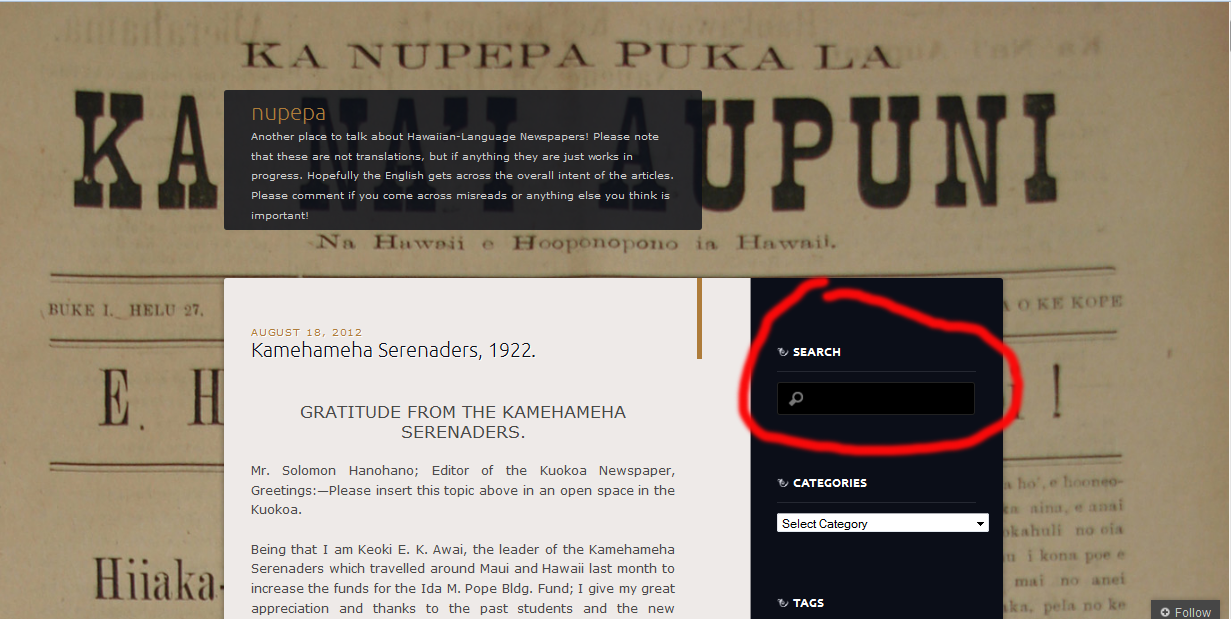
SEARCH.

http://www.nupepa-hawaii.com is the easiest way to search through all previously uploaded articles.

On the right side of the page, you will see a bar with various choices running from the top to bottom, the first being SEARCH

It is probably best to search for the most simplest terms possible, for instance:

“Beckley” instead of “Fred Malulani Beckley Kahea”

“Liliuokalani” instead of “Queen Liliuokalani”

“Kekahuna” instead of “Kekahuna family”

The broader the search terms, the more likely it will be that you get other articles not related directly to what you were looking for. But on the other hand, you might find something unexpectedly related.

Search

Search

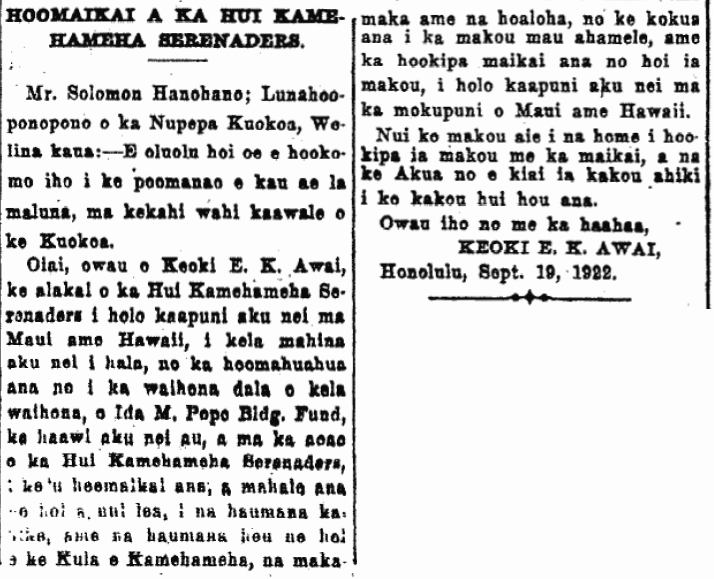
Kamehameha Serenaders, 1922.

GRATITUDE FROM THE KAMEHAMEHA SERENADERS.

Mr. Solomon Hanohano; Editor of the Kuokoa Newspaper, Greetings:—Please insert this topic above in an open space in the Kuokoa.

Being that I am Keoki E. K. Awai, the leader of the Kamehameha Serenaders which travelled around Maui and Hawaii last month to increase the funds for the Ida M. Pope Bldg. Fund; I give my great appreciation and thanks to the past students and the new students as well of Kamehameha School, and intimates and friends, for their assisting our concerts and for the good care given us while we went around Maui and Hawaii.

We are greatly indebted to the homes which offered us their fine hospitality, and may God watch over us until we meet once again.

Sincerely,

GEORGE E. K. AWAI,

Honolulu, Sept. 19, 1922.

(Kuokoa, 9/21/1922, p. 8)

HOOMAIKAI A KA HUI KAMEHAMEHA SERENADERS.

Ka Nupepa Kuokoa, Buke LXI, Helu 38, Aoao 8. Sepatemaba 21, 1922.

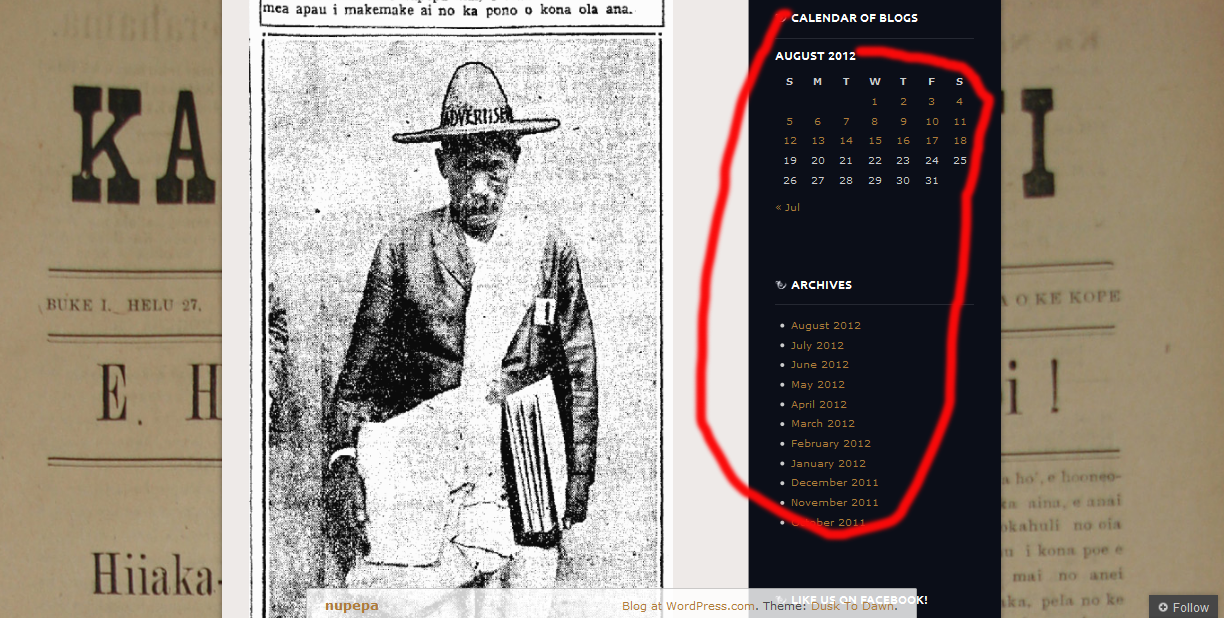
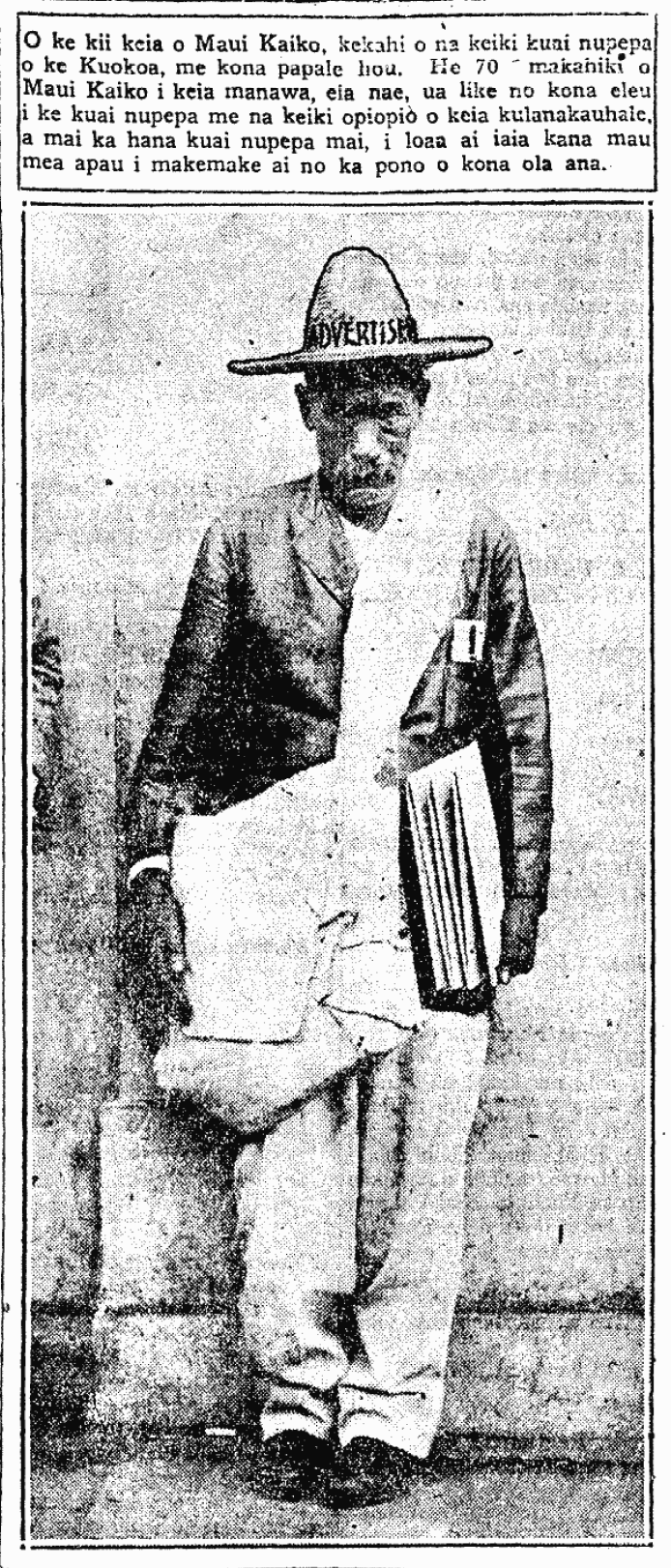
Old Kuokoa “Paper Boy”, 1923.

This is a picture of Maui Kaiko, one of the paper boys of the Kuokoa, along with his new hat. Maui Kaiko is 70 years old now, yet he is just as lively selling newspapers as the youngsters of town, and by selling newspapers, he has everything he needs in life.

[Notice how the word “keiki” is not only used for young boys (or children in general), but is also used how we use it today, as in: “Maui boy” or “local boy”…]

(Kuokoa, 6/14/1923, p. 4)

O keia ke kii o Maui Kaiko...

Ka Nupepa Kuokoa, Buke LXII, Helu 24, Aoao 4. Iune 14, 1923.

George Healii Kahea Beckley awarded military medal, 1919.

MEDALS AWARDED, BRINGING HONOR TO HAWAII.

For the past year,  there has been no word to his family, and they did not know whether he was dead or not. However, during the past couple of weeks, a letter arrived written by him from Britain.

Four years ago, George Healii Kahea Beckley left Hawaii for America. in 1914, he departed America aboard the steamship Missourian, full of mules to take to France for the armed forces of Britain.

He got off the ship in France, and entered the battlefield with the British Army; he was shot and returned to Britian.

After he recovered, he joined the war once again on the east side at the Balkans and Salonika; there he again faced injury: he, a friend, and his cousin Hoapili from Hawaii. The three of them were returned to Britain to the Hospital.

Thereafter, he was not heard from again, but last week, his cousin, Leander Beckley,  of the group of car drivers of Fort Street, received a letter from him.

The letter was written on the 22nd of December, saying that he was in Britain, and in good health. He is awaiting his discharge, and then he’ll return home.

[I am not sure about the first reference to “four years ago” and then “1914”… Also, does anyone know who this Hoapili refers to?]

(Aloha Aina, 2/8/1919, p. 2)

LOAA NA MEDALA HOOHANOHANO IA HAWAII.

Ke Aloha Aina, Buke XXXIV, Helu 5, Aoao 2. Feberuari 8, 1919.

Alligator loose?? 1928.

The body of an Alligator [moo Aligeto] that wandered from the port of Hilo and caught in Honuapo in Kau was taken to show before the school children of the Government School, Union, of Hilo nei. The sea navigating serpent is being cared for by a Japanese Committee of Hilo nei, and it will be sent all the way to Japan aboard a Japanese ship one of these upcoming days.

(Hoku o Hawaii, 1/10/1928, p. 2)

Ua lawe hoikeike ia ae ke kino o kahi moo Aligeto...

Ka Hoku o Hawaii, Buke XXI, Helu 32, Aoao 2. Ianuari 10, 1928.

Vital Statistics, 1912.

BIRTHS.

To Tom Onokea and Mrs. Hattie Miranda, a daughter, July 29.

To Daniel Bartholomew and Ida Kahaawinui, a daughter, July 25.

To Ah Nau and Lani Kui, a son, July 31.

To B. N. Kahalepuna and Mary Keonaona, a daughter, August 6.

DEATHS.

Kalino, Jr., on Fort De Russy Lane, July 27.

Ellen Kalaikini, on Auld Lane, July 29.

Kahaunani Kaipo, on Luso Street, July 30.

A baby of Ah Nau, on the street of the Insane Asylum, August 1.

(Kuokoa, 8/9/1912, p. 8)

NA HANAU. / NA MAKE.

Ka Nupepa Kuokoa, Buke XLVIII, Helu 32, Aoao 8. Augate 9, 1912.

Gift from Liliuokalani to the soldiers of Leilehua, 1912.

BRONZE VASE, A GIFT BY THE QUEEN

The gift of Queen Liliuokalani, given to decorate the interior of the new church of the soldiers of Leilehua, were some bronze flower vases to be always stood upon the pulpit. On the morning of this past Saturday, she told of her interest in presenting the vases, and signed her own name on the paper with the words to be inscribed upon those vases.

On that morning the Chaplain, Major Pruden came before her, the one who worked at getting a church built there, and it took over a year to build. Sometime earlier, they vases were ordered, and here they now are ready to inscribe the name of the Queen. The Queen is overjoyed at the building of a chapel at the military base at Leilehua, and she expressed her desire to go in person to Leilehua when the church is consecrated, when the vases shall be placed upon the pulpit for all times. The date of the consecration of the church is almost two months from now.

Here below are the words inscribed upon the flower vases:

The Armed Forces at Leilehua, H. T.,
By Her Highness, Queen Liliuokalani of Hawaii.

[I wonder where these are today!]

(Kuokoa, 8/9/1912, p. 6)

HE IPU PUA KELEAWE KA KA MOIWAHINE MAKANA

Ka Nupepa Kuokoa, Buke XLVIII, Helu 32, Aoao 6. Augate 9, 1912.

Samuel Kamakaia’s Royal Order of Kalakaua to the Bishop Museum, 1919.

PRESENTATION MEDAL OF KALAKAUA TO KAMAKAIA.

The silver medal of King Kalakaua [Royal Order of Kalakaua] presented to Samuel Kamakaia, one of the members of the Bana Hawaii [Royal Hawaiian Band] is now in the possession of Malulani Beckley Kahea, who is also a band member; it is his to care for until the time comes for it to go to another member of the band, although according to Kamakaia’s wishes, it should be returned to the Bishop Museum.

Rightfully, this medal will be given to James K. Pohina, to oldest member of the Bana Hawaii active today. In 1883, this medal was awarded to Kamakaia, a gift from the King for his work as the leader of the band. In 1869, Kamakaia joined the band, and two years ago he left.

(Kuokoa, 7/4/1919, p. 1)

KA MEDALA MAKANA A KALAKAUA IA KAMAKAIA.

Ka Nupepa Kuokoa, Buke LVII, Helu 27, Aoao 1. Iulai 4, 1919.

Paper Lei and Hawaiian foods popular in New York. 1912.

PAPER LEI ARE MUCH SOUGHT AFTER IN NEW YORK.

At the return of the head manager of the clothiers, Sachs, which stands at the corner of Fort and King Streets; [he said,] “Luau and paper lei have become popular with New Yorkers, and Hawaiian foods and lei are seen at parties given by many people on the banks of the Hudson River.

Supposedly at three places that haole went to visit, he saw people holding luau parties, and the only thing missing at those places was poi, salmon, tomatoes, onions and some other foods seen at luau in Hawaii nei.

One day when he went to go see one of his friends in New York, shown before him was an ilima lei and a lauhala hat upon which was a ribbon which read “Aloha,” and he said that they were a gift from Jim McCandless, as a memento.

(Kuokoa, 8/9/1912, p. 6)

MAKEMAKE NUIIA NA LEI PEPA MA NU IOKA

Ka Nupepa Kuokoa, Buke XLVIII, Helu 32, Aoao 6. Augate 9, 1912.

Makalei Cave, North Kona, Hawaii, 1924.

ENJOYMENT OF TIME

DESCRIPTION OF MAKALEI

This is a cave to the south of the hill of Akahipuu, and it was there that a man named Ko’amokumoku-o-hueia [Ko’amokumokuoheeia] lived, who came from Koolau and settled here, living as a newcomer.

And he lived here with his family: his wife, whose name was Kahaluu; and their two daughters; and one young son named Makalei.

And it was for this boy that this cave is called the cave of Makalei until this day.

While this man was living here, he began to farm taro, sweet potato, banana, sugar cane, and awa; and it all appeared to be well watered.

The natives of the area came to him and said, “The problem with this land is the water; it is a land without water, and you have to get water from the cave, but the places to store water here are kapu and cannot be fetched from in secret; if you are caught, you will be killed by the one who the water belongs.

Ko’amokumoku-o-heeia heard this talk of the locals, and this caused him to contemplate about where he and his family could get their water; and therefore, he made a reservoir [pa-o wai ?] for himself, and when the rains returned, water would fill receptacles [haona] then be held in the reservoir.

While living there with the family, one day, the boy went to relieve himself at a ravine behind their house, and while he was throwing the old waste into a plain old hole, right then wind blew out from that hole, and Makalei examined it and saw this deep, dark hole.

This boy was however not frightened at all; he stood up and went to where his father was farming and said:

“I went over there to defecate, but this is the astonishing thing, there was a lot of wind coming from that pit, maybe it is a hole of winds.”

“Where?” the father asked. “Down there,” and the father went to see.

When Ko’amokumoku-o-heeia reached the area and cleared away the stones covering the hole, he saw that it was a deep cave and wind rose from it as if it came from the mountains.

He turned and said to the child, “We have our place to hold water for our life here in this land without water, and I will make a hole for us to defecate in.”

The mouth to the cave was finished off nicely and there they defecated; while one side of the opening was made so that a person could enter.

No kamaaina knew of this cave, and he did not tell his wife, and nor did he talk of it again to his son; he totally refused to speak of the things pertaining to this cave.

One day, he entered the cave and saw the great vastness, and that he could walk upright without his head touching the wall above, and there was a lot of water dripping down; he decided to make containers [waa] of ohia, and containers of wiliwili.

In the night he fetched wiliwili and carried it on his back inside the cave, and it was inside of the cave that he dug until he made the opening of the wiliwili water container; the ohia chosen was dug out by the farmer and he carried it on his back into the cave. The inside of the cave grew criss-crossed with water troughs of wiliwili and ohia; there was just so many of the water containers that continued to be fitted inside.

When the dry season of this land returned as always, he did nothing other than farm, and he had ample water and had no problems with it.

It was at night that he fetched water and filled containers and gourds [olo], until the reservoir was full, and this was their drinking water for the month, and so forth.

The locals were suspicious about where these people go their water from, being that they did not see the source of their water, and they spoke often about the water of these malihini.

This cave still remains, and the entrance is very small but made like the entrance to a house, but within is very spacious and the walls are very tall.

When Maguire lived at Huehue, a great water catchment was built inside of the cave and a pipe was laid from the catchment until his house because he wanted cold water like ice water; also, pipes were laid above the catchment so that more water would go into it.

The story of this boy, Makalei is a beautiful one, along with his father, and it is a very long story; and should the writer have time to write this touching entertainment, then Makalei will be seen, the one whose name this cave is named after, Makalei Cave.

Here we will list the famous storied places [wahi pana kaulana] of these ahupuaa, from the sea until the summit of the mountain of Hualalai. With their names that they were called by the people of old.

1. Kileo hill.

2. Kaaialalaua.

3. Kapuukao.

4. Pahulu.

5. Moanuiahea.

6. Puumamaki.

7. Puuiki.

8. Puukoa.

9. Kaiwopele [Kaiwiopele].

10. Puuuhinuhinu.

11. Kahuaiki.

12. Kamawae.

13. Hikuhia, in the uplands of Napua.

14. Uau pooole [Uaupooole].

15. Na hale o Kaua [Nahaleokaua].

16. Kipuka o Oweowe.

17. Pualala.

18. Kawahapele.

19. Keoneeli.

20. Hinakapoula.

21. Kalulu.

22. Na puu Mahoe [Napuumahoe].

23. Kumu mamane [Kumumamane].

24. Kaluamakani.

25. Pohokinikini.

26. Hopuhopu.

27. Kipahee.

28. Hanakaumalu.

29. Kapuu o Honuaula [Honuaula Hill].

30. Ka puu o Hainoa [Hainoa Hill].

31. The summit of Hualalai and the pit of Milu.

32. Kipahee.

33. Makanikiu, Hill.

The pit of Milu [lua o Milu] spoken of is the pit which Hikuikanahele went to fetch Kawelu under the [Nuu ?] of Milu, the chief of the dark night; this is the round pit atop the summit of Hualalai which still remains to this day; it is a very deep hole and if you drop a rock down the pit, you will not hear the rattling of the rock.

The width of the mouth of this pit is perhaps about 6 to 7 feet in my estimation as I am familiar with those regions.

The water of Kipahee is a pit which goes down and reaches a spring.

It is not rippling water from which to scoop water out of, but it is moss [limu] which you collect until the container is full and then return to the top.

Climbing back up is troublesome; should you try to go straight up thinking you will exit immediately, you won’t be able to because you will keep sliding back until you are sitting after exhaustion from sliding down. In order to return to the top with ease, you have to climb zigzag, turning to the right and then to the left, and that is how you climb back to the top easily.

(Not complete.)

[This article continues into the next issue (6/5/1924, p. 4) and is signed: “Ka Ohu Haaheo I na Kuahiwi Ekolu. Kona Hawaii, April 30 1924.”]

(Hoku o Hawaii, 5/29/1924, p. 4)

NA HOONANEA O KA MANAWA

Ka Hoku o Hawaii, Buke XVIII, Helu 1, Aoao 4. Mei 29, 1924.