Vital Statistics, 1912.

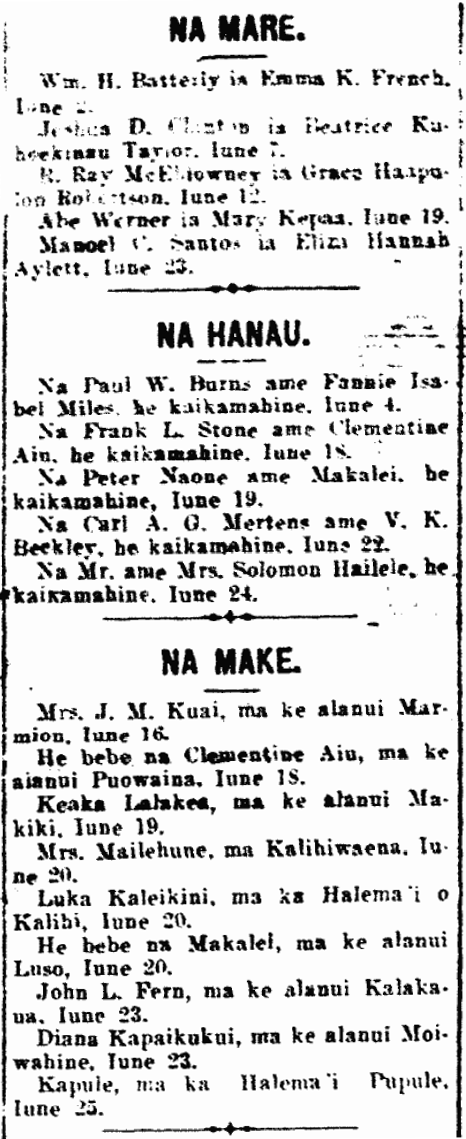
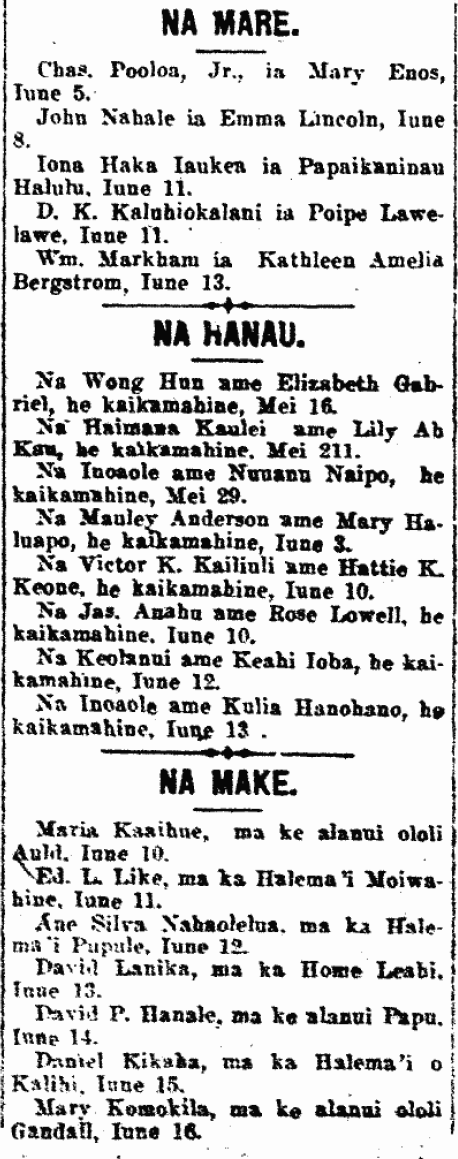
MARRIAGES.

Charles Poola, Jr. to Mary Enos, June 5.
John Nahale to Emma Lincoln, June 8.
Iona Haka Iaukea to Papaikaninau [Papakaniau ?] Halulu, June 11.
D. K. Kaluhiokalani to Poipe Lawelawe, June 11.
William Markham to Kathleen Amelia Bergstrom, June 13.

BIRTHS.

To Wong Hun and Elizabeth Gabriel, a daughter, May 16.
To Haimana Kaulei and Lili Ah Kau, a daughter, May 211.
To Nameless and Nuuanu Naipo, a daughter, May 29.
To Manley Anderson and Mary Haluapo, a daughter, June 3.
To Victor K. Kailiuli and Hattie K. Keone, a daughter, June 10.
To James Anahu and Rose Lowell, a daughter, June 10.
To Keolanui and Keahi Ioba, a daughter, June 12.
To Nameless and Kulia Hanohano, a daughter, June 13.

DEATHS.

Maria Kaaihue, on Auld Lane, June 10.
Edward L. Like, at Queen’s Hospital, June 11.
Ane Silva Nahaolelua, at the Insane Asylum, June 12.
David Lanika, at Leahi Home, June 13.
David P. Hanale, on Fort Street, June 14.
Daniel Kikaha, at Kalihi Hospital, June 15.
Mary Komokila [Kamokila?] on Gandall Lane, June 16.

(Kuokoa, 6/21/1912, p. 8)

MARE. / HANAU. / MAKE.

Ka Nupepa Kuokoa, Buke LXVIII, Helu 25, Aoao 8. Iune 21, 1912.

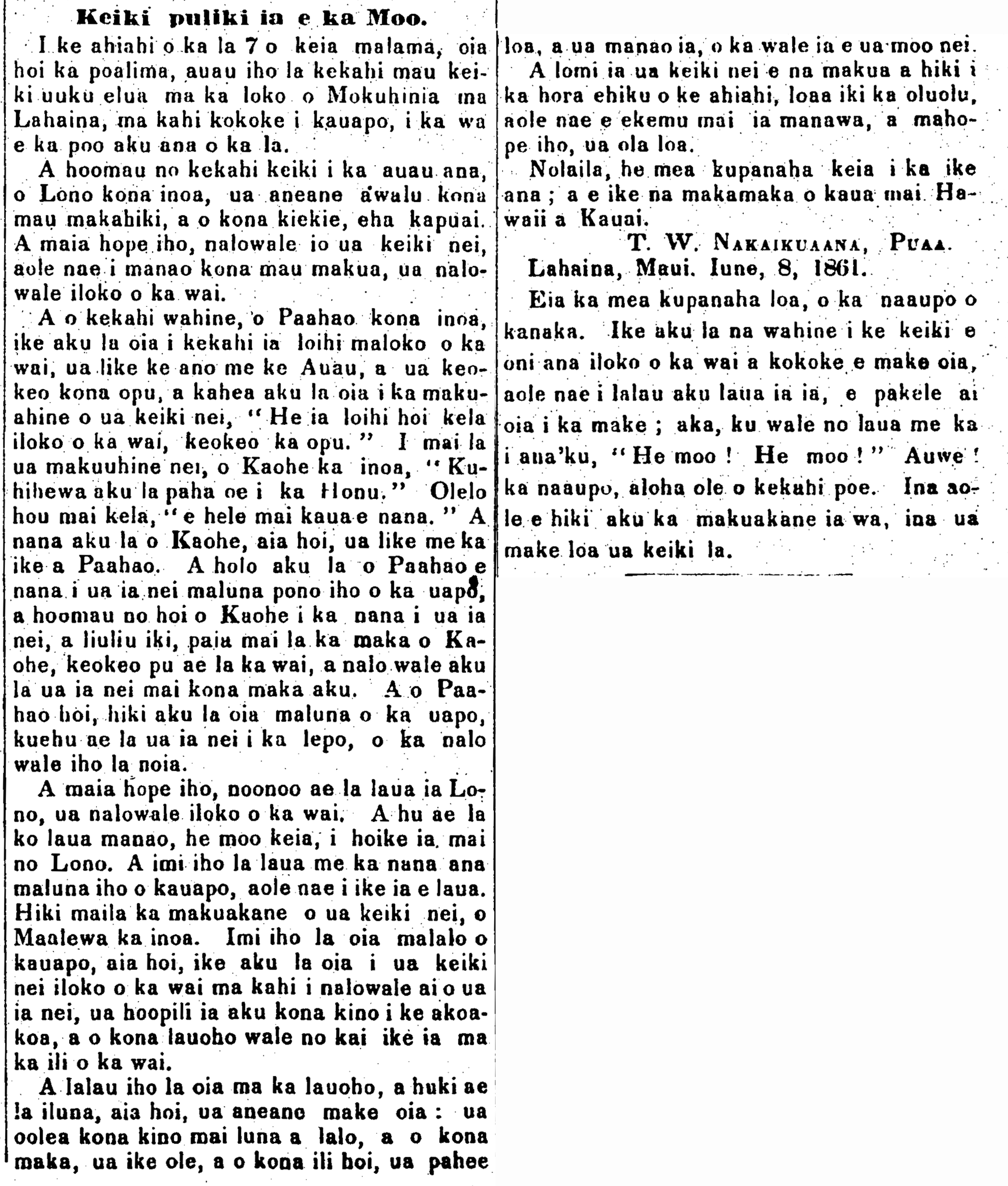
Moo at Mokuhinia, Lahaina, 1861.

Child Grabbed by Moo.

On the evening of the 7th of this month, that being a Friday, a couple of small children were bathing in Mokuhinia Pond in Lahaina, close to the bridge [uapo], when the sun was going down.

One of them continued to bathe, his name was Lono; he was almost eight years old, and his height was four feet. Right then after, this boy plain disappeared, but his parents did not think that he disappeared in the water.

A woman named Paahao saw a long fish in the water like an Swordfish [Auau], and its belly was white; she called out to the mother of the boy, “There is a long fish in the water with a white belly.” The mother named Kaohe said, “You must be confusing it with a Turtle.” The other responded, “Let’s go and see.” Kaohe went, and lo and behold, it was as Paahao had seen. Paahao went to go see the fish from atop the bridge while Kaohe continued to watch the fish; after a little time, Kaohe’s eyes were struck [temporarily blinded? “paia mai la ka maka”] and the water turned white, and the fish disappeared from her sight. As for Paahao, she arrived atop the bridge and the fish sprayed up dust, and it disappeared.

Then after, the two thought of Lono, and that he disappeared in the water. And they concluded that this was a moo that had revealed itself for Lono. They searched and went to look on the bridge, but it was not seen.

The father of the boy arrived, named Maalewa. He looked under the bridge, and come to find out, he saw the boy in the water where he was hidden by the moo; his body was attached to the coral and his hair was all that could be seen on the surface of the water.

The father grabbed him by the hair, and pulled him up, and he was almost dead; his body was stiff from top to bottom, and his eyes could not see, and his skin was slimy, which was believed to be the slime of the moo.

He was massaged by his parents until seven in the evening, whereupon he got slightly better but did not say a word, but later he revived.

Therefore, this was something miraculous to see; let it be known to all our friends from Hawaii to Kauai.

T. W. NAKAIKUAANA, PUAA.

Lahaina, Maui. June 8, 1861.

This is the remarkable thing; the foolishness of man. The women saw the child shaking in the water, close to dying, and they did not grab him and save him; but they just stood there saying, “A moo! A moo!” Auwe! the foolishness and heartlessness of some people. If the father had not arrived then, the child would be dead.

[I posted this article a long time ago on the Hoolaupai Facebook page, but because it has such bad search capabilities, i can’t find it. That is one of the reasons i started this blog. Searching for names or places or subjects, etc., is so much easier to do!

I am not sure what the commentary at the bottom is referring to, about the women seeing the boy shaking in the water…

For more on Mokuhinia and the work being done to restore this historic place, see: Friends of Mokuula.]

(Hae Hawaii, 6/12/1861, p. 41)

Keiki puliki ia e ka Moo.

Ka Hae Hawaii, Buke 6, Ano Hou.—Helu 11, Aoao 41. Iune 12, 1861.

English-Language Newspaper articles less important than Hawaiian-Language articles? 2012

Here is something to consider…

There are many who believe that English-Language articles are somehow less important than Hawaiian-Language ones. We should not turn our noses up at any history passed down by those who lived it—in any language. Although it is important to take into account who wrote the information and under what circumstances, any information is better than no information!

Here for instance is the coverage the first Kamehameha Girls School graduation received in The Hawaiian Gazette of July 6, 1897, p. 2, “CLOSING EXERCISES”.

Compare this to what we saw earlier from the Kuokoa of July 2, 1897, p. 2, “KA HOIKE O KE KULA KAIKAMAHINE O KAMEHAMEHA”.

First graduating class of Kamehameha School for Girls, 1897.

PERFORMANCE OF KAMEHAMEHA GIRLS SCHOOL.

The Graduates.

On the evening of this past Tuesday, June 29, a performance of speeches and singing was held at Kaumakapili Church by the students of the Kamehameha School for girls, and this was an assembly for the graduation of some students of this school this year with them receiving diplomas.

It is said that there were almost 2000 onlookers who crowded into the walls of Kaumakapili Church, with still more excited people outside, from the Government road until the steps and covering up the entrance.

Right before the Organ was made a stage, and above it were placed pots of greenery of all sorts. And upon this sad the students for whom was that beautiful night [“ka po nani o Halalii”¹].

These are the young ladies of the school who graduated this year: Lydia Aholo, Julia Akana, Kalei Ewaliko, Miriama Hale, Lewa Iokia, Helen Kahaleahu, Elizabeth Kahanu, Malie Kapali, Hattie Kekalohe, Elizabeth Kaliinoi, Keluia Kiwaha, Julia Lovell, Jessie Mahoahoa, Elizabeth Waiamau, and Aoe Wong Kong.

This is the program of events: Chorus: In Heavenly Love Abiding”—”Noho ma ke Aloha Lani” (Mendelssohn). Kamehameha Girls’ School.

Prayer: Rev. C. M. Hyde, D. D.

Topic: “The Teacher and Trainer of Hawaii’s Little Ones”—Ke Kumuao a Alakai o ko Hawaii Poe Pokii: Lewa Iokia.

Mele (Poem): “The Greatest Discovery—Ke Pookela o na Mea i Huliia: Hattie Kekalohe.

Topic: “My Life at Kamehameha”—Ko’u mau La ma Kamehameha: Aoe Wong Kong.

Topic: “The Servant of the Soul”—Ke Kauwa a ka Uhane: Elizabeth Kahanu.

Topic: “Wake the Divine Within”—Hoala ae i ko loko Uhane Pono: Elizabeth Waiamau.

Topic: “A Bit of Clay”—He Huna Lepo Palolo: Kalei Ewaliko.

Chorus: “Sweet May” (Barnby): Class.

Topic: “A Plea for the Children”—He leo i na Keiki: Malie Kapali.

Topic: “Domestic Sciences”—Na Ike Nohona Home: Jessie Mahoahoa.

Topic: “The Use of Music”—Ka Waiwai o ka Ike Mele: Lydia Aholo.

Topic: “A Practical Art”—Ka Ike Hana maoli: Julia Lovell.

Mele (Music): “At School Close” (Whittier): Elizabeth Keliinoi.

Diplomas Given.

Chorus: “Cradle Song:” Kamehameha School for Girls.

Benediction [Pule Hoomaikai] by Rev. E. S. Timoteo.

¹”Ka po nani o Halalii” [Beautiful night of Halalii] seems to be a variation of the idiom “Ka po le’a o Halalii” [Enjoyable night of Halalii].

[I just ran across this article while looking for something else today, and thought it would be a nice follow up to the earlier articles on the opening of Kamehameha Girls School.]

(Kuokoa, 7/2/1897, p. 2)

KA HOIKE O KE KULA KAIKAMAHINE O KAMEHAMEHA.

Ka Nupepa Kuokoa, Buke XXXVI, Helu 27, Aoao 2. Iulai 2, 1897.

John Palimoo, Jr., steel guitarist on the radio, 1927.

ENTERTAINING THE MULTITUDES ON K. G. U., JOHN PALIMOO, JR.

He is a member of the Firemen’s Glee Club [Kalapu Himeni], the one who entertained the pubic many a time on K. K. U. [K. G. U.] recently, receiving acclaim because of his new way of playing on his guitar, making it sound like bells.

[Notice the first line on the right column. On occasion, there will be a misplaced line or section, especially in the later years of the newspapers, and the line that reads “le ai iloko o ka muliwai he ekolu” seems to be out of place.

Does anyone have any information on this steel guitar player, John Palimoo, Jr.?]

(Kuokoa, 9/8/1927, p.2)

HE MEA HOOHAUOLI MA KE K. G. U. I KA LEHULEHU, JOHN PALIMOO, JR.

Ka Nupepa Kuokoa, Buke LXVI, Helu 35, Aoao 2. Sepatemaba 8, 1927.

Samuel Kauahipaula, 1940.

A Man of Patience

Sam Kauahipaula
(In His Youth)

The picture placed above is a picture of Sam Kauahipaula of Hamakua, a man who patiently worked for 50 years, and who currently is receiving retirement pay.

He worked at the Kukaiau Sugar Plantation from when he was just a young boy and worked for the pay of 50¢ a day. Although receiving such a pittance, he worked patiently without giving up.

While putting up with adversity and having a good attitude, he was promoted to company driver, where he hauled cane to the mill. He continued at working at this position and the fruit of his patience was that he was promoted to sub-foreman [luna liilii] in charge of the laborers, and at a certain point, he was made assistant timekeeper [kokua luna kiko la] for the workers.

He held on to the position of foreman until he was retired, whereupon he received a pension from the sugar plantation company.

Sam Kauahipaula was a trusted man, not by his bosses, but by the people of his area, and he was chosen as the inspector of elections of his voting district, and he held that position for a great many years, until …

Sam Kauahipaula
(At this time)

the inspectors of election were changed because of the change in government leadership.

Throughout his life, he was never a man that did not put himself behind the Almighty, and became a servant of His Kingdom. He was elected as treasurer of Maunahoano Church in Paauilo that was presided over by J. W. Waiohinu. This is because he was trusted.

He was born in Kainehe, between Kukaiau and Paauilo, and he still lives at the same place now.

His first born, Kahaili Kauahipaula, is living in Villa Franca [Villafranca]. The next born was a member of the Legislature for a number of years gone by, that being W. N. Kauahipaula [W. N. K. Kauahipaula was of the Home Rule Party]

There are very few Hawaiians who continued at a profession like this Hawaiian. 50 years is not a short period of time. Let us Hawaiians be proud of that kind of man.

(Aloha Aina Hoku o Hawaii, 6/12/1940, p. 1)

Ke Kanaka Hoomanawanui

Ke Aloha Aina Hoku o Hawaii, Volume XXXV, Number 7, Page 1. Mei Iune 12, 1940.

And speaking of language… 2012.

You guys keeping up with Oiwi TV’s Ka Leo Oiwi? It is a fun and easy way to get introduced/reintroduced to the Hawaiian Language! Episode 4 just out today!! Go check it out, go check it out, go!!!

Ka Leo Oiwi—Episode 1

Ka Leo Oiwi—Episode 2

Ka Leo Oiwi—Episode 3

Ka Leo Oiwi—Episode 4

Hoku o Hawaii begins printing front page in English, 1936.

UNDER NEW MANAGEMENT

Ka Hoku o Hawaii, Star of Hawaii, is published this week under new management under whose direction the newspaper that represents the Hawaiian people will have many new and improved features. One of these is an entire page printed in the English language, for the benefit of the younger generation of Hawaiians, many of whom understand English better than the language of their forefathers. It is for these young readers that the publishers have decided to print this one page in English.

Since the death of the Hoku’s beloved founder, the late Rev. Stephen L. Desha, Sr., who established it some thirty years ago, it has had to struggle along in a more o less indifferent way, with rather poor success, until the decision was made by the publishers to either suspend publication or place it in the hands of someone who could devote the required amount of time and labor necessary to build it up to a degree of efficiency that will make it of worthwhile service to the Hawaiian people.

Its policy will be one of constructiveness. It is not affiliated with any political party but it is primarily for the benefit of Hawaiians in general.

The publishers have appainted as manager, as well as editor of the English section, Henrietta F. Dixon, while Bernard Kelekolio is appointed editor of the Hawaiian language section. Both editors will give their best efforts toward making the Hoku a newspaper that will be a credit to the race it represents.

To make this newspaper a success, however, requires the financial and moral support of every individual interested in the future of the Hawaiian race, and in the Hoku’s efforts to sponsor their political and economic development. Among the several hundred individuals who have been subscribers for several years, a great number have not paid their subscription. The new management takes this opportunity of urging them to send in whatever amount is now due, as well as payment of renewal for another year. The price of $2.00 per year is a very nominal sum, and there are few persons who cannot afford to pay this small amount to help in assuring its future success. In the aggregate it amounts to a considerable sum, and is essential in determining whether the efforts of the new management will result in success or failure.

Without funds no newspaper can exist long. The future of the Hoku depends upon the response its readers give to this appeal for their cooperation and financial support.

(Hoku o Hawaii, 2/4/1936, p. 1)

UNDER NEW MANAGEMENT

Ka Hoku o Hawaii, Volume XXVII, Number 31, Page 1. February 4, 1936.