Pāʻū riding for Kamehameha Day a hundred and ten years ago! 1906.

PA-U RIDERS HONOR DAY

Picturesque Cavalcade Revives Old-Time Custom.

The Hui Holopa-u Maile Alii have every reason to be satisfied with their first parade as a society, which occurred yesterday in celebration of Kamehameha Day.

The custom of pa-u riding is an old and kingly one and it was eminently fitting that the initial gathering of the club should take place on the anniversary of the birth of Hawaii’s greatest king.

About 30 riders gathered at the residence of Mrs. Kainana Puahi at Waikiki early yesterday morning. The costumes, which were uniform, consisted of yellow skirts, white waists, and straw hats encircled with ilima leis. Each rider wore a black ribbon as a sash, bearing the word “Kaonohiokala,” done in gold. The word means “the eye of the sun.” Continue reading

Fun Star-Bulletin feature on paperboys, 1916.

ALERT STAR-BULLETIN NEWSBOYS—No. 1

SHIGETARO SARUHASHI.

Son of Mr. and Mrs. Saruhashi of Kalihi-uka. Shigetaro is 16 years old and a Hawaiian-born Japanese. He attends the Royal school and is in the 8th grade. “Chicken,” as he is familiarly known by his customers and fellow newsboys, is a good hustler, disposing of 125 Star-Bulletins each afternoon. He covers the corner of Hotel and Fort streets and along Hotel to River. He has been selling papers about five years and has built up quite a profitable business by his energetic work. He belongs to the Boy Scouts and is “right there” when duty calls.

(Star-Bulletin, 6/19/1916, p. 14)

StarBulletin_6_19_1916_14

Honolulu Star-Bulletin, Volume XXIII, Number 7456, Page 14. June 19, 1916.

Kamehameha School graduation a hundred years ago, 1916.

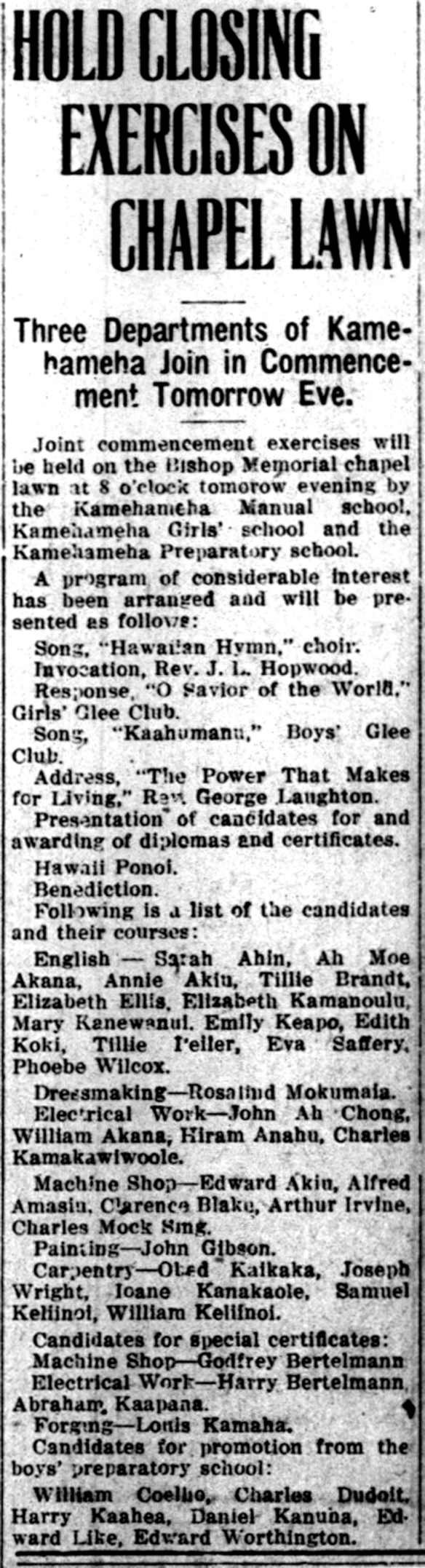
HOLD  CLOSING EXERCISES ON CHAPEL LAWN

Three Departments of Kamehameha Join in Commencement Tomorrow Eve.

Joint commencement exercises will be held on the Bishop Memorial chapel lawn at 8 o’clock tomorrow evening by the Kamehameha Manual school, Kamehameha Girls’ school and the Kamehameha Preparatory school.

Song, “Hawaiian Hymn,” choir.
Invocation, Rev. J. L. Hopwood.
Response, “O Savior of the World,” Girls’ Glee Club.
Song, “Kaahumanu,” Boys’ Glee Club.
Address, “The Power That Makes for Living,” Rev. George Laughton.
Presentation of candidates for and awarding of diplomas and certificates.
Hawaii Ponoi.
Benediction.

Following is a list of the candidates and their courses:

English—Sarah Ahin, Ah Moe Akana, Annie Akiu, Tillie Brandt, Elizabeth Ellis, Elizabeth Kamanoulu, Mary Kanewanui, Emily Keapo, Edith Koki, Tillie Peller, Eva Saffery, Phoebe Wilcox.

Dressmaking—Rosalind Mokumaia.

Electrical Work—John Ah Chong, William Akana, Hiram Anahu, Charles Kamakawiwoole.

 Machine Shop—Edward Akiu, Alfred Amasiu, Clarence Blake, Arthur Irvine, Charles Mock Sing.

Painting—John Gibson.

Carpentry—Obed Kaikaka, Joseph Wright, Ioane Kanakaole, Samuel Keliinoi, William Keliinoi.

Candidates for special certificates:

Machine Shop—Godfrey Bertelmann.

Electrical Work—Harry Bertelmann, Abraham Kaapana.

Forging—Louis Kamaha.

Candidates for promotion from the boys’ preparatory school:

William Coelho, Charles Dudoit, Harry Kaahea, Daniel Kanuha, Edward Like, Edward Worthington.

[Congratulations to the class of 2016! Make Pauahi proud!!]

(Star-Bulletin, 6/8/1916, p. 8)

HOLD CLOSING EXERCISES ON CHAPEL LAWN

Honolulu Star-Bulletin, Volume XXIII, Number 7537, Page 8. June 8, 1916.

Octopus fishing and more described by Emma Metcalf Beckley, 1902.

HOW NATIVES ONCE FISHED

Women Got the Octopus With Spears.

The Hawaiians have five methods of fishing: by spearing, hand catching, baskets, hook and line, and with nets.

The Ia O is the spearing of fish and is of two kinds, below and above water. That below water is the most important, and is generally employed for the different kinds of rock fish. The spear used by the diver is a slender stick of from 6 to 7 feet in length made of very hard wood and sharply pointed at one end, but more tapering at the other. Since the possession of iron, spears are always tipped with it, but perfectly smooth, without hook or barb. Diving to a well-known station by a large coral rock or against the steep face of the reefs, the diver places himself in a half crouching position on his left foot, with his right foot free and extended behind, his left hand holding on to the rock to steady himself, watches and waits for the fish. Fish in only two positions are noticed by him, those passing before and parallel to him, and those coming straight towards his face. he always aims a little in advance, as, by the time the fish is struck, its motion has carried it so far forward that it will be hit on the gills or middle of the body and thus secured, but if the spear were aimed at the body it would be very apt to hit the tail, or pass behind. When the fish is hit, the force of the blow generally carries the spear right through to the hand, thus bringing the fish up to the lower part or handle of the spear, where it remains whilst the fisherman strikes rapidly at other fish in succession should they come in a huakai (train) as they usually do. Continue reading

Joe Kauwila captures shark in Hana, 1903.

TOWED UNDER WATER BY SHARK

UNUSUAL EXPERIENCE OF NATIVE SAILOR ON THE CLAUDINE WHILE AT HANA.

It is not often that any one is towed under water by a shark and lives to tell the tale, but this is precisely what happened last Thursday to Joe Kauwila a native sailor aboard the steamer Claudine. Not only did he survive the experience, but at last accounts he was shoving a truck at the Wilder wharf today helping to load the steamer Claudine with freight.

On Thursday at Hana while the Claudine was in the port, the sailors heard that a dead horse had been moored near one of the buoys, for the purpose of attracting a shark. A big shovel nose shark about 12 feet in length, came circling in the vicinity of the horse. Captain Parker took a boat crew and went over by the buoy. J. Welch a man from the shore, shot at the shark with a rifle and struck the shark in the head and evidently stunned it. The idea of Captain Parker and the men in the boat was to get a line on the shark and haul it aboard. There were two young natives in the boat one of them Joe Kauwila. Joe is about 18 years of age and the other man about 20.

The shark could be seen a few yards away lying on its back. Some thought the shark had been killed. The natives talked of going over with the line.

“I think he no make,” ejaculated one of the men.

“Oh! I think he make, all right,” declared Joe. “Any how, plenty more kanakas. I try get line on him.” Joe hauled off his shirt, seized the line and started swimming toward the shark. He caught hold of the shark’s tail and began to put the line over the tail. The instant that the shark felt the boy catch hold of its tail, the shark sprang into sudden life, and started to swim. Joe held onto the shark’s tail though. Down went the shark intending evidently to dive under the boat. Continue reading

“A Night in Hawaii of Old,” by Kaai Glee Club, 1913.

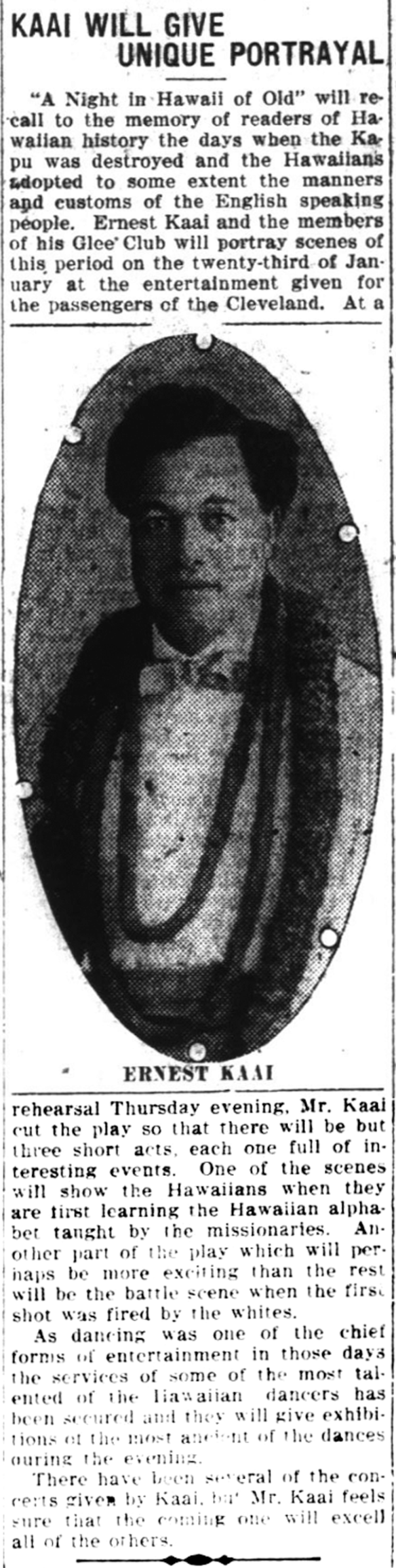
KAAI WILL GIVE UNIQUE PORTRAYAL

“A Night in Hawaii of Old” will recall to the memory of readers of Hawaiian history the days when the Kapu was destroyed and the Hawaiians adopted to some extent the manners and customs of the English speaking people. Ernest Kaai and the members of his Glee Club will portray scenes of this period on the twenty-third of January at the entertainment given for the passengers of the Cleveland. At a…

ERNEST KAAI

…rehearsal Thursday evening, Mr. Kaai cut the play so that there will be but three short acts, each one full of interesting events. One of the scenes will show the Hawaiians alphabet taught by the missionaries. Another part of the play which will perhaps be more exciting than the rest will  be the battle scene when the first shot was fired by the whites.

As dancing was one of the chief forms of entertainment in those days the services of some of the most talented of the Hawaiian dancers has been secured and they will give exhibitions of the most ancient of the dances during the evening.

There have been several of the concerts given by Kaai, but Mr. Kaai feels sure that the coming one will excell all of the others.

(Star-Bulletin, 1/20/1913, p. 12)

StarBulletin_1_20_1913_12.png

Honolulu Star-Bulletin, Volume XX, Number 6489, Page 12. January 20, 1913.

Conclusion of Piilani’s Story, 1917.

The Story of Piilani

(Continued from last week.)

The next day they moved up the valley and found a place where it was good to stay as there was plenty of water and lots of wild bananas. On that day they heard for the first time the cannon roar and they saw shells strike their old hiding place. They found lots of shrimps and oopu in the river and also some wild taro. During all this time Piilani stood guard half of the time. About a week later the shooting stopped. They stayed in this place about one month and then moved further makai, where there was some kalo patches, lots of fruit and more fish and opae in the river and they stayed around there for nearly two years and often saw their friends, but their friends did not see them.

Always hiding in daytime and foraging in the night, nobody knew what had become of them, some thought they had been killed or were dead from hunger, thirst and exposure.

One day as Piilani was pulling some taro she heard some noise as from a man coming. She crawled up on a high place and saw Willie Kinney coming together with Kelau and George Titcomb. She ran back to where Koolau was hidden and told him. Koolau and family went into hiding further back in the valley, but when they saw who it was they came out and shook hands with them and had a long talk with them, and when they left Kinney told Koolau that he might shoot any bipi that he needed, however, Koolau never killed any of Kinney’s cattle.

A few days after Kinney’s visit Kelau and his wife brought some more clothes for them Continue reading

Continuation of Piilani’s story, 1916.

The Story of Piilani

(Continued from last week.)

Several days later they got the news that Mr. Stolz and some policemen all armed with revolvers and guns had arrived to get the lepers and particularly to capture Koolau. When Koolau heard this he said: “It may be their idea, but the man who tries to do that will do so at the peril of his life.”

This word was brought to Stolz, and he sent the word back that Koolau would repent it if he refused to obey the orders of the authorities. Koolau took his gun, kissed it and held it to his breast and talked to the gun as if it was a friend and charged it to stand by him and shoot straight, and from that time Koolau kept guard and shortly afterwards they saw a ten being put up on the beach, and he thought it was to watch him and some of his friends went down to find out for him.

One day Koolau, Piilani and the child went makai on the path by the stream, and there they found Mr. Stolz’s raincoat with some crackers in the pocket, also a blanket, and Koolau told Piilani to take these things along with her. Shortly afterwards they met Penikala, a policeman from Waimea, and Koolau asked him, where Louis Stoltz was, and Penikala said, he did not know, but thought that Louis Stoltz had gone to Hanalei. A little later they met Peter Nowlein, a policeman from Hanalei, and Nowlein told them that Louis Stoltz had gone further up the valley to catch Koolau by surprise. Koolau and family kept going till they reached Kaumeheiwa’s house and found there a lot of their friends. Koolau told them that he was in search of Louis Stoltz and if they were afraid told them to go somewhere else. Penikila was there and Koolau upbraided him for telling a falsehood and told him he ought to be shot, but told him he would forgive him, as he was after Louis Stoltz only. The most of the people went further down towards the beach. Continue reading

Piilani, the Wife of Kaluaikoolau, 1916.

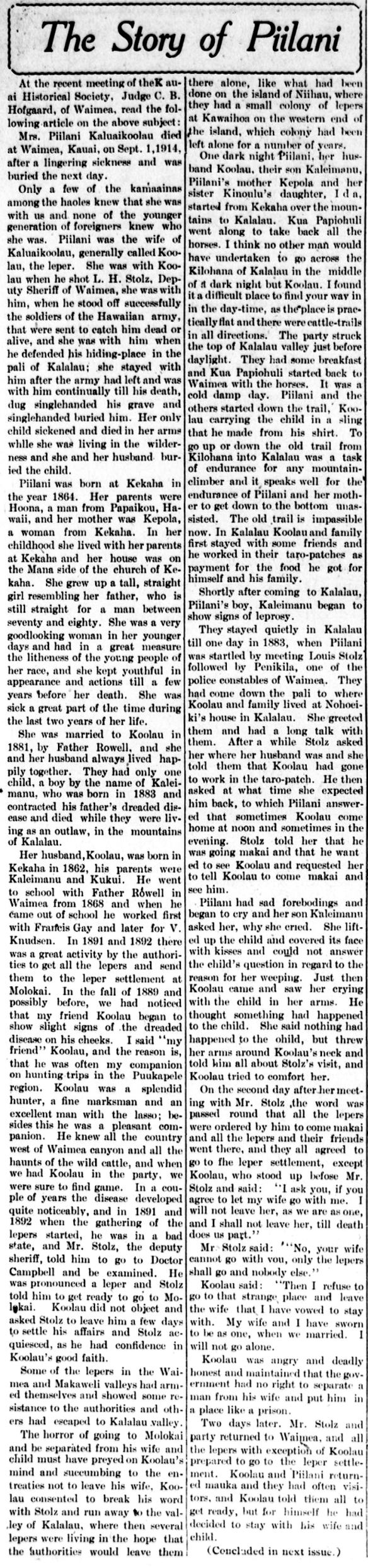
The Story of Piilani

At the recent meeting of the Kauai Historical Society, Judge C. B. Hofgaard, of Waimea, read the following article on the above subject:

Mrs. Piilani Kaluaikoolau died at Waimea, Kauai, on Sept. 1, 1914, after a lingering sickness and was buried the next day.

Only a few of the kamaainas among the haoles knew that she was with us and none of the younger generation of foreigners knew who she was. Piilani was the wife of Kaluaikoolau, generally called Koolau, the leper. She was with Koolau when he shot L. H. Stolz, Deputy Sheriff of Waimea, she was with him, when he stood off successfully the soldiers of the Hawaiian army, that were sent to catch him dead or alive, and she was with him when he defended his hiding-place in the pali of Kalalau; she stayed with him after the army had left and was with him continually till his death, dug singlehanded his grave and singlehanded buried him. Her only child sickened and died in her arms while she was living in the wilderness and she and her husband buried the child.

Piilani was born at Kekaha in the year 1864. Her parents were Hoona, a man from Papaikou, Hawaii, and her mother was Kepola, a woman from Kekaha. In her childhood she lived with her parents at Kekaha and her house was on the Mana side of the church of Kekaha. She grew up a tall, straight girl resembling her father, who is still straight for a man between seventy and eighty. She was a very goodlooking woman i her younger days and had in a great measure the litheness of the young people of her race, and she kept youthful in appearance and actions till a few years before her death. She was sick a great part of the time during the last two years of her life.

She was married to Koolau in 1881, by Father Rowell, and she and her husband always lived happily together. They had only one child, a boy by the name of Kaleimanu, who was born in 1883 and contracted his father’s dreaded disease and died while they were living as an outlaw, in the mountains of Kalalau.

Her husband, Koolau, was born in Kekaha in 1862, his parents were Kaleimanu and Kukui. He went to school with Father Rowell in Waimea from 1868 and when he came out of school he worked first with Francis Gay and later for V. Knudsen. In 1891 and 1893 there was a great activity by the authorities to get all the lepers and send them to the leper settlement at Molokai. In the fall of 1889 and possibly before, we had noticed that my friend Koolau began to show slight signs of the dreaded disease on his cheeks. I said “my friend” Koolau, and the reason is, that he was often my companion on hunting trips in the Puukapele region. Koolau was a splendid hunter, a fine marksman and an excellent man with the lasso; besides this he was a pleasant companion. He knew all the country west of Waimea canyon and all the haunts of the wild cattle, and when we had Koolau in the party, we were sure to find game. In a couple of years the disease developed quite noticeably, and in 1891 and 1892 when the gathering of the lepers started, he was in a bad state, and Mr. Stolz, the deputy sheriff, told him to go to Doctor Campbell and be examined. He was pronounced a leper and Stolz told him to get ready to go to Molokai. Koolau did not object and asked Stolz to leave him a few days to settle his affairs and Stolz acquiesced, as he had confidence in Koolau’s good faith.

Some of the lepers in the Waimea and Makaweli valleys had armed themselves and showed some resistance to the authorities and others had escaped to Kalalau valley.

The horror of going to Molokai and be separated from his wife and child must have preyed on Koolau’s mind and succumbing to the entreaties not to leave his wife, Koolau consented to break his word with Sotlz and run away to the valley of Kalalau, where then several lepers were living in the hope that the authorities would leave them there alone, like what had been done on the island of Niihau, where they had a small colony of lepers at Kawaihoa on the western end of the island, which colony had been left alone for a number of years.

One dark night Piilani, her husband Koolau, their son Kaleimanu, Piilani’s mother Kepola and her sister Kinoulu’s daughter, Ida, started from Kekaha over the mountains to Kalalau. Kua Papiohuli went along to take back all the horses. I think no other man would have undertaken to go across the Kilohana of Kalalau in the middle of a dark night but Koolau. I found it a difficult place to find your way in in the day-time, as the place is practically flat and there were cattle-trails in all directions. The party struck the top of Kalalau valley just before daylight. They had some breakfast and Kua Papiohuli started back to Waimea with horses. It was a cold damp day. Piilani and the others started down the trail, Koolau carrying the child in a sling that he made from his shirt. To go up or down the old trail from Kilohana into Kalalau was a task of endurance for any mountain-climber and it speaks well for the endurance of Piilani and her mother to get down to the bottom unassisted. The old trail is impassible now. In Kalalau Koolau and family first stayed with some friends and he worked in their taro-patches as payment for the food he got for himself and his family.

Shortly after coming to Kalalau, Piilani’s boy, Kaleimanu began to show signs of leprosy.

They stayed quietly in Kalalau till one day in 1883, when Piilani was startled by meeting Louis Sotlz followed by Penikila, one of the police constables of Waimea. They had come down the pali to where Kolau and family lived at Nohoeiki’s house in Kalalau. She greeted them and had a long talk with them. After a while Stolz asked her where her husband was and she told them that Koolau had gone to work in the taro-patch. He then asked at what time she expected him back, to which Piilani answered that sometimes Koolau come home at noon and sometimes in the evening. Stolz told her that he was going makai and that he wanted to see Koolau and requested her to tell Koolau to come makai and see him.

Piilani had sad forebodings and began to cry and her son Kaleimanu asked her, why she cried. She lifted up the child and covered its face with kisses and could not answer the child’s question in regard to the reason for her weeping. Just then Koolau came and saw her crying with the child in her arms. He thought something had happened to the child. She said nothing had happened to the child, but threw her arms around Koolau’s neck and told him all about Stolz’s visit, and Koolau tried to comfort her.

On the second day after her meeting with Mr. Stolz the word was passed round that all the lepers were ordered by him to come makai and all the lepers and their friends went there, and they all agreed to go to the leper settlement, except Koolau, who stoo up before Mr. Stolz and said: “I ask you, if you agree to let my wife go with me. I will not leave her, as we are as one, and I shall not leave her, till death does us part.”

Mr. Stolz said: “No, your wife cannot go with you, only the lepers shall go  and nobody else.”

Koolau said: “Then I refuse to go to that strange place and leave the wife that I have vowed to stay with. My wife and I have sworn to be as one, when we married. I will not go alone.

Koolau was angry and deadly honest and maintained that the government had no right to separate a man from his wife and put him in a place like a prison.

Two days later, Mr. Stolz and party returned to Waimea, and all the lepers with exception of Koolau prepared to go to the leper settlement. Koolau and Piilani returned mauka and they had often visitors, and Koolau told them all to get ready, but for himself he had decided to stay with his wife and child.

(Concluded in next issue.)

(Garden Island, 12/19/1916, p. 6)

GardenIsland_12_19_1916_6.png

The Garden Island, Volume 12, Number 51, Page 6. December 19, 1916.