Episcopal Church in Hawaii, 1861.

[Found under: “NOTES OF THE WEEK.”]

We are frequently inquired of whether anything definite has been done towards establishing an Episcopal Church at Honolulu. By the following, which we extract from the London Examiner of March 9, our readers will be gratified to learn that the matter is in progress and has been referred to a committee consisting of responsible and intelligent men, who will probably see that it is carried to a successful issue. It will be a source of great pleasure not only to us but to all interested in the progress of religion in the Pacific, to announce that the establishment of an Episcopal Church here, has been fully decided upon: Continue reading

More on Lady Franklin and ahuula and upcoming events, 1861 / 2015–2016.

While in Hawaii in 1861, Lady Franklin enjoyed the company often of King Kamehameha IV and Queen Emma. According to newspaper reports, the relationship between them was very cordial. She was given this treasured ahuula in commemoration of this bond.

If you find yourself in San Francisco at the end of this summer until the early part of next year (8/29/2015–2/28/2016), do make your way to the de Young Museum:

Lady Franklin cape

Lady Franklin cape (detail) (#5948). ‘apapane feathers, ‘ō‘ō feathers. Bernice Pauahi Bishop Museum, Ethnology Collection, 09670/1909.007

Royal Hawaiian Featherwork: Nā Hulu Ali‘i

August 29, 2015February 28, 2016

Explore the distinctive art, culture, and history of Hawai‘i with the first exhibition of Hawaiian featherwork on the U.S. mainland, developed in partnership with the Bernice Pauahi Bishop Museum, Honolulu. Presented in San Francisco, which is considered to be the gateway to the Pacific, the exhibition will feature approximately 75 rare and stunning examples of the finest featherwork capes and cloaks in existence, as well as royal staffs of feathers (kāhili), feather lei (lei hulu manu), helmets (mahiole), feathered god images (akua hulu manu), and related eighteenth- and nineteenth-century paintings and works on paper. Continue reading →

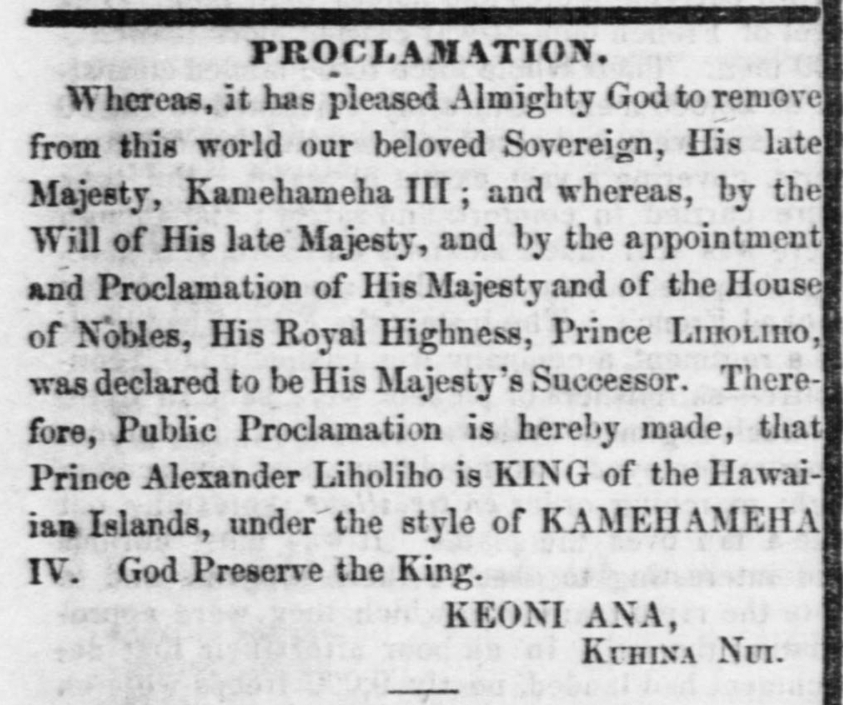
Alexander Liholiho is proclaimed Kamehameha IV, 1854.

PROCLAMATION.

Whereas, it has pleased Almighty God to remove from this world our beloved Sovereign, His Late Majesty, Kamehameha III; and whereas, by the Will of His late Majesty, and by the appointment and Proclamation of His Majesty and of the House of Nobles, His Royal Highness, Prince Liholiho, was declared to be His Majesty’s Successor. Therefore, Public Proclamation is hereby made, that Prince Alexander Liholiho is KING of the Hawaiian Islands, under the style of KAMEHAMEHA IV. God Preserve the King.

KEONI ANA,

Kuhina Nui.

(Polynesian, 12/16/1854, p. 2)

PROCLAMATION.

The Polynesian, Volume XI, Number 32, Page 2. December 16, 1854.

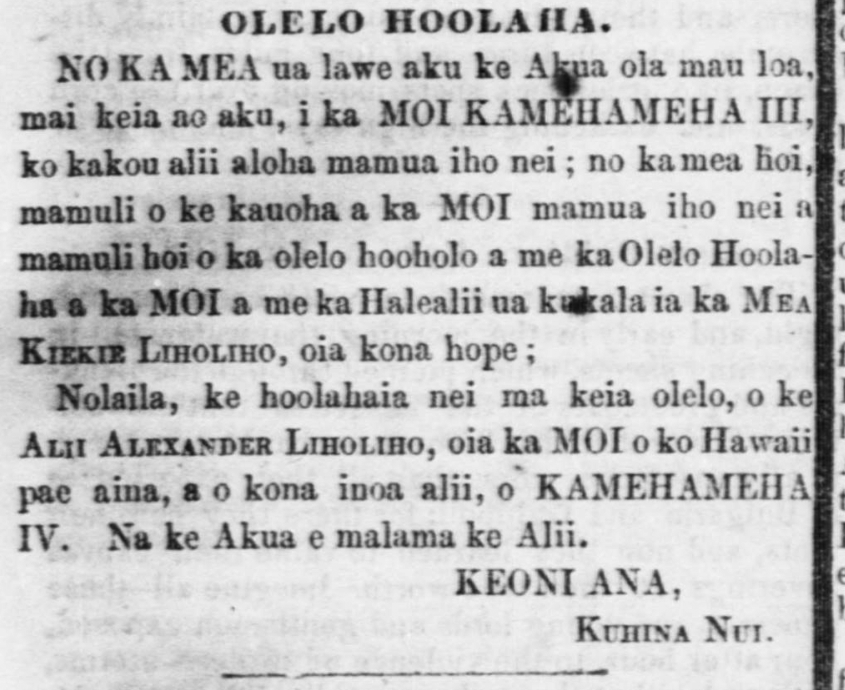
Alexander Liholiho becomes Kamehameha IV, 1854.

OLELO HOOLAHA.

NO KA MEA ua lawe aku ke Akua ola mau loa, mai keia ao aku, i ka MOI KAMEHAMEHA III, ko kakou alii aloha mamua iho nei; no ka mea hoi, mamuli o ke kauoha a ka MOI mamua iho nei a mamuli hoi o ka olelo hooholo a me ka Olelo Hoolaha a ka MOI a me ka Halealii ua kukala ia ka Mea Kiekie Liholiho, oia kona hope;

Nolaila, ke hoolahaia nei ma keia olelo, o ke Alii Alexander Liholiho, oia ka MOI o ko Hawaii pae aina, a o kona inoa alii, o KAMEHAMEHA IV. Na ke Akua e malama ke Alii.

KEONI ANA,

Kuhina Nui.

(Polynesian, 12/16/1854, p. 2)

OLELO HOOLAHA.

The Polynesian, Volume XI, Number 32, Page 2. December 16, 1854.

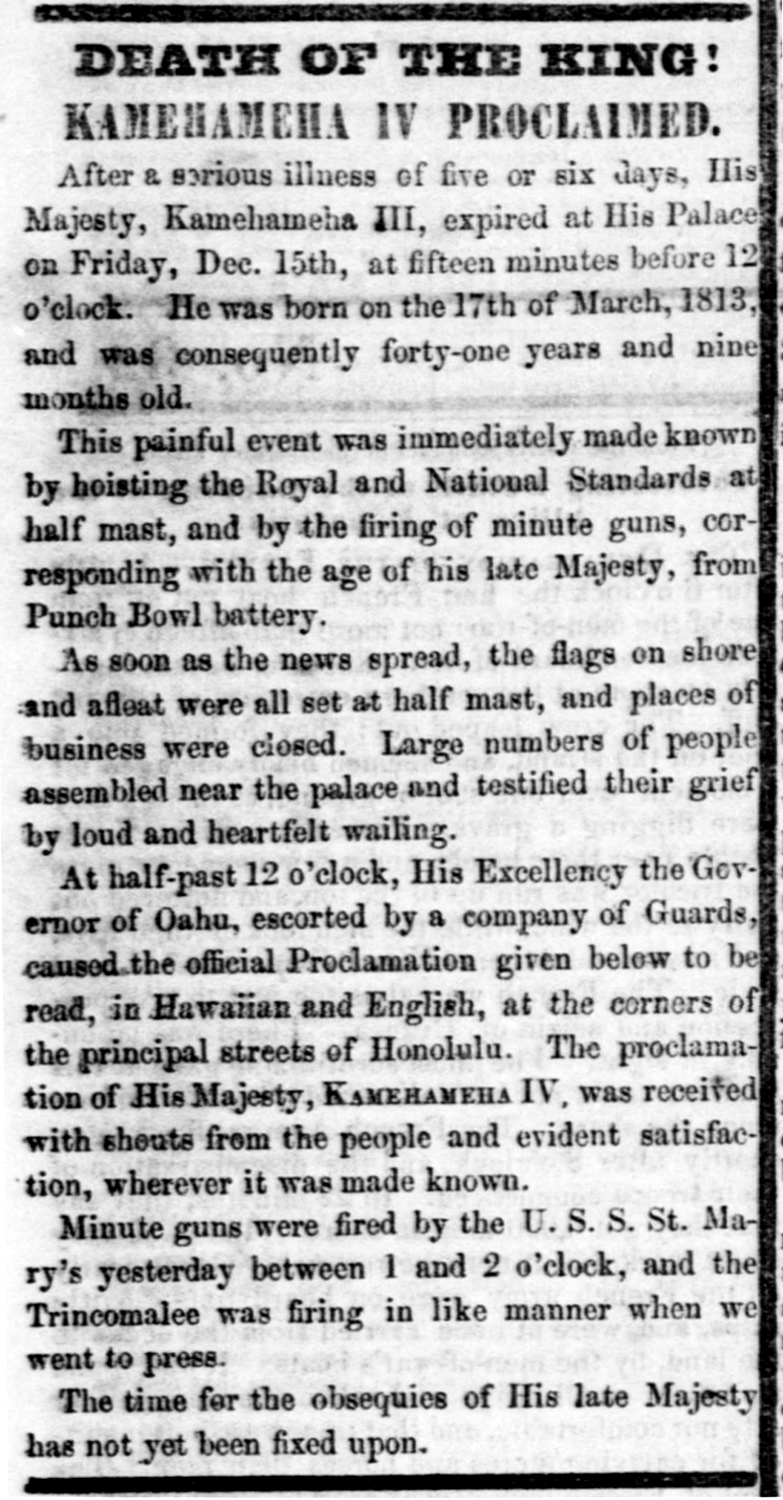
Kauikeaouli, Kamehameha III, dies a hundred and sixty years ago, 1854.

DEATH OF THE KING!

KAMEHAMEHA IV PROCLAIMED.

After a serious illness of five or six days, His Majesty, Kamehameha III, expired at His Palace on Friday, Dec. 15th, at fifteen minutes before 12 o’clock. He was born on the 17th of March, 1813, and was consequently forty-one years and nine months old.

This painful event was immediately made known by hoisting the Royal and National Standards at half mast, and by the firing of minute guns, corresponding with the age of his late Majesty, from Punch Bowl battery.

As soon as the news spread, the flags on shore and afloat were all set at half mast, and places of business were closed. Large numbers of people assembled near the palace and testified their grief by loud and heartfelt wailing.

At half-past 12 o’clock, His Excellency the Governor of Oahu, escorted by a company of Guards, caused the official Proclamation given below to be read, in Hawaiian and English, at the corners of the principal streets of Honolulu. The proclamation of His Majesty, Kamehameha IV, was received with shouts from the people and evident satisfaction, wherever it was made known.

Minute guns were fired by the U. S. S. St. Mary’s yesterday between 1 and 2 o’clock, and the Trincomalee was firing in like manner when we went to press.

The time for obsequies of His late Majesty has not yet been fixed upon.

[Unfortunately, the Hawaiian-Language Newspaper running at the time, Ka Nupepa Elele is not available digitally or on microfilm at this time.

The dark borders as seen here are found in newspapers when report of someone of import dies.]

(Polynesian, 12/16/1854, p. 2)

DEATH OF THE KING!

The Polynesian, Volume XI, Number 32, Page 2. December 16, 1854.

Tahitian mele for La Kuokoa, 1861.

Songs of Polapola

Aue oe tau hoa hele e,
E fiteri tou e,
Tai ta pea ta te fa tu,
O Iesu ta haa maitai.

Eau ia oe te oa oa,
Eau ia oe te haa maitai,
Ia oe nae te fei a haa wale,
I loto i te au ahi oia nae.

Aue oe e ta Moi e,
He aroha to oe,
Mai horoa i te hau ia Mareta,
E ta pea maitai.

Iaorana oe e ta Hatu o Hawaii,
Tai haapao ia tai haapao hia,
E mono i tooe toloa.

Iaorana oe e Ema,
Te Alii Vahine e,
Faatere maitai to otou haue,
E mau te ora o te Alii e amuri no atu.

Auwe oe tou hoa he re e,
Pi te ri tou e tei ta pea i ta te fatu,
Oietu te parau maitai,
eau ia oe te oaoa,
Eau ia oe te haa maitai,
Ia oto nae te feia faa vare,
I roto o te au ahi oia nae.

Auwe oe e ta Moi e,
E aroha to oe e,
Mai ho roa i te hau,
Ia Amerita,
E ta pea maitai mai,
Iaorana oe e ta Hatu Hawaii e,
Tei haa pao hia i mano to oe to roa,
Iaorana oe e Ema te Rii vahine e,
Faa te re maitai to otou hau,
E mau te aroha o te Rii e,
Ea muri noatu.

Himeni 27.

1 Te ra, te aoae, te fetia,
Maramarama ai te ao,
Maitai atoa ai te po,
Na te Atua i faaue iho,

2 Ia ara, e ia moe tatou,
Te merahi maitai tei mau,
To ratou tiai ia tatou,
Aore e ino i roohia mai.

3 Te rai anaana i nia ae,
Te aihere rii i raro nei,
Te miti atoa e ati ae,
Na te Atua i hamani.

4 Te puapua, noanoa,
Unauna ai te raau nei,
Te raau maa na tatou a,
Na te Atua i horoa mai.

5 Te ata i pee, te ua i pou,
Te matai farara e oraʻi,
Te manu, i rere nei,
Te mau puaa nana anae,

6. Te ia e tere i te tai,
Tei nee i raro i te repo,
Tatiou atoa te taata nei,
Ohipa na te Atua mau.

7 Ia hamanihia ra tatou
Ia hau tu teie i te maitai,
E ia ra oe ta te Arii parau,
Ma te aau au i a rue ai.

[These are some of the mele performed on the 28th of November, 1861, at Kawaiahao Church in celebration of Independence Day.

For more Tahitian mele, see this composition of Ninito and Manaiula Sumner for Victoria Kaahumanu from 1862.]

(Kuokoa, 12/2/1861, p. 2)

He Mele Polapola.

Ka Nupepa Kuokoa, Buke I, Helu 4, Aoao 2. Dekemaba 2, 1861.

Kanikau for Kamehameha IV, 1864.

ROUND—(4 Parts.)

1

Auwe! Auwe!

2

Aloha ino no,
Ka Moi Iolani,

3

Ua hala aku nei,
I ke ala hoi ole mai,

4

Auwe! Auwe!

ROUND of 4 parts.

1

Alas! Alas!

2

How sad for
The King Iolani,

3

He has passed,
On the path of no return,

4

Auwe! Auwe!

[This kanikau for Kamehameha IV shows that even as far back as 1864, dirges took all sorts of forms!]

(Kuokoa, 1/23/1864, p. 1)

ROUND--[4 Parts)

Ka Nupepa Kuokoa, Buke III, Helu 4, Aoao 1. Ianuari 23, 1864.

Death of Mary Ann Kaaumokulani Kinoole Pitman Ailau, 1905.

DIED.

AILAU—In Hilo, Hawaii. February 11, 1905. Mrs. Mary Ann Kaaumokulani Kinoole Pitman Ailau, daughter of the High Chiefess Kinoole and the late Benjamin Pitman, and widow of John Keakaokalani Ailau, aged 67 years.

Mrs. Ailau was known from one end of the group to the other, and in Boston and many of the Atlantic watering places.

She was born at Hilo 67 years ago, and with the exception of a number of years spent in Boston and New England completing her education, she always resided in the islands. She was a daughter of Benjamin Pitman a capitalist, who resided both in Hilo and Honolulu. The Pitman home was at the corner of Alakea and Beretania streets, on the site now occupied by the C. Q. Yee Hop building.

The Pitmans came here from Boston, where they were well connected. Mrs. Ailau’s father-in-law also resided here for a number of years. Her father married the High Chiefess Kinoole, daughter of the High Chief Hoolulu. Continue reading

Custom House, 1895.

Custom House of Honolulu.

We are adorning these columns of the Kuokoa with a picture of the grand Hale Oihana Dute of Honolulu nei, at the corner of Fort [Papu] and Allen [Alani] Streets. this building was built during the reign of Kamehameha IV., and it was added to at various times when it was found that it was not adequate for the incoming goods to be stored, so it has become very long and wide. This is the entrance [makaha] into the nation, where goods from foreign lands are stored, and duty is collected on taxable items, and not only that, the owners pay a fee for care of their goods in this building by the government. There is a big force of government employees in this bureau under the Department of Finance [Oihana Waiwai], starting with the collector-general and the deputy-collector, and down to the secretary and the storekeeper, guards, and so forth. The money expended to rebuild or perhaps extend this entrance comes from the revenues of the growing public funds due to the duties charged by this entity.

(Kuokoa, 3/16/1895, p. 2)

Ka Hale Oihana Dute o Honolulu.

Ka Nupepa Kuokoa, Buke XXXIV, Helu 11, Aoao 2. Maraki 16, 1895.

More on Kamehameha III 100th birthday memorial, 1914.

CENTENARY OF KAMEHAMEHA III IS MARKED WITH IMPRESSIVE SERVICE

Handsome Tablet Is Unveiled Accompanied by Sacred Chant of Loved King

The unveiling of a handsome tablet of Hawaiian lava granite, to the accompaniment of sacred chants composed a century ago, marked the 100th anniversary of the birth of Kauikeaouli, the third of the Kamehamehas, which yesterday afternoon was observed at old Kawaiahao church by the Daughters of Hawaii. It was a fitting memorial to that ruler who, known to his subjects as the beneficent king, gave to the inhabitants of these islands their first written constitution, and, to make the observance further complete, the tablet will be taken to Keauhou, Kona, where it will mark the birthplace of ka moi lokomaikai.

The historical structure of Kawaiahao, around which is woven innumerable tales dear to the heart of the kamaaina, was occupied by more than 2600 persons, the majority of whom were Hawaiian. The memorial tablet occupied the center of the platform, hidden from view by the royal standard of Liliuokalani and High Chiefess Elizabeth Kekaaniau Pratt, both lineal descendants of the Hawaiian King who was the founder of the Kamehameha dynasty. Feathered cloaks of almost priceless value draped the chairs in which they sat.

The strange, yet beautiful, setting doubtless was a perfect replica of a court scene in the days of the old regime when the Kamehameha held sway. The costuming of the participants was perfect, and there was presented a spectacle in which was brought out many ancient and rare relics which today are treasured by Honolulu families and which are seldom seen other than in private homes, where they are held almost sacred.

Attired in feather cloaks and helmets, High Chief Fred Kahapula Beckley and High Chief Albert Kalaninoanoa Hoapili, the spear and kahili bearers respectively, occupied places just back of the queen and High Chiefess Pratt, representing the figures which are seen on the royal Hawaiian coat-of-arms. Both are lineal descendants of chiefs of the court of Kamehameha I, High Chief Beckley being a descendant of Kameeiamoku, and High Chief Hoapili a descendant of Kamanawa, the royal kahili bearer. Boys from the Kamehameha school, to the number of 16, acted as court attendants and kahili bearers, and occupied places on either side of the court representatives. They were attired in feather capes and other accessories adopted by the Hawaiian warriors of other days. Above this gathering was suspended the royal standard of Kalakaua, as well as other Hawaiian flags, their colors blending in perfect harmony with the vivid green of the palms and ferns with which the nave was banked.

Continue reading