Diamond Kekona passes away in Germany, 1922.

That Hawaiian Boy Dies in Germany

Diamond Kekona Grew Weary of This Life After One Week of Being Ill.

HIS WIFE WAS AT HIS DEATH BED

It was His Wife Who Announced the Sad News to Honolulu nei on Monday

On Monday, this town received the sad news about the death of Diamond Kekona, the son of D. K. Kekona of this town, in Berlin, Germany, on the 13th of last month, February.

It was Mrs. Diamond Kekona, the wife of Kekona, who sent the sad news of the death of her husband to Mekia Kealakai, the leader of the Royal Hawaiian Band [Bana Hawaii], because he was a friend of the young Kekona and his wife when they were all living in London.

A letter was also received by Mr. D. K. Kekona, the father of the young man, confirming the news about the passing of his son.

Diamond Kekona was born on the 6th of October, 1890, so at his death, he was thirty-three years old and some.

Diamond left Honolulu in 1905 for New York, with a group of singers and musicians. He spent many years in America in this occupation.

During the great war of the world, Diamond Kekona was in England, and he enlisted in the service under Britain, going off to war in France and Belgium. He married a British woman and had two children, however the two of them died.

At the end of the war, Mr. and Mrs. Kekona lived in Belgium, and just last year they went to Berlin, Germany, where they met up with Joe Puni, William Kanui, and Joseph Nihali [?]; but according to the letter of Mrs. Kekona, he did not get along with Joe Puni, and they did not talk.

Mr. Kekona was not sick for long before he died, it was just a week; and in the letter his wife wrote to Mr. D. K. Kekona, she told him of her intent to return the body of her husband to London to bury, in her homeland, close to her home.

With the passing of this Hawaiian youth in foreign lands, he left behind, grieving for him: his young British wife; his grandmother, Mrs. Makalohi, who is 91; his father, Mr. D. K. Kekona, working in the sheriff department and a pastor of the Christian Science Church [Hoomana Naauao]; two younger brothers named Hugo and August Kekona; and their sister, Mrs. Lonohira [Mrs. George Lonohiwa]; and a big family.

(Kuokoa, 3/22/1922, p. 1)

Make Ia Keiki Hawaii Maloko o Kelemania

Ka Nupepa Kuokoa, Buke LXI, Helu 12, Aoao 1. Maraki 22, 1922.
More mele, this time from Liliuokalani! 1920.

NEW MELE BY LILIU.

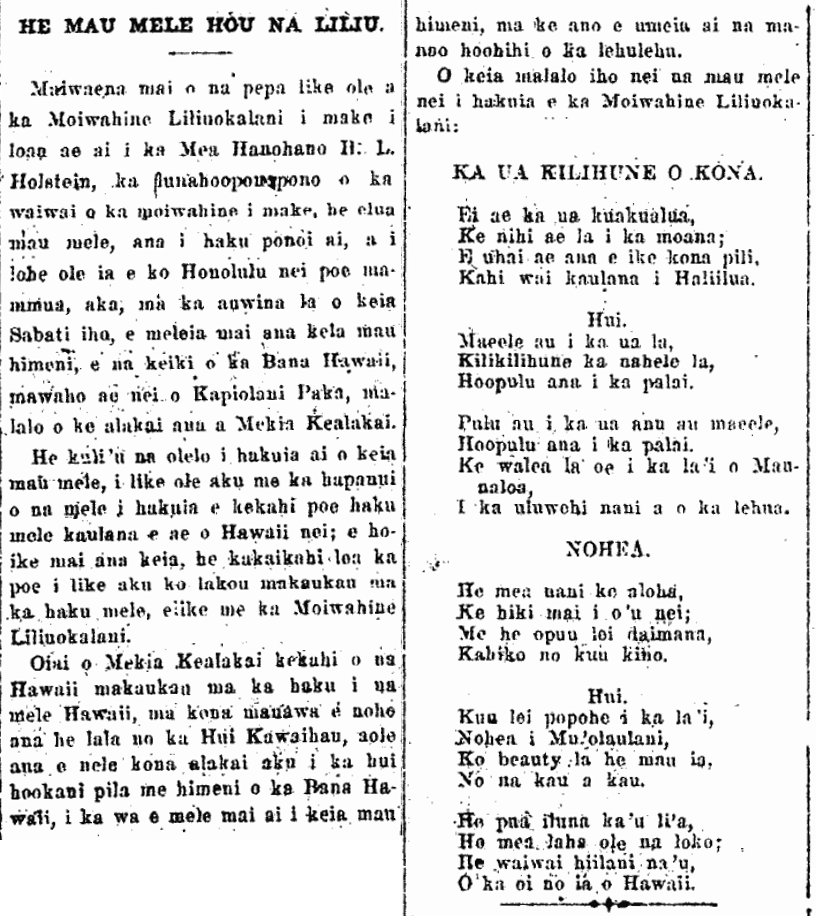
From within the various papers of the deceased Queen Liliuokalani, the Honorable H. L. Holstein, the executor of the deceased queen’s estate, found two mele which she composed herself, and which Honolulu’s people have not heard before; however, on the evening of this Sunday, the mele will be sung by the Royal Hawaiian Band [Bana Hawaii] outside of Kapiolani Park, under the direction of Mekia Kealakai.

The words of these compositions are profound, unlike most of the mele composed by other famous composers of Hawaii nei; this shows that there are but few people who are adept at composing mele like Queen Liliuokalani.

Being that Mekia Kealakai is one of those skilled at composing Hawaiian mele while he was a member of the Hui Kawaihau [Kawaihau Glee Club], there will be nothing lacking in his directing of the playing and singing of the Royal Hawaiian Band, when the mele are sung, drawing forth feelings of admiration from the audience.

Here below are the mele composed by Queen Liliuokalani:

KA UA KILIHUNE O KONA.

Ei ae ka ua kuakualua
Ke nihi ae la i ka moana;
E uhai ae ana e ike kona pili,
Kahi wai kaulana i Haliilua.

Hui.

Maeele au i ka ua la,
Kilikilihune ka nahele la,
Hoopulu ana i ka palai.

Pulu au i ka ua anu au maeele,
Hoopulu ana i ka palai.
Ke walea la oe i ka la’i o Maunaloa,
I ka uluwehi nani a o ka lehua.

NOHEA.

He mea nani ke aloha,
Ke hiki mai i o’u nei;
Me he opuu lei daimana,
Kahiko no kuu kino.

Hui.

Kuu lei popohe i ka la’i,
Nohea i Mu’olaulani,
Ko beauty la he mau ia,
No na kau a kau.

He pua iluna ka’u li’a,
He mea laha ole na loko;
He waiwai hiilani na’u,
O ka oi no ia o Hawaii.

[This must have been some performance! “Nohea” is also known as “Nohea i Mu’olaulani” and as just “Mu’olaulani.” I am not sure why this song is referred to as an unknown composition in 1920. But does anyone know if there are any recordings of “Ka Ua Kilihune o Kona”?]

(Kuokoa, 12/10/1920, p. 3)

HE MAU MELE HOU NA LILIU.

Ka Nupepa Kuokoa, Buke LVIII, Helu 50, Aoao 3. Dekemaba 10, 1920.

Royal Hawaiian Band gets new instruments, 1912.

EXPRESSION OF APPRECIATION.

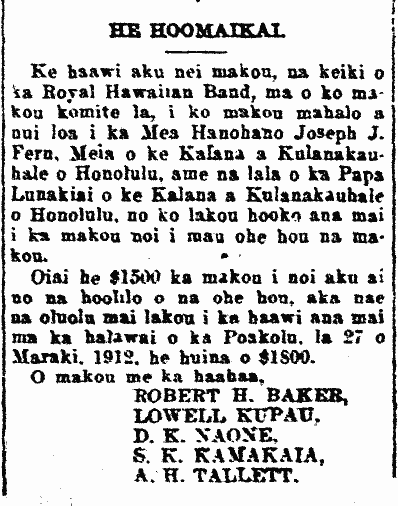
We, the boys of the Royal Hawaiian Band, by means of our committee, give our great appreciation to the Honorable, Joseph J. Fern, Mayor of the City and County of Honolulu, and the Board of Supervisors of the City and County of Honolulu, for their approving our request for new wind instruments.

Although we requested $1500 for the costs of the new instruments, they kindly granted us at the meeting of Wednesday, the 27th of March, 1912, the sum of $1800.

We, with sincerity,

Robert H. Baker,
Lowell Kupau,
D. K. Naone,
S. K. Kamakaia,
A. H. Tallett.

(Kuokoa, 4/5/1912, p. 6)

HE HOOMAIKAI.

Ka Nupepa Kuokoa, Buke XLVIII, Helu 14, Aoao 6. Aperila 5, 1912.

Kawaihau Glee Club off to San Francisco. 1905.

The Famous Singing Group “Kawaihau”

They Left for Afar.

“E nihi ka helena mai hoopa; [Tread carefully, don’t touch;]
Mai pulale i ka ike a ka maka [Don’t get excited by what the eye sees:]
Hookahi no makamaka o ke ALOHA [There is but one companion, that is ALOHA];
A hea mai ia Kawaihau e kipa. [Calling out to Kawaihau to come visit.]”¹

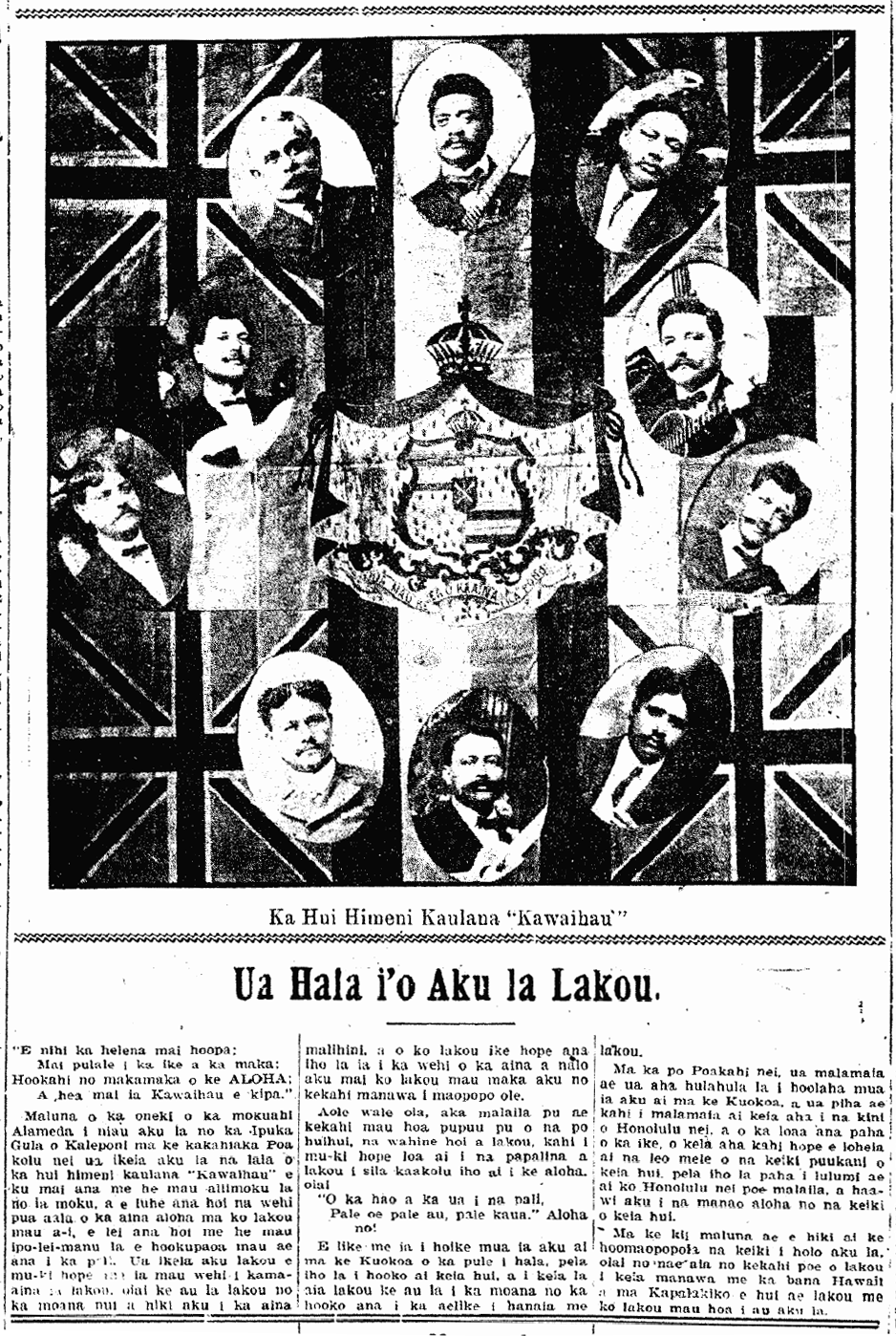
Aboard the deck of the steamship Alameda that moved swiftly on to the Golden Gate of California on the morning of Wednesday was seen the members of the famed singing group “Kawaihau” standing like officers of the ship while garlands of fragrant flowers of the beloved land hung about their necks; they wore the lei like a beloved sweetheart ever imbuing fragrance in their bosom. They were seen inhaling for the last time the adornment familiar to them as they were leaving for the great sea headed for foreign lands; and they were seeing for the last time the verdure of the land which disappeared from their eyes for who knows how long.

Not just them, but also there were the companions to curl up together in the cold nights—their wives, there to kiss their cheeks for the last time, which they sealed threefold with love, as

“O ka hao a ka ua i na pali [The assault of the rain in the cliffs]
Pale oe, pale au, pale kaua.” Aloha no! [I fend off, you fend off, we both fend off.”² Aloha!]

Just as reported earlier in the Kuokoa of last week, so did this group carry out, and today they are travelling over the ocean to fulfill the contract made with them.

This past Monday that dance advertised earlier in the Kuokoa was held, and the venue where the event took place was filled with the multitudes of Honolulu; perhaps they knew that this gathering would be the last they’d hear the singing of the performers of this group, and that is probably why Honolulu’s people thronged there and gave their aloha to the boys of the band.

In the picture above, you can see the boys who went, although some of them are currently with the Hawaiian Band in San Francisco and will meet up with their companions who left.

¹Play on the chorus of Kalakaua’s “E Nihi ka Hele.”
²Anyone know what mele this might come from?

[This is who played at that huge wedding celebration in Pauoa attended by Kaiulani in 1898 (the articles posted yesterday)]

(Nupepa Kuokoa, 9/22/1905, p. 1)

Ua Hala i'o Aku la Lakou

Ka Nupepa Kuokoa, Buke XLIII, Helu 38, Aoao 1. Sepatemaba 22, 1905.

Laying of the cornerstone of Liliuokalani School, 1912.

The Cornerstone of the New Great School is Laid.

At three o’clock on the afternoon of last Friday (4/12/1912), a ceremony was conducted to lay the cornerstone of the new school house in Kaimuki, that will be called hereafter, Liliuokalani School.

Queen Liliuokalani laid the cornerstone, and Legislator Dole, and former President of the Republic of Hawaii gave a speech about the school. The Hawaiian Band was there along with many invited guests.

When it is completed, this will be one of the most distinguished and beautiful schools, according to what is being said. And when you look at the artist’s rendering, it is indeed splendid. Authorization for building and funds were set aside in the previous session of the Legislature, through the efforts of Legislator Towse, and it was he that gave the final speech that afternoon.

The grounds of this school is near the corner of Waialae and Koko Head. It is being constructed of cement, like many of the great buildings being built these days. And the entire costs will be, as decided by the legislature, $60,000. $8000 was spent to purchase the land. The artist who drew the rendering was J. H. Craig. A. P. McDonald is the one doing the constructing; he received the contract to build the school to completion. Should there be no accidents or hinderances to the progress, the school will be unveiled this coming fall, as per what was decided.

Everything concerning the dedication of the cornerstone fell under the Improvement Club of Palolo and Kaimuki. Present also the head of the DOE, Willis T. Pope, as well as many men and women invited to attend.

[Although sadly this school has been closed, I hear there will be a 100th year celebration of the laying of the cornerstone to be held on the Queen Liliuokalani School grounds, on the 12th of April, with gates opening at 3:00 p. m.

See also from Chronicling America these related articles in English:

Evening Bulletin, 4/13/1912, p. 11,

Hawaiian Gazette, 4/16/1912, p. 7.

And about the actual opening of the school:

Hawaiian Gazette, 10/15/1912, p. 7.]

(Kuokoa, 4/19/1912, p. 6)

HOOMOEIA KA POHAKU KIHI O KA HALEKULA NUI HOU.

Ka Nupepa Kuokoa, Buke XLVIII, Helu 16, Aoao 6. Aperila 19, 1912.