More on the missionaries, 1894.

Missionary Descendants Show Their Knowledge of Hula Ku’i.

In the Advertiser of 2/7/1894, was shown that at New Haven, United States of America, on the past 17th of January 1894, there was held a party to commemorate the anniversary of the government by the P. G. Those present were: J. R. Kauka [James Robert Judd?], G. S. Walakahauki [George S. Waterhouse], C. M. Kuke [C. Montague Cooke, Jr.?], W. D. Balauina [William D. Baldwin], A. M. Atherton, A. S. Knudsen, J. A. Waila [James Austin Wilder], H. A. Balauina [Harry A. Baldwin], and F. Hastings.

Before drinking to the delight at the Cabinet of Ministers of Cleveland, the young missionaries danced a hula ku’i to a hapa haole song. When the music started, the youths among them who knew how to hula ku’i jumped up immediately and danced and started to sway! …the mixed poi of Poniuailana goes the limit; there you go!—answer the call!—…¹

KE MELE HULA-KUI.

Kaulana mai nei o Mr. Cleveland,
Anti-Annexation no ia ia,
Ua olelo Cleveland i Mr. Willis,
E hele ana oe e Honolulu,
Aia hiki ana oe malaila,
E kipaku oe i ka P. G.
A komo oe Liliuokalani,
Maluna o kona throne!”
Ua hai mai Peresidena Dole,
E noho oe Malie”
Pilikia loa no Alapaki Willis,
E hoka no o Mr. Cleveland.

A MELE HULA KU’I

Famed is Mr. Cleveland,
An Anti-Annexationist is he,
Cleveland said to Mr. Willis,
[“]You are going to Honolulu,
When you get there,
Banish the P. G.
And place Liliuokalani,
Upon her throne!”
President Dole spoke,
[“]You just sit still.”
Albert Willis is perplexed,
Mr. Cleveland is thwarted.

The adeptness at the hula ku’i by these missionary descendants was seen first hand here in Honolulu, along with the girls carrying ukulele.

There you go! Mixed up is the cultivated taro with the wild! The white is smeared; the black gets the score.

What is this S. E. Bishop!—Look to New Haven! Your people’s hula ku’i dancer descendants were  gyrating away!

You missionaries, don’t be hypocritical.

¹…kuupau na ai hoowali o Poniuailana; o—ia!—e, o!—…

[Does anyone have more information on the “Kuupau na ai hoowali o Poniuailana” phrase?]

(Nupepa Ka Oiaio, 2/9/1894, p. 3)
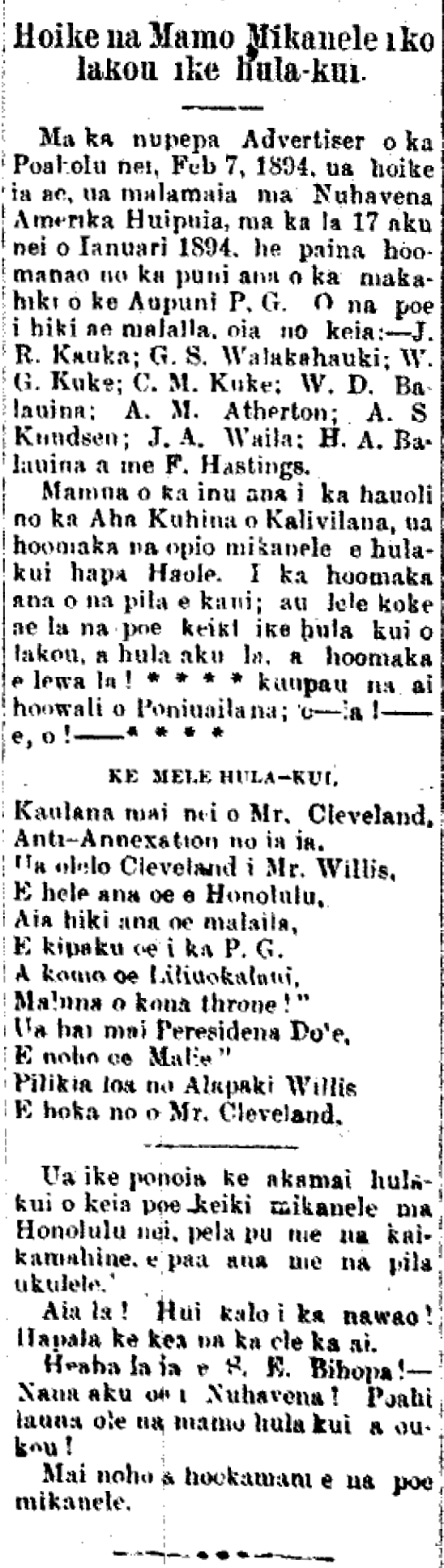
Hoike na Mamo Mikanele i ko lakou ike hula-kui.

Nupepa Ka Oiaio, Buke VI, Helu 6, Aoao 3. Feberuari 9, 1894.

The Hawaiian Moses? 1893.

“THE MISTAKES OF MOSES.”

We refer, of course, to the Hawaiian political Moses, who has recently broken camp, and set the faithful in motion through sea, desert and wilderness to the Land of Promise, beyond the shadow of the Throne. Yes! We refer to the Hawaiian political Moses, but whether his other name is Dole or Thurston, has not, at this writing, fully transpired. Still, the doubt as to his other name is a merely nominal doubt, not affecting the merits of the case. And as the original state—man of that name was not gifted with immunity from error, so neither has the Hawaiian Moses, even during his very brief pilgrimage, avoided all mistakes. It should ever be the part of a friend to note his friends’ infirmities, and, by bringing them mildly to their authors’ notice, suggest their reform, or convey a warning against their repetition.

———

We are all aware of the high pressure of seeming necessity under which the present government was formed. We can therefore appreciate, to some extent, the causes of the neglect to observe, towards the numerous Native element, those marks of regard and confidence without which no government can hope to endure in Hawaii. We repeat, that the pressure of the occasion must be the excuse of the gentlemen at the head of the movement for their seemingly unfriendly, and even hostile attitude toward the entire Native race, in the ordering of early events under the new dispensation.

———

The exclusion of Hawaiians from a participation in the beneficent project not only seemed, but was, and is complete. There may have been, and no doubt were reasons, seemingly sound to those who adopted them, for such a course,—reasons of which the public cannot judge, because the public know them not. Yet it would seem that one of two propositions must be true; viz.: either the Hawaiians were needlessly, and, therefore, harshly excluded from such participation in the reforming of their own government, or else the entire race were deemed by the leaders to be unfit to participate in such an enterprise.

———

If the former of the above propositions be true, one would naturally expect the mistake to be rectified at the earliest opportunity. That it has not been rectified would seem to stamp it as having been no mistake, but a course deliberately adopted, for, note the opportunity to retrieve the error, (if error it had been thought to be) in the filling of the four vacancies in the Advisory Council, on the 21st inst. It was then, as seems to us, the manifest duty of the government to seek out and appoint to those vacancies, men of Hawaiian blood, whose brains, interests and loyalty to the new idea bespoke than as deserving of such honor and confidence.

———

The failure of the government to attempt to bring even one Hawaiian to a seat at the Council Board is susceptible of only one of two meanings:—1st, that no Hawaiian could be found possessing those qualifications, or, 2nd, that the government were determined to ignore and exclude them, in any event.

———

If such exclusion was premeditated and malicious, the less said of it the better, as it is self-condemnatory. If on the other hand, there be no native Hawaiian fit to occupy a seat in the government councils, with what degree of candor or confidence can the Provisional Government request of expect the United States to incorporate our country into itself? What a commentary upon that request is the action of the government itself, in thus excluding from their confidence the entire aboriginal race, more completely than the Mongolian is now excluded from the Union. Forty odd thousand Hawaiians on these shores, and not one, (in the opinion of the government,) entitled or qualified to have a voice in the government of his native land. What a text for the American enemies of annexation, and how they will use it!

(Liberal, 1/25/1893, p. 2)

"THE MISTAKES OF MOSES."

The Liberal, Volume I, Number 39, Page 2. January 25, 1893.

Where did all of these treasures from the Kingdom go? 1922.

THERE ARE MANY OLD THINGS PLACED ON DISPLAY.

There are many old things from the monarchial period saved as memorabilia on display in the window of the business of Hawaiian News Co., which is headed by John H. Soper, the first General of the Hawaiian National Guards [Pualikoa Kiai Lahui Hawaii]; and amongst the old things is the sword of King Kalakaua, memorabilia from the P. G. [Provisional Government; aupuni kuikawa], and many various documents.

There also is a ticket signed by G. E. Smithies of the treasury office, for the receipt of the crown and sword of Kalakaua and many other items within Iolani Palace at the time, and now the Executive Building [Hale Mana Hooko].

Near the sword is a written document, explaining that it was presented to Colonel Soper (that being Soper’s rank at the time) from James W. Robertson, the first chamberlain of the King, by order of Sanford B. Dole, and it was written on the 18th of January, 1893, the day after Queen Liliuokalani was driven from the throne.

There are also proclamations signed by President Dole and the ministers of the P. G. giving authority to John H. Soper, the one who was appointed as marshal of the republic of Hawaii, to proclaim martial law. There are also several documents sent to Marshal Soper from President Dole ordering Soper to circulate the proclamations should the troops of the Provisional Government be waged war upon.

There is also an order giving authority to Marshal Soper to arrest some men here in Honolulu, should they defy the government. In the list of names of those people are: Charles J. McCarthy, former mayor of Hawaii; also C. B. Wilson, marshal of the kingdom under Queen Liliuokalani; Samuel Parker and some other former ministers; along with other important people of the time amongst the Hawaiians.

Also in the window is a portrait painted of President Dole and also of General Soper in full dress, in the role of General of the Republic of Hawaii; and so too with other important people during the time of the overthrow of 1893.

All of the appointment documents of General Soper as a marshal [ilamuku] for the kingdom signed by King Kalakaua from 1884 to 1886, and also the appointment as marshal by President Dole for the republic of Hawaii, and the appointments as colonel and brigadier general for the National Guards, can all be seen in the window.

[Speaking of treasures and swords and auctions… Why is this sword up for auction?]

(Kuokoa, 9/22/1922, p. 1)

LEHULEHU NA MEA KAHIKO I KAUIA NO KA HOIKEIKE ANA.

Ka Nupepa Kuokoa, Buke LXI, Helu 39, Aoao 1. Sepatemaba 28, 1922.

Laying of the cornerstone of Liliuokalani School, 1912.

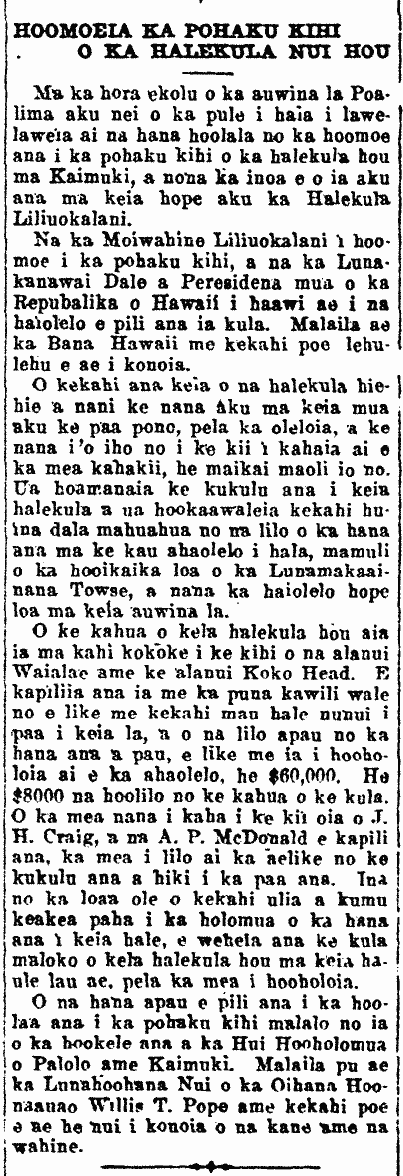
The Cornerstone of the New Great School is Laid.

At three o’clock on the afternoon of last Friday (4/12/1912), a ceremony was conducted to lay the cornerstone of the new school house in Kaimuki, that will be called hereafter, Liliuokalani School.

Queen Liliuokalani laid the cornerstone, and Legislator Dole, and former President of the Republic of Hawaii gave a speech about the school. The Hawaiian Band was there along with many invited guests.

When it is completed, this will be one of the most distinguished and beautiful schools, according to what is being said. And when you look at the artist’s rendering, it is indeed splendid. Authorization for building and funds were set aside in the previous session of the Legislature, through the efforts of Legislator Towse, and it was he that gave the final speech that afternoon.

The grounds of this school is near the corner of Waialae and Koko Head. It is being constructed of cement, like many of the great buildings being built these days. And the entire costs will be, as decided by the legislature, $60,000. $8000 was spent to purchase the land. The artist who drew the rendering was J. H. Craig. A. P. McDonald is the one doing the constructing; he received the contract to build the school to completion. Should there be no accidents or hinderances to the progress, the school will be unveiled this coming fall, as per what was decided.

Everything concerning the dedication of the cornerstone fell under the Improvement Club of Palolo and Kaimuki. Present also the head of the DOE, Willis T. Pope, as well as many men and women invited to attend.

[Although sadly this school has been closed, I hear there will be a 100th year celebration of the laying of the cornerstone to be held on the Queen Liliuokalani School grounds, on the 12th of April, with gates opening at 3:00 p. m.

See also from Chronicling America these related articles in English:

Evening Bulletin, 4/13/1912, p. 11,

Hawaiian Gazette, 4/16/1912, p. 7.

And about the actual opening of the school:

Hawaiian Gazette, 10/15/1912, p. 7.]

(Kuokoa, 4/19/1912, p. 6)

HOOMOEIA KA POHAKU KIHI O KA HALEKULA NUI HOU.

Ka Nupepa Kuokoa, Buke XLVIII, Helu 16, Aoao 6. Aperila 19, 1912.