Still more on the Makee, the Malulani, and a reminder on naming, 1897.

[Found under: “ALL ALONG THE DOCKS”]

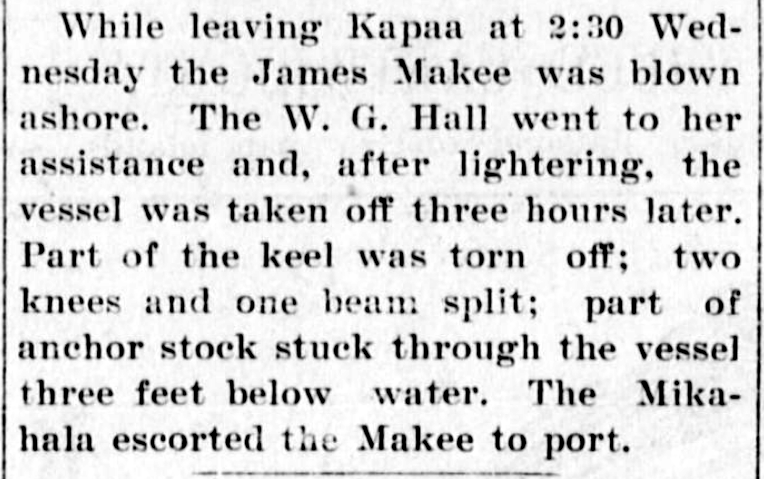
While leaving Kapaa at 2:30 Wednesday the James Makee was blown ashore. The W. G. Hall went to her assistance and, after lightering, the vessel was taken off three hours later. Part of the keel was torn off; two knees and one beam split; part of the anchor stock stuck through the vessel three feel below water. The Mikahala escorted the Makee to port.

[It is good to at least be aware that many times, Hawaiians called things (boat, for instance) a different name from what it was called in English. Here you see the W. G. Hall mentioned. It might sound more familiar to you as the Malulani.

Spelling is also varied in Hawaiian on occasion. You would expect in the Hawaiian-Language Newspapers, the James Makee to be written Kimo Maki (which it is at times), but it is also seen as Kimo Makee, James Maki, and James Makee as well! On a somewhat related note, Ena Road in Waikiki is not pronounced like “ena” as is so often heard today from the youngsters, but it is pronounced like “ina” and refers to the old-time Ing Family. So you will see in the Hawaiian-Language Newspapers, John Ena, John Ina, Keoni Ena, Keoni Ina…

I would like to see an easy online reference done for English/Hawaiian name variants done!]

(Hawaiian Star, 1/2/1897, p. 2)

While leaving Kapaa at 2:30...

The Hawaiian Star, Volume III, Number 1160, Page 2. January 2, 1897.

More on the Makee, 1897.

JAMES MAKEE AGROUND.

Accident to One of the Inter-Island Boats at Kapaa.

The James Makee met with a streak of misfortune on her last trip to Kauai. She was leaving Kapaa about 2:30 p. m. on Wednesday with 650 bags of sugar on board. The wind was blowing a perfect gale, and the Makee was blown upon the knuckle, sticking fast.

The W. G. Hall¹ came over from Koloa to the assistance of the Makee.

Capt. Peterson gave orders to have the sugar discharged. Something over 200 bags was put into the W. G. Hall and the rest was taken back to Kapaa.

The Makee had her stern lightened, and she swung around into deep water about 5 p. m. Five hours later she had all her cargo out, and she slid off with her keel very badly damaged.

The Makee left for Koloa at 8:30 a. m. on Thursday and arrived in Hanamaulu at 7:30 p. m. same day. Here she met the Mikahala and the two came to Honolulu together.

¹The W. G. Hall was also known as Malulani.

(Hawaiian Gazette, 1/5/1897, p. 5)

JAMES MAKEE AGROUND.

The Hawaiian Gazette, Volume XXXII, Number 2, Page 5. January 5, 1897.

Auhea iho nei la o Makee, A ka Malulani la e huli hele nei… 1897.

Kimo Maki Near Disaster.

Tuesday Night past, when the steamship James Makee was in Kapaa, Kauai, while the strong winds were blowing upon us and there as well, it was blown towards land while it attempted to head out to sea. It was stuck for two hours, and during this time, its cargo was unloaded, and the Malulani arrived to give assistance. Looking from the underside, it was seen that part of its keel [kila] was lost, two knees [kuli] and one beam [kua] at the stem were split, and there was a hole underneath, perhaps three feet below sea level at the base of the anchor. The Malulani accompanied it until arriving here in the morning of this past Friday. It will be placed atop the marine railway.

[I am guessing that this is the incident which inspired the famous composition still often heard today!]

(Makaainana, 1/4/1897, p. 8)

Kokoke e Poino ke Kimo Maki.

Ka Makaainana, Buke VII, Ano Hou—Helu 1. Aoao 8. Ianuari 4, 1897.

Updated Elepaio Story, 1894.

DON’T WORRY.

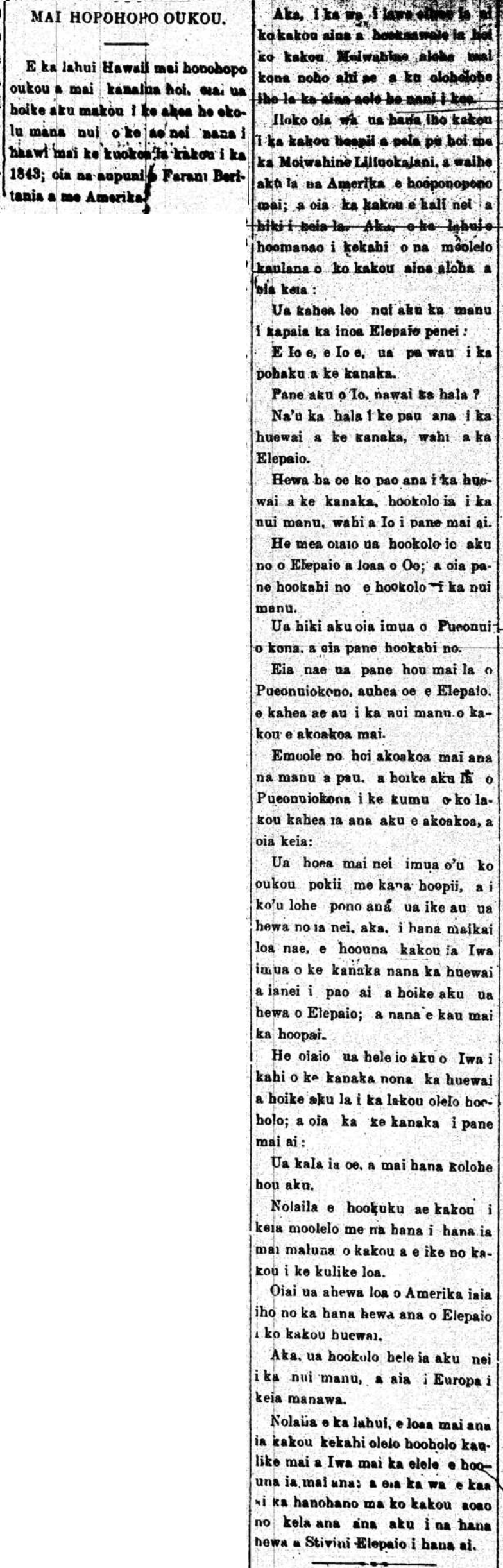
O Hawaiian people, don’t worry and don’t be uncertain. for we have publicly shown that there are three great powers of the world who have granted independence to us in 1843, that being France, Britain, and America.

But when our land was stolen and our beloved Queen was taken from her throne and our land stood bare without any beauty remaining,

During that time, we composed our protest, along with Queen Liliuokalani, and left if for America to make right; and it for this that we wait until today. But O Nation, do recall one of the famous stories of our beloved land, this being:

The bird called Elepaio called out loudly:

“O Io, O Io, I was hit by the rock of the man.”

Io answered, “Who was at fault?”

“I was wrong for pecking at the huewai of the man,” answered Elepaio.

“You are indeed at fault for puncturing the huewai of the man; let it be judged by the many birds,” was Io’s answer.

It was so, Elepaio was judged; he came upon Oo, and his answer was the same, that it be judged by the many birds.

Elepaio arrived before Pueonuiokona, and his answer was the same.

But Pueonuiokona went on to say, “Say Elepaio, I will call our many fellow birds to come together.”

In no time, all the birds came together, and Pueonuiokona revealed the reason for them being called to assemble, like this:

“Before me appeared your younger sibling with his protest, and when I heard correctly, I knew he was wrong, however, the best thing to do would be for us to send Iwa before the man to whom belonged the huewai that Elepaio pecked, and to tell him that Elepaio was guilty, and it is for him to set the punishment.”

And it was so, Iwa went to the place of the man to whom belonged the huewai, and told him of their decision; this is what the man said:

“You are forgiven, and don’t do anymore harmful acts.”

So we compare this story with the actions carried out upon us, and we see that they are exactly the same.

For America totally blames itself for the wrong done by Elepaio to our huewai.

But it is going around being judged by the many birds, and is currently in Europe.

So therefore, O Nation, we will receive a fair judgement from Iwa, the messenger that is being sent; and that will be when the dignity shall be awarded to our side through the judgement of the crimes carried out by Stevens Elepaio.

(Leo o ka Lahui, 10/11/1894, p. 2)

MAI HOPOHOPO OUKOU.

Ka Leo o ka Lahui, Buke II, Helu 1047, Aoao 2. Okatoba 11, 1894.

Offense, Judgement, and Remorse, 1862.

The Tale of the Elepaio and the Water Gourd.

One day, a man named Piiwai went up the mountains to fetch drinking water, for the water of that area was located in the mountains, that being at Kahului, Kona, Hawaii. From one side to the other of that area in Kona, there was water by the ocean, but brackish water, and was not pleasant to drink, and the cool and very refreshing water to drink was in the uplands in the mountains; it is still this way these days, that they go into the mountains to fetch water.

When he made his ascent until this spring, he scooped in his water gourd [huewai] until it was filled with water, and he made his way back until a hill where he rested. He put down his huewai and stood it upright and went elsewhere.

At that time, a bird flew down, an Elepaio, and alighted on the spout of the huewai of that man, and the bird pecked at the huewai of the man until all the water flowed out; the man returned to where the huewai stood and the bird flew away and perched.

But the man saw the bird fly away, yet he did not imagine that his huewai was pecked on by the bird. He grabbed it and lifted it up, and it felt lighter; the man looked at it and saw that there was a hole; he figured that the bird pecked at it until making a hole; his anger at the bird boiled over and said to himself, “Ha! You are one very mischievous bird; I will kill you.”

The man grabbed a rock, and threw it at the bird, hitting it, but it did not die. The bird flew away; it flew away so that its many fellow birds could judge this stoning by the man.

When it flew away in search of the birds, after flying for a while, he first spotted Pueo, the owl; he flew by Pueo and called out like this:

“O Pueo, O Pueo,”

Pueo heard this call from Elepaio; Pueo turned and poised aloft and gently, Pueo inquired like this:

“O Elepaio, O Elepaio, What is it that you want of me?”

Elepaio told of what he did to the huewai of the man in a chanting song [olioli], like this:

“I was hit, By the rock, Of a man.”

Pueo asked Elepaio,

“Who was at fault.” Elepaio responded in chant:

“I was at fault, For pecking,
The huewai, Of the man.”

Pueo said in chant:

“Let it be judged, By the many birds, Among us.”

Elepaio went in search; he flew for a while and saw Io, the hawk, soaring atop the gentle winds, and Elepaio called out:

“O Io, O Io,”

Io turned toward him and asked, “What do you want of me?”

Elepaio answered:

“I was hit, By the Rock. Of a man.”

Io questioned, “Who was at fault?” Elepaio responded:

“I was at fault, For pecking,
The huewai of the man.”

Io said, just as did Pueo,

“Let it be judged, By the many birds, Among us.”

Elepaio took off flying and spotted Amakihi, and Elepaio called out:

“O Amakihi, O Amakihi.”

Amakihi turned and asked, “What is it that you want of me?” Elepaio said,

“I was hit, By the rock, Of a man.”

Amakihi questioned in a chanting song, “Who was at fault?” Elepaio answered:

“I was at fault, For pecking,
At the huewai, Of the man.”

At which point, the head of the Amakihi shook, and he raised his head and looked at Elepaio and said in a chant:

“O Elepaio, O Elepaio, You are indeed at fault,
For pecking at, The huewai, Of the man.
And if you die, It is just, For you are a trouble maker.”

When Elepaio heard these feelings of Amakihi, he grew angry, and he chanted this to Amakihi:

“There it stands, That Amakihi, [Kau pono ka ia, Kela Amakihi,]
Sour tail feathers, Horribly rank, [Pupua awaawa, He hohono pakui,]
If you were to broil it, The sauce would smell, [Ke pulehu aku, He hauna e ke kai,]
There is no meat to begin with.” [Io ole e ka mole,]

Elepaio was through talking with Amakihi and flew away; when he flew away Elepaio was very sad that Amakihi saw his guilt, so he flew away with a heavy heart.

But he was not through with his search for the many birds like he decided. He flew on and Elepaio spotted Iiwimakapolena, the yellow-eyed iiwi, and he called out to it as with the other birds previously.

Iiwi responded just as did Amakihi, that he was at fault. This was the end of his being judged by the many birds, and Elepaio was saddened, and he was truly remorseful in his guilt.  S. W. K.

Kamakela, Honolulu, May 12, 1862.

[It is interesting to compare this 1862 telling with the one put out by Kamehameha Schools Press in 2008 and these bilingual animated videos on Oiwi TV.]

(Hoku o ka Pakipika, 5/15/1862, p. 1)
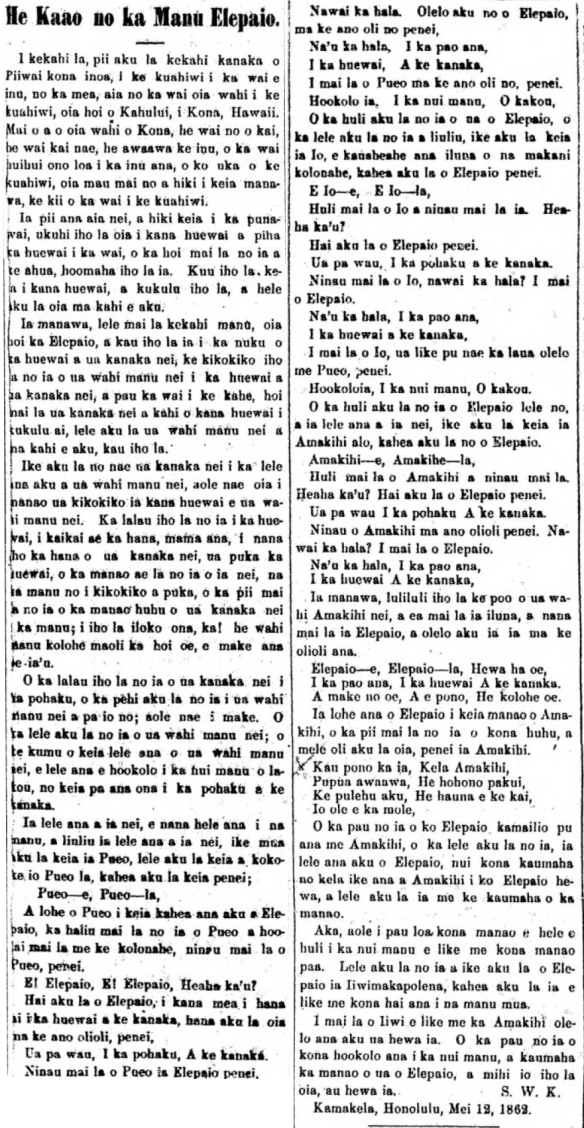
He Kaao no ka Manu Elepaio.

Ka Hoku o ka Pakipika, Buke I, Helu 34, Aoao 1. Mei 15, 1862.
More on opening of Uluhaimalama, 1894.

BEAUTIFUL CHARITY PLAN.

The Queen Establishes a Garden for the Flower Mission.

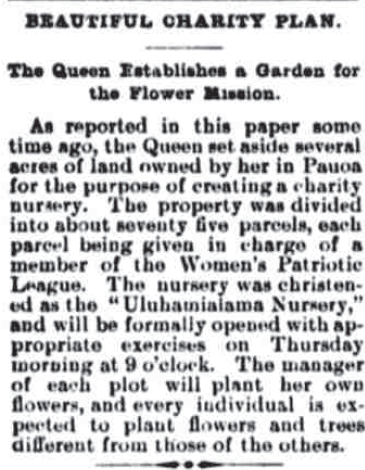
As reported in this paper some time ago, the Queen set aside several acres of land owned by her in Pauoa for the purpose of creating a charity nursery. The property was divided into about seventy five parcels, each parcel being given in charge of a member of the Women’s Patriotic League. The nursery was christened as the “Uluhaimalama Nursery,” and will be formally opened with appropriate exercises on Thursday morning at 9 o’clock. The manager of each plot will plant her own flowers, and every individual is expected to plant flowers and trees different from those of the others.

(Daily Bulletin, 10/8/1894, p. 3)

BEAUTIFUL CHARITY PLAN.

The Daily Bulletin, Volume VIII, Number 1156, Page 3. October 8, 1894.

The beginnings of Uluhaimalama, 1894.

ULUHAIMALAMA.

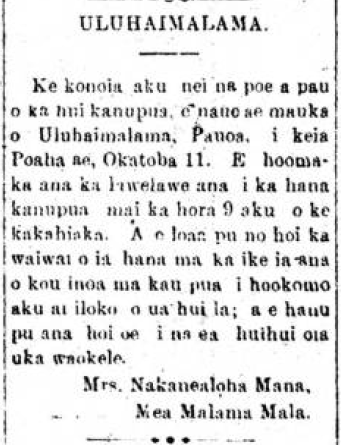
Everyone in the flower planting association [? hui kanupua] is invited to make their way to Uluhaimalama, Pauoa, on this Thursday, October 11. The flower planting will begin from 9 o’clock in the morning. And the importance of the efforts will be seen by having your name by your flower placed by the association; and you will also breathe in the bracing air of the upland forests.

Mrs. Nakanealoha Mana,

Caretaker of the  Garden.

(Oiaio, 10/5/1894, p. 3)

ULUHAIMALAMA.

Ka Oiaio, Buke VI, Helu 40, Aoao 3. Okatoba 5, 1894.

Two mele for Liliu and her garden, Uluhaimalama, 1894.

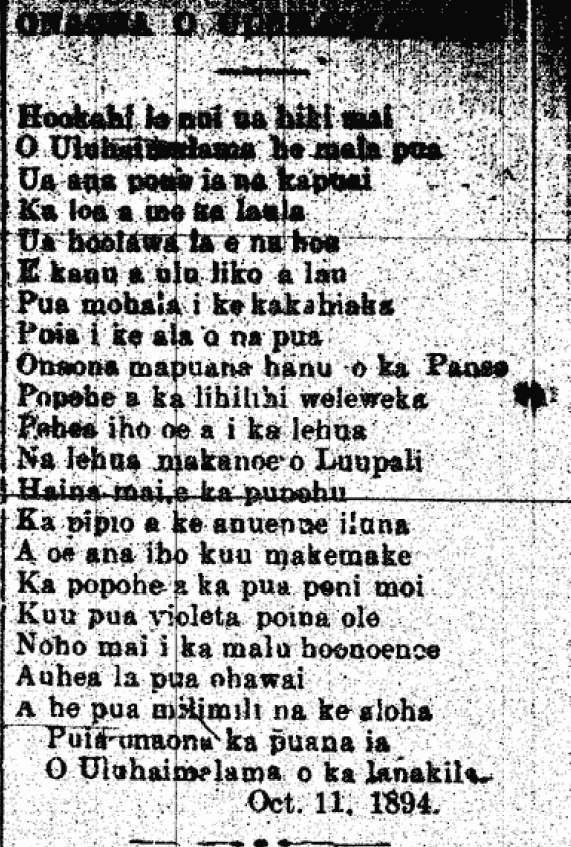
ONAONA O ULUHAIMALAMA.

Hookahi la nui ua hiki mai
O Uluhaimalama he mala pua
Ua ana pono ia na kapuai
Ka loa a me ka laula
Ua hoolawa ia e na hoa
E kanu a ulu liko a lau
Pua mohala i ke kakahiaka
Puia i ke ala o na pua
Onaona mapuana hanu o ka Panse
Popohe a ka lihilihi weleweka
Pehea iho oe a i ka lehua
Na lehua makanoe o Luupali
Haina mai e ka punohu
Ka pipio a ke anuenue iluna
A oe ana iho kuu makemake
Ka popohe a ka pua poni moi
Kuu pua violeta poina ole
Noho mai i ka malu hoonoenoe
Auhea la pua ohawai
A he pua milimili na ke aloha
Puia onaona ka puana ia
O Uluhaimalama o ka lanakila.

Oct. 11, 1894.

(Leo o ka Lahui, 10/16/1894, p. 2)

ONAONA O ULUHAIMALAMA.

Ka Leo o ka Lahui, Buke II, Helu 1050, Aoao 2. Okatoba 16, 1894.

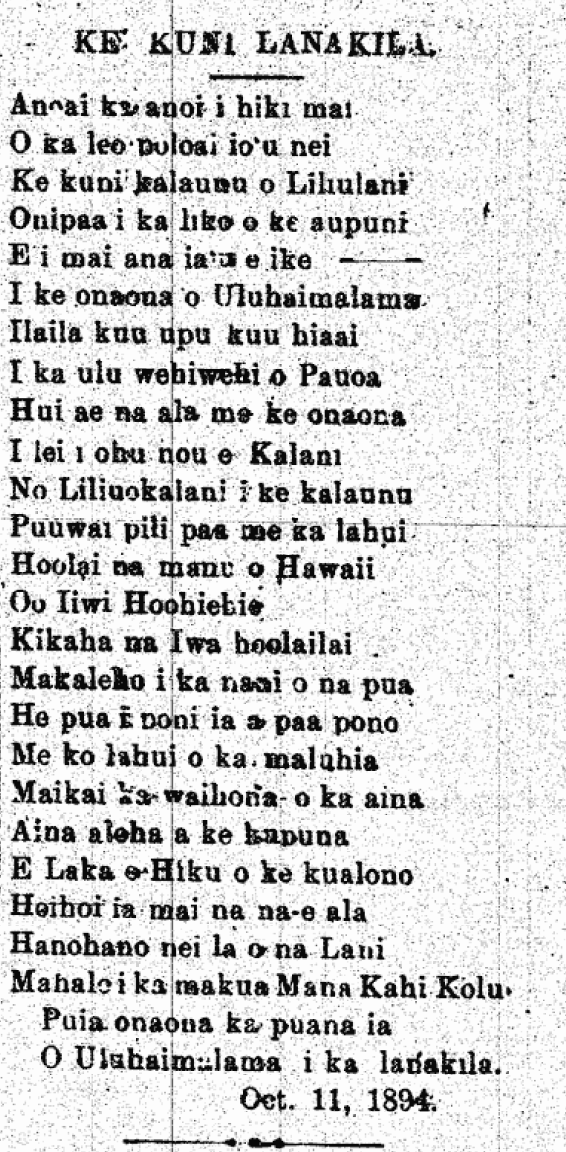
KE KUNI LANAKILA.

Anoai ka anoi i hiki mai
O ka leo poloai io’u nei
Ke kuni kalaunu o Liliulani
Onipaa i ka liko o ke aupuni
E i mai ana ia’u e ike
I ke onaona o Uluhaimalama
Ilaila kuu upu kuu hiaai
I ka ulu wehiwehi o Pauoa
Hui ae na ala me ke onaona
I lei i ohu nou e Kalani
No Liliuokalani i ke kalaunu
Puuwai pili paa me ka lahui
Hoolai na manu o Hawaii
Oo Iiwi Hoohiehie
Kikaha na Iwa hoolailai
Makaleho i ka nani o na pua
He pua i poni ia a paa pono
Me ko lahui o ka maluhia
Maikai ka waihona o ka aina
Aina aloha a ke kupuna
E Laka e Hiku o ke kualono
Hoihoi ia mai na na-e ala
Hanohano nei la o na Lani
Mahalo i ka makua Mana Kahi Kolu
Puia onaona ka puana ia
O Uluhaimalama i ka lanakila

Oct. 11, 1894.

(Leo o ka Lahui, 10/16/1894, p. 2)

KE KUNI LANAKILA.

Ka Leo o ka Lahui, Buke II, Helu 1050, Aoao 2. Okatoba 16, 1894.