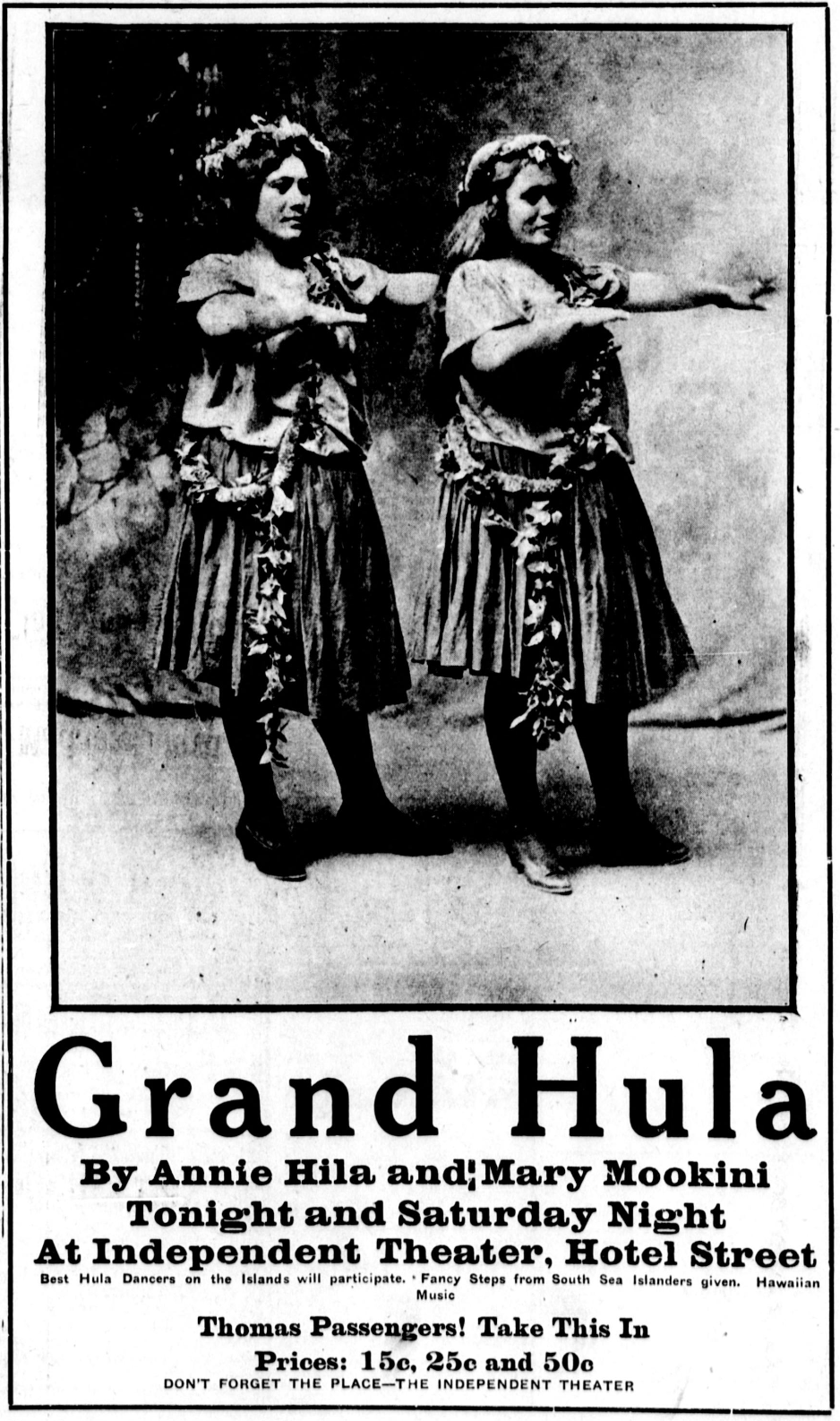
Hula performance, 1911.

Grand Hula

By Annie Hila and Mary Mookini

Tonight and Saturday Night

At Independent Theater, Hotel Street

Best Hula Dancers on the Islands will participate. Fancy Steps from South Se Islanders given. Hawaiian Music

Thomas Passengers! Take This In

Prices: 15c, 25c and 50c

DON’T FORGET THE PLACE—THE INDEPENDENT THEATER

(Evening Bulletin, 11/14/1911, p. 6)

Grand Hula

Evening Bulletin, Established 1882, Number 5083, Page 6. November 14, 1911.

Hula and the play “Umi-a-Liloa,” 1917.

TRULY HAWAIIAN IS ‘UMI-A-LILOA’

The hula alaapapa will be one of the special entre act features of the performance of “Umi-a-Liloa” at the opera house next Thursday evening. This hula is danced standing in contradiction to the older hulas which is called for a sitting position. It will be interpreted by a band of four young girls, who are experts in the art of the real Hawaiian dance. They are assisted by a man who beats the hula drum in old-time style. It is only in recent years that the hula has been accompanied by the music of instruments.

The second act contains an elaborate representation of the court of the king of Hawaii in the year 1640 and during the scene of the royal festivity some of the very ancient dances are introduced. They are danced, if one may call it so, sitting cross-legged upon the floor and the beauty of the performance lies in the grace and graphic intensity of the gestures of the body and arms of the dancers. Continue reading

Hula from Kahuku at the Orpheum, 1905.

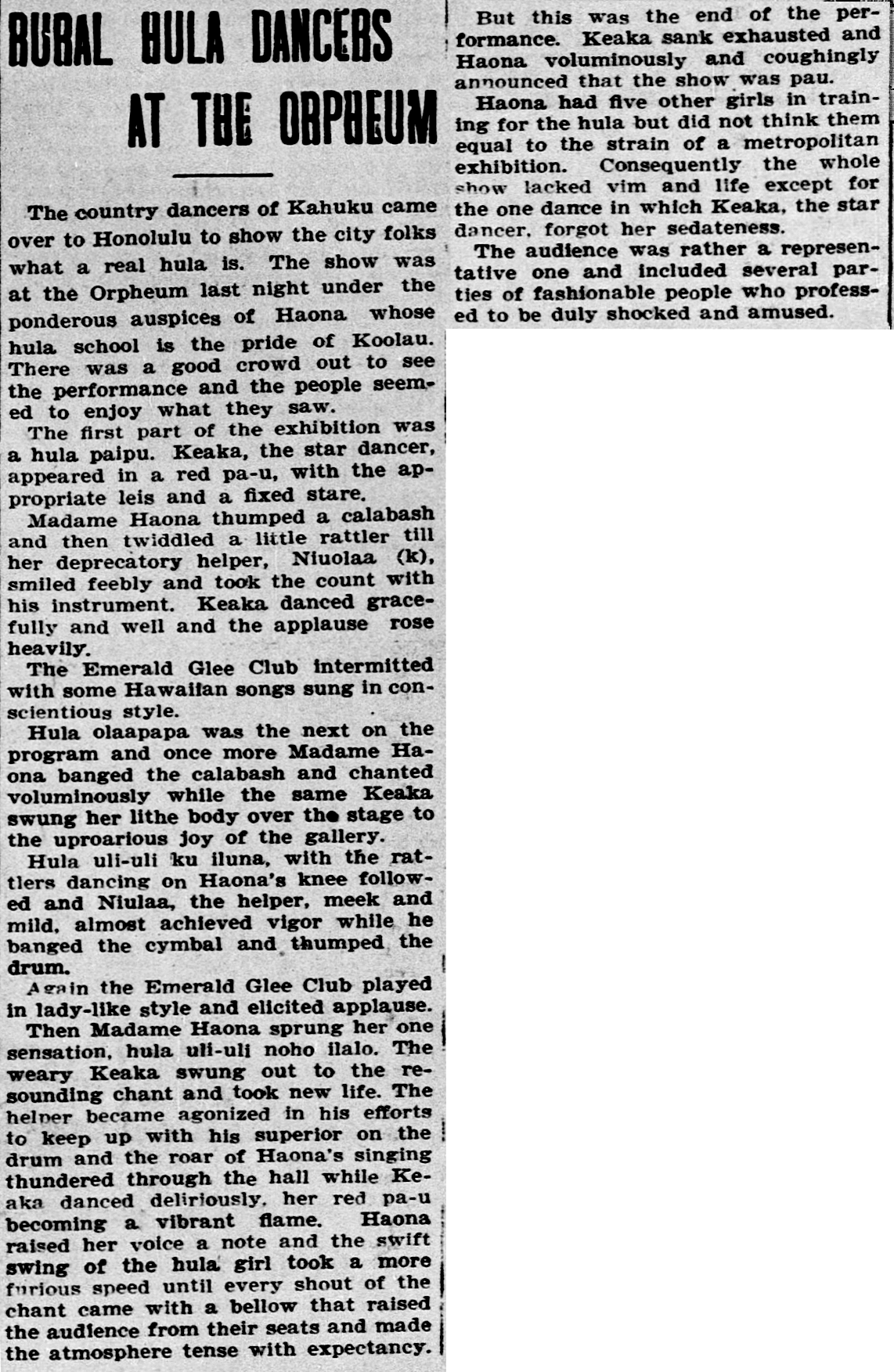
RURAL HULA DANCERS AT THE ORPHEUM

The country dancers of Kahuku came over to Honolulu to show the city folks what a real hula is. The show was at the Orpheum last night under the ponderous auspices of Haona whose hula school is the pride of Koolau. There was a good crowd out to see the performance and the people seemed to enjoy what they saw.

The first part of the exhibition was a hula paipu. Keaka, the star dancer, appeared in a red pa-u, with the appropriate leis and a fixed stare.

Madame Haona thumped a calabash and then twiddled a little rattler till her deprecatory helper, Niuolaa (k), smiled feebly and took the count with his instrument. Keaka danced gracefully and well and the applause rose heavily.

The Emerald Glee Club intermitted with some Hawaiian songs sung in conscientious style.

Hula olaapapa was the next on the program and once more Madame Haona banged the calabash and chanted voluminously while the same Keaka swung her lithe body over the stage to the uproarious joy of the gallery.

Hula uli-uli ku iluna, with the rattlers dancing on Haona’s knee followed and Niulaa, the helper, meek and mild, almost achieved vigor while he banged the cymbal and thumbed the drum.

Again the Emerald Glee Club played in lady-like style and elicited applause.

Then Madame Haona sprung her one sensation, hula uli-uli noho ilalo. The weary Keaka swung out to the resounding chant and took new life. The helper became agonized in his efforts to keep up with his superior on the drum and the roar of Haona’s singing thundered through the hall while Keaka danced deliriously, her red pa-u becoming a vibrant flame. Haona raised her voice a note and the swift swing of the hula girl took a more furious speed until every shout of the chant came with a bellow that raised the audience from their seats and made the atmosphere tense with expectancy.

But this was the end of the performance. Keaka sank exhausted and Haona voluminously and coughingly announced that the show was pau.

Haona had five other girls in training for the hula but did not think them equal to the strain of a metropolitan exhibition. Consequently the whole show lacked vim and life except for the one dance in which Keaka, the star dancer, forgot her sedateness.

The audience was rather a representative one and included several parties of fashionable people who professed to be duly shocked and amused.

(Pacific Commercial Advertiser, 10/15/1905, p. 1)
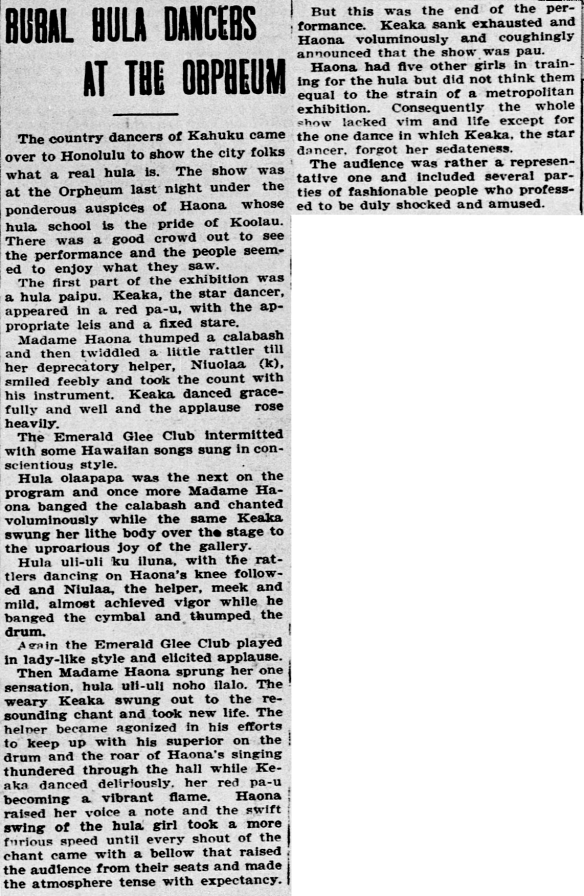
RURAL HULA DANCERS AT THE ORPHEUM

The Pacific Commercial Advertiser, Volume III, Number 146, Page 1. October 15, 1905.

Thomas Hina, police officer during King Kalakaua’s reign dies, 1917.

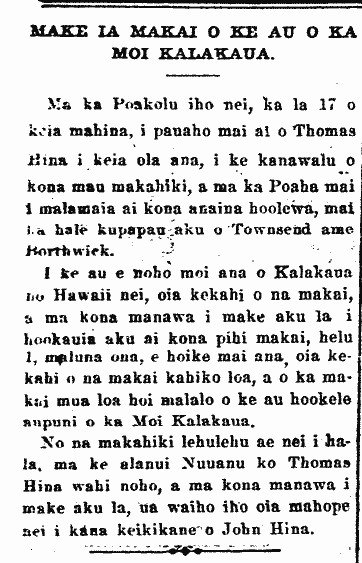
Officer From the Time of King Kalakaua Dies.

On last Wednesday, the 17th of this month, Thomas Hina grew weary of this life at 80 years old. On Thursday his funeral was held at the mortuary of Townsend and Borthwick.

When Kalakaua was the ruler of Hawaii nei, he was one of the police officers, and at his death, his badge, number 1, was placed upon him, showing that he was one of the oldest officers, and he was the first officer from the reign of King Kalakaua.

For a long time now, Thomas Hina was living on Nuuanu Avenue, and when he died, he left behind his son, John Hina.

(Kuokoa, 1/19/1917, p. 2)

MAKE IA MAKAI O KE AU O KA MOI KALAKAUA.

Ka Nupepa Kuokoa, Buke LV, Helu 3, Aoao 2. Ianuari 19, 1917.

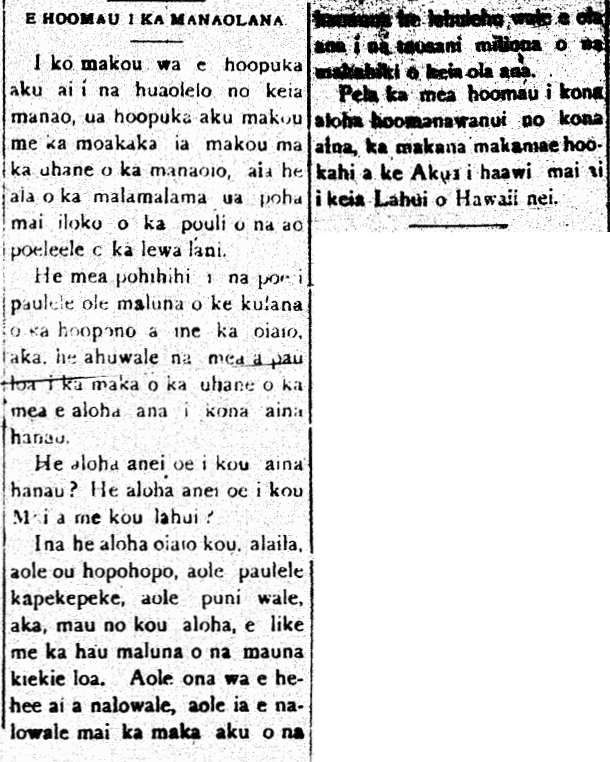
On hope, faith, and love, 1896.

CONTINUE TO HOPE.

While we publish the words of this thought, we print it knowing for certain in the spirit of faith, that there is a path of light that bursts through the darkness of the black clouds in the heavens.

It is unclear to those who do not believe in righteousness and truth, but everything is clearly visible to the eyes of one whose spirit has aloha for his land of birth.

Do you have aloha for your birth land? Do you have aloha for your Monarch and your people?

If you have true aloha, then you have no trepidation, you do not just believe with uncertainty, you do not believe in lies, but your aloha is steadfast like the snow atop very tall mountains. It never melts and disappears, it will never vanish from the eyes of many generations living for thousands of millions of years in this life.

That is the way one who continues to patiently be patriotic for his land is; that is the single precious gift God gave this Lahui of Hawaii nei.

(Aloha Aina, 7/18/1896, p. 4)

E HOOMAU I KA MANAOLANA.

Ke Aloha Aina, Buke II, Helu 29, Aoao 4. Iulai 18, 1896.

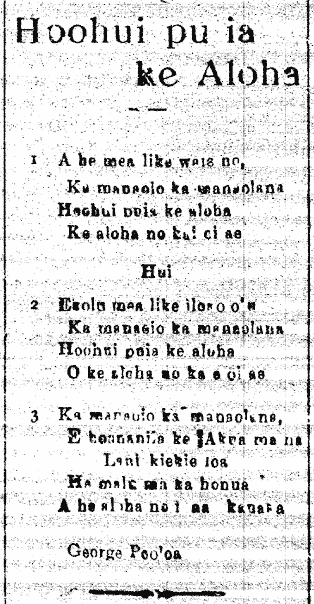
Above all is Aloha: a mele by George Pooloa, 1933.

Hoohui pu ia ke Aloha

1 A he mea like wale no,
Ka manaoio ka manaolana
Hoohui puia ke aloha
Ke aloha no kai oi ae

Hui

2 Ekolu mea like iloko o’u
Ka manaoio ka manaolana
Hoohui puia ke aloha
O ke aloha no ka e oi ae

3 Ka manaoio ka manaolana
E hoonaniia ke Akua ma na Lani keikie la
He malu ma ka honua
A he aloha no i na kanaka

[Along With Aloha

1 All are the alike
Faith, Hope
Along with Love
But the greatest is Love

Chorus

2 There are three things alike within me
Faith, Hope
Along with Love
But the greatest is Love

3 Faith and Hope
Glory to God in the high Heavens
Peace on earth
Goodwill toward men]

George Pooloa

(Hoku o Hawaii, 2/7/1933, p. 4)

Hoohui pu ia ke Aloha

Ka Hoku o Hawaii, Buke XXVI, Helu 36, Aoao 4. Feberuari 7, 1933.

Payment of subscription and positive reinforcement, 1879.

List of Honor of Ko Hawaii Pae Aina.—Lauded in the List of Honor are those who paid two dollars towards the life of the newspaper, “Ko Hawaii Pae Aina,” for the year 1879, and they are the Ladies and Gentlemen below:

R. P. Kuikahi,  Kukuihaele,  Hamakua
Charles Williams,  Eleio,  ”
D. Papohaku,  ”  ”
S. Kihei,  ”  ”
J. W. Kalehuawehe,  ”  ”
Elena f,  ”  ”
Mohai f,  ”  ”
Paahao Mose Hao,  ”  ”
Kumimi f,  ”  ”
Hoopii f,  ”  ”
Paahao f,  ”  ” Continue reading

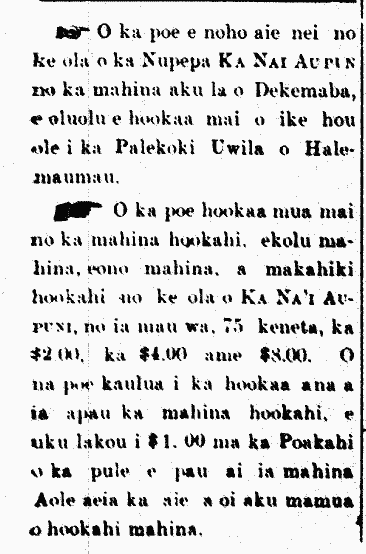
Pay your subscription, 1906.

To the people who have not paid their debt to the life of the Newspaper Ka Nai Aupuni for previous month of December, please submit your payment, lest the Lightning Skirt of Halemaumau not be seen of again.

To those who prepay for one month, three months, six months, and a year, for the life of Ka Na’i Aupuni, for those periods are .75 cents, $2.00, $4.00, and $8.00. For those who are late with their payments and a month goes by, they are to pay a $1.00 on the last Monday of that month. No credit will be allowed for more than a month.

[The Palekoki Uwila o Halemaumau is a reference to one of the serials that Ka Na’i Aupuni is running at the time, “Ka Moolelo o Hiiakaikapoliopele: Ka Wahine i ka Hikina a ka La, a o ka Ui Palekoki Uwila o Halemaumau” (The Story of Hiiakaikapoliopele: The Woman at the Rising of the Sun, and the Beauty of the Lightning Skirt of Halemaumau) by Hooulumahiehie.]

(Na’i Aupuni, 1/20/1906, p. 2)

O ka poe e noho aie...

Ka Na’i Aupuni, Buke I, Helu 47, Aoao 2. Ianuari 20, 1906.