This is the first masthead of the newspaper, Ka Hae Hawaii. It is simple, but what more needed be said?
[Hae Hawaii was a four-page weekly that ran from March 5, 1856 until May 15, 1861.]



This is the first masthead of the newspaper, Ka Hae Hawaii. It is simple, but what more needed be said?
[Hae Hawaii was a four-page weekly that ran from March 5, 1856 until May 15, 1861.]
William Panui: Fish tales
Pacific Islands: Reef fishing on the Big Island
William Panui was adopted by his grandparents and grew up on land the family owned at remote Keei Beach on the South Kona coast.
His grandfather—Lui Kauanoe Panui—only spoke Hawaiian and taught him the old ways of fishing. “The old techniques depended on what was available,” he said. “Now you can just go to the store and buy everything you need.” Continue reading
By CARL THOENE
Alexander Minoaka Thoene has been elected kahuna nui of Hui Oiwi, the Hawaiian club, at the Kamehameha School for Boys. Minoaka, who is a senior, has been a member of the club since 1939. Norman Lunahooponopono Rosehill has been chosen kahuna, and William Kahuelani Stewart is now the club’s kakauolelo. Howard Kalani Benham has been chosen puuku and Edwin Mahiai Beamer has been re-elected alakai himeni. Continue reading
We are waiting for the payment of some of the subscribers of the Hoku o Hawaii. The well being of the “Laborers” depends upon your keeping in mind the life of the newspaper.
[For as long as there have been newspapers, it seems there have been this sort of reminder to those delinquent in paying for their subscriptions.]
(Hoku o Hawaii, 6/21/1917, p. 2)
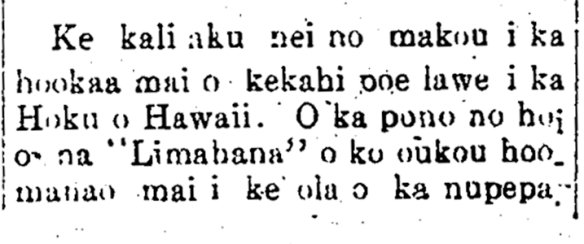
Ka Hoku o Hawaii, Buke 12, Helu 4, Aoao 2. Iune 21, 1917.
Akahi no po a ke ala
I hiki mai ai i ou nei
Koikoi mai ana i ka manao
I hoapili no ka makemake
E ake ka manao e ike
I ka nani i lohia i ka poli
Ua mali ia ua paa
Ua hei i kau makau. Continue reading
During the period of Lonoikamakahiki, a section went to his older brother, Kanaloakuaana; Kona, Kohala, and Hamakua were ruled by Kanaloakuaana. Kau, Puna, and Hilo were ruled by Lonoikamakahiki.
There were many chiefs of Hawaii [island] who were warring, and there were many alii that were killed by the makaainana for their tyranny and for plundering the belongings of the makaainana. Continue reading
By Clarice B. Taylor
RETRIBUTION IS DEALT KO’IHALA
The ohia log, destined to be carved into a god for the heiau at Makanau, was partially raised up the temple walls with the assistance of the High Chief Ko’ihala.
The priests in charge of the work had persuaded Ko’ihala to exert his mana (spiritual power) by placing his hands upon the log as the men on the upper heiau wall pulled up on the lines attached to the log.
THE LOG STALLS
When the log had been raised to a distance just above the chief’s head, it seemed to be stalled again. The chief had stepped back to survey the work.
# # #
The priest turned to Ko’ihala and urged him to step under the log and press his hands up against it as the men pulled on the lines.
# # #
Ko’ihala complied with the request.
At a signal from the priest, the men hauled the log up a foot or so and then let it drop on their chief. Continue reading
By Clarice B. Taylor
KO’IHALA HELPS RAISE THE OHIA LOG
There was an unusual stir and bustle among the men of the Kau district on the day they assembled to lift the great oohia log up over the walls of the new heiau at Makanau upon orders from their chief, Ko’ihala.
# # #
This great log, hauled with much labor and misery from the forest area on Mauna Loa, was to be carved into the image of Ko’ihala’s protecting god.
# # #
The men assigned to the work were in a very jovial mood. It was the first day they had not grumbled since the early days of the heiau construction. Continue reading
By Clarice B. Taylor
THE PRIESTS PLOT AGAINST KOIHALA
From being a respected and beloved ruler, Koihala became the most hated when he forced his men to climb Mauna Loa and fetch a great ohia log for the heiau he was building at Makanau.
During the wretched trip up into the forests, the Kau men had eaten fern roots, starvation food ordinarily fed pigs and dogs.
# # #
It was during this trip that the priests in charge took pity upon the Kau men doing this forced labor.
The priests had a foreboding that no good could come of the construction of a heiau under these unhappy circumstances. Continue reading
By Clarice B. Taylor
THE KAU MEN ARE SENT INTO MOUNTAINS
The Hawaiian people who inhabited the Kau district on the Big Island were accustomed to a dry, hot climate.
The nature of the district led the men to seek their food in the ocean where there was a wealth of fine fish. For that reason, the Kau people loved their fresh fish.
When the high chief Koihala ordered the Kau men to construct the great heiau at Makanau, the men worked cheerfully as long as the food supplies lasted.
# # #
They grumbled continuously while they fetched the little pebbles from Punaluu to pave the inner heiau courtyard. They endured this work, for they believed the end of the project was in sight. Continue reading
 nupepa