Unknown's avatar

About nupepa

Just another place that posts random articles from the Hawaiian Newspapers! It would be awesome if this should become a space where open discussions happen on all topics written about in those papers!! And please note that these are definitely not polished translations, but are just drafts!!! [This blog is not affiliated with any organization and receives no funding. Statements made here should in now way be seen as a reflection on other organizations or people. All errors in interpretation are my own.]

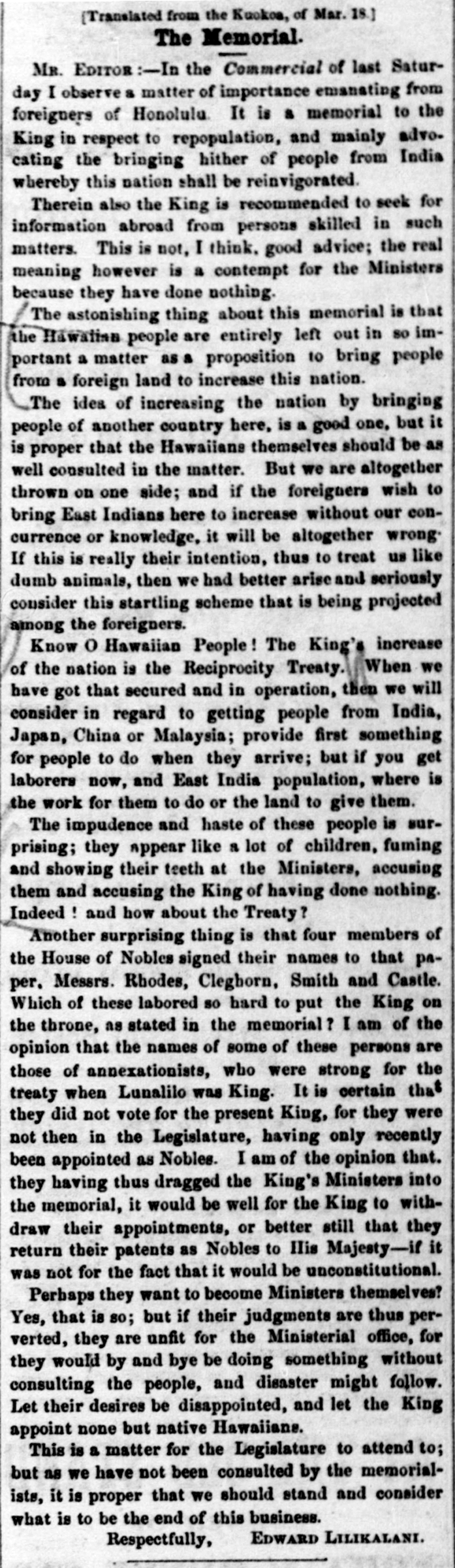
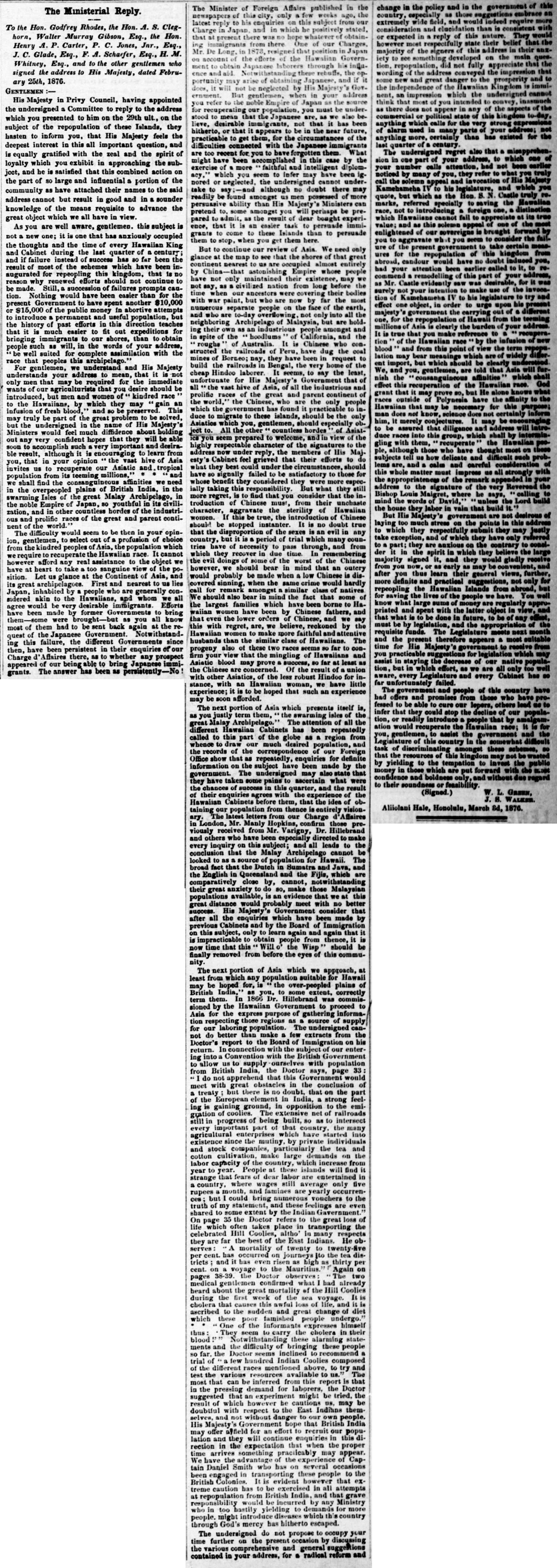
A memorial on repopulation, 1876.

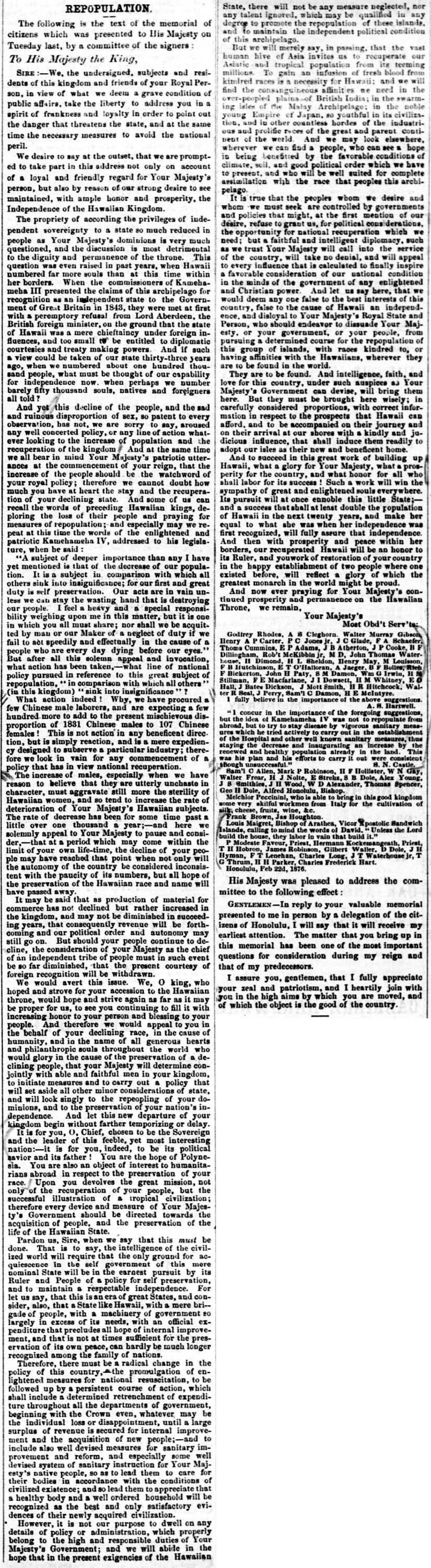
REPOPULATION.

The following is the text of the memorial of citizens which was presented to His Majesty on Tuesday last, by a committee of the signers:

To His Majesty the King,

Sire:—We, the undersigned, subjects and residents of this kingdom and friends of your Royal Person, in view of what we deem a grave condition of public affairs, take the liberty to address you in a spirit of frankness and loyalty in order to point out the danger that threatens the state, and at the same time the necessary measures to avoid the national peril.

We desire to say at the outset, that we are prompted to take part in this address not only on account of a loyal and friendly regard for Your Majesty’s person, but also by reason of our strong desire to see maintained, with ample honor and prosperity, the Independence of the Hawaiian Kingdom.

 The propriety of according the privileges of independent sovereignty to a state so much reduced in people as Your Majesty’s dominions is very much questioned, and the discussion is most detrimental to the dignity and permanence of the throne. This question was even raised in past years, when Hawaii numbered far more souls than at this time within her borders. When the commissioners of Kamehameha III presented the claims of this archipelago for recognition as an independent state to the Government of Great Britain in 1843, they were met at first with a peremptory refusal from Lord Aberdeen, the British foreign minister, on the ground that the state of Hawaii was a mere chieftaincy under foreign influences, and too small to be entitled to diplomatic courtesies and treaty making powers. And if such a view could be taken of our state thirty-three years ago, when we numbered about one hundred thousand people, what must be thought of our capability for independence now, when perhaps we number barely fifty thousand souls, natives and foreigners all told?

And yet this decline of the people, and the sad and ruinous disproportion of sex, so patent to every observation, has not, we are sorry to say, aroused any well concerted policy, or any line of action whatever looking to the increase of population and the recuperation of the kingdom. And at the same time we all bear in mind Your Majesty’s patriotic utterances at the commencement of your reign, that the increase of the people should be the watchword of your royal policy; therefore we cannot doubt how much you have at heart the stay and the recuperation of your declining state. And some of us can recall the words of preceding Hawaiian kings, deploring the loss of their people and praying for measures of repopulation; and especially may we repeat at this time the words of the enlightened and patriotic Kamehameha IV, addressed to this legislature, when he said:

“A subject of deeper importance than any I have yet mentioned is that of the decrease of our population. It is a subject in comparison with which all others sink into insignificance; for our first and great duty is self preservation. Our acts are in vain unless we can stay the wasting hand that is destroying our people. I feel a heavy and a special responsibility weighing upon me in this matter, but it is one in which you all must share; nor shall we be acquitted by man or our Maker of a neglect of duty if we fail to act speedily and effectually in the cause of a people who are every day dying before our eyes.” But after all this solemn appeal and invocation, what action has been taken,—what line of national policy pursued in reference to this great subject of repopulation, “in comparison with which all others” (in this kingdom) “sink into insignificance”?

What action indeed! Why, we have procured a few Chinese male laborers, and are expecting a few hundred more to add to the present mischievous disproportion of 1831 Chinese males to 107 Chinese females! This is not action in any beneficent direction, but is simply reaction, and is a mere expediency designed to subserve a particular industry; therefore we look in vain for any commencement of a policy that has in view national recuperation.

 The increase of males, especially when we have reason to believe that they are utterly unchaste in character, must aggravate still more the sterility of Hawaiian women, and so tend to increase the rate of deterioration of Your Majesty’s Hawaiian subjects. The rate of decrease has been for some time past a little over one thousand a year;—and here we solemnly appeal to Your Majesty to pause and consider,—that at a period which may come within the limit of your own life-time, the decline of your people may have reached that point when not only will the autonomy of the country be considered inconsistent with the paucity of its numbers, but all hope of the preservation of the Hawaiian race and name will have passed away.

 It may be said that as production of material for commerce has not declined but rather increased in the kingdom, and may not be diminished in succeeding years, that consequently revenue will be forthcoming and our political order and autonomy may still go on. But should your people continue to decline, the consideration of your Majesty as the chief of an independent tribe of people must in such event be so far diminished, that the present courtesy of foreign recognition will be withdrawn.

We would avert this issue. We. O king, who hoped and strove for your accession to the Hawaiian throne, would hope and strive again as far as it may be proper for us, to see you continuing to fill it with increasing honor to your person and blessing to your people. And therefore we would appeal to you in the behalf of your declining race, in the cause of humanity, and in the name of all generous hearts and philanthropic souls throughout the world who would glory in the cause of the preservation of a declining people, that your Majesty will determine conjointly with able and faithful men in your kingdom, to inititate measures and to carry out a policy that will set aside all other minor considerations of state, and will look singly to the repeopling of your dominions, and to the preservation of your nation’s independence. And let this new departure of your kingdom begin without farther temporizing or delay.

It is for you, O, Chief, chosen to be the Sovereign and the leader of this feeble, yet most interesting nation:—it is for you, indeed, to be its political savior and its father! You are the hope of Polynesia. You are also an object of interest to humanitarians abroad in respect to the preservation of your race. upon you devolves the great mission, not only of the recuperation of your people, but the successful illustration of a tropical civilization; therefore every device and measure of Your Majesty’s Government should be directed towards the acquisition of people, and the preservation of the life of the Hawaiian State.

 Pardon us, Sire, when we say that this must be done. That is to say, the intelligence of the civilized world will require that the only ground for acquiescence in the self government of this mere nominal State will be in the earnest pursuit by its Ruler and People of a policy for self preservation, and to maintain a respectable independence. For let us say, that this is an era of great States, and consider, also, that a State like Hawaii, with a mere brigade of people, with a machinery of government so largely in excess of its needs, with an official expenditure that precludes all hope of internal improvement, and that is not at times sufficient for the preservation of its own peace, can hardly be much longer recognized among the family of nations.

Therefore, there must be a radical change in the policy of this country,—the promulgation of enlightened measures for national resuscitation, to be followed up by a persistent course of action, which shall include a determined retrenchment of expenditure throughout all the departments of government, beginning with the Crown even, whatever may be the individual loss or disappointment, until a large surplus of revenue is secured for internal improvement and the acquisition of a new people;—and to include also well devised measures for sanitary improvement and reform, and especially some well devised system of sanitary instruction for Your Majesty’s native people, so as to lead them to appreciate that a healthy body and a well ordered household will be recognized as the best and only satisfactory evidences of their newly acquired civilization.

However, it is not our purpose to dwell on any details of policy or administration, which properly belong to the high and responsible duties of Your Majesty’s Government; and we will abide in the hope that in the present exigencies of the Hawaiian State, there will not be any measure neglected, nor any talent ignored, which may be qualified in any degree to promote the repopulation of these islands, and to maintain the independent political condition of this archipelago.

But we will merely say, in passing, that the vast human hive of Asia invites us to recuperate our Asiatic and tropical population from its teeming millions. To gain an infusion of fresh blood from kindred races is a necessity for Hawaii; and we will find the consanguineous affinities we need in the over-peopled plains—of British India; in the swarming isles of the Malay Archipelago; in the noble young Empire of Japan, so youthful in its civilization, and in other countless hordes of the industrious and prolific races of the great and parent continent of the world. And we may look elsewhere, wherever we can find a people, who can see a hope in being benefitted by the favorable conditions of climate, soil, and good political order which we have to present, and who will be well suited for complete assimilation with the race that peoples this archipelago.

It is true that the peoples whom we desire and whom we must seek are controlled by governments and policies that might, at the first mention of our desire, refuse to grant us, for political considerations, the opportunity for national recuperation which we need; but a faithful and intelligent diplomacy, such as we trust Your Majesty will call into the service of the country, will take no denial, and will appeal to every influence that is calculated to finally inspire a favorable consideration of our national condition in the minds of the government of any enlightened and Christian power. And let us say here, that we would deem any one false to the best interests of this country, false to the cause of Hawaii an independence, and disloyal to Your Majesty’s Royal State and Person, who should endeavor to dissuade Your Majesty, or your government, or your people, from pursuing a determined course for the repopulation of this group of islands, with races kindred to, or having affinities with the Hawaiians, wherever they are to be found in the world.

They are to be found. And intelligence, faith, and love for this country, under such auspices as Your Majesty’s Government can devise, will bring them here. But they must be brought here wisely; in carefully considered proportions, with correct information in respect to the prospects that Hawaii can afford, and to be accompanied on their journey and on their arrival at our shores with a kindly and judicious influence, that shall induce them readily to adopt our isles as their new and beneficent home.

And to succeed in this great work of building up Hawaii, what a glory for Your Majesty, what a prosperity for the country, and what honor for all who shall labor for its success! Such a work will win the sumpathy of great and enlightened souls everywhere. Its pursuit will at once ennoble this little State;—and a success that shall at least double the population of Hawaii in the next twenty years, and make her equal to what she was when her independence was first recognized, will fully assure that independence. And then with prosperity and peace within her borders, our recuperated Hawaii will be an honor to its Ruler, and youwork of restoration of your country in the happy establishment of two people where one existed before, will reflect a glory of which the greatest monarch in the world might be proud.

And now every praying for Your Majesty’s continued prosperity and permanence on the Hawaiian Throne, we remain,

Your Majesty’s

Most Obd’t Serv’ts:

Godfrey Rhodes, A. S. Cleghorn, Walter Murray Gibson, Henry A. P. Carter, P. C. Jones jr, J. C. Glade, F. A. Schaefer, Thomas Cummins, E. P. Adams, J. B. Atherton, J. P. Cooke, B. F. Dillingham, Robert McKibbin jr, M. D., John Thomas Waterhouse, H. Dimond, H. L. Sheldon, Henry May, M. Louisson, F. B. Hutchinson, E.T. O’Halloran, A. Jaeger, B. F. Bolles, Richard F. Bickerton, John H. Paty, S. M.Damon, William G. Irwin, H. M. Stillman, F. E. Macfarlane, J. I Dowsett, H. M. Whitney, E. O. Hall, J. Bates Dickson, J. Mott Smith, H. R. Hitchcock, Walter R. Seal, J. Perry, Samuel C. Damon, H. E. McIntyre.

I fully believe in the importance of the above suggestion.

A. S. Hartwell.

“I concur in the importance of the foregoing suggestions, but the idea of Kamehameha IV was not to repopulate from abroad, but to try to stay disease by vigorous sanitary measures which he tried actively to carry out in the establishment of the Hospital and other well known sanitary measures, thus staying the decrease and inaugurating an increase by the renewed and healthy population already in the land. This was his plan and his efforts to carry it out were consistent through unsuccessful.”  S. N.Castle.

Samuel C. Allen, Mark P. Robinson, H. F. Hollister, W. N. Gay, Walter Frear, H. J. Nolte, E. Strehz, S. B. Dole, Alex Young, J. S. Smithies, J. H. Wood, W. D Alexander, Thomas Spencer, George H. Dole, Alfred Honolulu, Bishop.

Melchior Peccinini, who is able to bring in this good kingdom some very skillful workmen from Italy for the cultivation of silk, cheese, fruits, wine, &c.

Frank Brown, James Houghton.

Louis Maigret, Bishop of Arathea, Vicor Apostollic Sandwich Islands, calling to mind the words of David, “Unless the Lord build the house, they labor in vain that builds it.”

P. Modeste Faveur, Priest, Hermann Kockemangeath, Priest, T. H. Hobron, James Robinson, Gilbert Waller, D. Dole, J.H. Hyman, F. T. Lenehan, Charles Long, J. T. Waterhouse jr, T. G. Thrum, H. H. Parker, Charles Frederick Hart.

Honolulu, Feb 22d, 1876.

His Majesty was pleased to address the committee to the following effect:

Gentlemen—In reply to your valuable memorial presented tome in person by a delegation of the citizens of Honolulu, I will say that it will receive my earliest attention. The matter that you bring up in this memorial has been one of the most important questions for consideration during my reign and that of my predecessors.

I assure you, gentlemen, that I fully appreciate your zeal and patriotism, and I heartily join with you in the high aims by which you are moved, and of which the object is the good of the country.

(Pacific Commercial Advertiser, 3/4/1876, p. 3)

REPOPULATION.

The Pacific Commercial Advertiser, Volume XX, Number 36, Page 3. March 4, 1876.

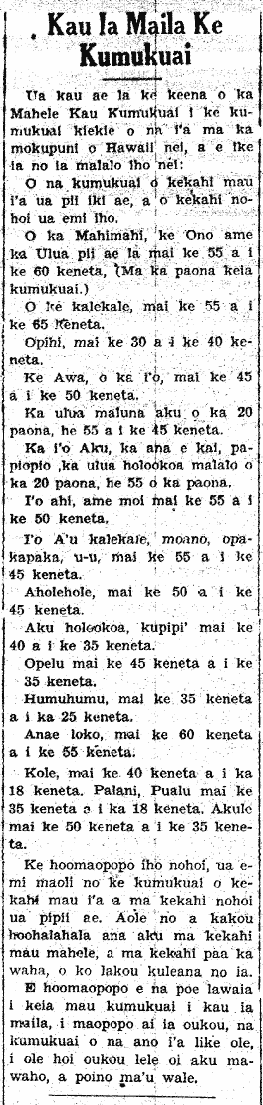
John Shorland Wilmington retires as postmaster of Kalaupapa, 1925.

THAT HAWAIIAN LEFT HIS POST FLAWLESSLY

This past May, John Shorland Wilmington turned in his resignation, requesting in that letter to leave the position as Postmaster of Kalaupapa, Molokai, on the 30th of June 1925.

The resignation was accepted with much regret, and Mrs. Augusta Nascimento was selected and Postmaster in his place, but because the new Postmaster was not prepared to immediately assume the position, Mr. Wilmington continued at that position until the 30th of September 1925, whereupon everything was given into the hands of the new Postmaster, and Mr. Wilmington put aside the Postmaster position which he held for 25 years and 4 months.

Wilmington was chosen as Postmaster for Kalaupapa, Molokai on the 1st of June 1900, and on the 1st of June 1925, he held the position of Postmaster of Kalaupapa for 25 years.

The Post Office of Kalaupapa was constantly rated “Excellent,” the highest rating attainable for a Postmaster for his good, accurate, and respectable carrying out of his work.

During the past great war, while War Stamps were being sold, Kalaupapa was the only Post Office in the Union that was allowed to purchase War Stamps on Credit; all of the other Post Offices were to send in the money first and then receive the Stamps; this showed that Mr. Wilmington had the full trust of his supervisors in the Department.

In the month of July 1916, Wilmington was losing his sight, but he continued at his job until he formally left the position.

KALAUPAPA

(Hoku o Hawaii, 11/10/1925, p. 2)

WAIHO IA OIWI HAWAII I KA OIHANA ME KA MAEMAE

Ka Hoku o Hawaii, Buke XIX, Helu 25, Aoao 2. Novemaba 10, 1925.

Daughter born to Mr. and Mrs. Lydia K. Keaumoku, 1876.

[Found under: “Nu Hou Kuloko.”]

A flower blossomed.—At 9 o’clock A. M. of Thursday, the 9th of this month, a daughter was born to Mr. and Mrs. Lydia K. Keaumoku, at Kapaakea, Waikiki. This is their first child gotten in their youth; but there is one regretful thing, that the husband is separated at Kalawao because of the problem; if not, they would have more offspring. The baby’s size when it was born was 9 pounds.

(Kuokoa, 3/11/1876, p. 2)

Mohala ka pua.

Ka Nupepa Kuokoa, Buke XV, Helu 11, Aoao 2. Maraki 11, 1876.

William Luther Moehonua turns back and recalls his life with Lucy Lulea Kaiamoku Muolo Moehonua, 1865.

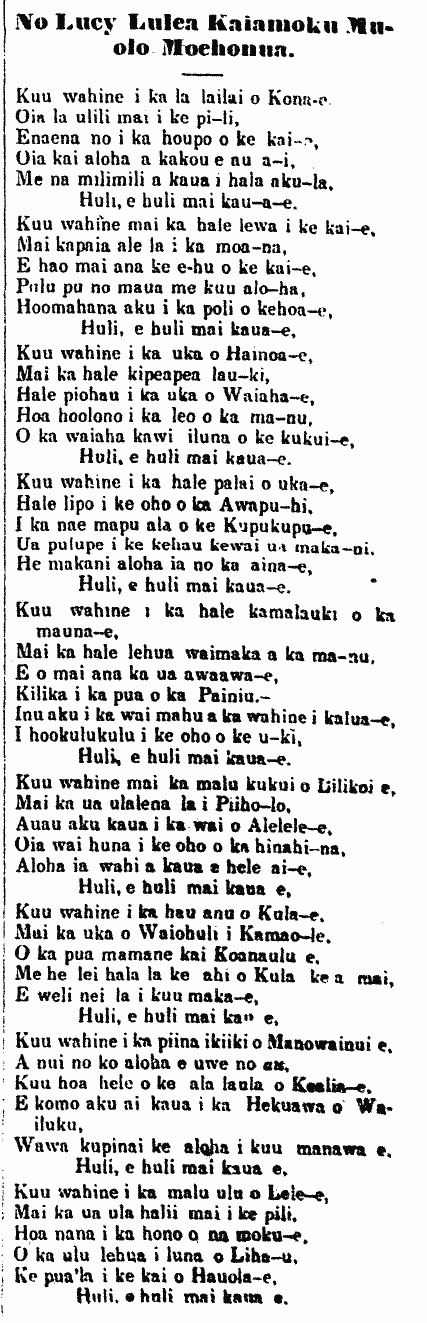
No Lucy Lulea Kaiamoku Muolo Moehonua.

Kuu wahine i ka la lailai o Kona—e,
Oia la ulili mai i ke pi—li,
Enaena no i ka houpo o ke kai—e,
Oia kai aloha a kakou e au a—i,
Me na milimili a kaua i hala aku—la,
Huli, e huli mai kau—a—e.

Kuu wahine mai ka hale lewa i ke kai—e,
Mai kapaia ale la i ka moa—na,
E hao mai ana ke e—hu o ke kai—e,
Pulu pu no maua me kuu alo—ha,
Hoomahana aku i ka poli o kehoa—e,
Huli, e huli mai kaua—e.

Kuu wahine i ka uka o Hainoa—e,
Mai ka hale kipeapea lau—ki,
Hale piohau i ka uka o Waiaha—e,
Hoa hoolono i ka leo o na ma—nu,
O ka waiaha kawi iluna o ke kukui—e,
Huli, e huli mai kaua—e.

Kuu wahine i ka hale palai o uka—e,
Hale lipo i ke oho o ka Awapu—hi,
I ka nae mapu ala o ke Kupukupu—e,
Ua pulupe i ke kehau kewai ua maka—ni,
He makani aloha ia no ka aina—e,
Huli, e huli mai kaua—e.

Kuu wahine i ka hale kamalauki o ka mauna—e,
Mai ka hale lehua waimaka a ka ma—nu,
E o mai ana ka ua awaawa—e,
Kilika i ka pua o ka Painiu—
Inu aku i ka wai mahu a ka wahine i kalua—e,
I hookulukulu i ke oho o ke u—ki,
Huli, e huli mai kaua—e.

Kuu wahine  mai ka malu kukui o Lilikoi—e,
Mai ka ua ulalena la i Piiho—lo,
Auau aku kaua i ka wai o Alelele—e,
Oia wai huna i ke oho o ka hinahi—na,
Aloha ia wahi a kaua e hele ai—e,
Huli, e huli mai kaua e.

Kuu wahine i ka hau anu o Kula—e,
Mai ka uka o Waiohuli i Kamao—le,
O ka pua mamane kai Koanaulu—e,
Me he lei hala la ke ahi o Kula ke a mai,
E weli nei la i kuu maka—e,
Huli, e huli mai kaua e.

Kuu wahine i ka piina ikiiki o Manowainui e,
A nui no ko aloha e uwe no au,
Kuu hoa hele o ke ala laula o Kealia—e,
E komo aku ai kaua i ka Hekuawa o Wailuku,
Wawa kupinai ke aloha i kuu manawa e,
Huli, e huli mai kaua e.

Kuu wahine i ka malu ulu o Lele—e,
Mai ka ua ula halii mai i ke pili,
Hoa nana i ka hono o na moku—e,
O ka ulu lehua i luna o Liha—u,
Ke pua’la i ke kai o Hauola—e,
Huli, e huli mai kaua e.

(Kuokoa, 11/11/1865, p. 1)

No Lucy Lulea Kaiamoku Muolo Moehonua.

Ka Nupepa Kuokoa, Buke IV, Helu 45, Aoao 1. Novemaba 11, 1865.

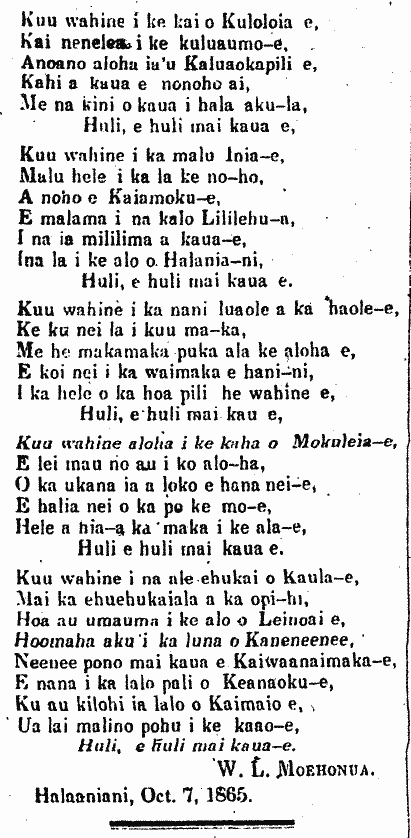
Kuu wahine i ke kai o Kuloloia e,
Kai nenelea i ke kuluaumo—e,
Anoano aloha ia’u Kaluaokapili e,
Kahi a kaua e nonoho ai,
Me na kini o kaua i hala aku—la,
Huli, e huli mai kaua e.

Kuu wahine i ka malu Inia—e,
Malu hele i ka la ke no—ho,
A noho e Kaiamoku—e,
E malama i na kalo Lililehu—a,
I na ia mililima a kaua—e,
Ina la i ke alo o Halania—ni,
Huli, e huli mai kaua e.

Kuu wahine i ka nani luaole a ka haole—e,
Ke ku nei la i kuu ma—ka,
Me he makamaka puka ala ke aloha e,
E koi nei i ka waimaka e hani—ni,
I ka hele o ka hoa piili he wahine e,
Huli, e huli mai kaua e.

Kuu wahine aloha i ke kaha o Mokuleia—e,
E lei mau no au i ko alo—ha,
O ka ukana ia a loko e hana nei—e,
E halia nei o ka po ke mo—e,
Hele a hia—a ka maka i ke ala—e,
Huli, e huli mai kaua e.

Kuu wahine i na ale ehukai o Kaula—e,
Mai ka ehuehukaiala o ka opi—hi,
Hoa au umauma i ke alo o Leinoai e,
Hoomaha aku i ka luna o Kaneneenee,
Neenee pono mai kaua e Kaiwaanaimaka—e,
E nana i ka lalo pali o Keanaoku—e,
Ku au kilohi ia lalo o Kaimaio e,
Ua lai malino pohu i ke kaao—e,
Huli, e huli mai kaua—e.

W. L. Moehonua.

Halaaniani, Oct. 7, 1865.

(Kuokoa, 11/11/1865, p. 2)

Kuu wahine i ke kai o Kuloloia e...

Ka Nupepa Kuokoa, Buke IV, Helu 45, Aoao 2. Novemaba 11, 1865.

A sort of kanikau for Lucy Muolo Moehonua by William Charles Lunalilo? 1865.

No ka mea i hala aku nei M. L. Moehonua.

Nau no i hana,
Nau no i lawe aku,
E aloha mai:
Ia makou nei a pau,
Kou mau kini nei,
He poe lepo no
Makou a pau.

E hilinai mau,
Ko keia ao a pau,
Ia oe no:
Ka Lunakanawai,
O na mea a pau,
Mahea e hoomaha ai,
Imua ou.

Hoomaikai mau makou,
Ia oe ka Moi,
O keia ao:
Ko ahonui mau,
Ia makou nei a pau,
Na lahui nei a pau,
Nou wale no.

W. C. L.

Waikiki, Augate 18, 1865.

[For the one who passed on, M. L. Moehonua

You created,
You take away,
Give aloha:
To us all,
Your multitudes,
People from the dirt,
Are all of us.

Constantly relying,
Is this whole world,
In you:
The Judge,
Of all things,
Where are we to rest,
Before you.

We always give praise,
To you the King,
Of this world:
Your constant patience,
For all of us,
For all of the nations,
Only for you.

W. C. L.

Waikiki, August 18, 1865.]

(Kuokoa, 8/26/1865, p. 4)

No ka mea i hala aku nei M. L. Moehonua.

Ka Nupepa Kuokoa, Buke IV, Helu 34, Aoao 4. Augate 26, 1865.

Funeral of Lucy Lusia Lulea Kaiamoku Muolo Moehonua, 1865.

[Found under: “HUNAHUNA MEA HOU O HAWAII NEI.”]

Funeral Performed.—Shortly after half past 3 o’clock, the funeral procession of Mrs. Lucy L. K. Moehonua began from their home until Kawaiahao Church, in the evening of the Sabbath, the 15th of this October. A short eulogy was read by the Rev. H. H. Parker [H. H. Pareka], and after that, the Rev. M. Kuaea rose and spoke on the passage 1 Thessalonians 4:18. It was not long after he was done speaking when the congregation was soon let out and the remains of Mrs. Lucy L. K. Moehonua were taken to be placed in her crypt, Hoakalei.

This crypt [hale kupapau] is the best in the cemetery of Kawaiahao, and in all of the nation of Hawaii nei. It is an unusual sight; it has four gables [kala] fashioned in the form of a cross; one gable faces the rising sun, one to the west, and the others to the north and south. And the cost for the building was nearly $800.00.

(Kuokoa, 10/21/1865, p. 2)

Ua Hoolewaia.

Ka Nupepa Kuokoa, Buke IV, Helu 42, Aoao 2. Okatoba 21, 1865.

A Kauai procreation chant for Princess Kaiulani, 1899.

[Found under: “KANIKAU NO KAIULANI.”]

A he mai keia ea ea,
No ka Wekiulani ea ea,
Aia ko mai ea ea,
A i Polihale ea ea.

Aia ko mai ea ea,
Ka lei Kaunaoa ea ea,
Ka Wailiula ea ea,
A i Mana ea ea.

Aia ko mai ea ea,
A i Papiohuli ea ea,
A e huli aku ana ea ea,
Aia i Limaloa ea ea.

Aia ko mai ea ea,
A i Polihale ea ea,
Ke kini punohu ea ea,
Auau ke kai ea [ea].

Aia ko mai ea ea,
A i Nohili ea ea,
Haa mai na niu ea ea,
O Kaunalewa ea ea.

Aia ko mai ea ea,
A i Makaweli ea ea,
Waiulailiahi ea ea,
A o Waimea ea ea.

Haina ko mai ea ea,

O niniu i ka pua ea ea.

Composed by,

Lala Mahelona.

(Aloha Aina, 3/18/1899, p. 6)

A he mai keia ea ea,

Ke Aloha Aina, Buke V, Helu 11, Aoao 6. Maraki 18, 1899.

Hauoli La Hanau, e Kaleiohawaii! 1877.

Held with much celebration was the birthday of the Princess Victoria Kaiulani Kalaninuiahilapalapa Kaleiohawaii, the first-born daughter of Her Highness the Alii the Princess Miriam Likelike and Hon. A. S. Cleghorn, on her second birthday, on this past October 16th, at Waikiki Kai, by way of the holding of a banquet laden with much food.

This day was greatly honored by the arrival of the Alii, the King, and by the great attendance of the Officers from foreign nations, the Captains of the warships, the domestic Officers, and the prominent ones of Honolulu nei. Also present was the band of the King, which entertained folks with their songs.

(Kuokoa, 10/20/1877, p. 2)

Ua malamaia ma ke ano hoomanao mahuahua loa...

Ka Nupepa Kuokoa, Buke XVI, Helu 42, Aoao 2. Okatoba 20, 1877.

Inez Ashdown and the Paniolo, 1939.

Cowboys of Hawaii Nei

By INEZ ASHDOWN

There are numerous books about cowboys. Some are written by the cowboys themselves, others were compiled by admiring friends. Whatever the manuscripts, all were written by those who wished to keep alive the old traditions and the romance of the western United States.

Yet while some of the finest American cowboys are those born and raised in Hawaii, no one has ever written about the native paniola and little is heard of them except for occasional news items, or, as during the recent Hoolaulea, one or tow are included in the general publicity.

Who were the first cowboys in Hawaii, who are the cowboys of today, where do they live and what do they do other than rope cattle and ride broncos?

To answer these questions research similar to that done by David Malo and the first missionaries when they endeavored to separate legend from actuality, would have to be followed. Yet who, in this modern day, can remember some long-forgotten mele telling of the first cowboys to visit this group of islands?

That they are Mexican or Spanish is known, because the name “paniola” is a derivation of the term “Espanol.” Some of the present day cowboys will tell about a father or grandfather who was of the Latin people.

Jack Aina, one of Maui’s most popular knights of the saddle, will say “Ai. My father Mexican. Those first paniola bring noho (saddles), kaula (rope), kaula waha (bridle), kipa (spurs), and all the things we get today.”

Aina is past 60, but is still the fastest shipping man and one of the best ropers on the island, and younger men will stand watching and shouting “Aina! Hu ka makani!” (Aina, go like the wind!) as he dashes out of a corral on his big shipping horse, a bawling crow-hopping steer at the end of his 20 foot manilla line, and into the sea with a fountain of spray.

The larger his audience the better he works and laughs and indulges in horse-play, particularly if there be present any malihini. Later, after he has washed and oiled his saddle and bridle, and done himself up in fancy shirt, chaps, boots and kipa pele (jingly spurs) and topped all the finery with a ten-gallon hat he enjoys singing and dancing the Hula for his Boss and guests.

He is now horsebreaker and trainer for Angus MacPhee at the Maui Agricultural Company’s Keahua stables where the Kahoolawe and company horses are kept. He is a master at braiding kaula ili (rawhide ropes) and uses most of his spare time for this and for putting fancy work on saddle or bridle, for he takes pride in his “jewelry” and “watches his shadow” as all fancy cowboys do.

He worked at Ulupalakua ranch when Mr. MacPhee was manager there, in company with the famous roping champion, Ikua Purdy, who is foreman of the ranch. Ikua who knows ranch work from A to Z, who jogs quietly along but seems to know by instict where the pipi ahiu (wild cattle) will be hiding. Then as they “scare” he and his horse unwind like clockwork, to rope and tie like lightning.

Aina knew old Hapakuka, now dead, whose sons quietly carry on his famous work and name. And Kinau, who looked like an ancient time warrior, and who brought to mind that first noted horseman, Kamehameha the Great, whose horses and cattle, the first in Hawaii, were brought as gifts by Vancouver and Cleveland in 1793–4.

Those first animals were placed under a ten year tabu by the Hawaiian monarch, and that tabu was probably the beginning of the wild cattle which roamed the mountain slopes of Hawaii and Maui until ranchmen who wished to have pure bred cattle and thoroughbred horsses, killed them off. Today’s roping does not need the wild riding, the pinning of roped animals to pipi kauo (pin oxen), any more than kaa pipi (bullock wagons) are needed for hauling.

George Davis of Hawaii was another of the ranch’s finest, working with Willie Purdy and his brothers, Moku Smythe, George Swift, and many others who have moved away or have died, but who remain unknown although their stories would equal, and, in some instances, surpass, many stories told of heroes of the old West.

There is another paniola man on Maui who is an artist as well as a cowboy. This Hawaiian Charlie Russel is called John Lihau Kaaihue and is foreman of the cattle work at Honolulu ranch. He is 41 years old, was married in Kaupo in 1919 and is proud of his fine wife and nine children. Six husky boys and three pretty girls who help Father with the chores, or Mother with housework or the preparing and weaving of lauhala.

Lihau can make a fine saddle tree and cover it to perfection, can strip and scrape a green hide for braiding a fine kaula ili, makes his own ili kalapu (knee leggings), ordinary leggings, or chaps; repairs the family shoes when they need half-soling, makes most of the household furniture, and can repair anything from a pan to a roof.

He makes canoes and boats, fish nets, lauhala hats or mats, and likes to employ old Hawaiian methods whenever possible. But in those akamai (clever) fingers, according to trained artists who have seen his carvings, is genius.

Charlie Russel, famous cowboy artist, liked to fashion little figures of men, horses or other things from candle wax as he yarned with the cowboys in a Wyoming bunk-house. His picture, The Last Stand, according to an old story, was given by him to a saloon owner in payment of a board-and-keep bill, and the owner later refused an offer of several thousand dollars for the now famous picture. Yet Russel did not, as he joked and worked with the men, believe he would someday be famous.

Nor did Lihau, a few months ago, think that he was doing exceptional carving with his pen-knife. He often does carving for friends just to please them. But some weeks ago he found a friend who was very much disturbed. The vocational school at Kahului had made a fine table of monkey pod wood and the owner desired that the legs of the table be carved as an akua (god or idol).

The only artist available for the carving had asked a prohibitive amount, others had no time or honestly admitted that they did not believe they could do justice to the exceptionally fine piece of wood.

Lihau inspected the table, looked at a drawing made by the owner, studied some old history pictures of ancient idols, and finally said quietly that he could do the work.

At the friend’s glance of incredulity Mrs. Lihau nodded and announced that indeed John could carve anything, when he had spare time.

Two weeks later they brought the table back to town from their ranch home. It was taken by the enthusiastic owner to the vocational school principal, Ernest Hood, whose own beautiful native-wood furniture is famous. At the school the coffee table was polished and completed, and people from all parts of Maui have called at the owner’s home to see that and other carvings done by Lihau, and mats made by his wife.

One and all agree that genius created this masterpiece of art and legend, for with a few deft lines the wraith of an akua rises from the “flames” of the wood-grain.

Lihau listens to their praises, accepts their congratulations, while his wife smiles proudly, and returns home to his family and his work wondering why they all give him so much attention, for he is a quiet unassuming man who does not look for attention but who does things because they are his jobs or because he wants to. And he would not be guilty of turning out poor work of any sort.

Is he a throw-back to those old ancestors who carved idols from forest trees for the ancient temples? Or is it just simply that real cowboys must use their heads and hands to such a degree that they can do anything they wish to do?

Lihau has had very little schoolhouse training, no one has ever taught him of Art and its principles, and he does most of his carving with his knife, although he does have a few tools now which were lent by a friend.

While he works at his hobby he teaches his boys also just as he teaches them to rope and to ride and to save time a trouble by learning to think quickly, such as at the time of the big flood at Punalau.

He was driving a truck-load of laborers home from the pineapple fields but when they came to the gulch the road was impassible. He could take the men back to the main camp where they might be able to stop with friends or get food at the ranch store and sleep in the big garage used for trucks, but that meant a lot of bother for everyone concerned, and the use of a great deal more gasoline.

Why not swim? But eighteen of the men could not swim enough to breast those swirling waters rushing to an angry sea.

Eighteen times Lihau swam back and forth across the flood to take the non-swimmers to a spot from which they could easily reach home, while others stood grouped about watching and wondering just how long the man could stand the strain.

When the last man was across Lihau turned his truck, drove it back to the garage and arrived home a little late for supper. He was bothered a bit by hunger because his habit is to eat breakfast, skip lunch, and eat a hearty meal at evening.

Ranch work and its life are always varied, interesting and romantic. Other walks of life may be as exciting, or so much more dangerous that all the fun is lacking, but for sheer freedom and soaring of the spirit no other work is more satisfying than that done by the cowboy. And of all the cowboys in the world there are none who are more joyously reckless, more dependable in tight spots, more full of song and versatility than the paniola of Hawaii.

Outstanding among them are always Eben Parker Low and Ikua Purdy, whose names and skill are known far and wide even as of their haole friend, Angus MacPhee of Wyoming, whose champion roping record of 1907 still holds first place, and who is a kamaaina here.

These men are known, but there are many fine paniola whose names have never been heard outside their home ranches or islands, and among these is Lihau, the cowboy-artist of Maui.

(Hoku o Hawaii, 4/26/1939, p. 6)

Cowboys Of Hawaii Nei

Ka Hoku o Hawaii, Volume XXXIII, Number 52, Page 6. Aperila 26, 1939.

Inez Ashdown and Queen Liliuokalani, 1939.

Was Friend of Liliuokalani

INEZ ASHDOWN

Ka Hoku’s Maui Corresponent.

This picture was taken at the time Mrs. Ashdown’s father Angus MacPhee was manager of the Ulupalakua ranch for Dr. Raymond. She had just returned from Dana Hall school at Wellesley and, as she says, “‘rarin’ to be a cowboy like him and all his Hawaiian paniola.”

“My people brought me here in 1907 when Dad was champion roper of the world and came to take part in Eben Low’s first wild west show,” writes Mrs. Ashdown. “Ikua went back to Cheyenne, our home town, the following year and took the title for that year, but no one has ever broken Dad’s time for that sort of roping. The first year we were here my parents were guests many times at the home of Queen Liliuokalani and I loved her very much. I was only a kid, but even then it made me boil because the people had taken her crown away.”

Mrs. Ashdown has lived on Maui most of the time since 1907, except for the years she was away at school. Her husband, C. W. Ashdown, is office manager for the Baldwin Packers at Lahaina. They have two sons and writing is Mrs. Ashdown’s hobby. She hopes some day to write some real good novels. She used to rope wild cattle, ride race horses and break colts, but says “that was a long time ago.”

(Hoku o Hawaii, 4/26/1939, p. 6)

Was Friend of Liliuokalani

Ka Hoku o Hawaii, Volume XXXIII, Number 52, Aoao 6. Aperila 26, 1939.