“The Value of Hawaiʻi 2,” 2014 and beyond.

The last post reminded me of this newly released must read, The Value of Hawaiʻi 2: Ancestral Roots, Oceanic Visions, edited by Aiko Yamashiro and Noelani Goodyear-Kaʻōpua. This is a book of essays all of us should sit down with, and let it allow us to ask of ourselves now what we think is important for our island community and what it is we want to leave behind for the future and what then we must do in order to achieve this…

How can more of us protect and create waiwai, value, for coming generations?

Culturally-rich education. Holistic health systems. Organic farming and aquaculture. Creative and conscious urban development. Caring for one another across difference. Telling our stories.

Continuing the conversation of The Value of Hawai‘i: Knowing the Past, Shaping the Future, this new collection offers passionate and poignant visions for our shared futures in these islands. The fresh voices gathered in this book share their inspiring work and ideas for creating value, addressing a wide range of topics: community health, agriculture, public education, local business, energy, gender, rural lifestyles, sacred community, activism, storytelling, mo‘olelo, migration, voyaging, visual art, music, and the ‘āina we continue to love and mālama. By exploring connections to those who have come before and those who will follow after, the contributors to this volume recenter Hawai‘i in our watery Pacific world. Their autobiographical essays will inspire readers to live consciously and lead as island people.

Essay contributors: Jeffrey Tangonan Acido, Kamana Beamer, Makena Coffman, Sean Connelly, Elise Leimomi Dela Cruz-Talbert, Noelani Goodyear-Ka‘ōpua, Consuelo Agarpao Gouveia, Tina Grandinetti, John “Prime” Hina, Sania Fa‘amaile Betty P. Ickes, Bonnie Kahapea-Tanner, Joseph Keawe‘aimoku Kaholokula, Kainani Kahaunaele, Hi‘ilei Kawelo, Keone Kealoha, Dawn Mahi, Ryan Oishi, Jamaica Heolimeleikalani Osorio, Eri Oura, Mark Kawika Patterson, Hawane Rios, Cheryse Julitta Kauikeolani Sana, Dean Itsuji Saranillio, Lyz Soto, Cade Watanabe, Aiko Yamashiro, Matt N. Yamashita, and Aubrey Morgan Yee.


The Value of Hawaiʻi 2

The Value of Hawaiʻi 2

Winona Kapuailohia Desha Beamer, 1943.

[Found under: “News From Boys, Girls Kamehameha Schools”]

By Pilialoha Hopkins

Miss Winona Kapuailohia Desha Beamer, a graduate of the Kamehameha Schools for Girls, class of ’41, returned from Barnard college, New York.

While she was there Winona was studying in the fields of ethnology and anthropology.

Because of health condition Miss Beamer will remain in the islands for some time. She hopes to continue her study after the war.

While a student at Kamehameha, Winona was engaged in various activities some being, class president, a member of Hui Kumolipo [Kumulipo], a piano and organ pupil, a member of the choir, silver and gold pin student, and was awarded upon graduation a scholarship to Colorado Women’s college. While in school she also won the Clarke-English award and was interested a great deal in relationship and study of the early Hawaiians and Polynesians.

Winona is the daughter of Mr. and Mrs. Francis Pono Beamer of Waikiki, Oahu. She is the granddaughter of Mr. and Mrs. Peter Carl Beamer of Hilo, Hawaii.

At present, Winona has two brothers Francis and Cleighton and a sister Flora attending Kamehameha. Also at Kam she has four cousins, Milton, Edwin, and Helen Beamer, and Helen Walker.

[This was a regular column on the happenings at Kamehameha Schools in the Hoku o Hawaii, and the articles were composed by the students, sometimes in English, and sometimes in Hawaiian.]

(Hoku o Hawaii, 4/14/1943, p. 2)

By Pilialoha Hopkins

Ka Hoku o Hawaii, Volume XXXVII, Number 51, Aoao 2. Apelila 14, 1943.

Construction of the Bishop Museum, 1889.

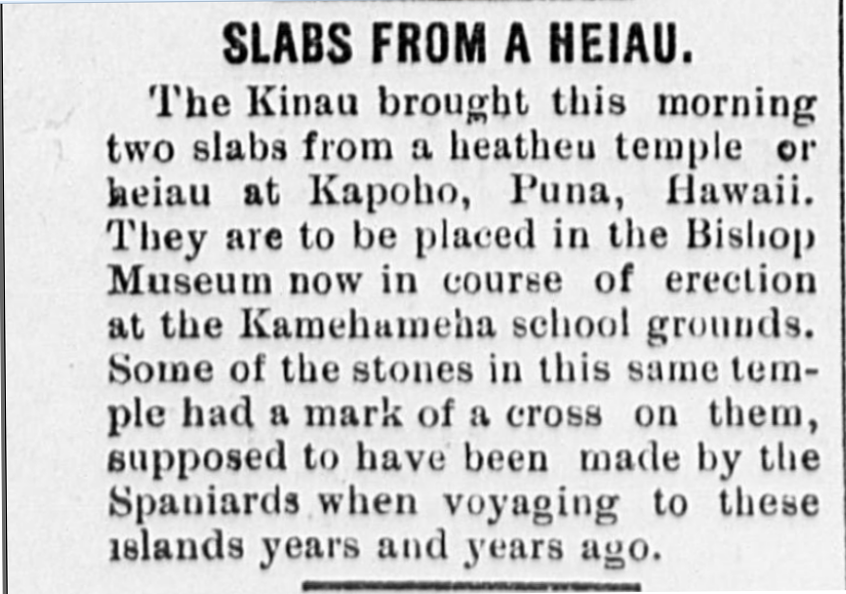
SLABS FROM A HEIAU.

The Kinau brought this morning two slabs from a heathen temple or heiau at Kapoho, Puna, Hawaii. They are to be placed in the Bishop Museum now in course of erection at the Kamehameha school grounds. Some of the stones in this same temple had a mark of a cross on them, supposed to have been made by the Spaniards when voyaging to these islands years and years ago.

(Daily Bulletin, 5/29/1889, p. 3)

SLABS FROM A HEIAU.

The Daily Bulletin, Volume XIV, Number 2262, Page 3. May 29, 1889.

Queen’s Hospital trustees and the Bishop Museum, 1886.

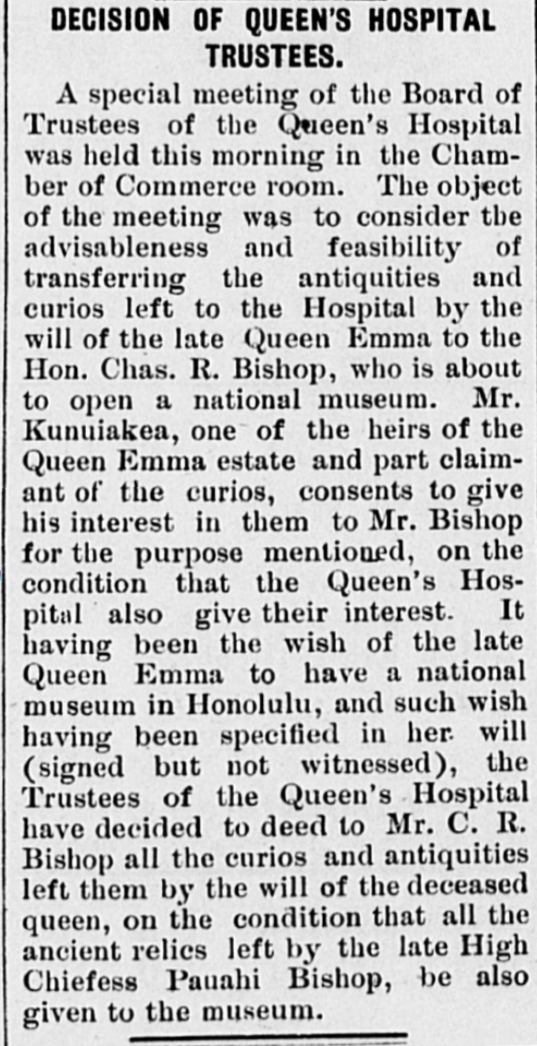
DECISION OF QUEEN’S HOSPITAL TRUSTEES.

 A special meeting of the Board of Trustees of the Queen’s Hospital was held this morning in the Chamber of Commerce room. The object of the meeting was to consider the advisableness and feasibility of transferring the antiquities and curios left to the Hospital by the will of the late Queen Emma to the Hon. Chas. R. Bishop, who is about to open a national museum. Mr. Kunuiakea, one of the heirs of the Queen Emma estate and part claimant of the curios, consents to give his interest in them to Mr. Bishop for the purpose mentioned, on the condition that the Queen’s Hospital also give their interest. It having been the wish of the late Queen Emma to have a national museum in Honolulu, and such wish having been specified in her will (signed but not witnessed), the Trustees of the Queen’s Hospital have decided to deed to Mr. C. R. Bishop all the curios and antiquities left them by the will of the deceased queen, on the condition that all the ancient relics left by the late High Chiefess Pauahi Bishop, be also given to the museum.

(Daily Herald, 9/16/1886, p. 3)

DECISION OF QUEEN'S HOSPITAL TRUSTEES.

The Daily Bulletin, Volume IX, Number 1432, Page 3. September 15, 1886.

Beginnings of the Bernice Pauahi Bishop Museum, 1886.

Museum of Antiquities.

A special meeting of the Board of Trustees of the Queen’s Hospital was held yesterday. It was called to consider the question of conveying the Hawaiian antiquities and curios, devised to the Trustees by the will of the late Queen Emma, to the Hon. C. R. Bishop for a projected public museum. Mr. Bishop had sometime ago formed the purpose of founding a museum of Hawaiian antiquities, with the collection of his late consort, Princess Bernice Pauahi Bishop, as the nucleus. Continue reading

Kuhio’s “Four Horsemen,” a translation from the time! 1939.

The Four Horsemen

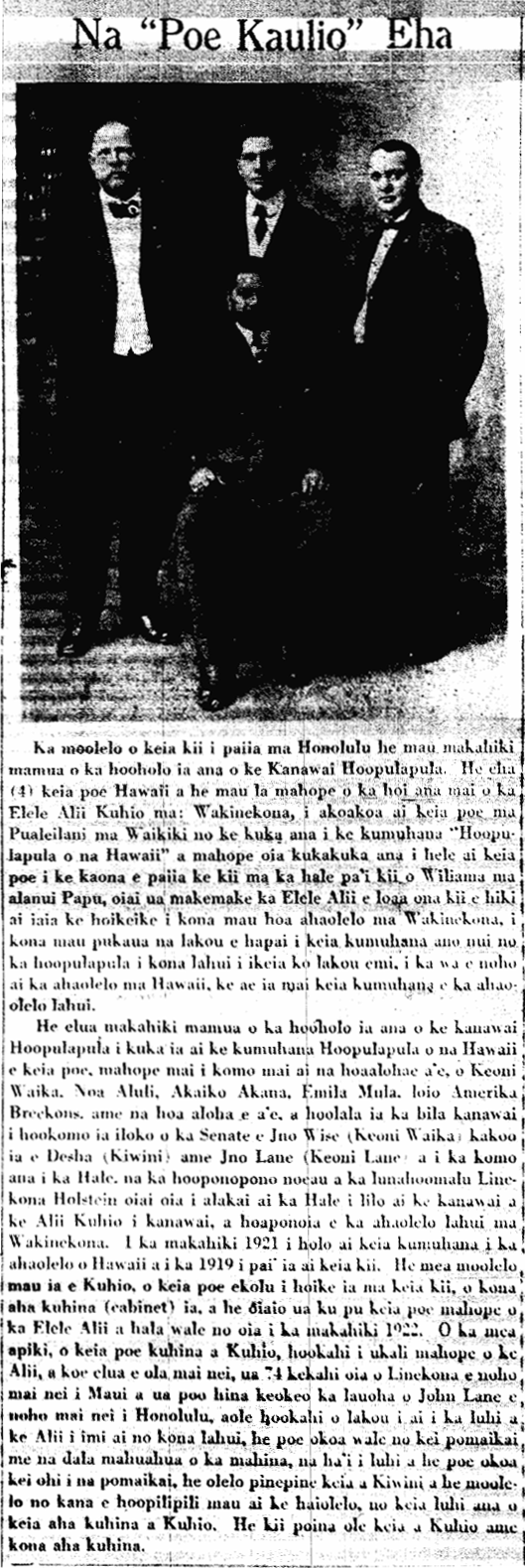
The above picture was taken at Honolulu a few years before the passage of the Rehabilitation Law. There were four of these Hawaiians, and a few days after the return of the Delegate Prince Kuhio from Washington, assembled at Pualeilani at Waikiki to discuss the subject “Rehabilitation of the Hawaiians and after that discussion, these men went to town and had their picture taken at the William’s Gallery on Fort Street, as it was the Prince’s wish, so that he can show to his fellow congressmen at Washington his backers that brought up this important matter for rehabilitating its people, known to be decreasing, during the session of the Hawaii legislature, if the measure is allowed by congress. They are sitting. Prince Kuhio, standing, from left to right, Rev. S. L. Desha, Sr., John C. Lane and H. L. Holstein.

Continue reading

Kuhio’s accomplishments did not come single-handedly, 1939.

Na “Poe Kaulio” Eha

Ka moolelo o keia kii i paiia ma Honolulu he mau makahiki mamua o ka hooholo ia ana o ke Kanawai Hoopulapula. He eha (4) keia poe Hawaii a he mau la mahope o ka hoi ana mai o ka Elele Alii Kuhio mai Wakinekona, i akoakoa ai keia poe ma Pualeilani ma Waikiki no ke kuka ana i ke kumuhana “Hoopulapula o na Hawaii” a mahope oia kukakuka ana i hele ai keia poe i ke kaona e paiia ke kii ma ka hale pa’i o Wiliama ma alanui Papu, oiai ua makemake ka Elele Alii e loaa ona kii e hiki ai iaia ke hoikeike i kona mau hoa ahaolelo ma Wakinekona, i kona mau pukaua na lakou e hapai i keia kumuhana ano nui no ka hoopulapula i kona lahui i ikeia ko lakou emi, i ka wa e noho ai ka ahaolelo ma Hawaii, ke ae ia mai keia kumuhana e ka ahaolelo lahui.

He elua makahaiki mamua o ka hooholo ia ana o ke kanawai Hoopulapula i kuka ia ai ke kumuhana Hoopulapula o na Hawaii e keia poe, mahope mai i komo mai ai na hoaalohae a’e, o Keoni Waika, Noa Aluli, Akaiko Akana, Emila Mula, loio Amerika Breckons, ame na hoa aloha e a’e, a hoolala ia ka bila kanawai i hookomo ia iloko o ka Senate e Jno Wise (Keoni Waika) kakoo ia e Desha (Kiwini) ame Jno Lane (Keoni Lane) a i ka komo ana i ka Hale, na ka hooponopono noeau a ka lunahoomalu Linekona Holstein oiai oia i alakai ai ka Hale i lilo ai ke kanawai a ke Alii Kuhio i kanawai, a hoaponoia e ka ahaolelo lahui ma Wakinekona. I ka makahiki 1921 i holo ai keia kumuhana i ka ahaolelo o Hawaii a i ka 1919 i pai ia ai keia kii. He mea moolelo mau ia e Kuhio, o keia poe ekolu i hoike ia ma keia kii, o kona aha kuhina (cabinet) ia, a he oiaio ua ku pu keia poe mahope o ka Elele Alii a hala wale no oia i ka makahiki 1922. O ka mea apiki, o keia poe kuhina a Kuhio, hookahi i ukali mahope o ke Alii, a koe elua e ola mai nei, ua 74 kekahi oia o Linekona e noho mai nei i Maui a ua poo hina keokeo ka lauoha o John Lane e noho mai nei i Honolulu, aole hookahi o lakou i ai i ka luhi a ke Alii i imi ai no kona lahui, he poe okoa wale no kei pomaikai me na dala mahuahua o ka mahina, na ha’i i luhi a he poe okoa kei ohi i na pomaikai, he olelo pinepine keia a Kiwini a he moolelo no kana e hoopilipili mau ai ke haiolelo, no keia luhi ana o keia aha kuhina a Kuhio. He kii poina ole keia a Kuhio ame kona aha kuhina.

[See the following post for an English translation done in the following issue of The Star of Hawaii!]

See here for a much clearer image from the Hawaii State Archives Digital Collection!!]

(Hoku o Hawaii, 4/26/1939, p. 1)

Na "Poe Kaulio" Eha

Ka Hoku o Hawaii, Volume XXXIII, Number 52, Aoao 1. Apelila 26, 1939.

More on Kamehameha III 100th birthday memorial, 1914.

CENTENARY OF KAMEHAMEHA III IS MARKED WITH IMPRESSIVE SERVICE

Handsome Tablet Is Unveiled Accompanied by Sacred Chant of Loved King

The unveiling of a handsome tablet of Hawaiian lava granite, to the accompaniment of sacred chants composed a century ago, marked the 100th anniversary of the birth of Kauikeaouli, the third of the Kamehamehas, which yesterday afternoon was observed at old Kawaiahao church by the Daughters of Hawaii. It was a fitting memorial to that ruler who, known to his subjects as the beneficent king, gave to the inhabitants of these islands their first written constitution, and, to make the observance further complete, the tablet will be taken to Keauhou, Kona, where it will mark the birthplace of ka moi lokomaikai.

The historical structure of Kawaiahao, around which is woven innumerable tales dear to the heart of the kamaaina, was occupied by more than 2600 persons, the majority of whom were Hawaiian. The memorial tablet occupied the center of the platform, hidden from view by the royal standard of Liliuokalani and High Chiefess Elizabeth Kekaaniau Pratt, both lineal descendants of the Hawaiian King who was the founder of the Kamehameha dynasty. Feathered cloaks of almost priceless value draped the chairs in which they sat.

The strange, yet beautiful, setting doubtless was a perfect replica of a court scene in the days of the old regime when the Kamehameha held sway. The costuming of the participants was perfect, and there was presented a spectacle in which was brought out many ancient and rare relics which today are treasured by Honolulu families and which are seldom seen other than in private homes, where they are held almost sacred.

Attired in feather cloaks and helmets, High Chief Fred Kahapula Beckley and High Chief Albert Kalaninoanoa Hoapili, the spear and kahili bearers respectively, occupied places just back of the queen and High Chiefess Pratt, representing the figures which are seen on the royal Hawaiian coat-of-arms. Both are lineal descendants of chiefs of the court of Kamehameha I, High Chief Beckley being a descendant of Kameeiamoku, and High Chief Hoapili a descendant of Kamanawa, the royal kahili bearer. Boys from the Kamehameha school, to the number of 16, acted as court attendants and kahili bearers, and occupied places on either side of the court representatives. They were attired in feather capes and other accessories adopted by the Hawaiian warriors of other days. Above this gathering was suspended the royal standard of Kalakaua, as well as other Hawaiian flags, their colors blending in perfect harmony with the vivid green of the palms and ferns with which the nave was banked.

Continue reading

Public invitation to celebration of Centenary of Kauikeaouli, 1914.

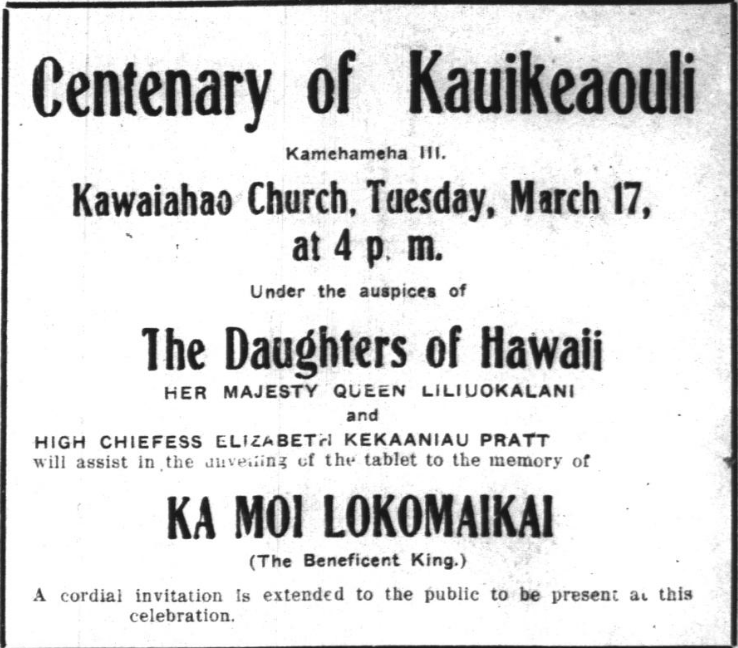
Centenary of Kauikeaouli

Kamehameha III.

Kawaiahao Church, Tuesday, March 17,

at 4 p. m.

Under the auspices of

The Daughters of Hawaii

HER MAJESTY QUEEN LILIUOKALANI

and

HIGH CHIEFESS ELIZABETH KEKAANIAU PRATT

will assist in the unveiling of the tablet to the memory of

KA MOI LOKOMAIKAI

(The Beneficent King.)

A cordial invitation is extended to the public to be present at this celebration.

(Star Bulletin, 3/11/1914, p. 8)

Centenary of Kauikeaouli

Honolulu Star-Bulletin, Volume XXI, Number 6840, Page 8. March 11, 1914.

Kauikeaouli’s 100th birthday at Kawaiahao Church, 1914.

TRIBUTE PAID TO MEMORY OF KING

Hawaiians Celebrate Centenary of Kamehameha III with Impressive Ceremony—Queen Liliuokalani Unveils Tablet to Mark Birthplace of Beloved Monarch

(From Wednesday Advertiser.)

The centenary of Kauikeaouli, Kamehameha III, was celebrated yesterday at Kawaiahao Church under the auspices of the Daughters of Hawaii. This old church, that has witnessed so many of the royal ceremonials of the Hawaiian people, was taxed to the utmost of its seating capacity. More than twenty-six hundred persons viewed the unveilling of the memorial tablet which had been prepared by the Daughters of Hawaii to mark the birthplace of “The Generous King” at Keauhou, in Kai-malino, Hawaii.

The tablet was hidden from view by the Royal Standard of Liliuokalani and a Hawaiian flag, both the property of and loaned by Hawaii’s venerable ex-queen for the sacred ceremonial.

The Queen and High Chiefess Elizabeth Kekaaniau Pratt, both of whom are lineal descendants of Keawe, the ancient king of Hawaii, and founder of the Kamehameha dynasty, were seated on either side of the memorial stone in the nave of the church. The palace chairs in which they sat were draped with ancient Hawaiian feather capes of priceless value.

Oldtime Dignitaries Attend.

Back of the Queen and High Chiefess Pratt were High Chiefs Beckley and Hoapili, clad in the ceremonial feather cloaks and helmets of the Royal Courtiers. High Chief Fred Kahapula Beckley, the spear-bearer, is a direct descendant through his father’s side from Kameeiamoku. High Chief Albert Kalaninoanoa Hoapili, the kahili bearer, is a lineal descendant of Kamanawa, the royal kahili bearer. These two therefore, in yesterday’s ceremony represented the spear-bearer and kahili bearer who are shown on the Hawaiian coat of arms and are descendants of the two chief court alii of Kamehameha I.

On either side of the royal court representatives were the kahili bearers in ordinary, sixteen young men from the Kamehameha School for Boys, robed in feather capes and the costumes of the warrior of old, representative of the court attendants.

The chancel and pulpit were tastefully decorated with beautiful ferns and palms while above was the Royal Standard of Kalakaua and the Hawaiian flags, both now the property of and loaned by the Kapiolani Estate.

Continue reading