Strangling Hands upon a Nation’s Throat. 1897.

STRANGLING HANDS UPON A NATION’S THROAT.

[This is the famous article by Miriam Michelson who went to Hilo and wrote of an anti-annexation petition drive held there.]

(San Francisco Call, 9/30/1897, pp. 1–3.)

http://chroniclingamerica.loc.gov/lccn/sn85066387/1897-09-30/ed-1/seq-1/

http://chroniclingamerica.loc.gov/lccn/sn85066387/1897-09-30/ed-1/seq-2/

http://chroniclingamerica.loc.gov/lccn/sn85066387/1897-09-30/ed-1/seq-3/

More on the lowering of the flag, 1898.

WHO HATH EARS TO HEAR, LET HIM HEAR.*

Being that in time that news reported of earlier will come, about the raising of the American Flag above Hawaii, from the authority of the Republic of America; and in regard to this, word is being sent out to my beloved nation of Patriots.

DECLARATION TO THE LAHUI.

To all Patriots, we pray [ke Ka o ia aku nei? ke Kalo ia aku nei?] that you will not visit nor approach the area where the American Flag will be raised; let everyone remain at their own Home, kneel and look to the almighty one to ask for his help for the Hawaiian Nation, Land, and Kingdom.

All heads and leaders of the men’s and women’s Ahahui Aloha Aina [Hawaiian Patriotic League] and Hui Kalaiaina [Hawaiian Political Association], are directed to heed this as well.

JAMES K. KAULIA.

President.

*Mataio (Matthew) 13:9.

(Aloha Aina, 8/6/1898, p. 4)

O KA MEA PEPEIAO LOHE E HOOLOHE IA.

Ke Aloha Aina, Buke IV, Helu 32, Aoao 4. Augate 6, 1898.

More on Hawaiians and the lowering of the flag, 1898.

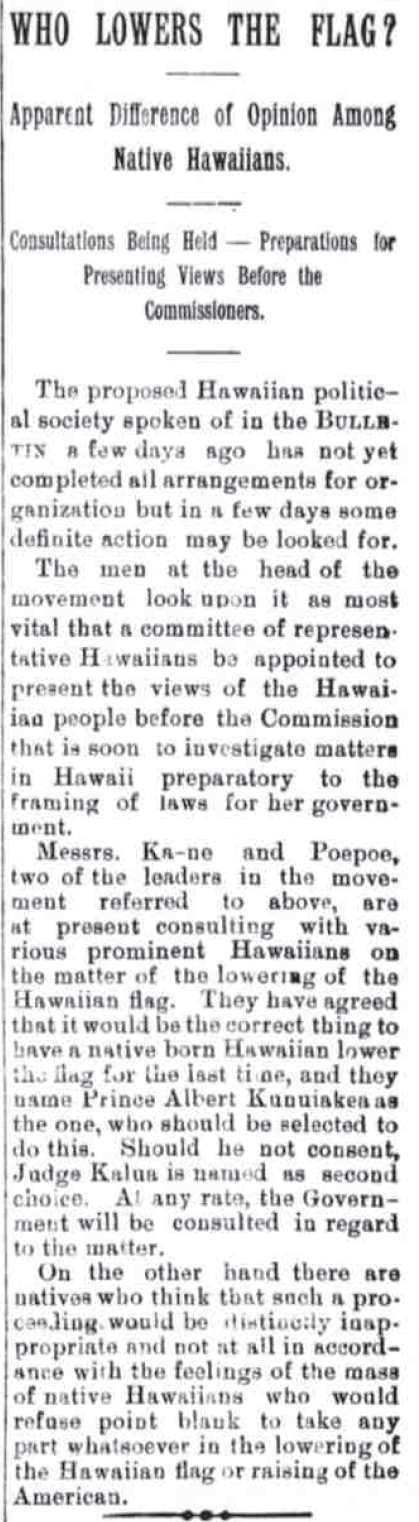
WHO LOWERS THE FLAG?

Apparent Difference of Opinion Among Native Hawaiians.

Consultations Being Held—Preparations for Presenting Views Before the Commissioners.

The proposed Hawaiian political society spoken of in the Bulletin a few days ago has not yet completed all arrangements for organization but in a few days some definite action may be looked for.

The men at the head of the movement look upon it as most vital that a committee of representative Hawaiians be appointed to present the views of the Hawaiian people before the Commission that is soon to investigate matters in Hawaii preparatory to the framing of laws for her government.

Messrs. Ka-ne and Poepoe, two of the leaders in the movement referred to above, are at present consulting with various prominent Hawaiians on the matter of the lowering of the Hawaiian flag. They have agreed that it would be the correct thing to have a native born Hawaiian lower the flag for the last time, and they name Prince Albert Kunuiakea as the one, who should be selected to do this. Should he not consent, Judge Kalua is named as second choice. At any rate, the Government will be consulted in regard to the matter.

On the other hand there are natives who think that such a proceeding would be distinctly inappropriate and not at all in accordance with the feelings of the mass of native Hawaiians who would refuse point blank to take any part whatsoever in the lowering of the Hawaiian flag or raising of the American.

[This is one of the articles in the English newspapers of the day, on the subject of having a Hawaiian be the one to lower the flag.]

(Evening Bulletin, 8/5/1898, p. 1)

WHO LOWERS THE FLAG?

Evening Bulletin, Volume V, Number 982, Page 1. August 5, 1898.

Hawaiians and the lowering of the flag, 1898.

WILL THE ONE WHO LOWERS THE FLAG BE A HAWAIIAN?

There is much talk going around these days about this disturbing subject, that some native Hawaiians are being asked to carry out this deed when the time comes, that being the 12th of this month.

The kanaka Hawaii maoli who agrees to do this vile act, betraying the Beloved Flag of his homeland, should think carefully, and set his eyes upon the Beautiful Hawaiian Flag as the wafts of breeze softly unfurls the Hawaiian Flag upon its throne, that being top of the flag pole, before he rushes to carry out the traitorous orders of the cowards who are full of evil.

Let us leave to the American haole and the American descendants the carrying out of this act, so that the consequences fall on the haole and not on the Hawaiians.

Remember this: “It is not upon the chief priests of the Jews of those days past that befell the bitter end for their pushing Judas Iscariot to betray the Lord Jesus. But the horrible end fell upon Judas for that deed of the chief priests, and not upon them. It was Judas’ bowels that gushed out, and not that of the people who urged him on.

This will be the same, O Beloved Hawaiian people, and the haole is taking by force from you Beloved Hawaii.

Leave it to the haole to take down the Beloved Flag of Hawaii.

Edward Kekoa.

(Aloha Aina, 8/13/1893, p. 2)

HE KANAKA HAWAII ANA ANEI KA MEA NANA E HUKI KA HAE HAWAII ILALO

Ke Aloha Aina, Buke IV, Helu 33, Aoao 2. Augate 13, 1898.

Hawaiian-Language Newspapers and the past and the future, 1906.

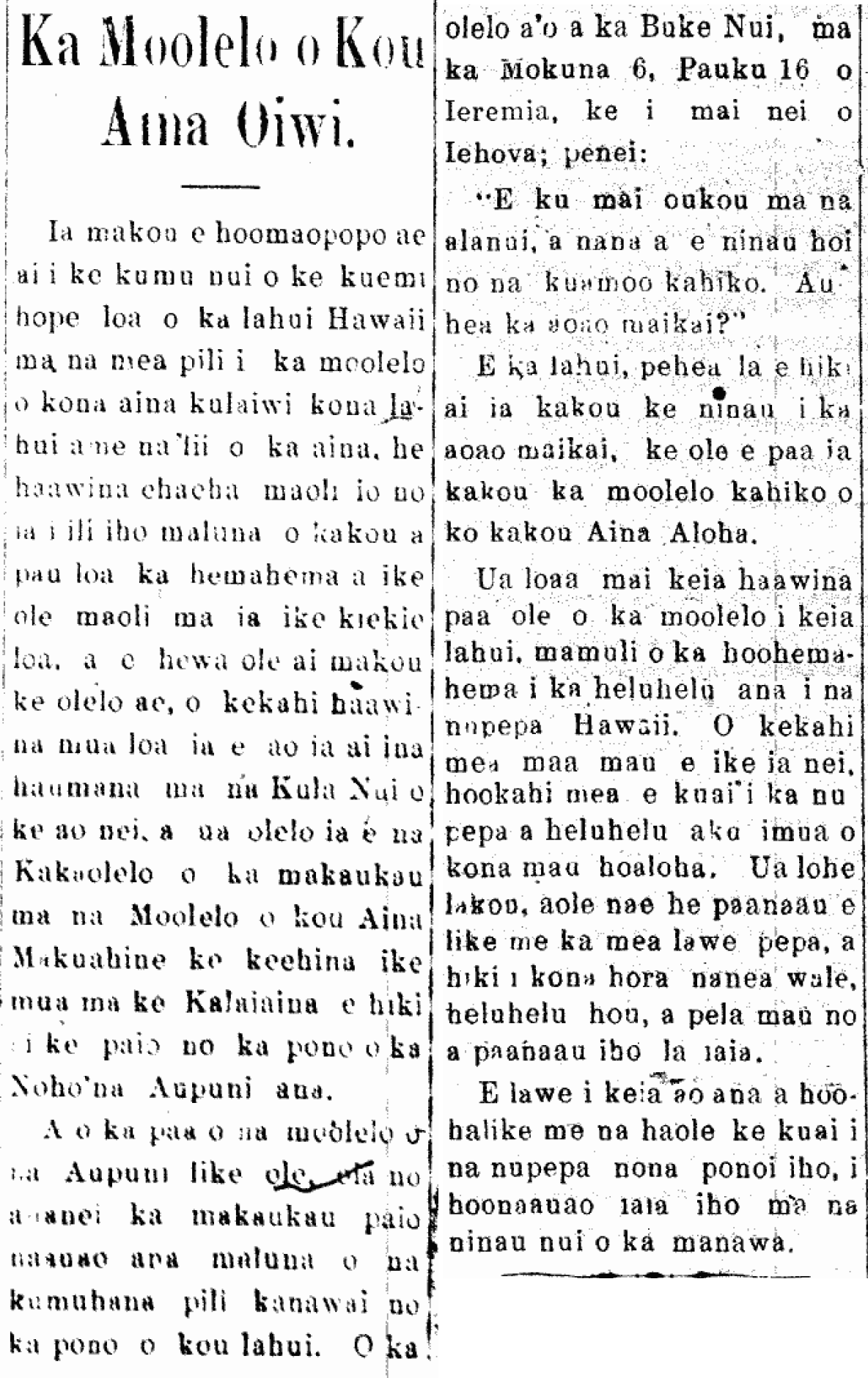
The History of Your Native Land.

As we contemplate the main reason for the falling far behind of the Hawaiian people in matters dealing with the history of their homeland, their lahui, and the alii of the land, we are all racked with intense pain at the haphazard and total lack of knowledge in this terribly important study; and it would not be wrong for us to say that it should be one of the first subjects that should be taught to the students at schools of higher education across the world; and it is said by the Orators that being knowledgeable in the History of your Motherland is the first step in Politics where you’d be able to fight for the good of the Rule of the Nation.

And understanding the histories of all Nations is what will prepare you to fight intelligently on legal grounds for the benefit of your lahui. In the teachings of the Great Book, in Jeremiah 6:16, Jehovah says to us:

“Stand ye in the ways and see and ask for the old paths. Where is the good way?”

O Lahui, how will we be able to ask of the right way if we do not know the old history of our Beloved Aina?

This lack of knowledge of the history of this people comes from not consistently reading the Hawaiian newspapers. Something frequently seen is one person buying a paper and reading it before his friends. They hear it but they don’t retain it like one who subscribes to the paper, who can re-read it at his leisure and thus commit to memory the information.

Learn from this instruction, and do as the haole, who buys his very own newspapers to educate himself in current events.

[The Hawaiian-Language Newspapers is a massive history book—a history on the most part told by Hawaiians living while the “history” was happening. As it was argued more than a hundred years ago, in order to fight for things like Sovereignty, Land, and Water, shouldn’t we know the history as told by Hawaiians? Perhaps we shouldn’t focus solely on what is written down in law books, but also on what Hawaiians actually said and did about these laws, about water rights, about land ownership, about fishing bans, etc., etc. etc.?

For sure this is no easy task. The original newspapers aren’t going to last forever. The current images for many of them are not totally clear (if there are images at all). They need to be word-searchable so that if you search for something, you will find it. There needs to be more people doing translations of them. But then again, Kamehameha Paiea didn’t exclaim, “Forward my younger brothers and drink of the sweet waters”…]

(Na’i Aupuni, 1/17/1906, p. 2)

Ka Moolelo o Kou Aina Oiwi.

Ka Na'i Aupuni, Buke I, Helu 44, Aoao 2. Ianuari 17, 1906.

Patriotic mele of a different sort, 1893.

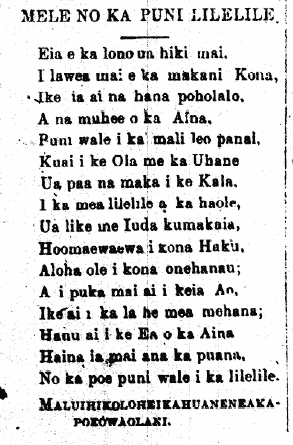
MELE NO KA PUNI LILELILE

Eia e ka lono ua hiki mai,

I lawea mai e ka makani Kona,

Ike ia ai na hana poholalo,

A na muhee o ka Aina,

Puni wale i ka mali leo panai,

Kuai i ke Ola me ka Uhane,

Ua paa na maka i ke Kala,

I ka mea lilelile a ka haole,

Ua like me Iuda kumakaia,

Hoomaewaewa i kona Haku,

Aloha ole i kona onehanau;

A i puka mai ai i keia Ao,

Ike ai i ka la he mea mehana;

Hanu ai i ke Ea o ka Aina,

Haina ia mai ana ka puana,

No ka poe puni wale i ka lilelile.

Maluihikoloheikahuaneneakapoeowaolani.

[There are not only patriotic compositions that laud and encourage, but there are also those like this one here which ridicule and disparage. This one goes something like:]

A SONG FOR THOSE WHO COVET SHINY THINGS.

The news has arrived,

Carried by the Kona breeze,

Witnessed are the deeds of deceit,

By the squids¹ of the Land,

Fawning after the sweet talk of reciprocity,

Selling away Life and Soul,

Eyes set on Riches,

That shiny thing of the haole,

Just like Judas the traitor,

Scorning his Lord,

With no aloha for his homeland;

If he’d come forth into the Light,

He’d see that the sun is a thing of warmth,

He’d breathe in the Ea² of the Land.

Let the story be told,

Of those who covet shiny things.

Maluihikoloheikahuaneneakapoeowaolani.

¹A squid can swim as easily backward as forward, so you never know if it is coming or going, and is thus used to describe a two-faced person.

²Ea can be seen as a play on the idea of Air as well as Sovereignty.

(Leo o ka Lahui, 2/21/1893, p. 3)

MELE NO KA PUNI LILELILE.

Ka Leo o ka Lahui, Buke II, Helu 646, Aoao 3. Feberuari 21, 1893.