Alii from history who understood English, 1942.

The Royal Men and Royal Women Who Knew English.

The Royal Men
Kamehameha, Ka Na’i Aupuni

Liholiho, Kamehameha II
Kaumualii (the High Chief of Kauai)
Humehume, George P. Kaumualii, Jr.
Kuakini (John Adams)
Poki
Hoapili
Kalanimoku (Bill Pitt)
Kaiana
Laanui
Kalakaua,
Keoua
Kekauonohi
Alapai
Kekauluohi

The Women
Keopulani
Piia Namahana
Kaahumanu
Kalapua
Kapiolani
Kinau
Kamamalu
Naihe
Liliha

These High Chiefs of Hawaii nei, the men and women and important advisers of Kamehameha, all of them knew English. They were not limited at all, as if it was part of the Hawaiian language.

Do remember, my conversation companions of the Hoku o Hawaii, the delicacies from which you get your fill, O Hawaii, which come from your kupuna, they will never be all consumed by us by gorging, as long as you continue to subscribe to our beloved spokesman, so that you may keep seeing the fatty delicacies of the birthing Stones of this land. There were many other alii who knew the English language, but these should suffice; and amongst the makaainana, the language of the haole (English) was wide spread; it was most widely known by the children, from those of the high to low classes.

[This is from a regular column called “Na Iliili Hanau” [The Birthing Stones], written by George K. Kane, Sr., speaking on a variety of historical topics.

(Hoku o Hawaii, 4/8/1942, p. 4)
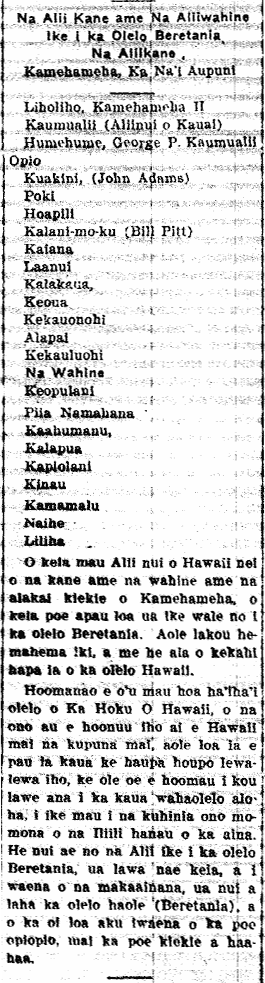
Na Alii Kane ame Na Aliiwahine Ike i ka Olelo Beretania.

Ka Hoku o Hawaii, Volume XXXVI, Number 42, Aoao 4. Aperila 8, 1942.

Papaikou School graduates, 1919.

This is a picture of the students who graduated from the school of Papaikou, Hawaii. The total number of children are eleven, but the astonishing thing is that there are no Hawaiian children amongst this crowd. From the children who graduated, eight of them are Japanese, five boys and three girls. Where are the Hawaiian children, the hope of this race to be looked to in the future? These children are prepared to enter Hilo High School in this new school year.

(Kuokoa, 8/15/1919, p. 1)

He kii keia no na haumana...

Ka Nupepa Kuokoa, Buke LVII, Helu 33, Aoao 1. Augate 15, 1919.

Western medical school for Hawaiians, 1870.

Kahunas.

We understand that one of our physicians, who is thoroughly conversant with the native language, has been authorized to form a class of eight or ten Hawaiian young men, (graduates of the highest schools,) for instructions in the principles and practice of medicine.

There has never been made, that we are aware of, any systematic or earnest effort to instruct Hawaiian youth in the medical art. The knowledge that is necessary to be acquired to make a skillful and thoroughly competent practitioner is not to be obtained in this country, which as yet, does not possess medical schools and colleges, and the difficulties in the way of sending Hawaiian pupils abroad to obtain a medical education, are so various and insurmountable, as almost to preclude any hope of being overcome. Continue reading

Dr. G. P. Judd starts a medical school for Hawaiians, 1870.

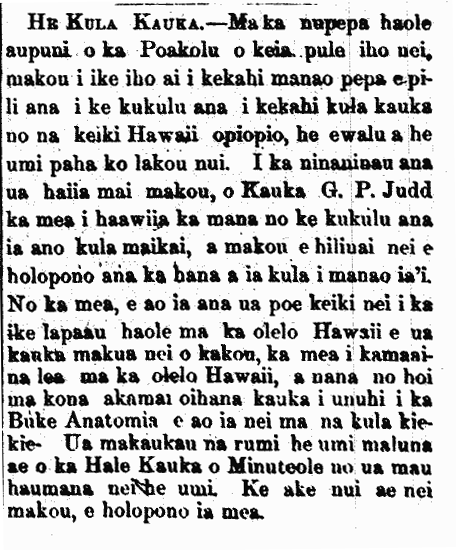
Medical School.—In the English government newspaper [Hawaiian Gazette], we saw an editorial [manao pepa] pertaining to the establishing of a medical school for Hawaiian youths, perhaps eight or ten in number. After asking about, we were told that it is Dr. G. P. Judd who suggested the idea of starting that type of fine school of which we have faith that this proposed school will go well. Because these youths will be taught the haole medicine in the Hawaiian language by that elder doctor of ours, the one that is fluent in Hawaiian, and it is he in his knowledge of medicine who translated the Anatomy Book which is being taught in the high schools. Ten room are set up above the Residence of Dr. Stangenwald [Minuteole] for those ten students. We dearly hope that it goes well.

(Manawa, 11/21/1870, p. 2)

He Kula Kauka.

Ka Manawa, Buke I, Helu 3, Aoao 2. Novemaba 21, 1870.

Pahala School, 1936.

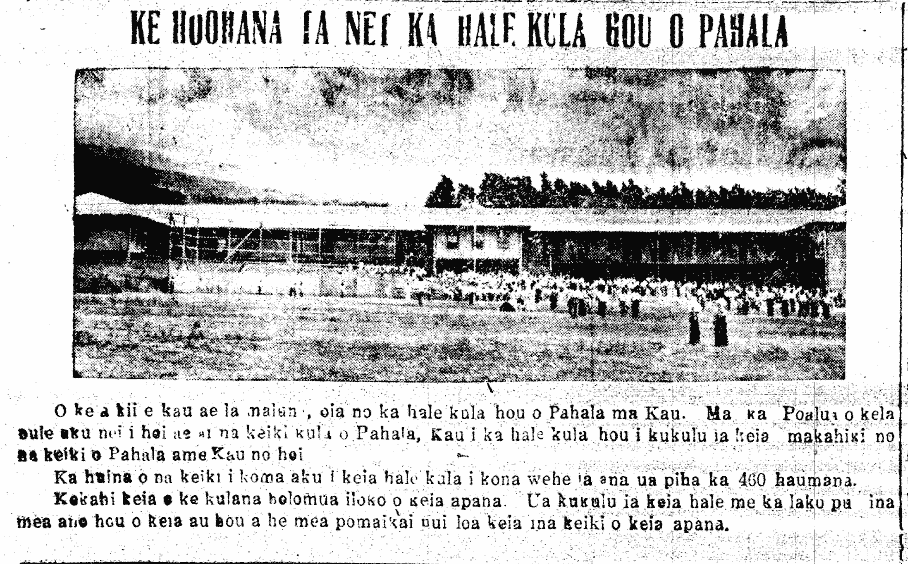
THE NEW SCHOOL OF PAHALA BEING BUILT

This picture above is of the new school of Pahala in Kau. On Tuesday of this past week, the children of Pahala, Kau returned to the new school house built this year for the children of Pahala and Kau.

The total number of children entering this school when it opened is 460 students.

This is one of the signs of progress in this district. This school and the yard equipment are of the newest models of this new age, and this is a great blessing for the children of this district.

(Hoku o Hawaii, 9/23/1936, p. 2)

KE HOOHANA IA NEI KA HALE KULA HOU O PAHALA

Ka Hoku o Hawaii, Volume XXXI, Number 21, Aoao 2. Sepatemaba 23, 1936.

James A. E. Kinney and his ohana, 1943.

At Sea

The picture above is of James A. E. Kinney, the son of K. W. Kinney of Hana, Maui, and one of the writers to Ka Hoku o Hawaii. It is believed that A. E. Kinney is at Sea with the Air Force, doing air surveillance [kilo ea]. He graduated from the air surveillance school in Grand Rapids, Michigan this past April and returned to his post at West Palm Beach, Florida, and thereafter it was decided to send him to sea.

A Hawaiian Youth

James Apollo Everett Kinney was born of the loins of Mr. K. W. [Kihapiilani William] and Mrs. Sarah Kaleo Kinney, at the McBryde Sugar Plantation in Kauai, when his father was working burning cane, and he was 32 years old. Continue reading

Sam Lia Kalainaina’s daughter weds, 1940.

A FINE MARRIAGE

MR. AND MRS. EMILIANO BARROGA

Joined in the holy covenant of marriage were Miss Anna Keolaanalani Lia Kalainaina, the only daughter of Mr. and Mrs. Samuel Lia Kalainaina of Kukuihaele, Hamakua, with Emiliano Barroga, a Filipino youth, an Owner of some passenger buses between Kukuihaele, Honokaa, and based in Hilo, and he holds many shares in a Insurance group in Manila; by the Catholic Priest, Father Henry, at the Catholic Church of Honokaa, on August 31 at 6:00 P. M.

After the ceremony was over, married couple, the parents, and the crowd headed for Kukuihaele Hale, as the family and many friends of all ethnicities were waiting to welcome them with a great Banquet to honor the Young Couple. Continue reading

Sun Yat Sen arrives, 1903.

Doctor Sun Yet Sen [Sun Yat Sen].

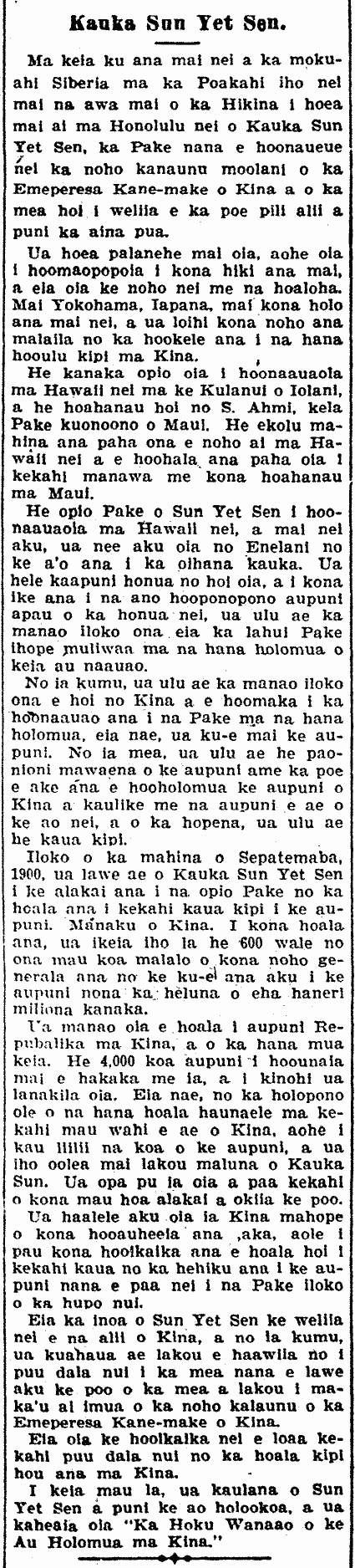
With the arrival of the steamship Siberia this past Monday from the ports of the East, Doctor Sun Yat Sen arrived in Honolulu, the Chinese man who is shaking the hereditary throne of the Empress Dowager of China, and the one who is feared by those  loyal to the throne all over China [aina pua].

He came quietly; it was not known that he was coming, and here he is staying with a friend. He came from Yokohama, Japan, where he was living for a long time to plan an uprising in China.

He is a young man educated in Hawaii nei at the College of Iolani, and he is a cousin of S. Ahmi, that wealthy Chinese man of Maui. He will perhaps be here for three months in Hawaii, and he will maybe spend some time with his cousin in Maui.

Sun Yat Sen is a young Chinese educated in Hawaii, and from here, he moved to England to study medicine. He travelled around the world, and after seeing the different governments of the world, he realized that here are the Chinese at the rear of progress in this age of enlightenment.

Because of this, within him grew the thought to return to China to start to educate the Chinese in things of progress, however, the government resisted. Therefore, there grew a struggle between the government and the people who want the nation of China to move forward and be equal to the other countries of the world; and this resulted in the start of a revolution.

In the month of September 1900, Sun Yat Sen took the leadership of young Chinese in starting a revolutionary war against the government. The Manchu [Manaku] of China. When he began the uprising, it was found that he only had 600 soldiers under his leadership for this revolution against the government with a population of four hundred million people

He decided to create a Republic in China, and this was his first act. 4,000 soldiers were sent to fight against him, and in the beginning, he was winning. However, because the inciting of uprisings in other places in China did not go well, the government soldiers were not dispersed, and so they came down in force upon Doctor Sun. He was crushed and some of his fellow leaders were captured and beheaded.

He fled from China after being routed, however, this did not end his efforts to incite a revolution to crush the government which holds the Chinese people in stupidity.

This name of Sun Yat Sen is feared by the royalty of China, and therefore, they proclaimed that a great sum of money will be given to the person who brings the head of that person who they fear before the throne of the Empress Dowager of China.

He is putting effort into raising substantial funds to start a new revolution in China.

These days, Sun Yat Sen is famous all over the world, and he is called the “Morning Star of the Progressive Era of China.”

(Kuokoa, 10/16/1903, p. 8)

Kauka Sun Yet Sen.

Ka Nupepa Kuokoa, Buke XLI, Helu 42, Aoao 8. Okatoba 16, 1903.

Criticism on the purchase of Keoua Hale, 1895.

The stupidity of the Board of Education has been made clear. The Legislature has not approved the money to purchase Kaakopua and Keoua Hale. This is a huge sum of money, and it is better if they purchased some other land and built buildings for the high school, and not that beautiful house which will cost a lot to clean it up, as a place for a few people to live haughtily and snobbily off the money of the Government. It is true!

(Makaainana, 8/12/1895, p. 8)

Ua akaka loa aenei hoi ka hupo...

Ka Makaainana, Buke IV—-Ano Hou, Helu 7, Aoao 8. Augate 12, 1895.

Keoua Hale becomes Honolulu High School, 1895.

Honolulu High School [Kula Kiekie o Honolulu].

The illustration above is of the beautiful house of Princess R. Keelikolani, standing in Honolulu, and called Keoua Hale. It is said that when many drawings of houses were placed before the alii for her to choose from, she looked through the many and chose the drawing of this house and instructed the artist, “build me a house like that.” Therefore, a house like the one in the picture was constructed to completion which now stands proudly, the building which graces that portion of Honolulu on Emma Street on the land of Kaakopua. Continue reading