Tsunami, 1946.

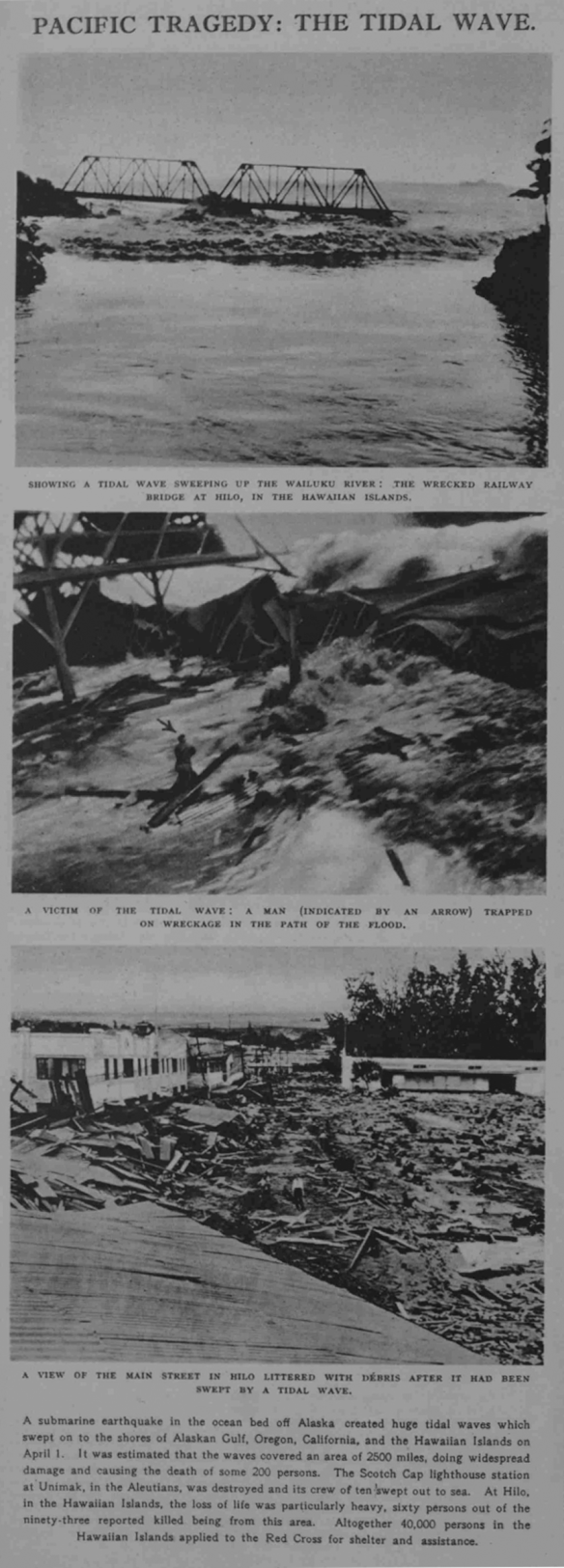
PACIFIC TRAGEDY: THE TIDAL WAVE.

SHOWING A TIDAL WAVE SWEEPING UP THE WAILUKU RIVER: THE WRECKED RAILWAY BRIDGE AT HILO, IN THE HAWAIIAN ISLANDS.

A VICTIM OF THE TIDAL WAVE: A MAN (INDICATED BY AN ARROW) TRAPPED ON WRECKAGE IN THE PATH OF THE FLOOD.

A VIEW OF THE MAIN STREET IN HILO LITTERED WITH DEBRIS AFTER IT HAD BEEN SWEPT BY A TIDAL WAVE.

A submarine earthquake in the ocean bed off Alaska created huge tidal waves which swept on to the shores of Alaskan Gulf, Oregon, California, and the Hawaiian Islands on April 1. It was estimated that the waves covered an area of 2500 miles, doing widespread damage and causing the death of some 200 persons. The Scotch Cap lighthouse station at Unimak, in the Aleutians, was destroyed and its crew of ten swept out to sea. At Hilo, in the Hawaiian Islands, the loss of life was particularly heavy, sixty persons out of the ninety-three reported killed being from this area. Altogether 40,000 persons in the Hawaiian Islands applied to the Red Cross for shelter and assistance.

[This was taken from The British Newspaper Archive, another awesome newspaper site online!]

(Illustrated London News, 4/20/1946, p. 14)
IllustratedLondonNews_4_20_1946_14

The Illustrated London News, Number 5583, Volume 208, Page 14. April 20, 1946.
Kamehameha III’s new royal standard, 1845.

Foreign Office, May 14th, 1845.

Sir,—I am commanded by the King, to make known to you His Majesty’s thanks for the kind courtesy with which you have allowed one of your men to prepare his Royal Standard, according to the national devices arranged at the Herald’s Office, in London. Continue reading

The Hawaiian flag in British waters, 1853.

A Maritime Novelty.—The arrival of the Hawaiian brig Magdalia, Capt. Taber, exhibited quite a Fourth of July novelty in our harbor. It was the first time that the royal flag of the far-off kingdom in the Pacific had ever been displayed in these waters, and a very good-looking flag it is, blending the main features of the American, British, and French national colors. The union is a mixture of St. George’s cross with some other devices which we do not understand, and look at a casual view almost identical with that of the British flag, while the body of the Kanaka ensign shows eight stripes, alternately of white, blue, and red; and, as it flung its folds to the breeze it seemed an appropriate emblem of independence, and a fitting accompaniment of our own rejoicings on the glorious day we were celebrating. Continue reading

Kahuna lapaau and the law, 1886.

AN ACT

To Regulate the Hawaiian Board of Health.

Be it enacted by the King and the Legislative Assembly of the Hawaiian Islands in the Legislature of the Kingdom Assembled:

Section 1. His Majesty the King shall appoint five native Hawaiians to be a Hawaiian Board of Health, and His Majesty the King shall appoint one of them to be President of said Board, and all of said Board shall be persons skilled in the practice of native medicine, of good character, and they shall serve during the King’s pleasure.

Section 2. It shall be the duty of said Hawaiian Board of Health to hear all applications made by native Hawaiians who wish to practice native medicine in this Kingdom for the cure of any kind of disease, or for the cure of chronic diseases or hereditary diseases, or for the cure of broken bones.

Section 3. Said Board, or a majority thereof, shall give to each applicant a certificate certifying to the Minister of the Interior the qualification of the applicant to practice native medicine in any kind of disease, or for the treatment of chronic disease or hereditary diseases, of the cure of broken bones, as may be stated in the application.

Section 4. The Minister of the Interior shall grant on the order of the said Board a license to any applicant who has received a certificate of his qualification to practice medicine in any kind of disease, upon receiving twenty dollars.

Section 5. Every person so licensed to practice medicine, as in Section 4 of this Act specified, shall keep records of his practice of medicine, and shall enter correctly in such records all the business done by him. Any person who shall practice hoomanamana, hoopiopio, anaana, or hoounauna, shall have his license cancelled immediately. Continue reading

Alexander Young Cafe, 1910.

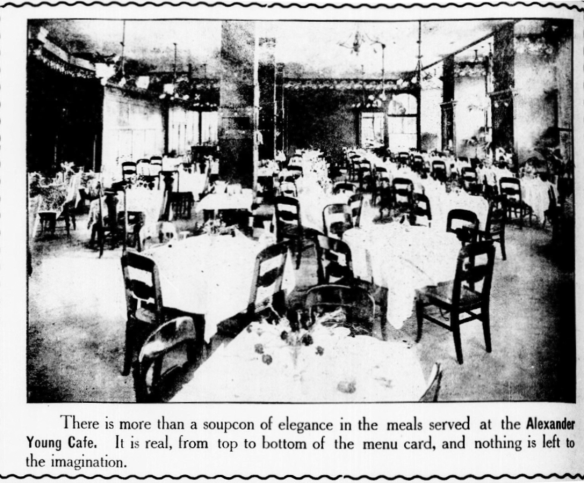
There is more than soupcon of elegance in the meals served at the Alexander Young Cafe. It is real, from top to bottom of the menu card, and nothing is left to the imagination.

[I was just told by someone who knew the establishment that the cheese bread that came out of the bakery was the best. But she heard that the baker took the recipe with him when he passed on… And you don’t hear the word “soupçon” very often these days!]

(Pacific Commercial Advertiser, 5/1/1910, p. 18)

PCA_5_1_1910_18.png

The Pacific Commercial Advertiser, Volume VII, Number 382, Page 18. May 1, 1910.

Lydia Bingham returns to head the Honolulu Female Seminary, 1867

[Found under: “NOTES OF THE WEEK.”]

Honolulu Female Seminary.—In our advertising columns will be seen the advertisement of the Honolulu Female Academy, which is another of the schools provided by Christian benevolence for the benefit of the children of this highly favored land. This institution will, it is hoped, supply a felt need for a home for girls, in the town of Honolulu, yet not too near its center of business. It is being commenced in the substantial buildings erected many years since by the American Mission as a printing house and bindery, in connection with the premises of the Rev. E. W. Clark, Continue reading