Newly pardoned, 1891.

[Found under: “By Authority.”]

It has pleased Her Majesty the Queen to grand full pardons, with restoration to their civil rights, to the following persons, viz:

Paulo, of Kalawao, Molokai.
Kamesona, of Kalawao, Molokai.
Halemano, of Kalawao, Molokai.
Kekuno, of Kalawao, Molokai.
Makea, of Kalawao, Molokai.
Peni Kaaialii, of Kalawao, Molokai.
Kanaulu, of Kalawao, Molokai.
Enorme Ferreira, of Makawao, Maui.
Kaluna, of Hilo, Hawaii.
Joseph Kamiano, of Hilo, Hawaii.
Haleakala, of Lihue, Kauai.
Lau Fong, of Lihue, Kauai.
Kaua, of Honolulu, Oahu.
Kaahu, of Honolulu, Oahu.
John Peterson, of Honolulu, Oahu.
Alohikea, of Honolulu, Oahu.
S. L. Kawelo, of Honolulu, Oahu.

And it has further pleased Her Majesty the Queen to grant a commutation of sentence to Akana of Honolulu, Oahu.

W. AUSTIN WHITING,
Attorney-General.

April 18, 1891.

(Hawaiian Gazette, 5/5/1891, p. 4)
It has pleased Her Majesty the Queen...

Hawaiian Gazette, Volume XXVI, Number 18, Page 4. May 5, 1891.
The Blue and White revived, 1904.

THE BLUE AND WHITE

The New Kamehameha School Paper of Students.

“Blue and White” is the title of a very neat four page paper published by the students of the Kamehameha Schools. The initial number was issued yesterday. The staff is composed of the following:

Abel Ah You, editor-in-chief; George Wells, assistant editor; Charles Lyman, athletics; David Desha, exchange editor; Charles Williams, superintendent of printing; associate editors, Enoch Hussey, Henry Sniffen, David Mahukona.

The leading editorial is devoted to a synopsis of an address made before the Kamehameha Alumni meeting held on June 8, 1904, as follows:

And now a serious word about Kamehameha. Kamehameha with all it means is the Hawaiian heritage. If ever an institution belonged to a people, this belongs to you. It is yours to guard, to use, to cherish. And to my mind, Kamehameha is the last hope of the Hawaiian people. But it is enough. Continue reading

New paper from the Hui Kalaiaina to begin, 1893.

A NEW NEWSPAPER

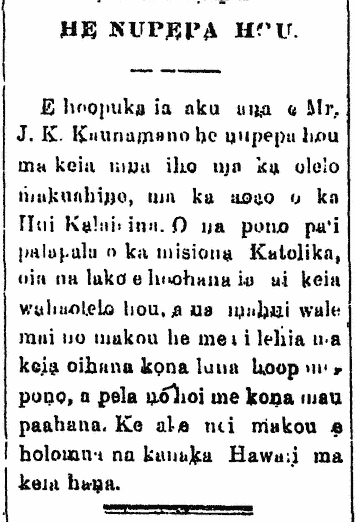
Mr. J. K. Kaunamano will print a new newspaper in the near future, in the mother tongue, from the side of the Hawaiian Political Association [Hui Kalaiaina]. The printing equipment of the Catholic Mission, will be what is employed by this new spokesman, and we simply assume that his editor will be someone skilled at this work, and so too of his workers. We hope that the Hawaiian people will progress through this endeavor.

[The first issue of Hawaii Holomua was published on 9/18/1893. It was a daily (except for Sundays). The last issue was printed on 1/5/1895. It was not printed in Hawaiian, but in English. This paper can be found on Chronicling America!]

[This was the newspaper, Ka Nupepa Puka La Aloha Aina, which began printing on 9/30/1893.]

(Lei Momi, 9/22/1893, p. 2)

HE NUPEPA HOU.

Ka Lei Momi, Buke I, Helu 78, Aoao 2. Sepatemaba 22, 1893.

Honolulu High School football team, 1907.

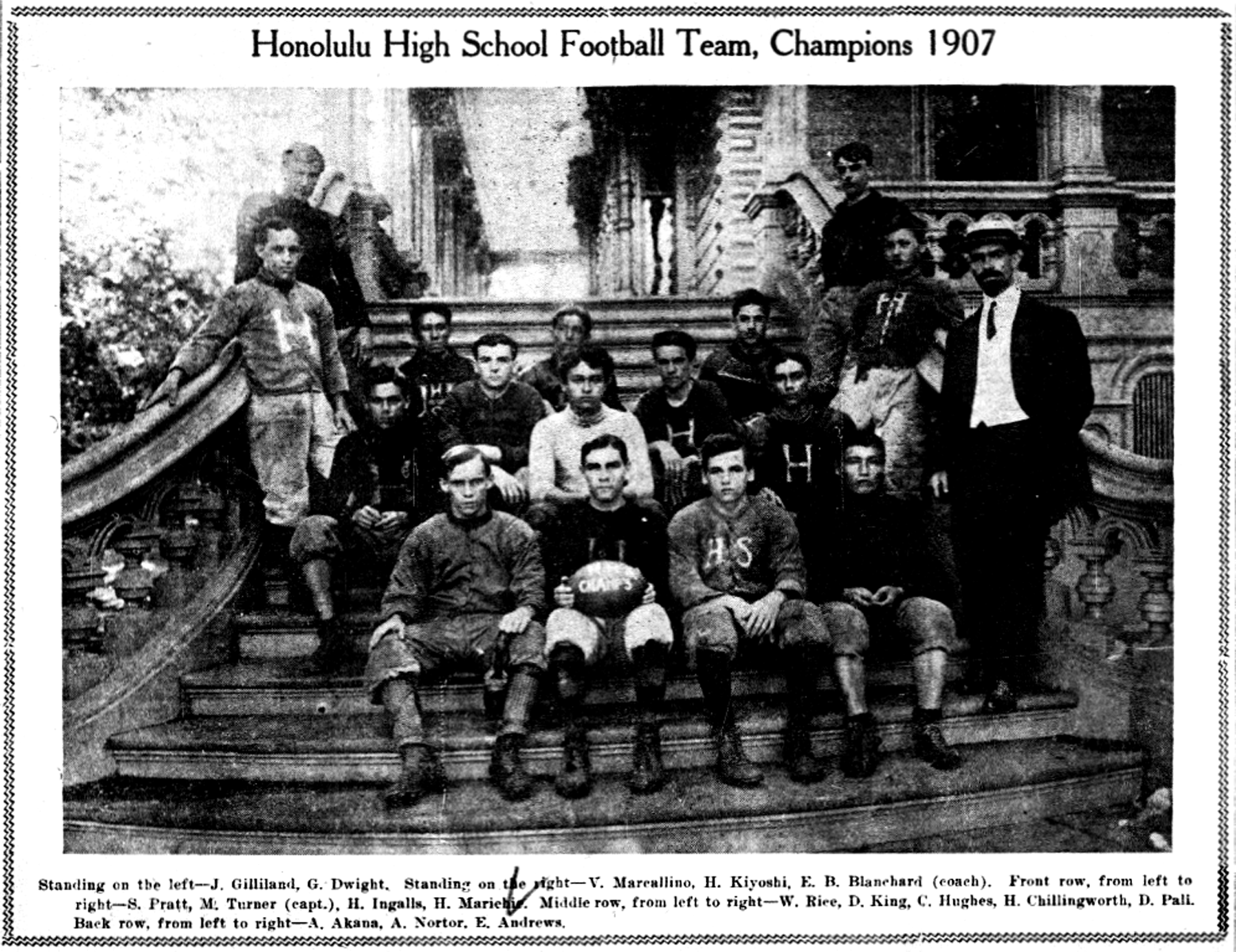
Honolulu High School Football Team, Champions 1907

Standing on the left—J. Gilliland, G. Dwight. Standing on the right—V. Marcallino, H. Kiyoshi, E. B. Blanchard (coach). Front row, from left to right—S. Pratt, M. Turner (capt.), H. Ingalls, H. Marichie. Middle row, from left to right—W. Rice, D. King, C. Hughes, H. Chillingworth, D. Pali. Back row, fro left to right—A. Akana, A. Nortor, E. Andrews.

[The Honolulu High School would go on to become what we know today as McKinley High School.]

(Sunday Advertiser, 12/8/1907, p. 7)

Honolulu High School Football Team, Champions 1907

Sunday Advertiser, Volume V, Number 258, Page 7. December 8, 1907.

Last words of the King, 1891.

Kalakaua’s Last Words Preserved by Phonograph.

Outside the little circle of immediate friends and attendants upon the late King Kalakaua who were admitted into the sick chamber it is not known that for the ten days prior to the monarch’s death an Edison phonograph stood near the bedside. Many who saw the instrument daily never suspected its character or use, and during the excitable days preceeding the King’s death, during which every nerve was taxed to its greatest tension, the innocent-looking little machine reposed in its shaded corner unnoticed and unobserved by all except the King’s chamberlain and his secretary. Continue reading

Walter McBryde purchases Kukuiolono, 1907.

[Found under: “COMMERCIAL NEWS By Daniel Logan”]

LAND MATTERS.

All of the interests of the estate of the late L. Ahlo in the rice industry were bought at auction sale on Monday by Jas. F. Morgan, trustee, and have since been incorporated under the name of Kaneohe Rice Mill Co., Ltd., with a capital of $50,000, the incorporators being Arnim Haneburg, W. Pfotenhauer, Geo. Rodiek, August Humburg and P. Bartels.

An agreement of sale has been made by the government with Walter McBryde for the mountain lot of Kukuiolono, in the Kalaheo tract, Kauai. The price is $894, one-tenth deposited on signing of papers, and the purchaser agrees to plant 3000 trees every year for ten years on the land. At the end of that period he is to receive a deed of the lot. The purpose of the agreement is stated to be conservation of the forest and of its water resources.

…..

(Sunday Advertiser, 1/13/1907, p. 4)

LAND MATTERS.

Sunday Advertiser, Volume V, Number 211, Page 4. January 13, 1907.

More local news from a hundred years ago, 1915.

LOCAL AND GENERAL

Regular meetings of Schofield lodge, Leilehua, this evening at 7:30 o’clock.

———

On the ground of non-support Judge Whitney today granted a divorce to Julia Nott from Wallace Nott.

———

According to recent news from Washington there will be no legislation to exclude the orientals from federal contract work in Hawaii.

———

A private letter from Washington says that the Kalihi harbor project is likely soon to be decided by the federal rivers and harbor board of engineers.

———

Joseph Green was ordered by Judge Whitney today to pay his wife, Lu Green, alimony of $25 a month pending the disposition of the divorce suit brought by her.

———

According to information from Washington, Congress has not yet reached the bill providing for the sale of the present public building site in Honolulu and the purchase of another site.

——— Continue reading

Hawaii at the Great London Exposition, 1862.

The Sandwich Islands.—During the last few days a stall has been fitted up near the department of the Ionian Islands which represents the latest and most distant echo in response to the invitation given to all nations and peoples to exhibit their natural and artificial products under the domes of South Kensington. The Hawaiian, or, as they are better known, the Sandwich Islands, were unrepresented in 1851, owing to the collection made there not reaching England till the Exhibition had finally closed, the voyage by a sailing vessel occupying five or six months. This year a similar fate threatened this remote group in the Pacific, and it seemed likely that the name of Hawaii would only be known in connexion with the International Exhibition of 1862 by a pair of silk banners in the nave, and a foreign commissioner with nothing to do. Continue reading

Episcopal Church in Hawaii, 1861.

[Found under: “NOTES OF THE WEEK.”]

We are frequently inquired of whether anything definite has been done towards establishing an Episcopal Church at Honolulu. By the following, which we extract from the London Examiner of March 9, our readers will be gratified to learn that the matter is in progress and has been referred to a committee consisting of responsible and intelligent men, who will probably see that it is carried to a successful issue. It will be a source of great pleasure not only to us but to all interested in the progress of religion in the Pacific, to announce that the establishment of an Episcopal Church here, has been fully decided upon: Continue reading

Lady Jane Franklin in Hawaii nei, 1861.

[Found under: “NOTES OF THE WEEK.”]

A Memento of Hawaii.—We strolled into Mr. Lafrenz’s cabinet shop a day or two since, to see some specimens of domestic cabinet ware, recently made by him. They consisted of two chests, manufactured by order of Mr. Wyllie, out of our native woods, and are intended as presents from His Excellency to lady Franklin and her niece Miss Cracroft. The larger of the two is made of koa, edged with ebony wood. The lid is tastefully decorated with various kinds of wood, and in the center is a square of black ebony inlaid, in which are bronze and pearl designs, with a small silver-plate, on which is inscribed “Lady Franklin, Honolulu, 1861.” The inside of the chest is lined with sandal-wood, which emits a most fragrant and pleasant odor. The whole is finished with French polish, and as a specimen of art in these islands, and as a memento of her visit here and of the generous donor, will no doubt be highly prized by her ladyship. The second chest, intended for Miss Cracroft, is quite small, but finished in the same style. We give the varieties of wood used: koa, kauwila, kou, koala, sandal-wood and black ebony; all native woods, except the last, which is from Ascension Island. As a specimen of cabinet ware, we have no fear of its being surpassed by the native products of any other country that may undertake to rival it.

(Pacific Commercial Advertiser, 5/16/1861, p. 2)

A Memento of Hawaii.

The Pacific Commercial Advertiser, Volume V, Number 46, Page 2. Mei 16, 1861.