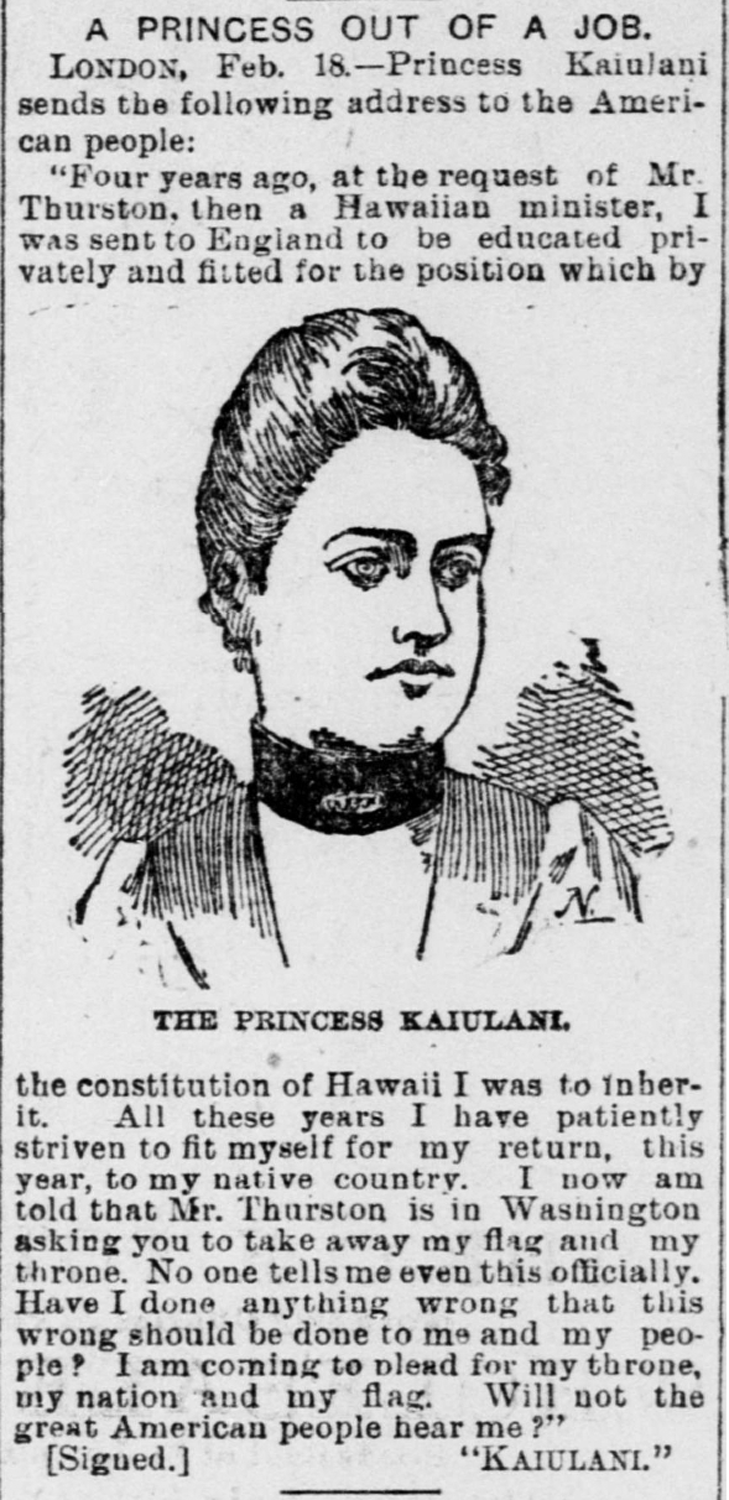
Princess Kaiulani protests, 1893.

A PRINCESS OUT OF A JOB

London, Feb. 18.—Princess Kaiulani sends the following address to the American people:

“Four years ago, at the request of Mr. Thurston, then a Hawaiian minister, I was sent to England to be educated privately and fitted for the position which by…

THE PRINCESS KAIULANI.

…the constitution of Hawaii I was to inherit. All these years I have patiently striven to fit myself for my return, this year, to my native country. I now am told that Mr. Thurston is in Washington asking you to take away my flag and my throne. No one tells me even this officially. Have I done anything wrong that this wrong should be done to me and my people? I am coming to plead for my throne, my nation and my flag. Will not the great American people hear me?”

[Signed.] “Kaiulani.”

(Wichita Daily Eagle, 2/19/1893, p. 2)

THE PRINCESS OUT OF A JOB.

The Wichita Daily Eagle, Volume XVIII, Number 82, Page 2. February 19, 1893.

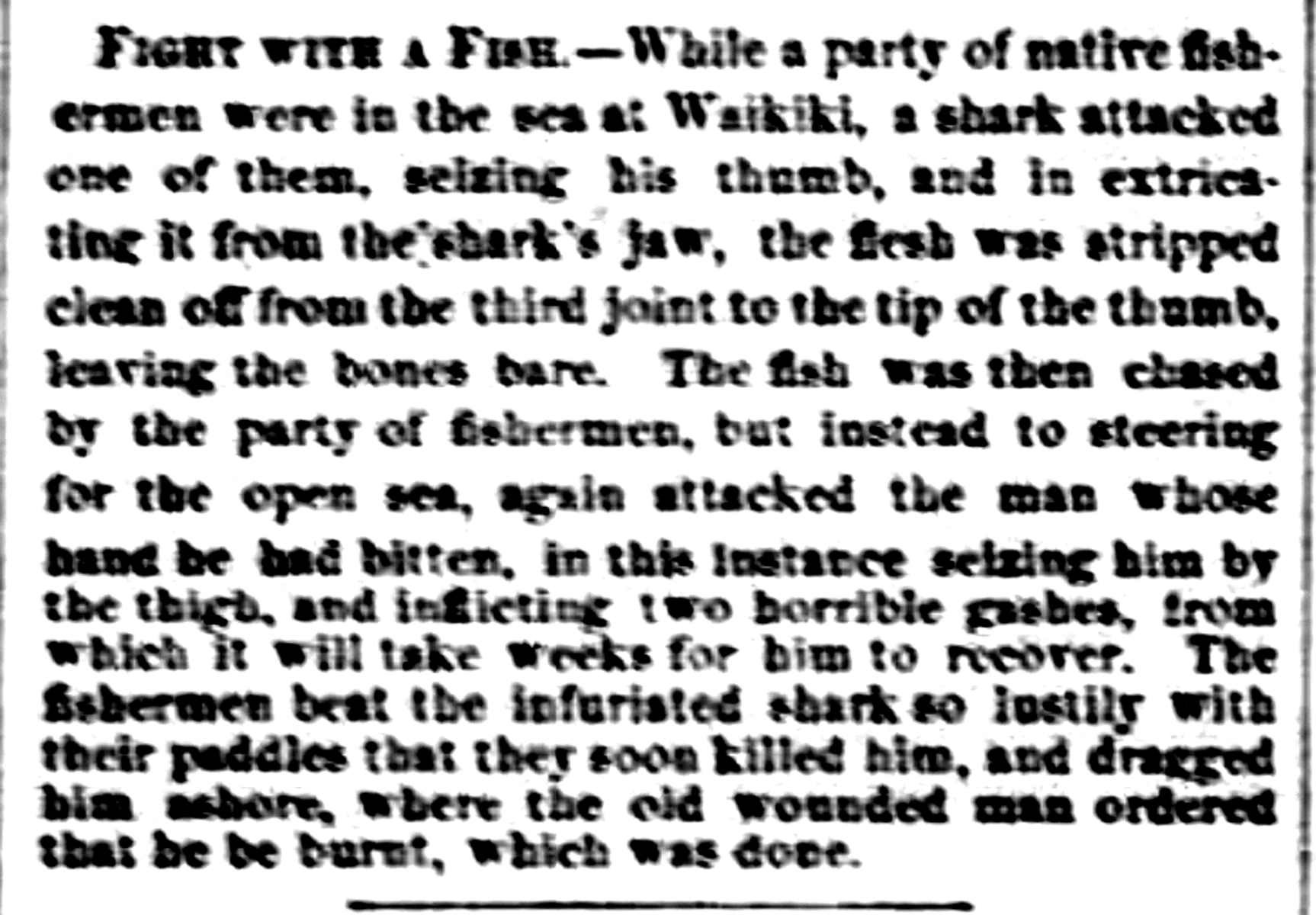
Shark attack, 1874.

Fight with a Fish.—While a party of native fishermen were in the sea at Waikiki, a shark attacked one of them, seizing his thumb, and in extricating it from the shark’s jaw, the flesh was stripped clean off from the third joint to the tip of the thumb, leaving the bones bare. The fish was then chased by the party of fishermen, but instead to steering for the open sea, again attacked the man whose hand he had bitten, in this instance seizing him by the thigh, and inflicting two horrible gashes, from which it will take weeks for him to recover. The fishermen beat the infuriated shark so lustily with their paddles that they soon killed him, and dragged him ashore, where the old wonded man ordered that he be burnt, which was done.

(Hawaiian Gazette, 5/20/1874, p. 3)

Fight with a Fish.

The Hawaiian Gazette, Volume X, Number 20, Page 3. May 20, 1874.

Wailuku memorial for Queen Liliuokalani, 1917.

[Found under: “QUEEN’S DEATH WIDELY MOURNED AROUND ISLANDS”]

WAILUKU, Maui, Nov. 23.—Most interesting services were held on Sunday in memory of Queen Liliuokalani. At the Church of the Good Shepherd at the usual hour of service, Rev. J. Charles Villiers preached a most interesting sermon, speaking of the good life of the queen and what she had done for her people and for Hawaii. There was a large and most appreciative audience.

At the Kaahumanu church there was also an unusually large audience, many coming from Waikapu, and the Japanese church in Wailuku, in honor of the queen. Revs. L. B. Kaumeheiwa and Rowland B. Dodge spoke upon the queen’s life and how much it meant that after the changes that had come in the government here the queen should have done so much to welcome and assist all the people of Hawaii irrespective of nationality.

References to the queen were also made in the Kahului Union chuch and the Makawao Union church by the pastors, though no special memorial services were held.

On Sunday evening at the Wailuku Union church, Rev. W. B. Coale of Lahaina, preached a strong sermon upon  “The Divine Silence.” He was listened to by a most appreciative audience.

(Honolulu Star-Bulletin, 11/24/1917, p. 37)

WAILUKU...

Honolulu Star-Bulletin, Volume XXV, Number 7993, Page 37. November 24, 1917.

Report of deaths in Japan, 1900.

By the Hongkong Maru.

Word was received by the Hongkong Maru from the Orient that Rev. David Keaweamahi, who left here about twelve years ago for Japan to undergo treatment for leprosy, died in Tokyo on the 29th of July last of consumption. No signs of the disease was visible on his face. He was buried that same evening, a large concourse of friends following his remains to the grave

W. H. Cummings died on July 15th at the Kusatsu springs and was buried there.

(Independent, 8/14/1900, p. 3)

By the Hongkong Maru.

The Independent, Volume XI, Number 1584, Page 3. August 14, 1900.

On the Wailuku Union Church, 1912.

Brief History of the Wailuku Church.

The first building of the Wailuku Union Church was erected in the early part of 1867. Mr. Christopher H. Lewers, Mr. Edward H. Bailey and several others then living in Wailuku were interested in its erection, and assisted in the work. “The Friend” of a somewhat earlier date speaks of the work of the ladies of Wailuku in raising nearly $400 toward the new building.

Rev. Thomas Gardner Thurston, second son of Asa and Lucy G. Thurston, of Kailua, Hawaii, was the first pastor of this Church. He was ordained in the Kaahumanu Church, and ministered to both English-speaking and Hawaiian congregations, beginning his work in the month of October, 1866.

The Wailuku Union Church was organized, January 15th, 1867. Rev. W. P. Alexander was moderator of that council, Rev. S. E. Bishop, D. D., was the scribe. The papers of incorporation were issued the year before, on October 10th. Continue reading

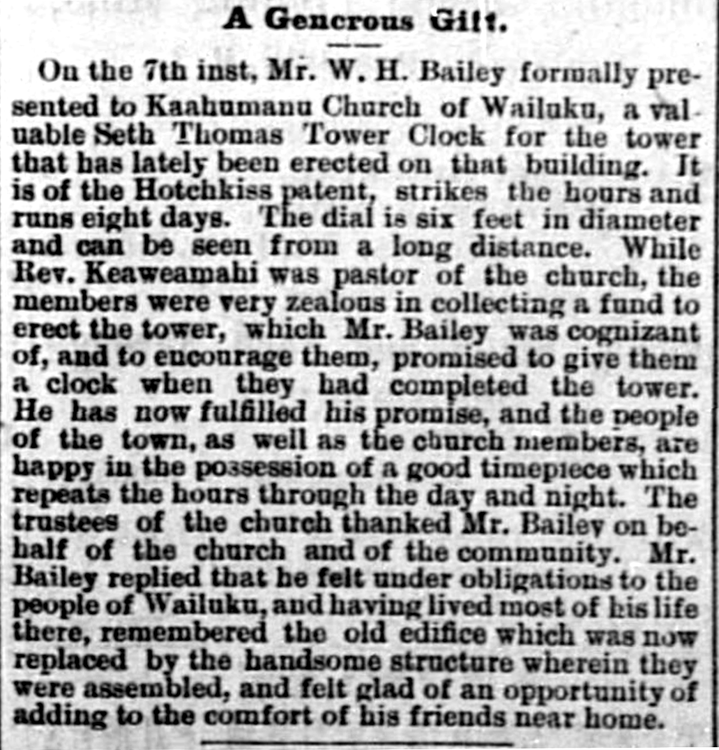
William H. Bailey donates grand clock to Kaahumanu Church, 1884.

A Generous Gift.

On the 7th inst, Mr. W. H. Bailey formally presented to Kaahumanu Church of Wailuku, a valuable Seth Thomas Tower Clock for the tower that has lately been erected on that building. It is of the Hotchkiss patent, strikes the hours and runs eight days. The dial is six feet in diameter and can be seen from a long distance. While Rev. Keaweamahi was pastor of the church, the members were very zealous in collecting a fund to erect the tower, which Mr. Bailey was cognizant of, and to encourage them, promised to give them a clock when they had completed the tower. He has now fulfilled his promise, and the people of the town, as well as the church members, are happy in the possession of a good timepiece which repeats the hours through the day and night. The trustees of the church thanked Mr. Bailey on behalf of the church and of the community. Mr. Bailey replied that he felt under obligations to the people of Wailuku, and having lived most of his life there, remembered the old edifice which was now replaced by the handsome structure wherein they were assembled, and felt glad of an opportunity of adding to the comfort of his friends near home.

(Hawaiian Gazette, 9/10/1884, p. 8)

A Generous Gift.

Hawaiian Gazette, Volume XIX, Number 37, page 8. September 10, 1884.

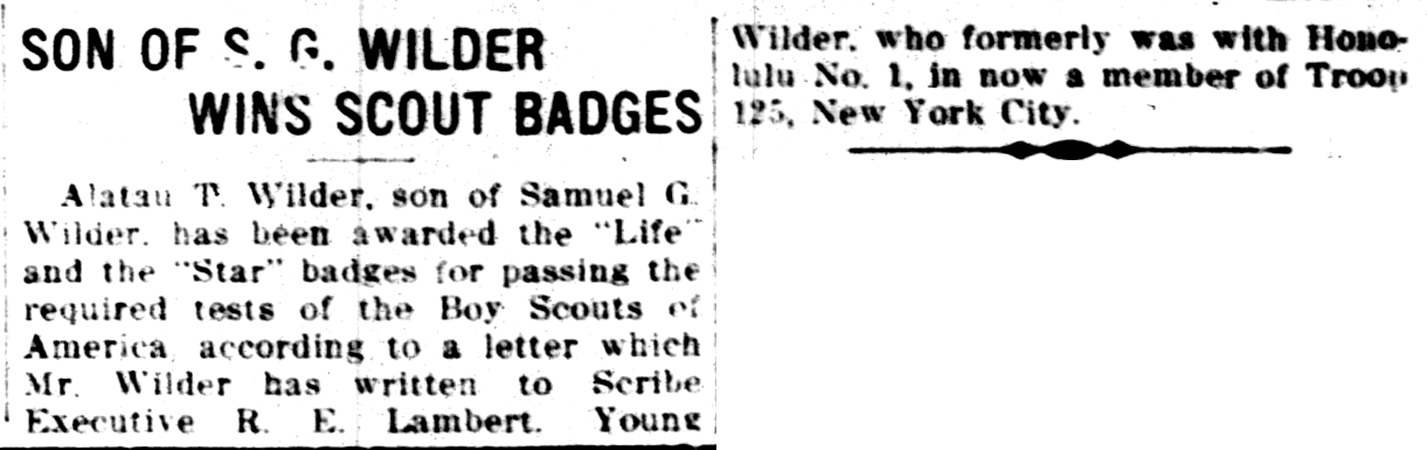
Alatau Wilder, Boy Scout, 1916.

SON OF S. G. WILDER WINS SCOUT BADGES

Alatau T. Wilder, son of Samuel G. Wilder, has been awarded the “Life” and the “Star” badges for passing the required tests of the Boy Scouts of America according to a letter which Mr. Wilder has written to Scribe Executive R. E. Lambert Young. Wilder, who formerly  was with Honolulu No. 1, is now a member of Troop 125, New York City.

(Honolulu Star-Bulletin, 5/16/1916, p. 8)

SON OF S. G. WILDER WINS SCOUT BADGES

Honolulu Star-Bulletin, Volume XXIII, Number 7517, Page 8. May 16, 1916.

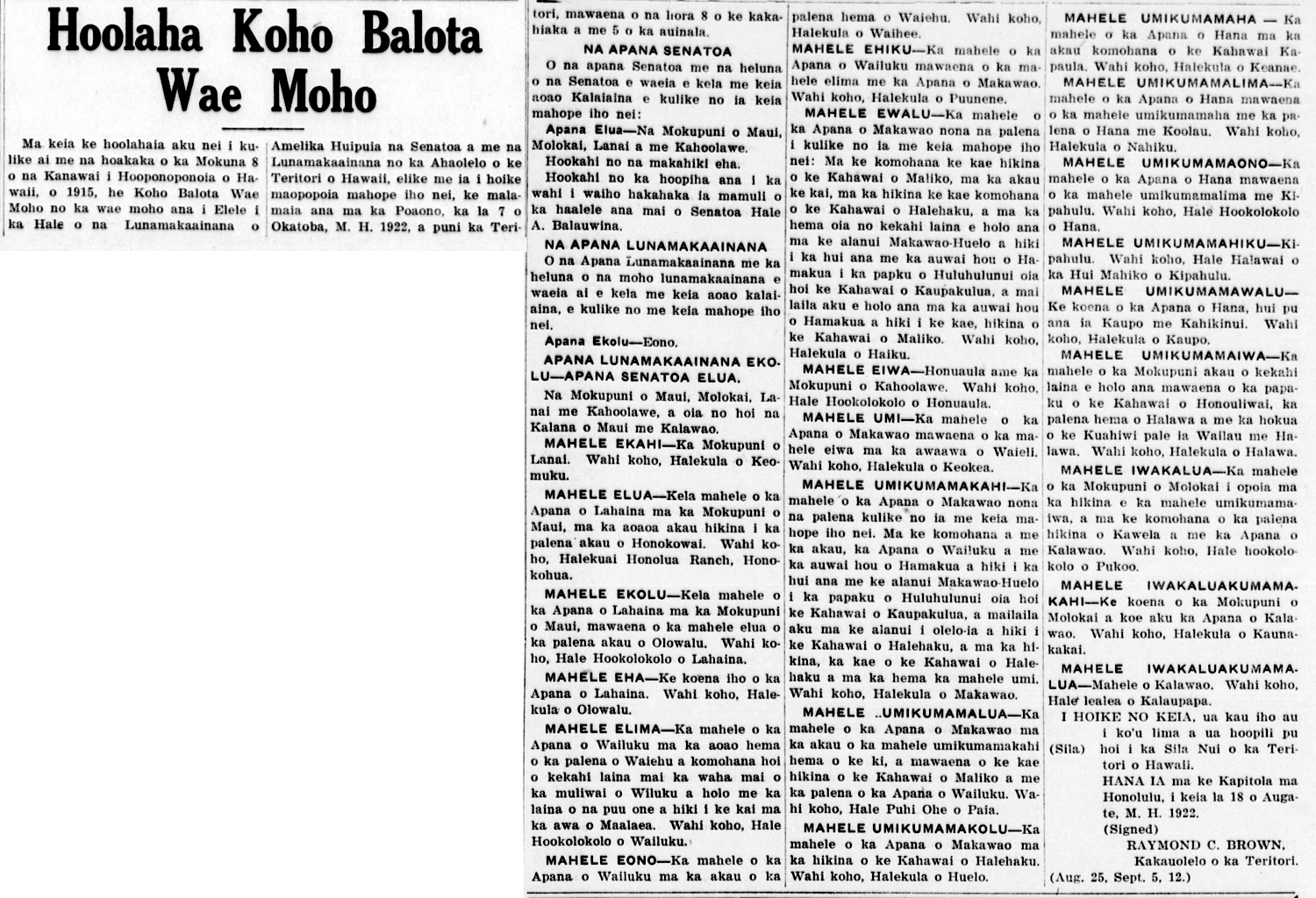
Voting Precincts in Hawaiian in an English newspaper, 1922.

Hoolaha Koho Balota Wae Moho

Ma keia ke hoolahaia aku nei i kulike ai me na hoakaka o ka Mokuna 8 o na Kanawai i Hooponoponoia o Hawaii, o 1915, he Koho Balota Wae Moho no ka wae moho ana i Elele i ka Hale o na Lunamakaainana o Amelika Huipuia na Senatoa a me na Lunamakaainana no ka Ahaolelo o ke Teritori o Hawaii, elike me ia i hoike maopopoia mahope iho nei, ke malamaia ana ma ka Poaono, ka la 7 o Okatoba, M. H. 1922, a puni ka Teritori, mawaena o na hora 8 o ke kakahiaka a me 5 o ka auinala.

NA APANA SENATOA

O na apana Senatoa me na heluna o na Senatoa e waeia e kela me keia aoao Kalaiaina e kulike no ia keia mahope iho nei:

Apana Elua—Na Mokupuni o Maui, Molokai, Lanai a me Kahoolawe.

Hookahi no na makahiki eha.

Hookahi no ka hoopiha ana i ka wahi i waiho hakahaka ia mamuli o ka haalele ana mai o Senatoa Hale A. Balauwina.

NA APANA LUNAMAKAAINANA

O na Apana Lunamakaainana me ka heluna o na moho lunamakaainana e waeia e kela me keia aoao kalaiaina, e kulike no me keia mahope iho nei.

Apana Ekolu—Eono.

APANA LUNAMAKAAINANA EKOLUAPANA SENATOA ELUA.

Na Mokupuni o Maui, Molokai, Lanai me Kahoolawe, a oia no hoi na Kalana o Maui me Kalawao.

MAHELE EKAHI—Ka Mokupuni o Lanai. Wahi koho, Halekula o Keomuku.

MAHELE ELUA—Kela mahele o ka Apana o Lahaina ma ka Mokupuni o Maui, ma ka aoao akau hikina i ka palena akau o Honokowai. Wahi koho, Halekuai Honolua Ranch, Honokohau.

MAHELE EKOLU—Kela mahele o ka Apana o Lahaina ma ka Mokupuni o Maui, mawaena o ka mahele elua o ka palena akau o Olowalu. Wahi koho, Hale Hookolokolo o Lahaina.

MAHELE EHA—Ke koena iho o ka Apana o Lahaina. Wahi koho, Halekula o Olowalu.

MAHELE ELIMA—Ka mahele o ka Apana o Wailuku a komohana hoi o ka palena o Waiehu a komohana hoi o kekahi laina mai ka waha mai o ka muliwai o Wailuku a holo me ka laina o na puu one a hiki i ke kai ma ka awa o Maalaea. Wahi koho, Hale Hookolokolo o Wailuku.

MAHELE EONO—Ka mahele o ka Apana o Wailuku ma ka akau o ka palena hema o Waiehu. Wahi koho, Halekula o Waihee.

MAHELE EHIKU—Ka mahele o ka Apana o Wailuku mawaena o ka mahele elima me ka Apana o Makawao. Wahi koho, Halekula o Puunene.

MAHELE EWALU—Ka mahele o ka Apana o Makawao nona na palena i kuliike no ia me keia mahope iho nei: Ma ke komohana ke kae hikina o ke Kahawai o Maliko, ma ka akau ke kai, ma ka hiki ke kae komohana o ke Kahawai o Halehaku, a ma ka hema oia no kekahi laina e holo ana ma ke alanui Makawao-Huelo a hiki i ka hui ana me ka auwai hou o Hamakua i ka papaku o Huluhulunui oia hoi ke Kahawai o Kaupakulua, a mai laila aku e holo ana ma ka auwai hou o Hamakua a hiki i ke kae hikina o ke kahawai o Maliko. Wahi koho, Halekula o Haiku.

MAHELE EIWA—Honuaula ame ka Mokupuni o Kahoolawe. Wahi koho, Hale Hookolokolo o Honuaula.

MAHELE UMI—Ka mahele o ka Apana o Makawao mawaena o ka mahele eiwa ma ka awaawa o Waieli. Wahi koho, Halekula o Keokea.

MAHELE UMIKUMAMAKAHI—Ka mahele o ka Apana o Makawao nona na palena kulike no ia me keia mahope iho nei. Ma ke komohana a me ka akau, ka Apana o Wailuku a me ka auwai hou o Hamakua a hiki i ka hui ana me ke alanui Makawao-Huelo i ka papaku o Huluhulunui oia hoi ke Kahawai o Kaupakulua, a mailaila aku ma ke alanui i olelo ia a hiki i ke Kahawai o Halehaku, a ma ka hikina, ka kae o ke Kahawai o Halehaku a ma ka hema ka mahele umi. Wahi koho, Halekula o Makawao.

MAHELE UMIKUMAMALUA—Ka mahele o ka Apana o Makawao ma ka akau o ka mahele umikumamakahi hema o ke ki, a mawaena o ke kae hikina o ke Kahawai o Maliko a me ka palena o ka Apana o Wailuku. Wahi koho, Hale Puhi Ohe o Paia.

MAHELE UMIKUMAMAKOLU—Ka mahele o ka Apana a Makawao ma ka hikina o ke Kahawai o Halehaku. Wahi koho, Halekula o Huelo.

MAHELE UMIKUMAMAHA—Ka mahele o ka Apana o Hana ma ka akau komohana o ke Kahawai Kapaula. Wahi koho, Halekula o Keanae.

MAHELE UMIKUMAMALIMA—Ka mahele o ka Apana o Hana mawaena o ka mahele umikumamaha me ka palena o Hana me Koolau. Wahi koho, Halekula o Nahiku.

MAHELE UMIKUMAMAONO—Ka mahele o ka Apana o Hana mawaena o ka mahele umikumamalima me Kipahulu. Wahi koho, Hale Hookolokolo o Hana.

MAHELE UMIKUMAMAHIKU—Kipahulu. Wahi koho, Hale Halawai o ka Hui Mahiko o Kipahulu.

MAHELE UMIKUMAMAWALU—Ke koena o ka Apana o Hana, hui pu ana ia Kaupo me Kahikinui. Wahi koho, Halekula o Kaupo.

MAHELE UMIKUMAMAIWA—Ka mahele o ka Mokupuni akau o kekahi laina e holo ana mawaena o ka papaku o ke Kahawai o Honouliwai, ka palena hema o Halawa a me ka hokua o ke kKuahiwi pale ia Wailau me Halawa. Wahi koho, Halekula o Halawa.

MAHELE IWAKALUA—Ka mahele o ka Mokupuni o Molokai i opoia ma ka hikina e ka mahele umikumamaiwa, a ma ke komohana o ka palena hikina o Kawela a me ka Apana o Kalawao. Wahi koho, Hale hookolokolo o Pukoo.

MAHELE IWAKALUAKUMAMAKAHI—Ke koena o ka Mokupuni o Molokai a koe aku ka Apana o Kalawao. Wahi koho, Halekula o Kaunakakai.

MAHELE IWAKALUAKUMAMALUA—Mahele o Kalawao. Wahi koho, Hale lealea o Kalaupapa.

I HOIKE NO KEIA, ua kau iho au i ko’u lima a ua hoopili pu hoi i ka Sila Nui o ka Teritori o Hawaii. HANA IA ma ke Kapitola ma Honolulu, i keia la 18 o Augate, M. H. 1922.

(Sila) (Signed)

RAYMOND C. BROWN,
Kakauolelo o ka Teritori.

[Yesterdayʻs post was of a personal ad, but here is a government announcement in Hawaiian from 1922. This is printed along with the English on the same page.]

(Maui News, 9/5/1922, p. 7)
Hoolaha Koho Balota Wae Moho

Semi-Weekly Maui News, Year 22, Number 1198, Page 7. September 5, 1922.

Voting Precincts in an English newspaper, 1922.

BY AUTHORITY

Public Notice of Primary Election

Notice is hereby given that in accordance with the terms of Chapter 8 of the Revised Laws of Hawaii, 1915, a Primary Election for the purpose of making nominations for a Delegate to the House of Representatives of the United States and for Senators and Representatives of the Legislature of the Territory of Hawaii, as more particularly hereinafter set forth, will be held on Saturday, the 7th day of October, A. D. 1922, throughout the Territory, between the hours of eight o’clock, a. m., and five o’clock p. m.

SENATORIAL DISTRICTS

The several Senatorial Districts and the number of candidates by each political party are as follows:

SECOND DISTRICT—Islands of Maui, Molokai, Lanai and Kahoolawe—

One for full term of four years.

One to fill vacancy caused by resignation of Senator H. A. Baldwin.

REPRESENTATIVE DISTRICTS

The several Representative Districts and the number of candidates for Representative to be nominated by each political party are as follows:

IN THE THIRD DISTRICT—Six.

THIRD REPRESENTATIVE DISTRICTSECOND SENATORIAL DISTRICT.

The Islands of Maui, Molokai, Lanai and Kahoolawe, constituting the Counties of Maui and Kalawao.

FIRST PRECINCT—The Island of Lanai. Polling place, Keomuku Schoolhouse.

SECOND PRECINCT—The portion of Lahaina District on the Island of Maui, northeasterly of the north boundary of Honokowai. Polling place, Honolua Ranch Store, Honokohau.

THIRD PRECINCT—The portion of Lahaina District on the Island of Maui, between the Second Precinct and the north boundary of Olowalu. Polling place, Lahaina Courthouse.

FOURTH PRECINCT—The remainder of Lahaina District. Polling place, Olowalu schoolhouse.

FIFTH PRECINCT—The portion of Wailuku District south of Waiehu and west of a line from the mouth of the Wailuku stream along the sand hills to the sea at Maalaea Bay. Polling place, Wailuku courthouse.

SIXTH PRECINCT—The portion of Wailuku District north of the south boundary of Waiehu. Polling place, Waihee schoolhouse.

SEVENTH PRECINCT—The portion of Wailuku District between the Fifth Precinct and the Makawao District. Polling place, Puunene schoolhouse.

EIGHTH PRECINCT—The portion of Makawao District bounded on the west by the east edge of the Maliko gulch; on the north by the sea; on the east by the west edge of the Halehaku gulch; and on the south by a line along the Makawao-Huelo road to its junction with the new Hamakua Ditch in the bottom of the Huluhulunui o Kaupakulua gulch, thence along the new Hamakua Ditch to the east edge of the Maliko Gulch. Polling place, Haiku schoolhouse.

NINTH PRECINCT—Honuaula and the Island of Kahoolawe. Polling palce, Honuaula courthouse.

TENTH PRECINCT—The portion of Makawao District between the Ninth Precinct and the bed of Waieli gulch. Polling place, Keokea schoolhouse.

ELEVENTH PRECINCT—The portion of Makawao District bounded on the west and north by the Wailuku District and the new Hamakua Ditch to its junction with the Makawao-Huelo road in the bottom of the Heluhulunui or Kaupakulua gulch, thence along said road to the Halehaku gulch; on the east by the west edge of the Halehaku gulch; and on the south by the Tenth Precinct. Polling place, Makawao schoolhouse.

TWELFTH PRECINCT—The portion of Makawao District north of the Eleventh Precinct south of the sea and between the east edge of the Maliko gulch and the boundary of Wailuku District. Polling place, Paia band hall.

THIRTEENTH PRECINCT—The portion of Makawao District east of the bed of Halehaku gulch. Polling place, Huelo schoolhouse.

FOURTEENTH PRECINCT—The portion of Hana District northwest of the Kapaula Stream. Polling place, Keanae schoolhouse.

FIFTEENTH PRECINCT—The portion of Hana District between the Fourteenth Precinct and the Hana-Koolau boundary. Polling place, Nahiku schoolhouse.

SIXTEENTH PRECINCT—The portion of Hana District between the Fifteenth Precinct and Kipahulu. Polling place, Hana courthouse.

SEVENTEENTH PRECINCT—The District of Kipahulu. Polling place, Kipahulu Plantation hall.

EIGHTEENTH PRECINCT—The remainder of Hana District, including Kaupo and Kahikinui. Polling place, Kaupo schoolhouse.

NINETEENTH PRECINCT—The portion of the Island of Molokai north of a line running along the bed of the Honouliwai gulch, the southern boundary of Halawa and the top of the ridge between Wailau and Halawa. Polling place, Halawa schoolhouse.

TWENTIETH PRECINCT—The portion of the Island of Molokai bounded on the east by the Nineteenth Precinct and on the west by the east boundary of Kawela and the Kalawao District. Polling place, Pukoo courthouse.

TWENTY-FIRST PRECINCT—The remainder of the Island of Molokai, excepting the Kalawao District. Polling place, Kaunakakai schoolhouse.

TWENTY-SECOND PRECINCT—The Kalawao District. Polling place, amusement hall at Kalaupapa.

IN TESTIMONY WHEREOF, I have hereunto set my hand and caused the Great Seal of the Territory of Hawaii to be affixed.

DONE at the Capitol, in Honolulu, this 18th day of August, A. D. 1922.

(Seal) (Signed)

RAYMOND C. BROWN,
Secretary of Hawaii.

[See the Hawaiian-Language article published on the same page.]

(Maui News, 9/5/1922, p. 7)

Public Notice of Primary Election

Semi-Weekly Maui News, Year 22, Number 1198, Page 7. September 5, 1922.
Kou trees, 1875.

Kou Trees.—The beautiful kou, which furnished a remarkably rich-grained furniture wood, and which old residents remember as growing abundantly as shade tree on the seacoasts all over the islands, has quite disappeared within the past ten or fifteen years, having been destroyed by a new insect enemy. A few days since, a gentleman whose occupation called him to the extreme low point of land seaward from Moanalua, discovered a thrifty young kou tree, growing in front of a native dwelling, on which were a number of bright yellow blossoms. It is to be hoped that the kou will be again cultivated. What would be finer than rows of these beautiful trees on the Esplanade? They flourish best near the sea, and do not succeed far inland. The same gentleman informs us that during his ramble he found a specimen of the ohai, native locust, a flowering shrub which is now considered rare on this island. This species bears a bright red flower, while that of the island of Hawaii is a dark red.

(Pacific Commercial Advertiser, 7/10/1875, p. 3)

Kou Trees.

The Pacific Commercial Advertiser, Volume XX, Number 2, Page 3. July 10, 1875.