The beginning of the “Pineapple Island,” 1922.

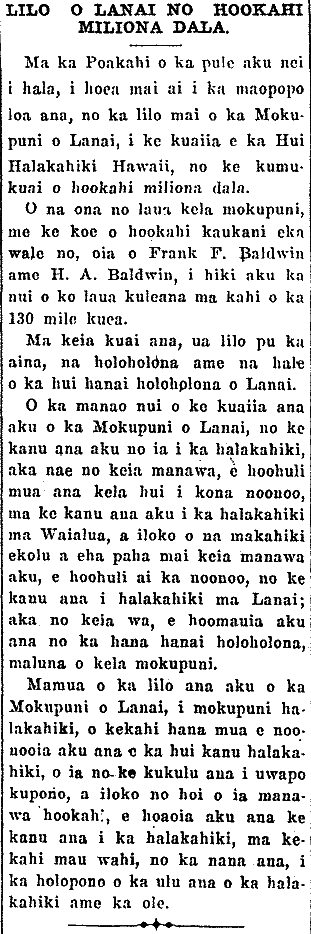
LANAI SOLD FOR A MILLION DOLLARS.

Last week Monday, it was confirmed that Lanai was purchased by Hawaiian Pineapple Company [Hui Halakahiki Hawaii] for the price of a million dollars.

The two owners of the island, except for a remainder of but a thousand acres, are Frank F. Baldwin and H. A. Baldwin, giving them ownership of about 130 square miles.

Included in this purchase was the land, animals, and the buildings of Lanai Ranch [hui hanai holoholona o Lanai].

The main purpose for buying the island of Lanai was to plant pineapple, but for the time being, the company will explore planting pineapple in Waialua, and within three or four years from now, they will think about planting pineapple on Lanai; but for now, ranching will continue on the island.

Before Lanai becomes a pineapple island, one of the things that the pineapple company must think about first is the building of a proper pier, and at the same time, to do test plantings of pineapple at different places to see how the pineapple grows or does not grow.

(Kuokoa, November 23, 1922, p. 3)

LILO O LANAI NO HOOKAHI MILIONA DALA.

Ka Nupepa Kuokoa, Buke LXI, Helu 47, Aoao 3. Novemaba 23, 1922.

Z. P. K. Kawaikaumaiikamakaokaopua’s treatise on kalaiaina, 1921–1922.

WHAT KALAIAINA IS.

(Written by Z. P. K. Kawaikaumaiikamakaokaopua).

Introduction.

God gave all men wealth [waiwai]; He gave land to grow food, He gave trees to build houses and to assist in great works, He gave all growing things to fulfill the desires of men, He gave us hands and strength to work and administer the land and all things that will bring us wealth.

But when man lived in ignorance, they were very poor. The things God gave him were not made into wealth. He lived in caves or shacks, or crude and dirty structures. His clothes were leaves, or animal hide, or tree bark; he hunted wild animals for food and plants that grew wild in the forest; he did not imitate the ant who prepared a lot of food. That is how ignorant men lived poorly. They did not know where to obtain wealth. The saw the wealth of foreign lands, and were amazed at the great wealth of other lands. They did not understand that God spread upon all lands things to make great wealth.

That is why kalaiaina is important. There are many facets of that word. The soil in which farmers farm is aina. The ocean in which fishing is done is aina. The public mart is aina. Canoe carving is aina. House building is aina. Everything done to bring wealth to many people is called aina. Administering to the different aina is how to gain wealth and it was called kalaiaina by the writers of old. Continue reading

Farming in Hawaii, 1913.

ENCOURAGING SMALL FARMER.

Beginning January 5, The Advertiser will publish a weekly list of wholesale prices for Island produce in Honolulu markets while A. T. Longley, superintendent of the home markets division of the Hawaii Experiment Station will also supply a weekly market letter for publication. The marketing division was authorized by the last legislature, an appropriation having been made for the purpose.

Dr. E. V. Wilcox has been a close student of cooperative marketing organizations for the last twenty years. He stated to The Advertiser Saturday that there are ten times as many cooperative marketing organizations in the United States as in England and Germany combined, although there is very little American literature on the subject. One Southern farmer’s organization that both sells produce and purchases machinery, fertilizers, seed and supplies for its members includes over three million farmers and planters. California, Oregon, Idaho, Washington, Utah and Colorado have their fruit marketing organizations. In the Central States the farmers have to together on their corn, wheat and oat crops as well on the scores of minor products usually associated in the Hawaiian public mind with “small farming.” There are cooperative societies in New York and New England; in Kentucky, Tennessee and the Carolinas they united in the marketing of tobacco, early truck crops, peach and berry crops; and in the Gulf States they are almost a controlling factor in cotton.

The prime objects of farmer’s cooperative unions are, continuity of supply, an honest and uniform pack, and standardization of grades. The idea is to put the growing, packing and marketing of farm produce on a business basis.

Continue reading

Nora Rickard of Honokaa turns 90, 1938.

Mother Rickard Celebrates her birthday

MRS. RICKARD

On Sunday, March 6, “Mother” Nora Rickard of Honokaa celebrated her 90th birthday, after living until local on the Island of Keawe for 71 years. She was born in Devonshire, England, and left there when she was 19 years old and went to America on a sailboat travelling under Cape Horn [Kaipo Hone], a trip that took five months.

“Mother” Rickard is the first white woman who lived in Honokaa. She is still strong and spry, even if she is very old. Pertaining to her trip from England, she says: Continue reading

Something to consider as more and more agricultural lands get covered over by concrete, 1911 / 2013.

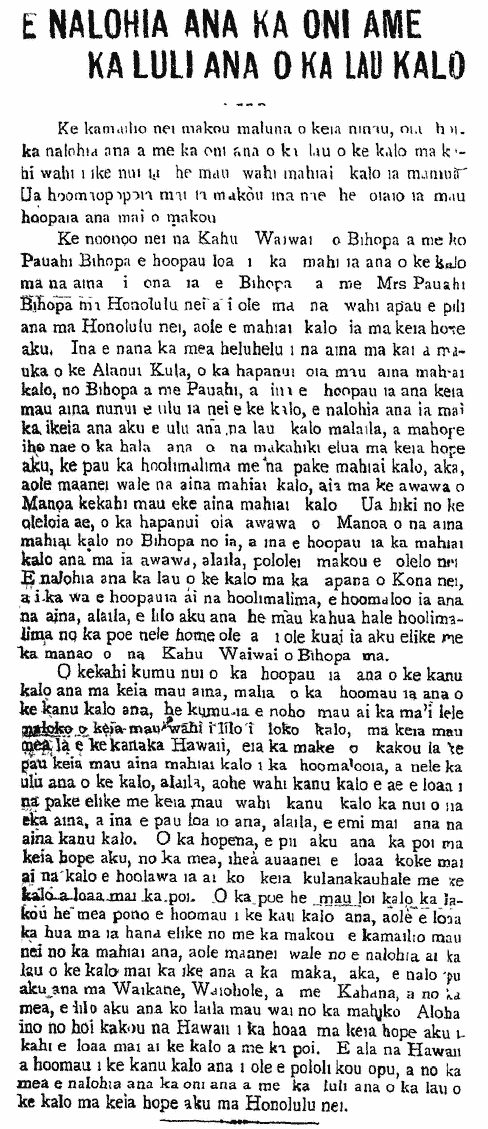
THE STIRRING AND FLUTTERING OF TARO LEAVES TO DISAPPEAR

 We are discussing this problem, that being the disappearance of the fluttering taro leaves from places where kalo farming was seen often before. This is clear should our speculation be true.

The Bishop Trustees and those of Pauahi Bishop are considering putting an end for all time to the farming of kalo on lands owned by Bishop and Mrs. Pauahi Bishop here in Honolulu, or in all areas near Honolulu; there will be no more farming of kalo from now on. Should the reader take a look at the lands towards the ocean and towards the uplands of School Street, the majority of those kalo lands belong to Bishop and Pauahi, and should these large tracts of kalo-growing lands be put an end to, taro leaves growing there will no longer be seen, and two years hence, the leases with the Chinese taro farmers will come to an end; but these are not the only taro lands; in Manoa Valley, there are acres of kalo land. It can be said that most of the taro-farming lands in Manoa Valley belong to Bishop, and should the kalo farming be put to an end in that valley, then it is appropriate for us to say that taro leaves will disappear from the district of Kona, and when the leases are stopped, the lands will be dried up, and they will be made into lots to lease to those who have no homes, or they will be sold, like what is being considered by the Trustees of Bishop folks.

 One of the main reasons to end the farming of kalo on these lands is perhaps because if the farming of kalo continues, these areas will be places for infectious diseases to reside; through this, O Hawaiians, our end will come; if these kalo lands are dried out and kalo is not grown, then there will be no other lands for the Chinese to lease like these tracts of lands of many acres, and should they indeed be done away with, then the places where kalo is grown will decrease. As a result, the poi prices will increase, for where will kalo be readily obtained to supply this town and to get poi? For those who have taro fields, it is important that they continue to plant taro; there will not be the profits in that work like what we always speak of when talking of farming; and it is not just here that the leaves of the taro will no longer be seen, but it will disappear from Waikane, Waiahole, and Kahana, for the water there is going to the sugarcane plantations. Alas for us Hawaiians who hereafter will be left wandering, looking for kalo and poi. Rise O Hawaiians and continue to farm kalo lest you be left hungry, being that the stirring and fluttering of kalo leaves will disappear from Honolulu nei.

[This deserves to be retranslated nicely…]

(Kuokoa Home Rula, 8/18/1911, p. 2)

E NALOHIA ANA KA ONI AME KA LULI ANA O KA LAU KALO

Kuokoa Home Rula, Buke IX, Helu 33, Aoao 2. Augate 18, 1911.

On kalo, poi, and life, 1901.

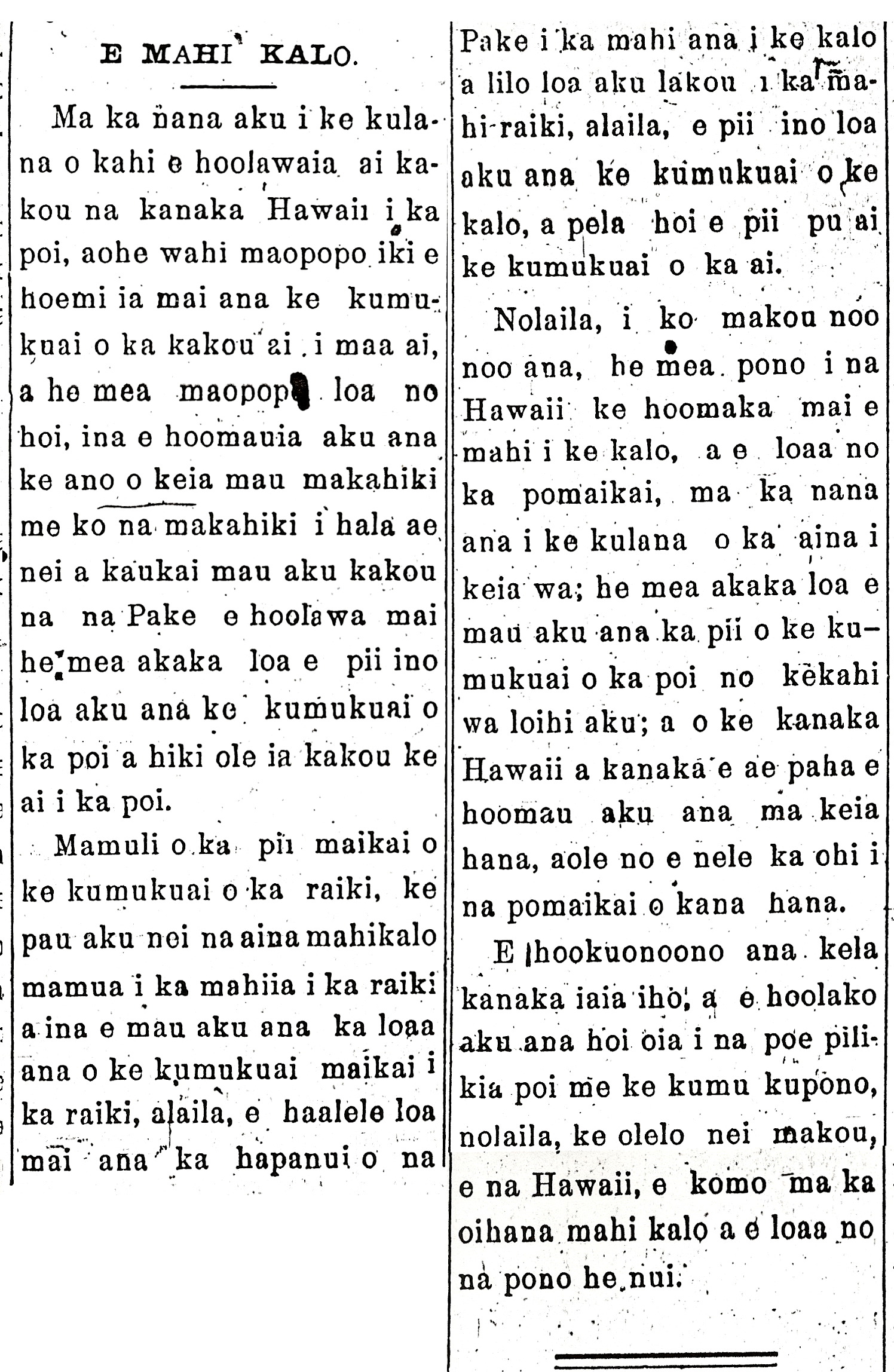
FARMING KALO.

When considering how we Hawaiians are being supplied with poi, there is not the slightest indication that the cost of our staple food will decrease, and it is also very clear that if what has happened in the past years continues on into the upcoming years, and we continue relying on the Chinese for our supply, it is obvious that the price of poi will shoot up, and we will not be able to eat poi.

As a result of the increase in the price of rice, the former taro lands are being planted with rice, and should the rice market continue to be favorable, then a majority of the Chinese will abandon taro and become rice farmers, then, the cost of kalo will skyrocket, and as a result, so too will the price of poi.

Therefore, in our opinion, Hawaiians should start farming kalo, and obtain its benefits; looking at the land situation these days, it is very clear that the price of poi will continue to rise for long into the future; and the Hawaiians or others perhaps who continue this occupation will not fail to reap its benefits.

That man will make himself prosper and he will supply those who are lacking poi at a fair price, and so we say, O Hawaiian people, go into the occupation of kalo farming, and there shall be many blessings.

[While rice is no longer being planted here, perhaps in its place are being planted buildings. What is there to be done today?]

(Lahui Hawaii, 6/22/1901, p. 4)

E MAHI KALO.

Ka Lahui Hawaii, Buke III, Helu 25, Aoao 4. Iune 22, 1901.


More on opening of Uluhaimalama, 1894.

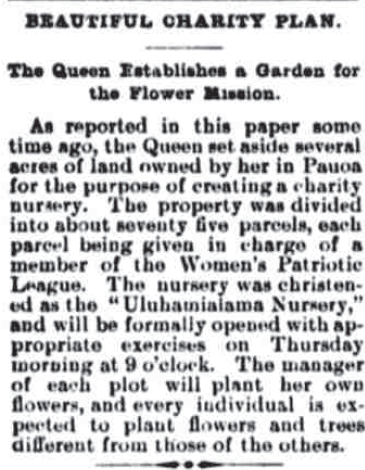
BEAUTIFUL CHARITY PLAN.

The Queen Establishes a Garden for the Flower Mission.

As reported in this paper some time ago, the Queen set aside several acres of land owned by her in Pauoa for the purpose of creating a charity nursery. The property was divided into about seventy five parcels, each parcel being given in charge of a member of the Women’s Patriotic League. The nursery was christened as the “Uluhaimalama Nursery,” and will be formally opened with appropriate exercises on Thursday morning at 9 o’clock. The manager of each plot will plant her own flowers, and every individual is expected to plant flowers and trees different from those of the others.

(Daily Bulletin, 10/8/1894, p. 3)

BEAUTIFUL CHARITY PLAN.

The Daily Bulletin, Volume VIII, Number 1156, Page 3. October 8, 1894.

The beginnings of Uluhaimalama, 1894.

ULUHAIMALAMA.

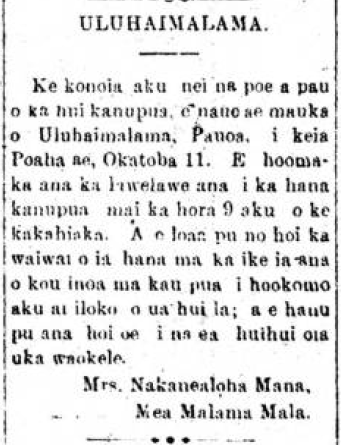
Everyone in the flower planting association [? hui kanupua] is invited to make their way to Uluhaimalama, Pauoa, on this Thursday, October 11. The flower planting will begin from 9 o’clock in the morning. And the importance of the efforts will be seen by having your name by your flower placed by the association; and you will also breathe in the bracing air of the upland forests.

Mrs. Nakanealoha Mana,

Caretaker of the  Garden.

(Oiaio, 10/5/1894, p. 3)

ULUHAIMALAMA.

Ka Oiaio, Buke VI, Helu 40, Aoao 3. Okatoba 5, 1894.

New birds introduced, 1865.

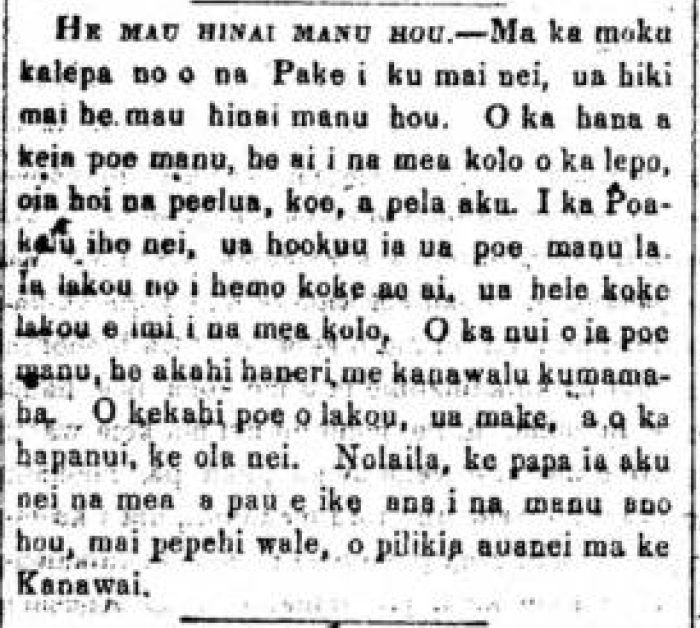
Containers of New Birds.—Aboard the trading ship of the Chinese that arrived were brought containers of new birds. The purpose of these birds are to eat bugs found in the dirt like caterpillars [peelua], koe [worms], etc. Last Wednesday, the birds were released. When they were immediately released, they quickly went in search of bugs. The number of those birds was one-hundred and eighty-four. Some of them died, but the majority are living. Therefore, anyone who sees these new birds is prohibited from killing them lest they be in trouble with the Law.

[This article most likely refers to the manu pihaekelo—mynah bird, now seen everywhere across the archipelago…]

(Au Okoa, 10/2/1865, p. 2)

He mau hinai manu hou.

Ke Au Okoa, Buke I, Helu 24, Aoao 2. Okatoba 2, 1865.

Hawaiian Homes on Molokai, 1922.

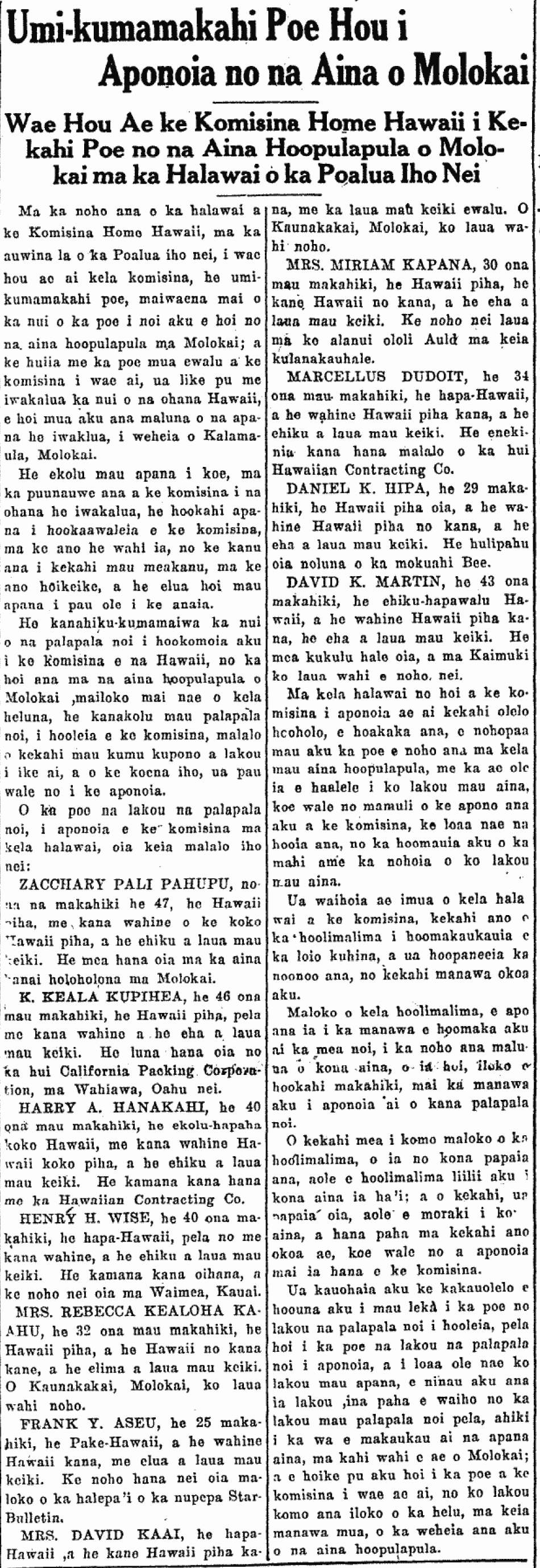
Eleven More People Approved for Lands on Molokai

The Hawaiian Homes Commission Selects Once More People for Homestead Lands on Molokai at the Meeting on this Past Tuesday

At the meeting of the Hawaiian Homes Commission on the afternoon of this past Tuesday, the commission selected eleven more people from amongst the many who applied to return to the homestead lands [aina hoopulapula] on Molokai; and added to the eight who the commission previously selected, that makes twenty Hawaiian families total who will be the first to go back to the twenty parcels opened up in Kalamaula, Molokai.

There are three parcels left to be divided up by the commission for twenty families and one section is set aside by the commission as an area to grow plants as a sample, and there are two pieces of land left to be surveyed.

There were seventy-nine applications submitted to the commission by Hawaiians, to return to homestead lands on Molokai, abut from amongst this number, there were thirty applications denied by the commission for appropriate reasons as deemed by them, and as for the rest, they were all approved.

The people whose applications were approved by the commission in that meeting are these below:

ZACCHARY PALI PAHUPU, who is 47 years old, a full Hawaiian, whose wife is also full Hawaiian, and they have seven children. He is employed at the ranch on Molokai.

K. KEALA KUPIHEA, who is 46 years old, a full Hawaiian, and so is his wife, and they have four children. He is a supervisor at the California Packing Corporation [CPC] in Wahiawa, Oahu.

HARRY A. HANAKAHI, who is 40 years old, three-fourths blooded Hawaiian, along with his wife who is full-blooded Hawaiian, and their seven children. He is a carpenter for the Hawaiian Contracting Co.

HENRY H. WISE, is 40 years old, a hapa Hawaiian, as well as his wife, along with their seven children. He is a carpenter by trade, and is living in Waimea, Kauai.

MRS. REBECCA KEALOHA KAAHU, is 32 years old, a full Hawaiian, and her husband is a Hawaiian as well, and they have five children. They reside in Kaunakakai, Molokai.

FRANK Y. ASEU, is 25 years old, Chinese-Hawaiian, and he has a Hawaiian wife, with two children. He is employed at the press of the Star-Bulletin Newspaper.

MRS. DAVID KAAI, is a hapa Hawaiian, and she has a full-Hawaiian husband, and they have eight children. They live in Kaunakakai, Molokai.

MRS. MIRIAM KAPANA, is 30 years old, she is full Hawaiian, she has a Hawaiian husband, and they have four children. They live on Auld Lane in this town.

MARCELLUS DUDOIT, is 34 years old, a hapa Hawaiian, and his wife is full Hawaiian, and they have seven children. He is an engineer working under the Hawaiian Contracting Co.

DANIEL K. HIPA, is 29 years old, a full Hawaiian, and he has a full-Hawaiian wife, and they have four children. He is a second mate aboard the ship the Bee.

DAVID K. MARTIN, is 43 years old, he is seven-eighths Hawaiian, and he has a full-Hawaiian wife, and they have four children. He is a house builder, and they reside in Kaimuki.

During that meeting of the commission, a resolution was passed clarifying that those who live on the homesteads must  live there permanently and not be allowed to move away from their land, except with approval from the commission with their promise that they will continue to farm and live on their land.

Put before the meeting of the commission were some terms of the lease drawn out by the attorney general and considerations of these were postponed until another time.

In the lease, it will specify the time when the person who applied must begin living on his land, that being within one year of his application being approved.

Another thing included in the lease is that it prohibits them from releasing out sections of their land to others; also, they are not to mortgage off their land, or do else wise other than what is approved of by the commission.

The secretary was instructed to send out letters to those whose applications were denied; as well as to those whose applications were approved but did not receive a parcel, asking them if they will leave their applications in until land is made available elsewhere on Molokai; and also to notify those who the commission selected that they will be put in a lottery [? komo ana iloko o ka helu] in the future when the homesteads open up.

(Kuokoa, 8/17/1922, p. 1)
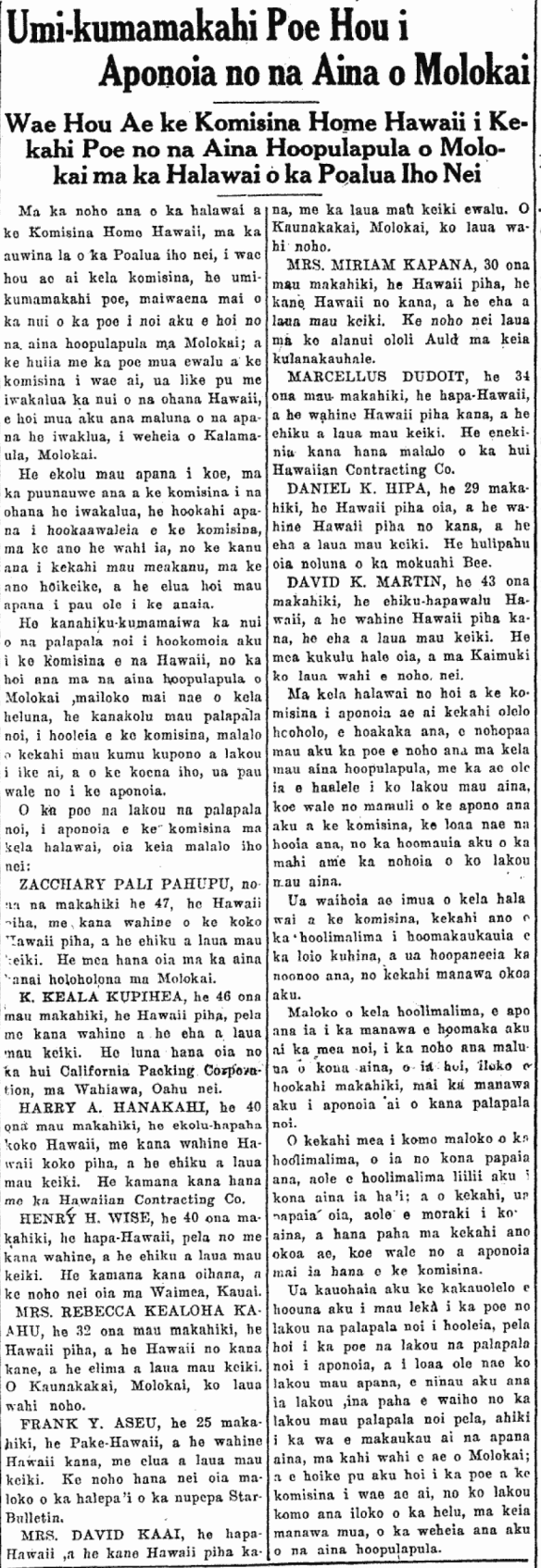
Umi-kumamakahi Poe Hou i Aponoia no na Aina o Molokai

Ka Nupepa Kuokoa, Buke LXI, Helu 33, Aoao 1. Augate 17, 1922.