Whale vs Shark, 1909.

WHALE BATTLES SHARK

Seeing a fight between a Shark and a Whale was something entranced the tourists of the Moana Hotel outside of Waikiki at ten o’clock or so in the morning of this past Wednesday.

Just as the tourists usually do when staying at that hotel, they often go out to the lanai to watch the steamships leaving Honolulu Harbor, and that is why they gathered on the lanai to watch the departure of the Steamship Alameda.

When the Alameda was nearing directly outside of the hotel, the jumping of a huge whale was seen, as it kept striking its tail upon the surface of the sea. Continue reading

Another beached whale, 1901.

WHALE WASHED ASHORE AT KEEI

NATIVES WAX RICH FROM BIG FIND MADE ON HAWAII LAST WEEK.

Some of the natives living at Keei, Hawaii made a rich find last Saturday. They caught a 32 foot whale. The leviathan was not harpooned while in the deep water but was washed ashore and caught close to the beach.

Just how the whale came to be washed ashore is not certain. It was alive when it was first discovered in the shallow water early Saturday morning. It is not improbable that a drove of sharks attacked the monster and in desperation the whale swam madly in shore in the hopes of escaping from the attacks of the sharks. If such had been the desire, the attacks of the sharks were escaped but the surer attacks from the natives followed. Continue reading

Beached whale at Kailua, 1911.

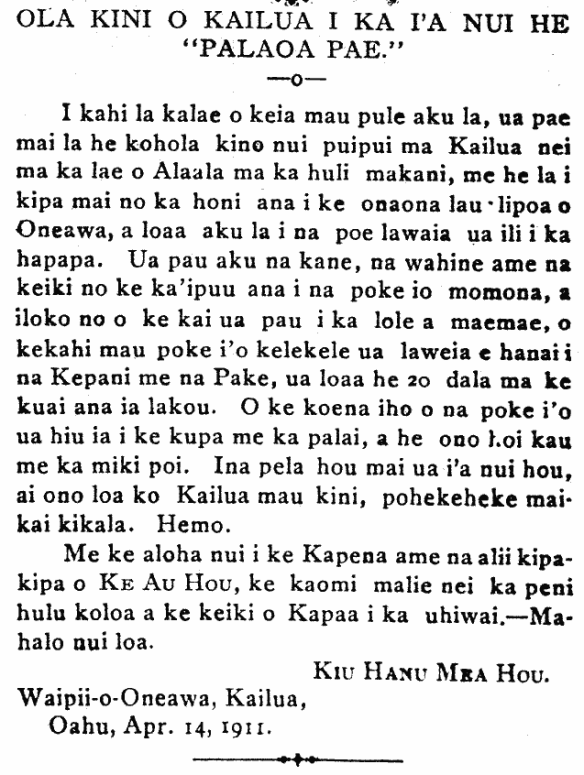
THE MANY OF KAILUA WERE SAVED BY THE GREAT FISH, THE “PALAOA PAE.”

One clear day some weeks ago, a large, heavy-bodied whale landed here in Kailua at the cape of Alaala on the windward side, and it was if we were visited by the scent of the sweet lipoa seaweed of Oneawa, and it was found by fishermen beached in the shallows. The men, women, and children all went and divided up the fatty pieces of flesh, and they all went into the water with their clothes on to get cleaned up; some of the chunks of oily flesh was taken to feed the Japanese and Chinese; 20 dollars was gotten through the sale. The remainder of the meat was thrown into soup and fried, and it was tasty with dabs of poi. If a large fish comes again, Kailua’s multitudes will eat with relish, and their hips will be nicely plump. Satisfaction.

With much aloha for the Captain and the officers [??? alii kipakipa] of Ke Au Hou; the duck feather pen of the son of Kapaa in the mist presses gently down.—Mahalo nui loa.

THE ONE WHO SNIFFS OUT NEWS

Waipii-o-Oneawa, Kailua,

Oahu, Apr. 14, 1911.

(Au Hou, 4/19/1911, p. 21)

AuHou_4_19_1911_21.png

Ke Au Hou, Buke 2, Helu 16, Aoao 21. Aperila 19, 1911.

Historian J. D. B. Kuakahela dies at sea, 1899.

DIED AT SEA.

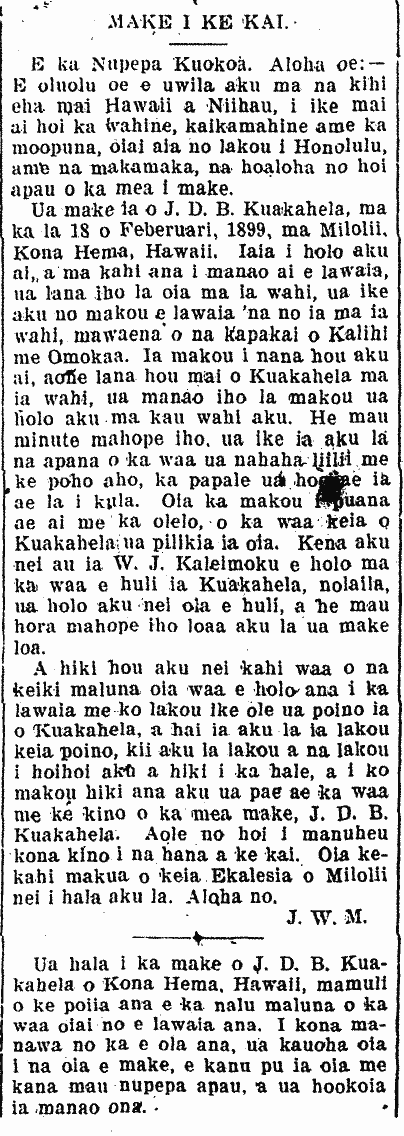
O Kuokoa Newspaper. Aloha oe:—Please flash across the four corners of Hawaii to Niihau, so that the wife, children and grandchildren see, being that they are in Honolulu, and also all of the friends and fellows of the one who died.

J. D. B. Kuakahela died on the 18th of February 1899 at Milolii, South Kona, Hawaii. When he went and was in the area where he wanted to fish, he was floating; we saw him fishing in that area, between the coast of Kalihi and Omokaa. When we looked once more, Kuakahela was no longer floating in that area, and we thought he sailed to some other place. Some minutes later, pieces of the canoe were seen broken into small bits, his fishing line container [poho aho], and his hat floated upon the shore. That is when we said, that is the canoe of Kuakahela; he is in trouble. I instructed W. J. Kaleimoku to go by canoe to search for Kuakahela, so he went to go look, and a number of hours later, he was found dead.

And thereafter a canoe arrived, and the boys aboard that waa were going fishing without knowing that Kuakahela met with disaster; they were told of the calamity and they went to bring him to the house, and when we got there, the waa with the body of the deceased, J. D. B. Kuakahela aboard, landed. His body was not bruised by the action of the ocean. He was one of the elders of this Church of Miloliii who passed on. Aloha no.

J. W. M.

—–

J. D. B. Kuakahela of South Kona, Hawaii, has died because a wave crashed onto his canoe while he was fishing. While he was living, he instructed that at his death, that he is to be buried with all of his newspapers, and this wish of his was carried out.

[That last comment is awesome. I bet I would have liked this man!]

(Kuokoa, 2/24/1899, p. 2)
Kuokoa_2_24_1899_2

Ka Nupepa Kuokoa, Buke XXXVIII, Helu 8, Aoao 2. Feberuari 24, 1899.

Moo spotting, 1915.

A SEA SNAKE FOUND ON THE KOOLAU SIDE

According to many of this town who went to go see a moo found in the ocean one of the days last week for themselves, it was indeed a moo and not an eel, for it looked like a snake [moo nahesa], but the only difference was that it was a moo that lived in the ocean.

The length of this moo was thirty inches long; it had a colorful body with stripes near its tail; its head was like a snake seen in foreign lands on shore. Continue reading

One big eel. 1931.

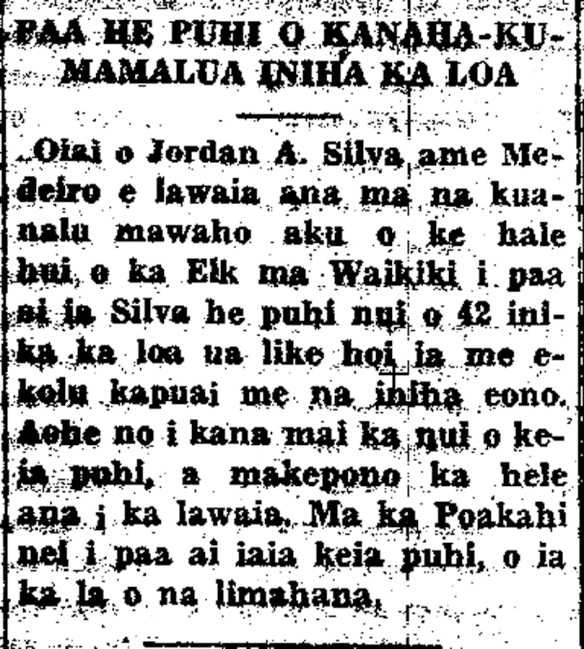
CAUGHT WAS A FORTY-TWO INCH LONG EEL

While Jordan A. Silva and Medeiro were fishing at the surf break behind the Elks Club building in Waikiki, Silva caught a 42 inch long eel, that is three feet and six inches long. This eel was huge, and it was worth going fishing. It was this Monday when he caught the eel, that being Labor Day [la o na limahana].

(Alakai o Hawaii, 9/17/1931, p. 3)

PAA HE PUHI O KANAHA-KUMAMALUA INIHA KA LOA

Ke Alakai o Hawaii, Buke 3, Helu 20, Aoao 3. Sepatemaba 17, 1931.

And more from the Deshas, 1944.

Our Day

THE CALM SEAS OF KONA

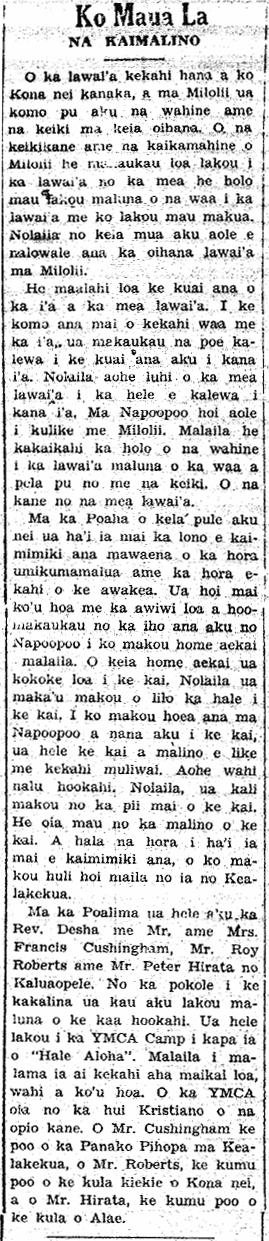
Kealakekua, Friday, May 12, 1944—This is the birthday of our firstborn, Stephen Luluhiwalani Desha, III. Today he is twenty-two years old. This afternoon the Rev. Desha will go down to Milolii because he will hold prayer there this Sunday. He is going to Milolii at once because he wants to go fishing. He wants some fish to take to Honolulu. The kamaaina sends you off, O malihini, with a bundle for your hand.

I will not get to Milolii this week, and our Aunty, Mrs. Annie Au of Napoopoo and her grandchild, will go down with Rev. Desha. She will stay with Mrs. Sarah Kalua, the teacher of Milolii, and Rev. Desha will stay at the home of his friends, Mr.and Mrs. Eugene Kaupiko.

 Saturday, May 13, 1944—By way of telephone from Honolulu, I heard the sad news of Mrs. Kaulani Woodward, that she left this world of life. Aloha ino no. Mrs. Woodward was the actual Aunty Judge R. Desha of Honolulu, Mrs. Eliza Desha Brown of Hilo and the Rev. Desha of Kona, and she was the actual younger sister of their mother, Mary Kaakopua Desha. Mrs. Kaulani Woodward was born in Napoopoo, Kona, and she was raised there until she was grown up. She married David Bent, and had two sons by this marriage, David Kaonohi Bent and Henry Kuuhaealoha Bent. Mrs. Pearl Nye and Samuel Kekumano are children of her brother, Samuel L. Kekumano who passed on earlier. She was married again to the Rev. Joseph Woodward perhaps twenty years ago or more. The first resided in Kohala, during the time when Rev. Woodward was assigned as Kahu for the Kalahikiola Church. They moved to Waimea when Woodward became Kahu for Imiola Church. They moved once more to Napoopoo when Rev. Woodward was called to be the Kahu for Kahikolu Church. There they lived until Woodward retired. They then returned to Honolulu this past year. From what I heard, the funeral will be held on Monday, May 15. The kamaaina of our beloved land are going little by little.

[This is a nice genealogy centered around Kaulani Woodward. Genealogy can be found anywhere!]

(Hoku o Hawaii, 5/24/1944, p. 1)

Ko Maua La

Ka Hoku o Hawaii, Volume XXXIX, Number 5, Aoao 1. Mei 24, 1944.

More from Kona and the Deshas, 1943.

Our Day

The Calm Seas of Kona

Fishing is an occupation carried out by Kona men, and in Milolii the women and children take part in this endeavor. The boys and girls of Milolii are totally capable at fishing because they always go out on the canoes to go fishing with their parents. Therefore, in the future, fishing will not disappear from Milolii.

It is a truly simple thing to sell the fish of the fishermen. When a canoe comes in with fish, the peddlers are ready to buy the fish. So the fisherman doesn’t have to bother with selling his fish. In Napoopoo, it is not like Milolii. There, there are a few women who go fishing on canoes and so too of the children. Men are the ones who go fishing.

On last week Thursday, the news was told that there would be a tsunami [kai mimiki] between eleven o’clock and one o’clock in the afternoon. My companion rushed home and made ready to go down to Napoopoo, to our home by the sea there. This beach home was very near the ocean. So we were afraid the house would be lost to the sea. When we arrived at Napoopoo and looked at the ocean, the water was calm like an estuary. There was not a single wave. Therefore, we waited for the water to rise. The water remained calm. And the time it was said that there would be a tsunami passed, and we turned back for Kealakekua.

On Friday, the Rev. Desha along with Mr. and Mrs. Francis Cushingham, Mr. Roy Roberts, and Mr. Peter Hirata went to the Crater. Because of the gasoline shortage, they all went on one car. They went to the YMCA Camp called “Hale Aloha.” There a fine meeting was held, according to my companion. The YMCA is the Christian association of young men. Mr. Cushingham is the head of the Bishop Bank [Panako Pihopa] at Kealakekua; Mr. Roberts is the principal of the high school of Kona, and Mr. Hirata is the principal of Alae School.

(Hoku o Hawaii, 11/17/1943, p. 1)

Ko Maua La

Ka Hoku o Hawaii, Volume XXXVIII, Number 30, Aoao 1. Novemaba 17, 1943.

Argument in Vernon, California, 1870.

Murder.

O Ke Au Okoa;—Aloha oe:

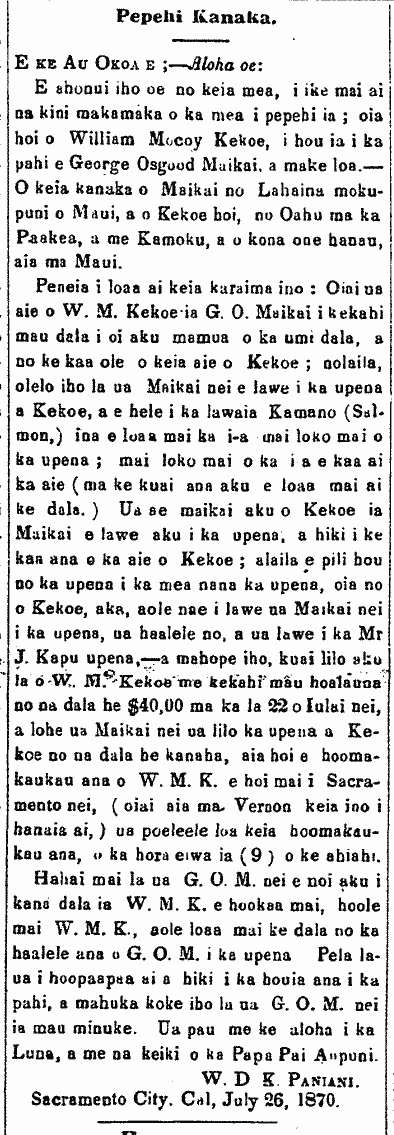
Please extend you patience for this, so that the many friends of the one killed will know; that being William McCoy Kekoe, who was stabbed with a knife by George Osgood Maikai, and died.—This man, Maikai, is from Lahaina, on the island of Maui, and Kekoe is from Oahu, at Paakea, and Kamoku, and his place of birth is on Maui.

This is how the heinous crime happened: while W. M. Kekoe owed G. O. Maikai a sum of money more than ten dollars, and being that Kekoe did not repay this debt; therefore, Maikai stated that he would take the net of Kekoe to go Salmon (Kamano) fishing, and if he caught fish in the net, the debt would be paid off with the fish (after selling it and getting money). Kekoe agreed to Maikai taking his net until Kekoe’s debt was paid off; and then the net would return to who it belonged, that being Kekoe; however, Maikai did not take the net and left it, and took Mr. J. Kapu’s net,—and thereafter, W. M. Kekoe sold his net off to some friends for $40.00 on the 22nd of this July, and Maikai heard that the net of Kekoe was sold for forty dollars, and that W. M. K. was getting ready to return here to Sacramento (being that it was in Vernon that this evil deed was done); this preparation was done in the dark, at nine (9) o’clock in the evening.

G. O. M. went after him to ask W. M. K. to repay his money, and W. M. K. refused; that G. O. M.  would not get the money because he left behind the net. They continued to argue in that way until the stabbing, and G. O. M. immediately fled in those minutes. This is all, with aloha for the Luna, and the boys of the Government Press [Papa Pai Aupuni].

W. D. K. Paniani.

Sacramento City, Cal, July 26, 1870.

(Au Okoa, 8/25/1870, p. 2)

Pepehi Kanaka.

Ke Au Okoa, Buke VI, Helu 19, Aoao 2. Augate 25, 1870.

Wailuku and Lahaina get new marketplace, 1880.

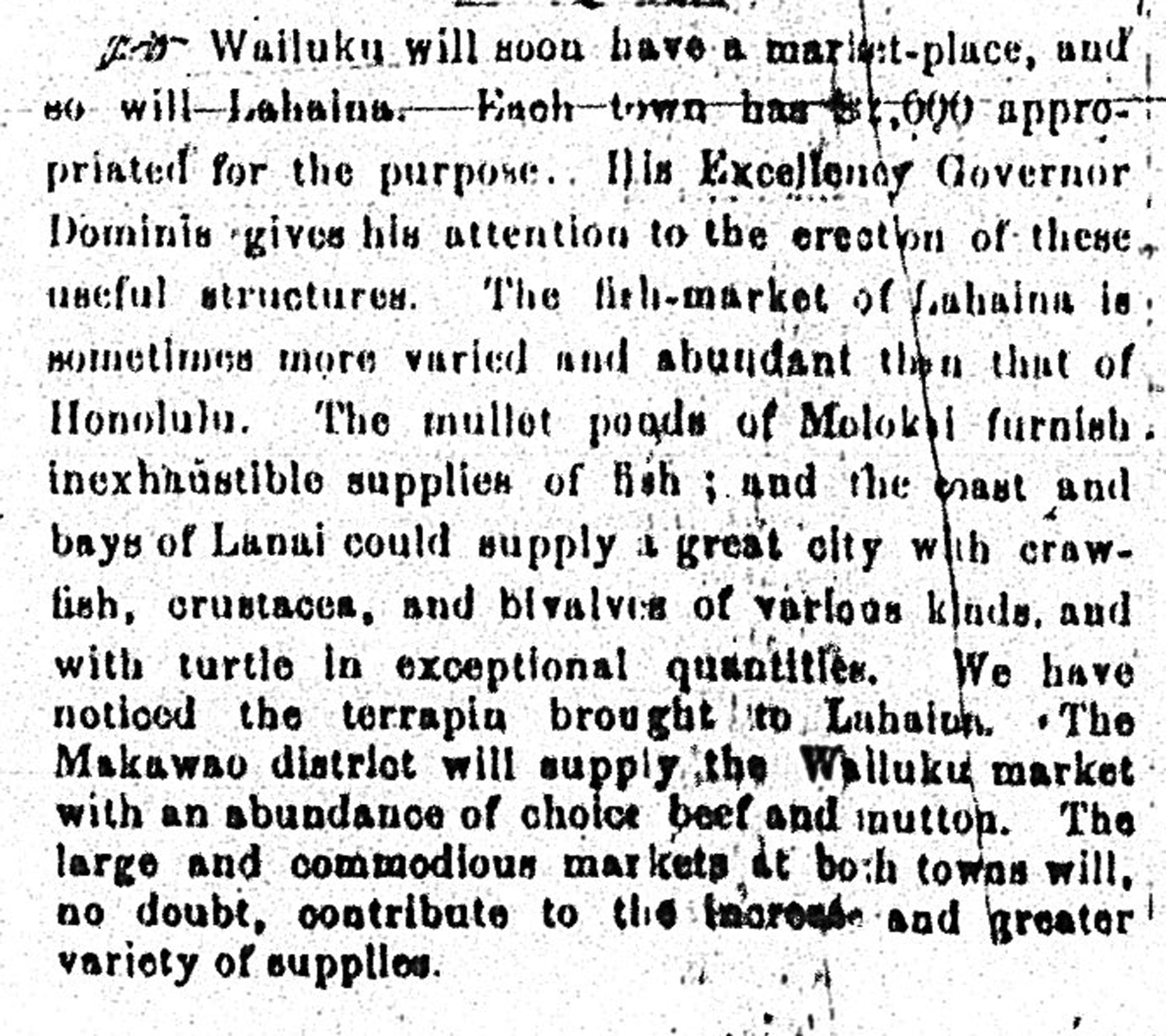
Wailuku will soon have a market-place, and so will Lahaina. Each town has $2,000 appropriated for the purpose. His Excellency Governor Dominis gives his attention to the erection of these useful structures. The fish-market of Lahaina is sometimes more varied and abundant than that of Honolulu. The mullet ponds of Molokai furnish inexhaustible supplies of fish; and the coast and bays of Lanai could supply a great city with crawfish, crustacea, and bivalves of various kinds, and with turtle in exceptional quantities. We have noticed the terrapin brought to Lahaina. The Makawao district will supply the Wailuku market with an abundance of choice beef and mutton. The large and commodious markets at both towns will, no doubt, contribute to the increase and greater variety of supplies.

[Wow, this article has so much varied information: on government spending, fish supply, fish ponds, ranching, &c., &c., &c.]

(Wednesday Express, 9/8/1880, p. 1)

Wailuku will soon have a market-place...

The Wednesday Express, Volume I, Number 1, Page 1. September 8, 1880.