Argument in Vernon, California, 1870.

Murder.

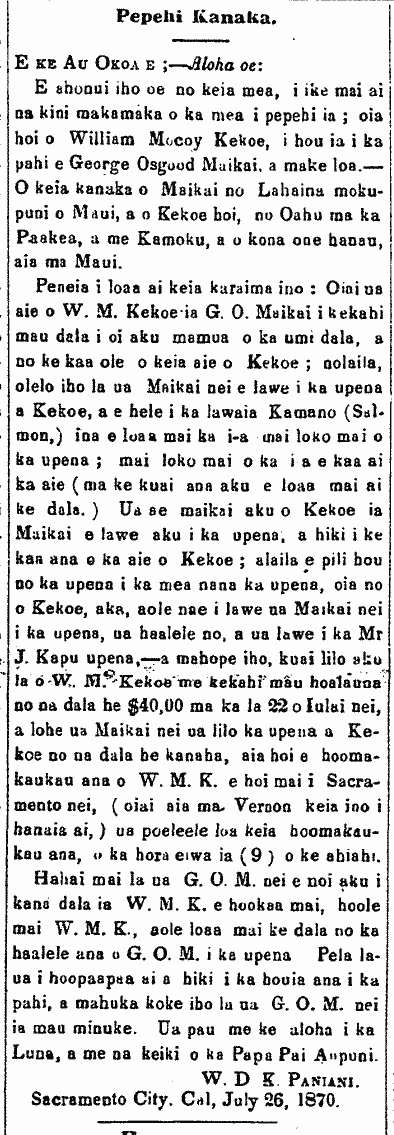
O Ke Au Okoa;—Aloha oe:

Please extend you patience for this, so that the many friends of the one killed will know; that being William McCoy Kekoe, who was stabbed with a knife by George Osgood Maikai, and died.—This man, Maikai, is from Lahaina, on the island of Maui, and Kekoe is from Oahu, at Paakea, and Kamoku, and his place of birth is on Maui.

This is how the heinous crime happened: while W. M. Kekoe owed G. O. Maikai a sum of money more than ten dollars, and being that Kekoe did not repay this debt; therefore, Maikai stated that he would take the net of Kekoe to go Salmon (Kamano) fishing, and if he caught fish in the net, the debt would be paid off with the fish (after selling it and getting money). Kekoe agreed to Maikai taking his net until Kekoe’s debt was paid off; and then the net would return to who it belonged, that being Kekoe; however, Maikai did not take the net and left it, and took Mr. J. Kapu’s net,—and thereafter, W. M. Kekoe sold his net off to some friends for $40.00 on the 22nd of this July, and Maikai heard that the net of Kekoe was sold for forty dollars, and that W. M. K. was getting ready to return here to Sacramento (being that it was in Vernon that this evil deed was done); this preparation was done in the dark, at nine (9) o’clock in the evening.

G. O. M. went after him to ask W. M. K. to repay his money, and W. M. K. refused; that G. O. M.  would not get the money because he left behind the net. They continued to argue in that way until the stabbing, and G. O. M. immediately fled in those minutes. This is all, with aloha for the Luna, and the boys of the Government Press [Papa Pai Aupuni].

W. D. K. Paniani.

Sacramento City, Cal, July 26, 1870.

(Au Okoa, 8/25/1870, p. 2)

Pepehi Kanaka.

Ke Au Okoa, Buke VI, Helu 19, Aoao 2. Augate 25, 1870.

Why are some religions “real” while others are “superstitions,” “myths,” and “legends”? 1905 / today.

WAKEA THE POLYNESIAN

(By Rev. W. D. Westervelt in Paradise of the Pacific.)

The fountain source of the Mississippi has been discovered and re-discovered. The origin of the Polynesian race has been a subject for discovery and re-discovery. The older theory of Malay origin as set forth in the earlier encyclopædias is now recognized as untenable. The Malays followed the Polynesians rather than preceded them. The comparative study of Polynesian legends leads almost irresistibly to the conclusion that Polynesians were Aryans, coming at least from India to Malaysia and possibly coming from Arabia, as Fornander of Hawaii so earnestly argues. It is now accepted that the Polynesians did not originate from Malay parentage, and that they did occupy for an indefinite period the region around the Sunda Straits from Java to the Molucca Islands, and also that the greater portion of the Polynesians was driven out from this region and scattered over the Pacific in the early part of the Christian Era. The legends that cluster around Wakea have greatly aided in making plain some things concerning the disposition of the Polynesians. By sifting the legends of Hawaii-loa, we learn how the great voyager becomes one of the first Vikings of the Pacific. His home at last is found to be Gilolo of the Molucca Islands. From the legends we become acquainted with Wakea (possibly meaning “noonday” or “the white time” and his wife Papa (“earth”), the most widely remembered of all the ancestors of the Polynesian race. Their names are found in the legends of the most prominent island groups, and the highest places are granted them among the chief dieties. Their deeds belong to the most ancient times—the creation or discovery of the various islands of the Pacific world. Those who worshipped Wakea and Papa are found in such widely separated localities that it must be considered impossible for even a demi-god to have had so many homes. Atea or Wakea was one of the highest gods of the Marquesas islands. Here his name means “light.” The Marquesans evidently look back of all their present history and locate Atea in the ancient home land. Va-tea, in the Society Islands, Wakea in Hawaii and New Zealand, Makea-Vakea and Akea are phonetic variations of the one name when written down by the students who made a written form for words repeated from generation to generation by word of mouth alone. Even under the name Wakea this ancient chief is known by most widely separated islands. The only reasonable explanation for this widespread reference to Wakea is that he was an ancestor belonging in common to all the scattered Polynesians. It seems as if there must have been a period when Wakea was king of chief of a united people. He must have been of great ability and probably was the great king of the United Polynesians. If this were the fact it would naturally result that his memory would be carried wherever the dispersed race might go.

In the myths and legends of the Hervey Islands, Vatea is located near the beginning of their national existence.” Then there came upon the ancient world Te Vaerua, “the breath” or “the life.” Then came the god time—Te Manawa roa, “the long ago.” Then their creation legends locate Vari, a woman whose name means “the beginning,” a name curiously similar to the Hebrew word bara, to create, as in Gen. 1:1. Her children were torn out of her breasts and given homes in the ancient mist land, with which without any preparation or introduction, Hawa-iki is confused in a part of the legend. One of the children of Vari dwelt in a “sacred tabu island” and became the god of the fish. Another sought a home “where the red parrots’ feathers were gathered”—the royal feathers for the high chief’s garments. Another became the echo-god and lived in the “hollow grey rocks.” Another as the gods of the winds went far out “on the deep ocean.” Another, a girl, found a home, “the silent land,” with her mother. Wakea, or Vatea, the eldest of this family remained in Avaiki (Hawaii) the ancestral home—”the bright land of Vatea.” Here he married Papa. This Ava-iki was to the Herveyites of later generations the fiery volcanic under-world. When the long sea voyages ceased after some centuries, the islanders realized that Ava-iki was very closely connected with their history. They had but a misty idea of far off lands, and they did know of earthquakes and lava caves and volcanic fires—so they located Ava-iki as the secret world under their islands. This underworld with legendary inconsistency was located on the ocean’s surface, when it became necessary to have their islands discovered by the descendants of Vatea. According to the Hervey legends, Vatea is the father of Lono and Kanaloa, two of the great gods of the Polynesians. They are twins. Lono has three sons, whom he sends away. They sail out through many heavens and from Ava-iki “pull up” out of the deep ocean two of the Hervey islands. The natives of the Hervey group supposed that the horizon around their group inclosed the world. Beyond this world were heaves after heavens. A daring voyager by sailing through the sky line would break out from this world into an unknown world or a heaven bounded by new horizons. Strangers thus “broke through” from heaven to heaven, sometimes making use of the path of the sun. Thus about twenty-five generations ago Raa (possibly Laa, the Hawaiian), broke down the horizon’s bars and established a line of kings in Raiatea. So also when Captain Cook came to the Hervey Islands the natives said: “Whence comes this strange thing? It has climbed up (come up forcibly) from the thin land the home of Wakea.” He had pierced the western heavens from which their ancestors had come. Continue reading

Hawaiian-based? fashion in New York, 1921.

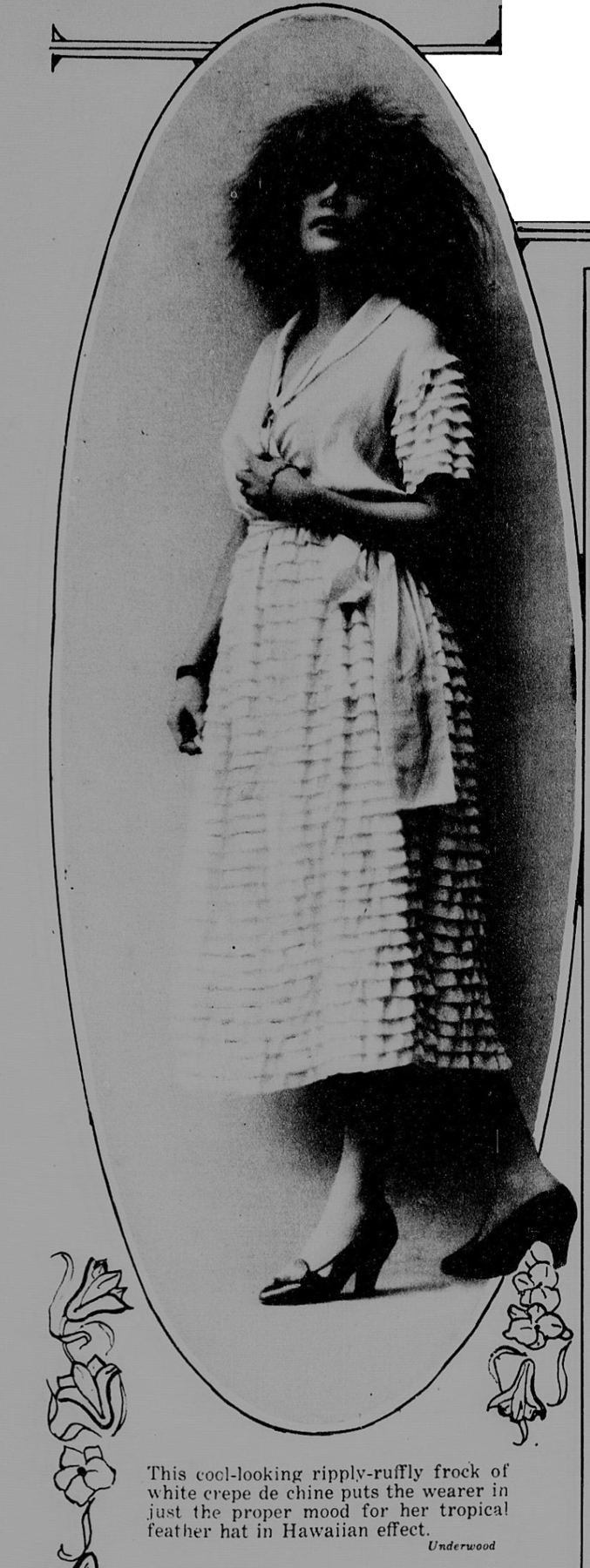
[Found under: “Maison Fashion Offers These Eight Appealing Suggestions For Miss Manhattan’s Everyday Wardrobe For the Coming Spring and Summer”]

This cool-looking ripply-ruffly frock of white crepe de chine puts the wearer in just the proper mood for her tropical feather hat in Hawaiian effect.

Underwood

(New York Tribune, 3/13/1921, pt. 6, p. 12)

This cool-looking...

New York Tribune, Volume LXXX, Number 27,146, Part 6, Page 12. March 13, 1921.

Fashion setting, 1901.

[Found in an advertisement for Hale’s Good Goods store in San Francisco]

In ready-to-wear hats

We are showing now a splendid variety of chic, nobby styles. This imitation of the Hawaiian hat, bound with silk and trimmed with silk and gold scarf, for $1.25 is a splendid illustration of the money’s worth we can give you Two or three others:…

(San Francisco Call, 3/24/1901, p. 32)

In ready-to-wear hats

The San Francisco Call, Volume LXXXIX, Number 114, Page 32, March 24, 1901.

Hawaiian influence in music and fashion, 1917.

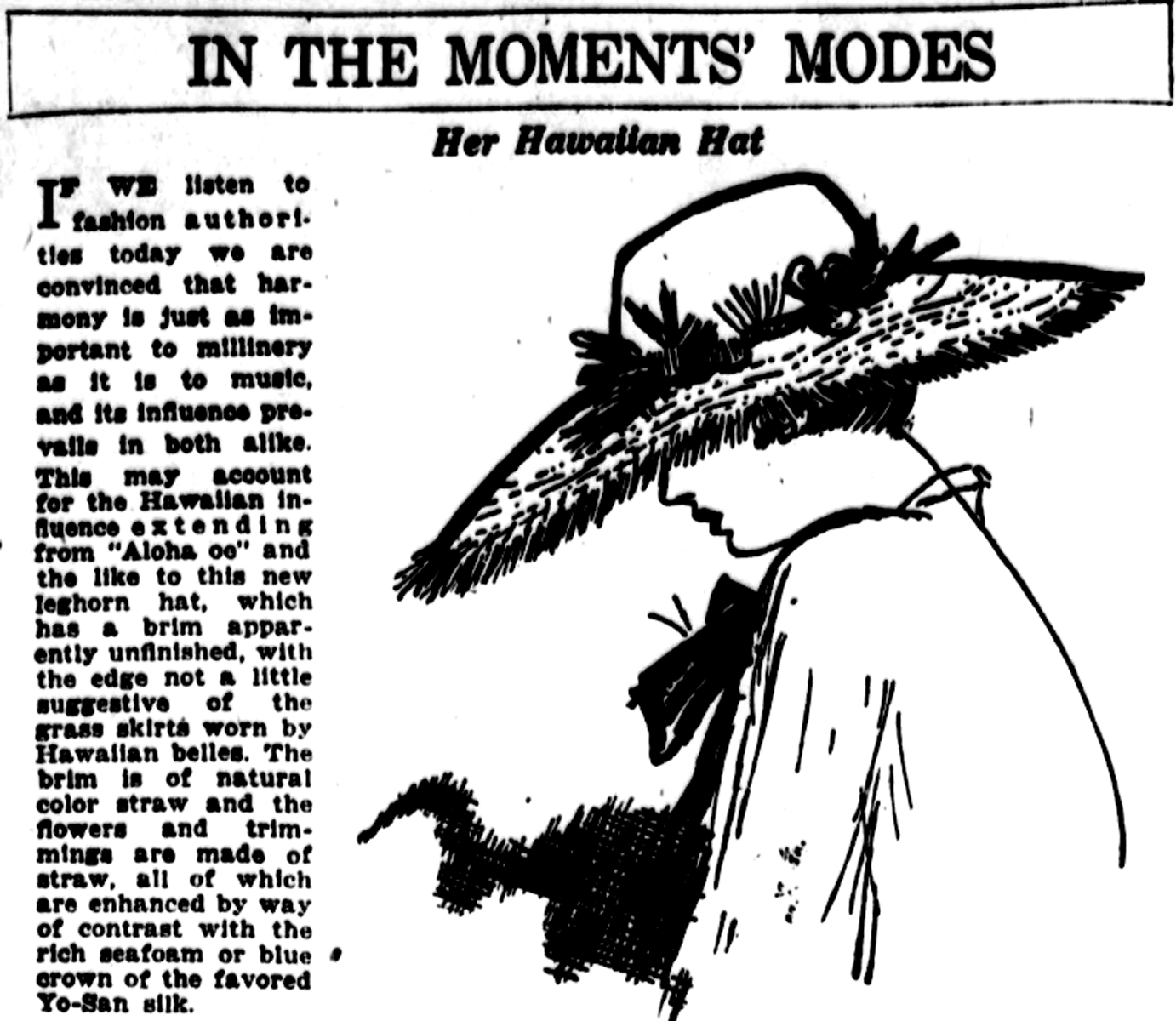
IN THE MOMENTS’ MODES

Her Hawaiian Hat

IF WE listen to fashion authorities today we are convinced that harmony is just important to millinery as it is to music, and its influence prevails in both alike. This may account for the Hawaiian influence extending from “Aloha oe” and the like to this new leghorn hat, which has a brim apparently unfinished, with the edge not a little suggestive of the grass skirts worn by Hawaiian belles. The brim is of natural color straw and the flowers and trimmings are made of straw, all of which are enhanced by way of contrast with the rich seafoam or blue crown of the favored Yo-San silk.

(Evening Ledger, 4/5/1917, p. 12)

IN THE MOMENTS' MODES

Evening Ledger, Volume III, Number 174, Page 12. April 5, 1917.

Stanford University Hawaii Club, 1905.

LEIS AT STANFORD

AN INTERESTING SOCIETY FORMED AT THE UNIVERSITY AT PALO ALTO—LEIS OF ROSES AND SCORE CARDS OF LAUHALA AT A CARD PARTY OF THOSE WHO HAVE LIVED IN THE ISLANDS.

STANFORD UNIVERSITY, April 13, 1905.—A number of Island people met on the evening of April 7, at the home of Mr. and Mrs. A. D. Larnach, and formed what was named the “Hui Hawaii” which is intended to bring together the Hawaiians about Stanford University in a social way. It was decided to have this a most informal affair and not to choose any regular officer, but simply to have it made known at one meeting who is to entertain at the next one. Anyone who has been in the Islands is to be eligible to membership. Continue reading

Papale fame to reach New York, 1906.

Hawaiian Hats for New York.

A question which has long puzzled the friends of the Hawaiian people has been how to provide, for the ones who wish to work, suitable occupations. Critics of the Hawaiian race have been free in their statements to the effect that the Hawaii is lazy and unprogressive, in utter forgetfulness of the fact that it takes more than a generation or two to outlive the old customs more especially when the vitality of a once healthy people has been sapped by the vices and evil productions of socalled civilizasion.

This attitude on the part of many whites and the importation of foreign goods has very nearly doomed to extinction many industries distinctively Hawaiian, but a determined effort is being made to revive at least some of them before they are forgotten entirely.

Perhaps among the most interesting of these is that of making Hawaiian hats and in this a fine start towards establishing a truely native industry has already been made.

The prices commanded by Panama and Filipino hats is such as to encourage those who are looking after the present attempt as there is no doubt that as good hats can be made by the Hawaiian women as any that come from the places mentioned. For these expensive hats however there is of course a limited demand and it is towards the production of grades for ordinary wear that attention has been directed.

First attempts to enlist Hawaiian women in the work were discouraging but after some time Theodore Richards and the Atherton Estate, recognizing the importance of the work, took it up in order to assist the lady who had the matter in hand.

“When Mr. Richards heard of the work he became interested and at once offered a work room at the Kauluwela lodgings, on Vineyard street,” she said this morning, “with out that we could have done nothing. There the women work on the hats and on the braids. Some of the original Hawaiian patterns for braids had disappeared entirely. Others were recalled by native women who remembered them from the early days. Others we managed to get from the other islands and one or two I designed. We have now thirty patterns in all.”
Continue reading

Hōkūleʻa, 1980 / 2015.

HOKULEʻA RETURNS

by Wayne Washburn

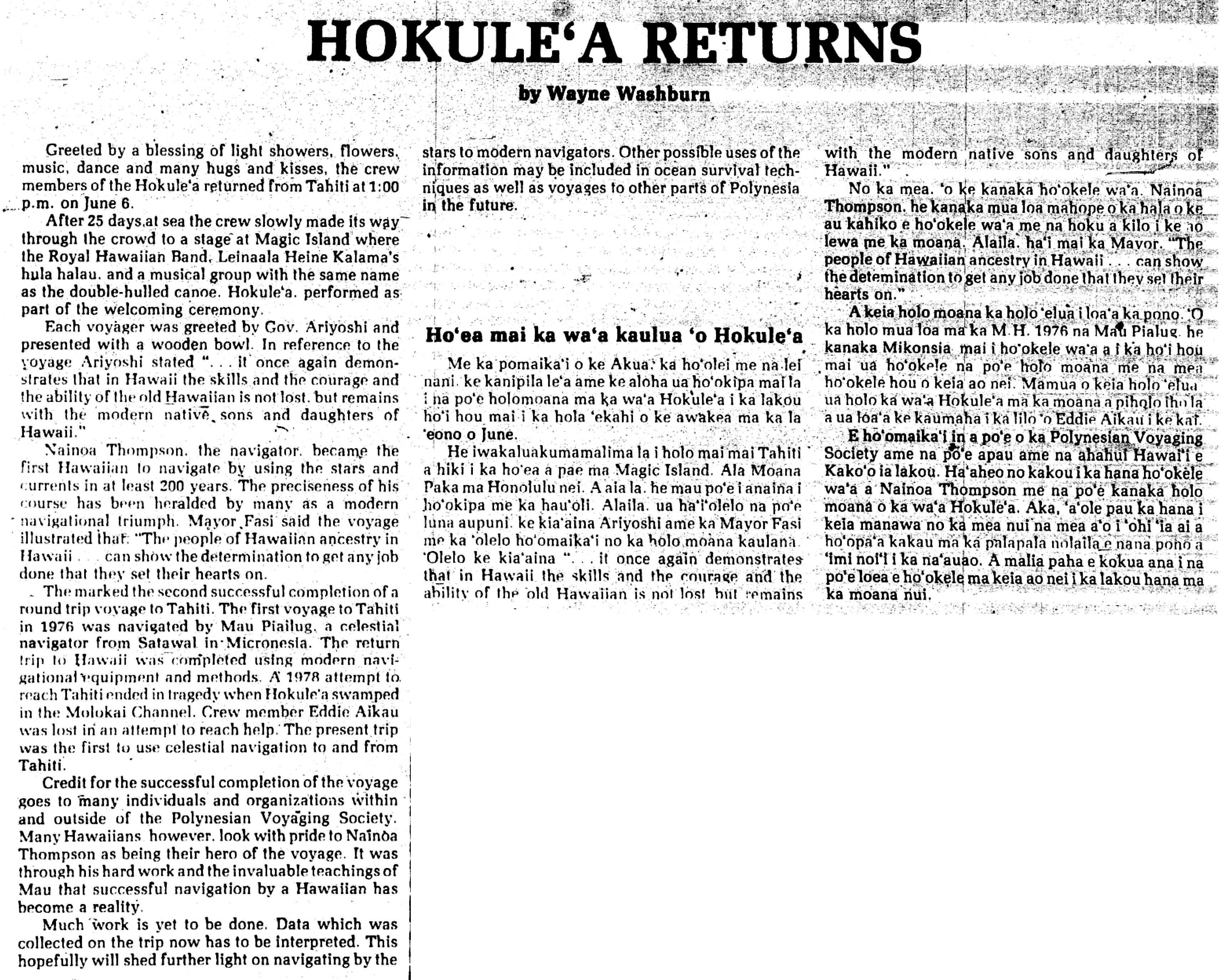
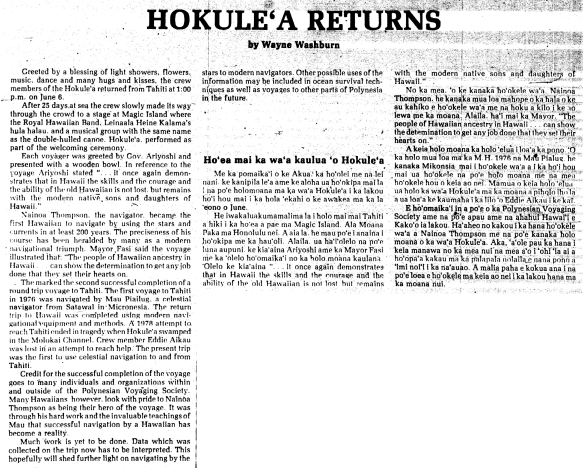
Greeted by a blessing of light showers, flowers, music, dance and many hugs and kisses, the crew members of the Hokuleʻa returned from Tahiti at 1:00 p.m. on June 6.

After 25 days at sea the crew slowly made its way through the crowd to a stage at Magic Island where the Royal Hawaiian Band, Leinaala Heine Kalama’s hula halau, and a musical group with the same name as the double-hulled canoe. Hokuleʻa, performed as part of the welcoming ceremony.

Each voyager was greeted by Gov. Ariyoshi and presented with a wooden bowl. In reference to the voyage Ariyoshi stated “…It once again demonstrates that in Hawaii the skills and the courage and the ability of the old Hawaiian is not lost, but remains with the modern native sons and daughters of Hawaii.”

Nainoa Thompson, the navigator, became the first Hawaiian to navigate by using the stars and currents in at least 200 years. The preciseness of his course has been heralded by many as a modern navigational triumph. Mayor Fasi said the voyage illustrated that: “The people of Hawaiian ancestry in Hawaii…can show the determination to get any job done that they set their hearts on.

This marked the second successful completion of a round trip voyage to Tahiti. The first voyage to Tahiti in 1976 was navigated by Mau Piailug, a celestial navigator from Satawal in Micronesia. The return trip to Hawaii was completed using modern navigational equipment and methods. A 1978 attempt to reach Tahiti ended in tragedy when Hokuleʻa swamped in the Molokai Channel. Crew member Eddie Aikau was lost in an attempt to reach help. The present trip was the first to use celestial navigation to and from Tahiti.

Credit for the successful completion of the voyage goes to many individuals and organizations within and outside of the Polynesian Voyaging Society. Many Hawaiians however, look with pride to Nainoa Thompson as being their hero through his hard work and the invaluable teachings of Mau that successful navigation by a Hawaiian has become a reality.

Much work is yet to be done. Data which was collected on the trip now has to be interpreted. This hopefully will shed further light on navigating by the stars to modern navigators. Other possible uses of the information may be included in ocean survival techniques as well as voyages to other parts of Polynesia in the future.

Hōʻea mai ka waʻa kaulua ʻo Hōkūleʻa

Me ka pōmaikaʻi o ke Akua ka hoʻolei me nā lei nani ke kanipila leʻa a me ke aloha ua hoʻokipa maila i na poʻe holomoana ma ka waʻa Hōkūleʻa i kā lākou hoʻi hou mai i ka hola ʻekahi o ke awakea ma ka lā ʻeono o June.

He ʻiwakāluakūmālima lā i holo mai ma Tahiti a hiki i ka hōʻea a pae ma Magic Island. Ala Moana Pāka ma Honolulu nei. A aia lā, he mau poʻe i anaina i hoʻokipa me ka hauʻoli. A laila, ua haʻiʻōlelo nā poʻe luna aupuni, ke kiaʻāina Ariyoshi a me ka Mayor Fasi me ka ʻōlelo hoʻomaikaʻi no ka holo moana kaulana. ʻŌlelo ke kiaʻāina, “…it once again demonstrates that in Hawaii the skills and the courage and the ability of the old Hawaiian is not lost but remains with the modern native sons and daughters of Hawaii.”

No ka mea, ʻo ke kanaka hoʻokele waʻa, Nāinoa Thompson, he kanaka mua loa ma hope o ka hala o ke au kahiko e hoʻokele waʻa me nā hōkū a kilo i ke ao lewa me ka moana. A laila, haʻi mai ka Mayor, “The people of Hawaiian ancestry in Hawaii…can show the determination to get any job done that they set their hearts on.”

A kēia holo moana ka holo ʻelua i loaʻa ka pono. ʻO ka holo mua loa ma ka M. H. 1976 na Mau Pialug, he kanaka Maikonia mai i hoike mai i hoʻokele waʻa a i ka hoʻi hou mai ua hoʻokele nā poʻe holo moana me nā mea hoʻokele hou o kēia ao nei. Ma mua o kēia holo ʻelua ua holo ka waʻa Hōkūleʻa ma ka moana a piholo ihola a ua loaʻa ke kaumaha i ka lilo ʻo Eddie Aikau i ke kai.

E hoʻomaikaʻi i nā poʻe o ka Polynesian Voyaging Society a me nā poʻe a pau a me na ʻahahui Hawaiʻi e kākoʻo iā lākou. Haʻaheo nō kākou i ka hana hoʻokele waʻa a Nāinoa Thompson me nā poʻe kānaka holo moana o ka waʻa Hōkūleʻa. Akā, ʻaʻole pau ka hana i kēia manawa no ka mea nui nā mea aʻo i ʻohi ʻia ai a hoʻopaʻa kākau ma ka palapala no laila e nānā pono a ʻimi noiʻi i ka naʻauao. A malia paha e kokua ana i nā poʻe loea e hoʻokele ma kēia ao nei i kā lākou hana ma ka moana nui.

[Now on their worldwide voyage, Mālama Honua!]

(Alahou, 5/1/1980, p. 7)
HOKULEʻA RETURNS

Ke Alahou, Helu 6 & 7, Aoao 7. May-June 1980.

Ku kilakila o Kamehameha, Kuu home hoonaauao… rang out in Long Beach, 1926.

THERE WAS GREAT DELIGHT IN THE SINGING OF MISS LOUISE POHINA

A newspaper from Long Beach, California described how the recent singing of Miss Louise Pohina became something that the haole who showed up to hear her were greatly delighted in, joining in with those who went to offer their thanks and congratulations to her, the singers, and the skilled dancers.

There was a concert given in this city by the Ebell Club, with Miss Pohina singing some numbers and Lillian Edwards of Pasadena playing the piano; at the concert, the audience kept clapping for each song performed by Miss Pohina, and one of those songs was Kamehameha Waltz. Continue reading

Duke Kahanamoku in Melbourne, 1915.

MORE IS HEARD OF DUKE KAHANAMOKU.

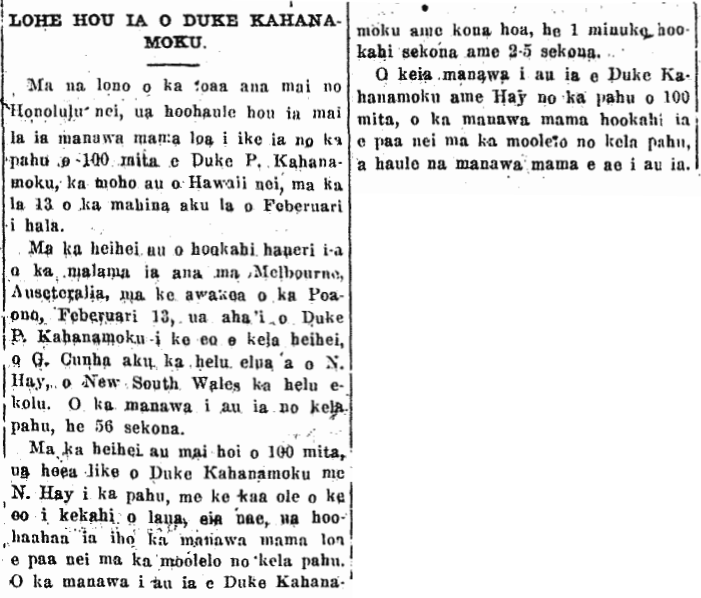
From the news received in Honolulu, the fastest time seen for the 100 meter goal was broken by Duke P. Kahanamoku, the swimming champ of Hawaii nei, on the 13th of the other month, February.

In the 100 yard race held in Melbourne, Australia, in the afternoon of Saturday, February 13, Duke P. Kahanamoku took the win of that race, G. Cunha was second, and N. Hay of New South Wales was third. His time that he swam for that goal was 56 seconds.

In the 100 meter swim, Duke Kahanamoku and N. Hay reached the goal at the same time, with the win going to neither of them, however, the fastest record held in the history of that distance was made shorter. The time swam by Duke Kahanamoku and his competitor was 1 minute and 1 2/5 seconds.

This time swam by Kahanamoku and Hay for the 100 meter distance is the fastest set in the history of that distance, and the other records were defeated.

(Kuokoa 3/12/1915, p. 3)

LOHE HOU IA O DUKE KAHANAMOKU.

Ka Nupepa Kuokoa, Buke LIII, Helu 11, Aoao 3. Maraki 12, 1915.