Thoughts for the upcoming Kamehameha Day, 1920.

THEY ARE TRUE HAWAIIANS BUT THEY CANNOT SING HAWAIIAN SONGS.

Mr. Editor of the Kuokoa Newspaper, Aloha oe:—Maybe at 3 o’clock or so in the morning of Friday, June 11, 1920, that being the birthday of the Nation Conqueror Kamehameha, there came to my home some singing boys, and this was something; it was a familiar thing where on holidays this and that person came around singing at houses lived in by Hawaiians.

Before the singers came, I got the idea that since these singers were coming to my home, I would get up and listen to the singing outside on the lanai like I was accustomed to in past years; it was not long before I heard strains of a guitar, and the singing started, but it was from my bedroom that I was listening. Continue reading

“E” ≠ “I”

I find it pretty embarrassing for people to use one language to eclipse another language.

“Kūkae”* is the word they were looking for.

But nonetheless, it is pretty ironic when people use Hawaiian Language in this way. For more on the story, click here.

*Kūkai: “dipped frequently in the sea”

Kukai.png

Ka Leo Hawaii, 1972 / 2016.

A labor of love

When Larry Kimura and his students first arrived at KCCN in Honolulu with a pitch for a new Hawaiian-language radio show, the station manager had one question.

“Do you have an audience?”

It was 1972. Hawaiian was dying out. Most native speakers were kupuna — and there were not many left. It was still technically illegal to speak Hawaiian in schools. Who was going to listen to a program conducted entirely in Hawaiian?

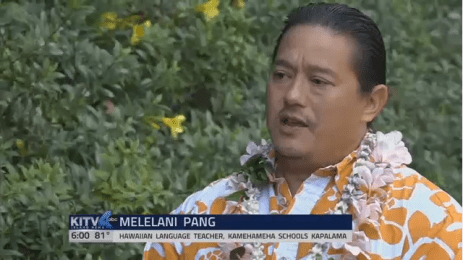
“But he was kind enough to say, ‘All right,’” Kimura, now 69 and an associate professor of Hawaiian language and culture at the University of Hawaii at Hilo, recalled last week. Continue reading at Hawaii Tribune Herald

[Check out this awesome article from the Hawaii Tribune Herald. I wonder who the station manager of KCCN was in 1972!]

Hawaiians to be referred to as “kanaka,” 1925.

HAWAIIANS WILL BE CALLED “KANAKA”

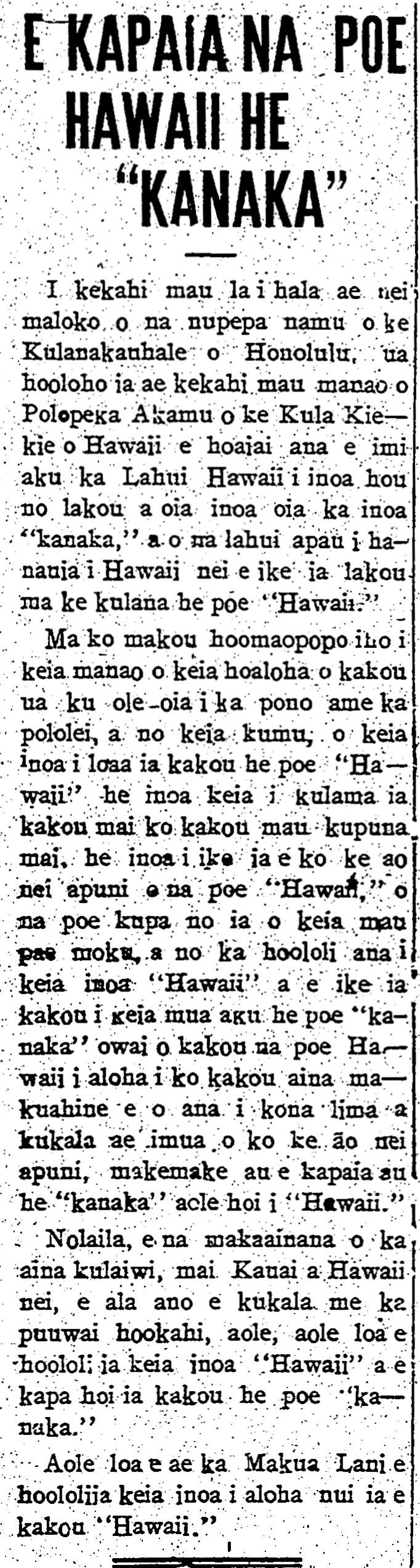
Several days ago, in the English newspapers of Honolulu Town, we heard the thoughts of Professor Adams [Polopeka Akamu] of the University of Hawaii, explaining that the Hawaiian People were looking for a new name for themselves, and that name being “kanaka,” and as for all of the other ethnicities born in Hawaii nei, they would be known as “Hawaiians.”

From our understanding of this idea of this friend of ours, it is not appropriate nor right, and for this reason: this name we have, “Hawaiians,” it is a name which we have been accustomed to from our ancestors; it is a name known worldwide, “Hawaiians” are the natives to these islands, and to change the name “Hawaiian” and for us to be known hereon as “kanaka;” who amongst us Hawaiians who love our motherland will raise his hand announce before the whole world, I want to be called a “kanaka,” not a “Hawaiian.”

Therefore, oh people of the native land, from Kauai to Hawaii, let us rise at once to announce with one heart, no, not at all shall we change this name “Hawaiian,” and call ourselves “kanaka.”

The Heavenly Father will definitely not allow this name that is beloved by us, “Hawaiians” to be changed.

(Hoku o Hawaii, 12/15/1925, p. 2)

E KAPAIA NA POE HAWAII HE

Ka Hoku o Hawaii, Buke XIX, Helu 30, Aoao 2. Dekemaba 15, 1925.

Books to teach Maori English arrive, 1878.

Maori Books.

We return our hearty thanks to a Brother Editor of the New Zealand Press for some nice Maori books forwarded by last mail. They are destined for the instruction of the Maoris in the English language. The Maori title of one of these books is:—He Akoranga i te reo Ingarihi mo te kura Maori, or, “Lessons in the English Language for Maori Schools.” Published at Wellington “by authority” by George Didsbury, Government Printer. Continue reading

English and education, 1903.

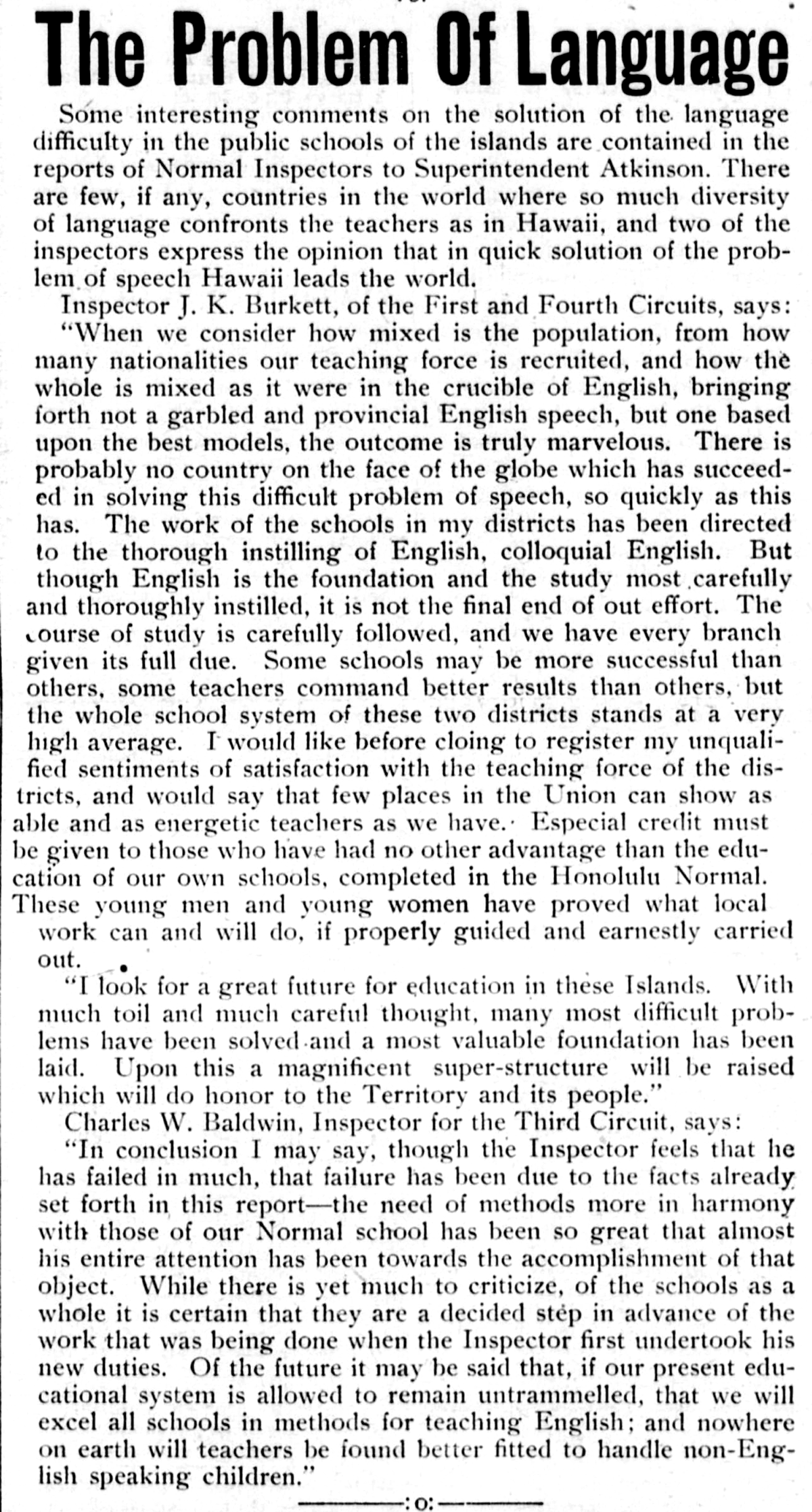
The Problem Of Language

Some interesting comments of the solution of the language difficulty in the public schools of the islands are contained in the reports of Normal Inspectors to Superintendent Atkinson. There are few, if any, countries in the world where so much diversity of language confronts the teachers as in Hawaii, and two of the inspectors express the opinion that in quick solution of the problem of speech Hawaii leads the world.

Inspector J. K. Burkett, of the First and Fourth Circuits, says:

“When we  consider how mixed is the population, from how many nationalities our teaching force is recruited, and how the whole is mixed as it were in the crucible of English, bringing forth not a garbled and provincial English speech, but one based upon  the best models, the outcome is truly marvelous. There is probably no country on the face of the globe which has succeeded in solving this difficult problem of speech, so quickly as this has. The work of the schools in my districts has been directed to the thorough instilling of English, colloquial English. But though English is the foundation and the study most carefully and thoroughly instilled, it is not the final end of our effort. The course of study is carefully followed, and we have every branch given its full due. Some schools may be more successful than others, some teachers command better results than others, but the whole school system of these two districts stands at a very high average. I would like before closing to register my unqualified sentiments of satisfaction with the teaching force of the districts, and would say that few places in the Union can show as able and as energetic teachers as we have. Especial credit must be given to those who have had no other advantage than the education of our own schools, completed in the Honolulu Normal. These young men and young women have proved what local work can and will do, if properly guided and earnestly carried out.

“I look for a great future for education in these Islands. With much toil and much careful thought, many most difficult problems have been solved and a most valuable foundation has been laid. Upon this a magnificent super-structure will be raised which will do honor to the Territory and its people.”

Charles W. Baldwin, Inspector for the Third Circuit says:

“In conclusion I may say, though the Inspector feels that he has failed in much, that failure has been due to the facts already set forth in this report—the need of methods more in harmony with those of our Normal school has been so great that almost his entire attention has been towards the accomplishment of that object. While there is yet much to criticize, of the schools as a whole it is certain that they are a decided step in advance of the work that was being done when the Inspector first undertook his new duties. Of the future it may be said that, if our present educational system is allowed to remain untrammelled, that we will excel all schools in methods for teaching English; and nowhere on earth will teachers be found better fitted to handle non-English speaking children.”

(Hawaiian Star, 3/5/1903, p. 7)

The Problem Of Language

The Hawaiian Star, Volume X, Number 3419, Page 7. March 5, 1903.

Hawaiian language in an English paper, 1884.

$25 REWARD.

FOR the Conviction of the person or persons that entered my premises on the 9th of Jan. 1884, and robbed the house, and destroyed several bags of feed.

———

NO KA HOPU ANA i ka mea a mau mea paha i hele ai ma ku’u aina ma ka la 9 o Ianuari, 1884, a komo iloko o ka hale a hoopoinoia he lehulehu o na Eke Ai (a ka holoholona).

R. GERKE.

Jan. 15th, 1884.

(Daily Bulletin, 2/5/1884, p. 4)

$25 REWARD.

The Daily Bulletin, Volume III, Number 628, Page 4. February 5, 1884.

Translation of H. Rider Haggard’s, “Morning Star,” 1910.

THE HEART-STIRRING TALE

—:OF:—

THE MORNING STAR

—AND—

RAMSES HER BELOVED SWEETHEART

“The Heir of Pharoah
The Favorite of Amen-Rah
The Proud Beauty of Egypt
The Darling of Her People.”

An Old Story from Egypt.
(Translated for the Hoku o Hawaii.)

Introduction.

We are printing this famous story of the Kingdom of Egypt. And it was near the time when Moses was living in Egypt. It is a story of speaking of the religion of that ancient people, and a story of their Chiefly kapu intertwined with their Godly kapu.

We published before our readers some years ago stories of our own Alii of ancient times of our land, and Tales of Hawaii which are nearly not remembered by the  current people of these times, and through this story which we are sharing with our readers, they will see some things about that ancient people of the land in the east. It is toilsome to translate these stories for the benefit of the people who enjoy reading stories in the Hoku. And from the Hoku, we lovingly urge its readers to please remember the life of this Hoku of ours. Printing a newspaper is very costly, and its existence and progress is reliant upon its readers.

We hope that some of the subscribers of the Hoku who are delinquent in their payments to the life of the Hoku will be moved with aloha, and they will make their payment towards the life of this patient servant.

Forgive us for these words that are not related to our story, however, “Ears do not get filled up with words.” And it is our responsibility to call out with aloha to our readers who have not paid their subscription, for the good of the newspaper to print educational stories and wise discussions of this new age.

[That was the introduction by the Hoku o Hawaii newspaper to their translation of the story, “The Morning Star” by H. Rider Haggard, which was printed just earlier that year in 1910. It ran in the weekly Hoku from March 17, 1910 to February 1, 1912.

It would be a cool thing if immersion students were introduced to old translations like these. They could see what kind of vocabulary and turns of phrase that were common during the period. I realize that trying to get through a novel in this format is tiresome and tedious, and I am considering reformatting a story (in the original orthography so that students can get more practice at reading material as they were presented in the newspapers) so that it reads continuously as a book. However, I am not sure if immersion teachers or students out there think that it would be beneficial. Perhaps it is already being done.]

(Hoku o Hawaii, 3/17/1910, p. 1)

HE MOOLELO HOONIUA PUUWAI NO KA HOKU KAKAHIAKA

Ka Hoku o Hawaii, Buke IV, Helu 46, Aoao 1. Maraki 17, 1910.

Party thrown by Arthur A. Wilder, 1916.

JUDGE WILDER THROWS A PARTY

Amongst the news spoken of in Honolulu nei, is the party given by Judge Wilder at the Hotel New Willard; it was a party adorned with a great amount of food along with the beauty of the decorations.

In the very short time it was organized, there were many malihini who showed up at the party, and speeches were given by members of Congress who were invited.

In a majority of the speeches given, appreciation was mentioned for the kindness of Hawaii’s people for welcoming the group of Congressmen the previous summer. Continue reading