All sorts of rumors spread on the streets, 1893.

RUMORS.

There are all sorts of stories spreading about on the sidewalks. Some of the news is shocking, some are exaggerations, and some are just baseless stories. Here is what is known—the Reformists’ idea to incite dissension is hard-pressed.

(Hawaii Holomua, 1/16/1893, p. 2)

NA LONO LAUAHEA.

Hawaii Holomua, Buke III, Helu 140, Aoao 2. 1/16/1893.

Proclamation by the Cabinet of Ministers of Queen Liliuokalani, 1893.

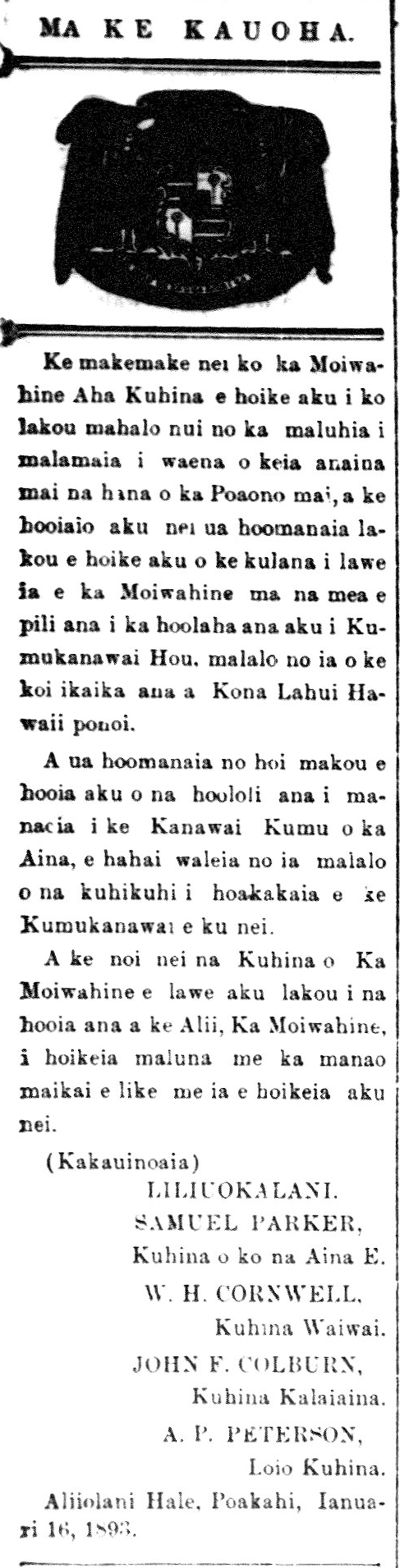
BY AUTHORITY.

Her Majesty’s Ministers desire to express their appreciation for the quiet and order which has prevailed in this community since the events of Saturday, and are authorized to say that the position taken by Her Majesty in regard to the promulgation of a new Constitution, was under stress of Her native subjects.

Authority is given for the assurance that any changes desired in the fundamental law of the land will be sought only by methods provided in the Constitution itself.

Her Majesty’s Ministers request all citizens to accept the assurances of Her Majesty in the same spirit in which it is given.

(Signed)

LILIUOKALANI,

SAMUEL PARKER,
Minister of Foreign Affairs.

W. H. CORNWELL,
Minister of Finance.

JOHN F. COLBURN,
Minister of the Interior.

A. P. PETERSON,
Attorney-General.

Iolani Palace [Aliiolani Hale], January 16th, 1893.

[English taken from Chronicling America, The Hawaiian Gazette, 1/17/1893, p. 4]

(Hawaii Holomua, 1/16/1893, p. 2)

MA KE KAUOHA.

Hawaii Holomua, Buke III, Helu 140, Aoao 2. Ianuari 16, 1893.

Early Consolidated Amusement and movies on Sundays, 1915.

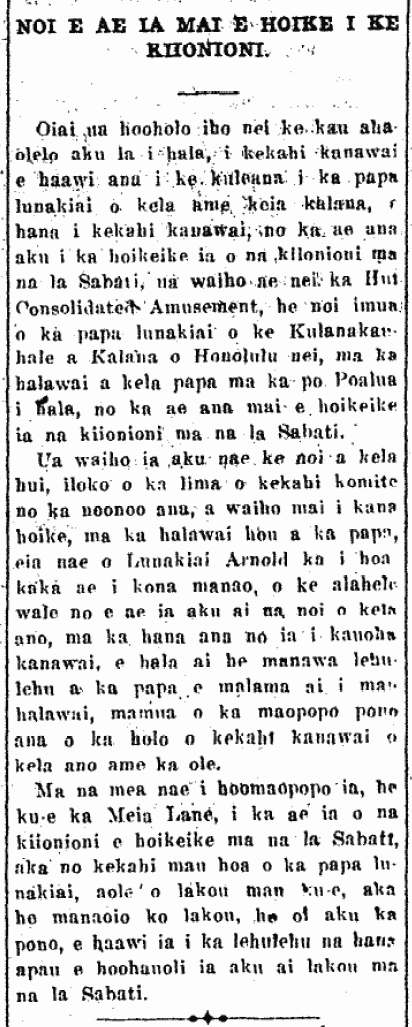
ASKED FOR APPROVAL TO SHOW MOVIES.

Being that a law was passed in this past legislative session giving the responsibility to the board of supervisors of each county to make laws to approve showing movies on the Sabbath; the Consolidated Amusement Company put a request before the board of supervisors of the City and County of Honolulu at the meeting of that board on this past Tuesday night, to ask for approval to show movies on Sundays.

But the request by that company was placed in the hands of a committee to consider, and to give its findings at the next meeting of the board; however Supervisor Arnold made his opinion clear that the only means by which those sorts of requests will be approved is by making an announcement of the law for which the board will spend much time holding meetings, before it is clear whether or not a law of that kind will pass or not.

From what is understood, Mayor Lane opposes the approval of movies being shown on Sunday, but some of the board members do not disapprove, but they believe that it is more important to give to the public all things that will make them happy on Sundays.

[Consolidated was entertaining Hawaii before 1917? That classic movie trailer we all are familiar with: Consolidated Amusement.]

(Kuokoa, 5/14/1915, p. 5)

NOI E AE IA MAI E HOIKE I KE KIIONIONI.

Ka Nupepa Kuokoa, Buke LIII, Helu 20, Aoao 5. Mei 14, 1915.

Patients released from Kalaupapa, 1917.

NEWS FROM THE LAND OF SUFFERING, KALAUPAPA, MOLOKAI.

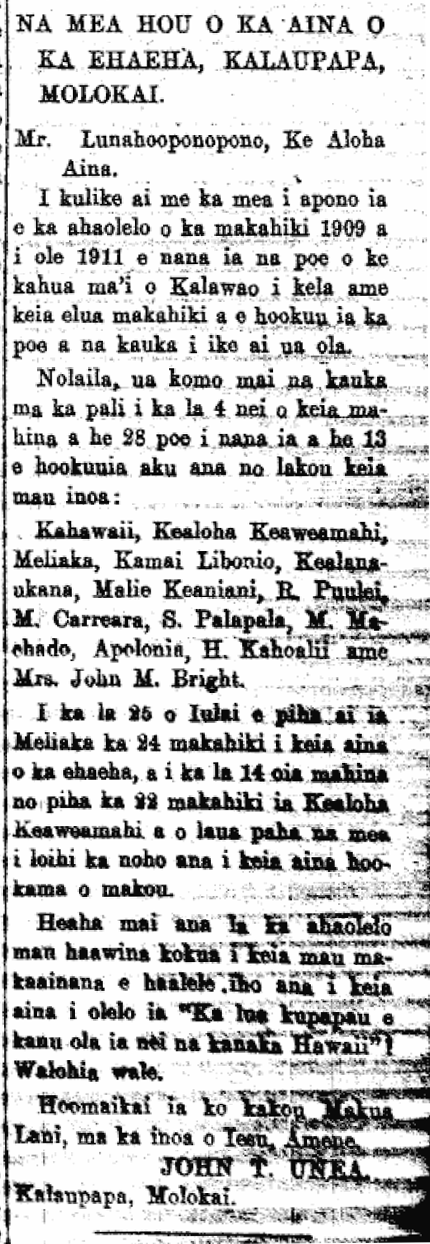
Mr. Editor, Ke Aloha Aina.

In accordance with what was approved of by the legislature of 1909 or 1911, the people of the patient colony of Kalawao will be examined every two years and the people who are determined by the doctor to be cured will be released.

Therefore, the doctors entered the pali on the 4th of this month, and 28 people were examined and 13 will be released, whose names are:

Kahawaii, Kealoha Keaweamahi, Meliaka, Kamai Libonio, Kealanaukana, Malie Keaniani, R. Puulei, M. Carreara, S. Palapala, M. Machado, Apolonia, H. Kahoalii and Mrs. John M. Bright.

On the 25th of July, Meliaka will have spent 24 years in this land of suffering, and on the 14th of that very month, Kealoha Keaweamahi will have spent 22 years, and the two of them are perhaps the ones who have lived the longest in this land which we adopt.

How will the legislature assist these citizens who will leave this land called, “The grave where Hawaiians are being buried alive”? How heart wrenching.

Blessed be our Heavenly Father, in the name of Jesus, Amen.

JOHN T. UNEA.

Kalaupapa, Molokai.

(Aloha Aina, 4/13/1917, p. 1)
NA MEA HOU O KA AINA O KA EHAEHA, KALAUPAPA, MOLOKAI.

Ke Aloha Aina, Buke XXII, Helu 15, Aoao 1. Aperila 13, 1917.

More on fishing laws, 1915.

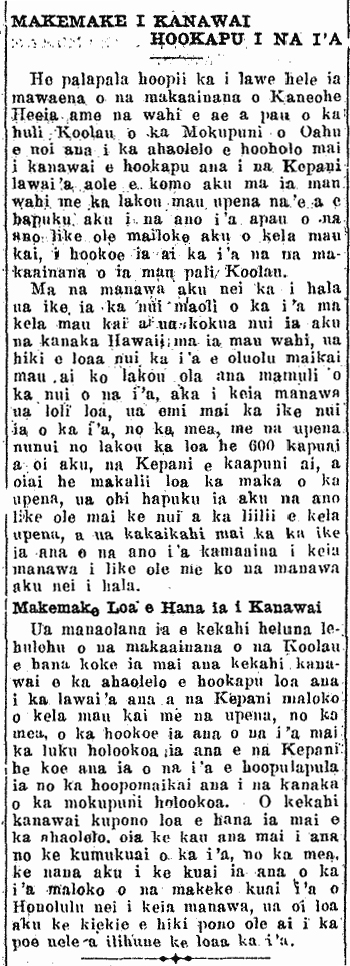
A LAW PROTECTING FISH IS WANTED.

There was a petition carried around to the citizens of Kaneohe, Heeia, and all the other areas on the Koolau side of the island of Oahu which asks the legislature to pass a law prohibiting the Japanese fishermen from going into those areas with their small-meshed nets and indiscriminately taking all kinds of fish from those waters, so that fish will be left for the people of those Koolau cliffs.

In times past, there was an abundance of fish seen in those waters, and the Hawaiian people of the place were greatly blessed, in that fish were easily caught making life easy because of this bounty of fish; however, these days, it is changed, because with their huge nets which are 600 feet or more long, the Japanese go about, and being that the eyes of their nets are tiny, caught haphazardly are all sorts from big to small; and these day you hardly see fish that were regularly seen before.

Desperately Wanting a Law Passed.

It is hoped by a great number of the people of the (two) Koolau that a law is passed soon by the legislature banning the Japanese from fishing in those waters with nets, because it will save the fish from being wiped out by the Japanese, and fish will be left to propagate for the benefit of the people of the entire island. One very good law being worked on by the legislature, is the limiting of fish prices, because when you observe the selling of fish in fish markets of Honolulu nei these days, the prices are so high that the poor and indigent can’t afford it.

(Kuokoa, 2/19/1915, p. 2)

MAKEMAKE I KANAWAI HOOKAPU I NA I'A

Ka Nupepa Kuokoa, Buke LIII, Helu 8, Aoao 2. Feberuari 19, 1915.

New fishing laws for amaama (mullet), 1911.

Ban on Amaama.

There are many people in this Territory who donʻt know that they have been breaking the law since the first of this month, December; those law breakers are the owners of fish ponds, and those who sell amaama at markets. According to the law passed during this past Legislative Session of 1911, eating of amaama is banned from the 1st of December until the 1st of March.

Therefore, Attorney General Lindsay sent notice to the fish sellers at the markets that the sale of amaama over the counter will not be allowed anymore from next Tuesday on. Both ocean amaama and pond amaama are banned.

With this restriction on amaama during these months, there will be seen fish shortages in town on occasion in the future. It is known that during stormy times and when the sea is rough you canʻt get ocean fish. Amaama is a fish you can get all the time, in good and bad weather, and it is a favorite fish of the people.

This law prohibiting its sale to the public will make it disappear for several months before reappearing again. And dining tables in the upcoming holidays will be without this familiar fish of the land.

(Aloha Aina, 1/23/1911, p. 1)

KAPU KA AMAAMA.

Ke Aloha Aina, Buke XVI, Helu 51, Aoao 1. Dekemaba 23, 1911.