Annie Freitas composition on trip to see Kapiliula, Maui, 1921.

KAPILIULA SONG

Ikemaka i ka nani o Kapiliula,
Hoohihi ka manao me ka makemake;
Ia wai kaulana o ka aina,
Makaikaiia e ka malihini.

Ua inu ia wai ono hu’ihu’i,
Ia wai kahe mai i ke kumupali;
O ka nee a ka ua me ka makani,
Mea ole nae ia i nei hookele.

Ilaila kamau kiaha bia,
Olu ai ka hele ana o ia kula loa;
Ua lei i ka pua a o ka lehua,
Ua ai i ka hua ohelo papa.

He nui na ono a o ia uka,
O ka lua leko me ka hoio;
Ku au mahalo aku o ka nani,
I ka papa auwai a ke aupuni.

Moani ke ala o ke kiele,
E kono mai ana ia’u e hoi;
Kau aku i ke kaa otomobile,
Olapa ka uwila i Kipahulu.

Aina a ka nani me ka maikai,
Kaulana i ka makani lawe huapala.

Kipa aku i ka hale kamaaina,
Ai i ka opae mahikihiki;
Ilaila hoohihi kahi manao,
I ka hanu aala o pua roselani.

E hoi kakou ua ahiahi,
E ike i ka wai a o Kumaka,
Ilaila makou miki wahi poi,
Ohua o ke kai ka’u i’a ia.

Ua lawa ka iini me ka makemake,
I ka ua Apuakea o Hana;
Hainaia mai ana ka puana,
E hoi ke aloha i Kapiliula.

Haina hou ia mai ka puana,
Malihini kaahele puni o Maui.

Composed by MISS ANNIE FREITAS.
1315 Miller St., Honolulu.

[Annie Freitas sounds like she had a really good time on this huakai!]

(Kuokoa, 6/3/1921, p. 3)

Kuokoa_6_3_1921_3

Ka Nupepa Kuokoa, Buke LIX, Helu 22, Aoao 3. Iune 3, 1921.
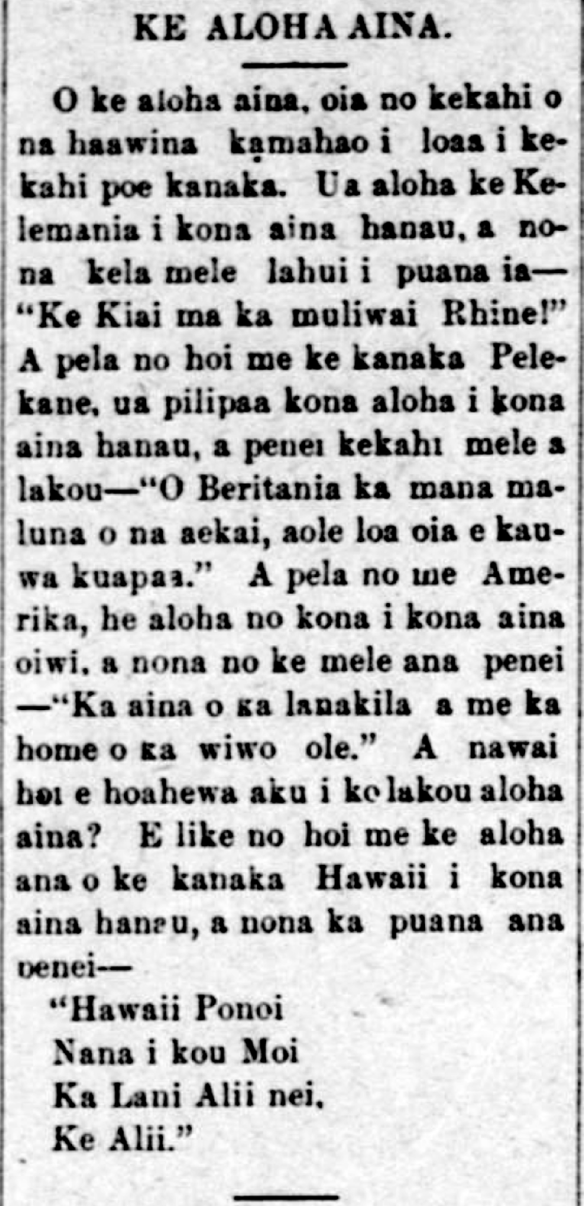
The National Anthem and Patriotism, 1893.

PATRIOTISM.

Aloha aina is a wonderful gift held by people. The German loves his land of birth, and for it is the national anthem sung—”Die Wacht am Rhein” [“Ke Kiai ma ka muliwai Rhine!”]* And so too  with the Briton, whose love is steadfast for his birth land, and this is one of their songs—”Rule, Britannia! rule the waves, Britons never will be slaves.” [“O Beritania ka mana maluna o na aekai, aole loa oia e kauwa kuapaa.” And it is the same with the American; he loves his native land, and for it is sung in this manner—”The land of the triumphant and the home of the brave.” [“Ka aina o ka lanakila a me ka home o ka wiwo ole.”] Who would fault their patriotism? This like the aloha that the Hawaiian has for his land of birth, and for it is sung like this—

“Hawaii Ponoi
Nana i kou Moi
Ka Lani Alii nei,
Ke Alii.”

*Look at this awesome translation by King Kalakaua of Die Wacht am Rhein!

(Hawaii  Holomua, 2/11/1893, p. 1)

HawaiiHolomua_2_11_1893_1.png

Hawaii Holomua, Buke III, Helu 7, Aoao 1. Feberuari 11, 1893.

Thoughts for the upcoming Kamehameha Day, 1920.

THEY ARE TRUE HAWAIIANS BUT THEY CANNOT SING HAWAIIAN SONGS.

Mr. Editor of the Kuokoa Newspaper, Aloha oe:—Maybe at 3 o’clock or so in the morning of Friday, June 11, 1920, that being the birthday of the Nation Conqueror Kamehameha, there came to my home some singing boys, and this was something; it was a familiar thing where on holidays this and that person came around singing at houses lived in by Hawaiians.

Before the singers came, I got the idea that since these singers were coming to my home, I would get up and listen to the singing outside on the lanai like I was accustomed to in past years; it was not long before I heard strains of a guitar, and the singing started, but it was from my bedroom that I was listening. Continue reading

A mele ipo for Edward Abnel Keliiahonui Piikoi by King Kalakaua, 1871.

He ipo na Abenela Keliiahonui Piikoi.

Sweet Leda Lani ke Ala.

Aia la i Kemamo,
Kuu wai kihene lehua,
Wai auau a ka wahine,
No Ledalani ke ala.

Aia ilaila kuu liko,
Aia ilaila ka lehua,
Puia nae he moani,
Sweet Ledalani ke ala.

Ua like ka welona a ka la,
Ka mania i ka ili kai,
Me ka poli nahenahe o ka ipo,
O Ledalani, ke ala.

Aia ilaila kuu liko,
Aia ilaila ka halia,
Puia nae he moani,
Sweet Leda lani, ke ala. Continue reading

Mele for Niihau by Mrs. Kipola Huluaulani, 1942.

Hanohano Niihau

1—Hanohano Niihau kuu aina,
Haaheo i ka maka a o kaopua.

2—He pua lei au na Kahelelani,
Milimili na ka la welo i Lehua.

3—Ilihia i ka nani o ka aina,
I ka loku a e ka ua Naulu.

4—Hoi no e pili me ke aloha,
Na makani kaulana o ka aina.

5—E ola e ka wehi o ka aina,
I ka mana kahikolu malamalama.

6—Haina kapuana i lohe ia,
Hanohano Niihau kuu aina.

(Hakuia e Mrs. Kipola Huluaulani.)

[Glorious is Niihau.

1—My dear island Niihau is glorious,
Proud in the face of the cloud banks.
2—I am a flower lei of Kahelelani,
A precious one of the sun setting at Lehua.
3—Awestruck by the beauty of the land,
In the torrents of the Naulu rain.
4—Returning to be with the beloved,
The famed winds of the land.
5—Long live the adornments of the land,
In the shining power of the trinity.
6—Let the refrain be told that it be heard,
My dear island Niihau is glorious.

(Composed by Mrs. Kipola Huluaulani.)]

(Hoku o Hawaii, 5/20/1942, p. 1)

HokuoHawaii_5_20_1942_1

Ka Hoku o Hawaii, Volume XXXVII, Number 4, Aoao 1. Mei 20, 1942.

For you mele people, another composition by Joseph W. K. Kapololu, 1919.

HAUPU SONG.

Ka luna au i Haupu,
Akahi no a upu ka manao,
A e lawe no au a lilo,
Lawe no au a lilo oe na’u.

Mahalo aku au o ka nani,
O ka nalu ha’i mai a o Maliu,
E maliu mai oe e ke aloha,
Ka iini a ka puuwai.

Huli mai oe e pili me a’u,
Pili kaua hemo ole oe,
Ua pilipaa i ka puuwai,
I ka pana holu i ka lihilihi. Continue reading

O Hawaii, My Beloved Homeland! 1932 and Forever.

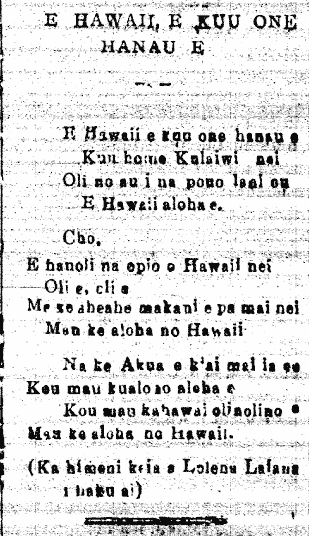
E HAWAII E KUU ONE HANAU E

E Hawaii e kuu one hanau e
Kuu home Kulaiwi nei
Oli no au i na pono lani ou
E Hawaii aloha e.

Cho.

E hauoli e na opio o Hawaii nei
Oli e, oli e
Me ke aheahe makani e pa mai nei
Mau ke aloha no Hawaii.

Na ke Akua e kiai mai ia oe
Kou mau kualono aloha e
Kou mau kahawai olinolino e
Mau ke aloha no Hawaii.

(Ka himeni keia a Lolena Laiana i haku ai)

[I just saw a report on a cool project featuring this mele by patriot Lorenzo Lyons. Hawaii News Now – Sunrise this morning did a piece on the Mana Mele Project being carried out by Mana Maoli and Playing For Change. Check out the story here! Mau ke aloha no Hawaii!]

(Hoku o Hawaii, 7/12/1932, p. 2)

HokuoHawaii_7_12_1932_2.png

Ka Hoku o Hawaii, Buke XXVI, Helu 5, Aoao 2. Iulai 12, 1932.

Lorenzo Lyons’ composition on patriotism, 1868.

ALOHA AINA.

THE TRUE PATRIOT.

Golden Censer.

1. Paa kuu manao aloha
Yes, yes, yes yes, yes, yes.
Paa kuu manao aloha
I ka aina hanau o’u.
Aole au e kipi,
No, no, no, no, no, no.
Aole kumakaia,
E aloha oia mau.
Kuu lima pu me kuu naau,
E lilo nona, nona mau,
Kuu lima pu me kuu naau
E lilo nona mau.

Cho.—Yes, yes, yes, yes, yes, yes,
Paa kuu manao aloha
Yes, yes, &c
Paa kuu manao aloha
I ka aina hanau o’u;
Aole au e kipi,
No, no, &c
Aole kumakaia,
E aloha oia mau. Continue reading

Lorenzo Lyons preached, “Never be a double-faced traitor,” 1894.

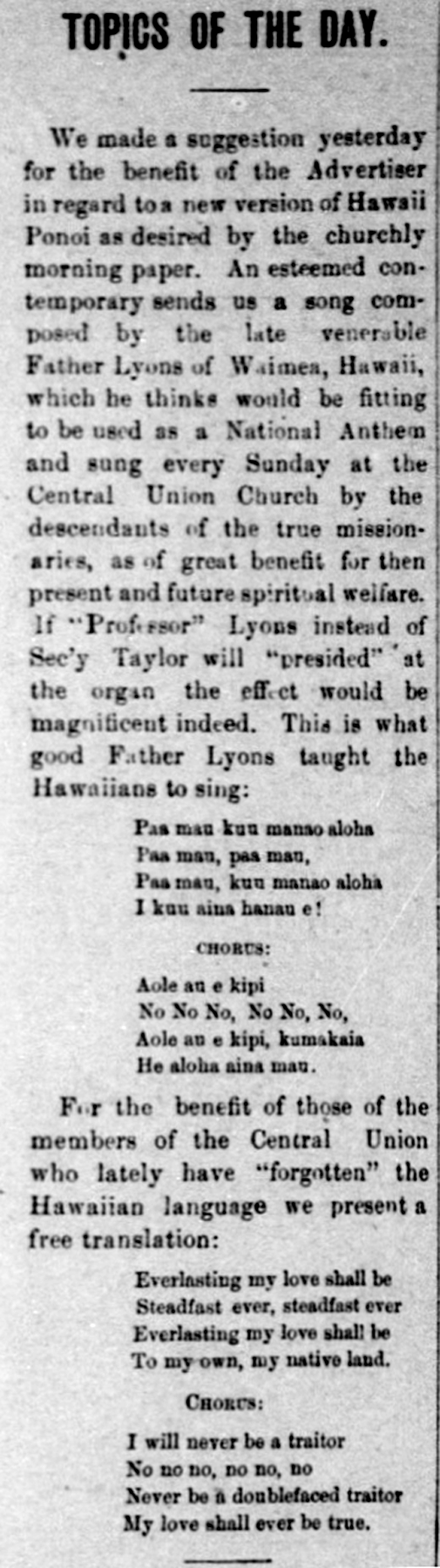
TOPICS OF THE DAY.

We made a suggestion yesterday for the benefit of the Advertiser in regard to a new version of Hawaii Ponoi as desired by the churchly morning paper. An esteemed contemporary sends us a song composed by the late venerable Father Lyons of Waimea, Hawaii, which he thinks would be fitting to be used as a National Anthem and sung every Sunday at the Central Union Church by the descendants of the true missionaries, as of great benefit for then present and future spiritual welfare. If “Professor” Lyons instead of Sec’y Taylor will “presided” at the organ the effect would be magnificent indeed. This is what good Father Lyons taught the Hawaiians to sing:

Paa mau kuu manao aloha
Paa mau, paa mau,
Paa mau, kuu manao aloha
I kuu aina hanau e!

CHORUS:

Aole au e kipi
No No No, No No, No,
Aole au e kipi, kumakaia
He aloha aina mau.

For the benefit of those of the members of the Central Union who lately have “forgotten” the Hawaiian language we present a free translation:

Everlasting my love shall be
Steadfast ever, steadfast ever
Everlasting my love shall be
To my own, my native land.

CHORUS:

I will never be a traitor
No no no, no no, no
Never be a doublefaced traitor
My love shall ever be true.

(Hawaii Holomua, 1/10/1894, p. 2)

HawaiiHolomua_1_10_1894_2.png

Hawaii Holomua, Volume II, Number 8, Page 2. January 10, 1894.

A new scathing “Hawaii Ponoi,” 1894.

TOPICS OF THE DAY.

The Advertiser with its usual ingenuity has finally found the cause for all the opposition among the Hawaiians to the P. G., and to the annexation cause. It is all on account of Hawaii Ponoi, our national anthem, and the morning organette demands, and immediate change in the words of that time-honored song. The new version given by the Advertiser will hardly be adopted, and we therefore take the liberty to substitute some words which we submit to the kind consideration of all loyal Hawaiians who are to be forbidden to sing the anthem of their native land. How is this brother Castle?

HAWAII PONOI HOU.

Pakaha Hawaii,
Kipi i ka lahui,
Na welo mikanele,
Na Pi Gi.

Ino ka ia e,
Ia Kolekaaka,
Pale i ka nani,
Me ka uahoa.

[NEW HAWAII PONOI

They plunder Hawaii
Conspire against the people,
Those missionary descendants,
The P. G.

How vile he is,
That Kole Kaaka,*
Pushing aside beauty,
With his cruelty.]

*”Kole Kaaka” can be found in the dictionary. Look it up. This term with a negative connotation is used often during this period. Might it also be a play on the name Dole? “Wretched Dole”?

(Hawaii Holomua, 1/9/1894, p. 2)

HawaiiHolomua_1_9_1894_2.png

Hawaii Holomua, Volume II, Number 7, Page 2. January 9, 1894.