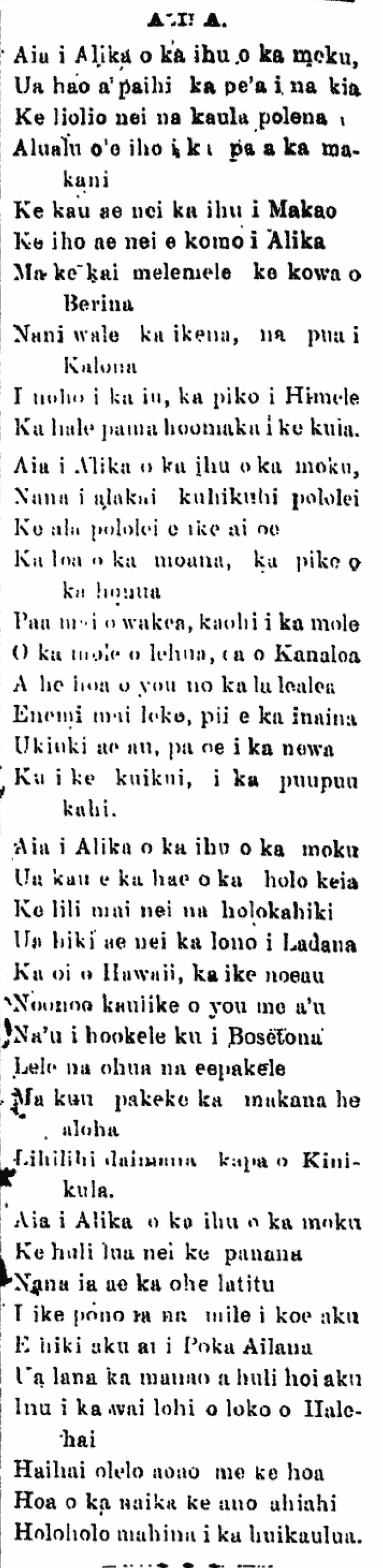
“Kaua i ka Nani o Hilo” and finding things where you might not expect. 1895.

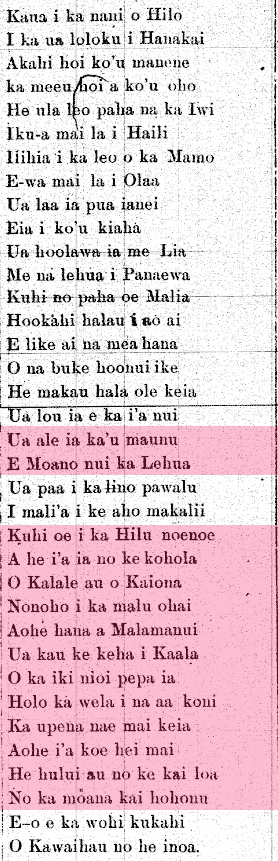
“Kaua i ka Nani o Hilo”

[This mele for Kalakaua is taken from an article entitled “OWAI LA O J. L. KUKAHI, KA IHEPA NUI O KA WAA PAE E PEE NEI?”, which is a scathing criticism by D. M. Punini, Jr. over an ongoing argument concerning the naming of Hawaiian traditional months. But here, I wanted to show once again, that you never know what you will find and where.

The version of “Kaua i ka Nani o Hilo” most widely known today is probably the one from the Roberts Collection at the Bishop Museum, which is quoted here. The Museum’s Mele Index can be searched online here. But notice that the Punini version has additional verses (highlighted in red).

Also note that “Kawaihau” is one of the names for Kalakaua.]

Kaua i ka nani o Hilo

I ka ua loloku i Hanakahi

Akahi hoi ko’u manene

ka meeu hoi a ko’u oho

He ula leo paha na ka Iwi

Iku-a mai la i Haili

Ilihia i ka leo o ka Mamo

E-wa mai la i Olaa

Ua laa ia pua ianei

Eia i ko’u kiaha

Ua hoolawa ia me Lia

Me na lehua i Panaewa

Kuhi no paha oe Malia

Hookahi halau i ao ai

E like ai na mea hana

O na buke hoonui ike

He makau hala ole keia

Ua lou ia e ka i’a nui

Ua ale ia ka’u maunu

E Moano nui ka Lehua

Ua paa i ka lino pawalu

I mali’a i ke aho makalii

Kuhi oe i ka Hilu noenoe

A he i’a ia no ke kohola

O Kalale au o Kaiona

Nonoho i ka malu ohai

Aohe hana a Malamanui

Ua kau ke keha i Kaala

O ka iki nioi pepa ia

Holo ka wela i na aa koni

Ka upena nae mai keia

Aohe i’a koe hei mai

He hului au no ke kai loa

No ka moana kai hohonu

E—o e ka wohi kukahi

O Kawaihau no he inoa.

(Leo o ka Lahui, 4/2/1895, p. 3)

OWAI LA O J. L. KUKAHI, KA IHEPA NUI O KA WAA PAE E PEE NEI?

Ka Leo o ka Lahui, Buke II, Helu 1078, Aoao 3. Aperila 2, 1895.

Another death announcement for John Kaaeae, 1912.

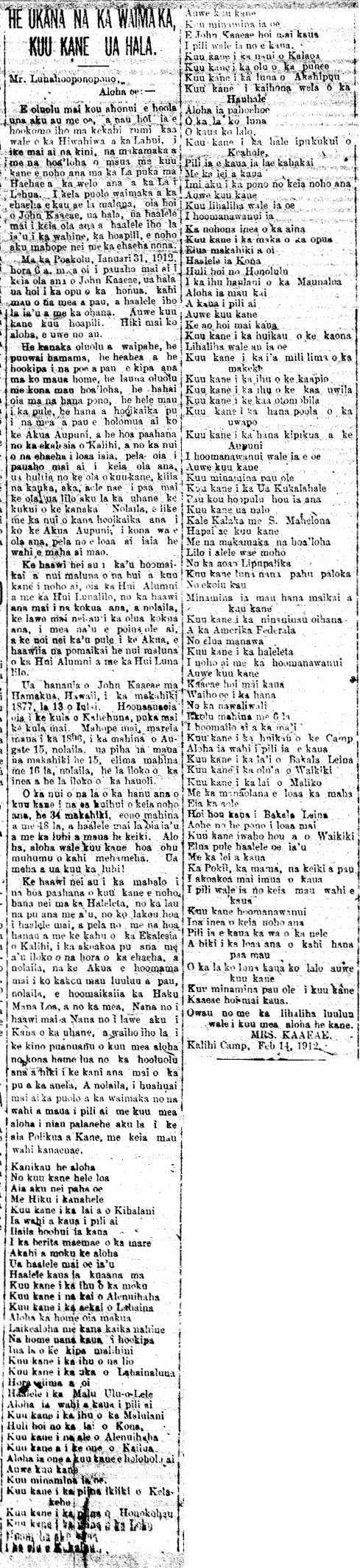
A CARRIER OF TEARS,
MY HUSBAND IS GONE.

[Here is another death announcement for John Kaaeae, but this one is written by his wife. There is added biographical information in the prose as well as the mele.

From the prose portion we see that John Kaaeae died at 6 a. m. He was a member of the Kalihi Church [Ekalesia o Kalihi?]. He belonged to the organizations, Hui Alumni [?] and Hui Lunalilo. Here it says he was born on July 13, 1877. They were married on August 15, 1896…

The mele seems like a chronology of their lives together.]

My husband in the calm of Kihalani

Where we were together

There we were joined

In the sacred covenant of marriage

My husband at the bow of the ship

My husband on the Alenuihaha Channel

My husband at the shores of Lahaina

Beloved is the home of the parents

Turned back to the calm of Kona

My kane on the Alenuihaha Channel

My kane on the sands of Kailua

Aloha to that sand upon which my kane travelled

Left Kona

Turned back to Honolulu

On the restless prow of the steamship Maunaloa

Beloved are those seas

My husband employed as a stevedore at the docks

My husband working a pickaxe for the Government

Became a delegate to choose a candidate

For the Republican party

My kane, a voting inspector

For three terms

&c., &c., &c.

(Aloha Aina, 2/17/1912, p. 4)

HE UKANA NA KA WAIMAKA, KUU KANE UA HALA.

Ke Aloha Aina, Buke XVI, Helu 7, Aoao 4. Feberuari 17, 1912.

Sheet music of famous songs being sung by Ernest Kaai, 1912.

SOME FAMOUS HAWAIIAN SONGS.

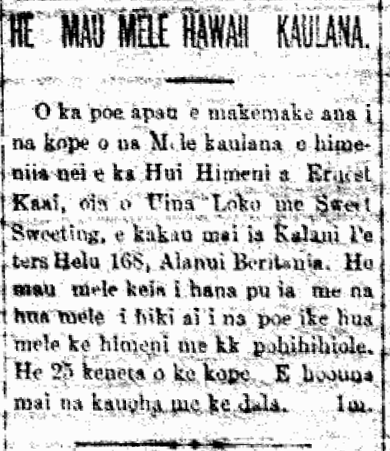
Everyone wanting copies of the famous songs being sung by the group of Ernest Kaai, they being “Uina Loko” and “Sweet Sweeting,” write to Kalani Peters, Number 168, Beritania Street. These are mele set with musical notes so that those who read music can sing them without confusion. They are 25 cents per copy. Send in your orders and money.

[I have not found a copy of this compilation as of yet… But i bet someone has a copy in their grandma’s piano bench, the kind with the lift-up music storage compartment!]

(Aloha Aina, 2/24/1912, p. 4)

HE MAU MELE HAWAII KAULANA.

Ke Aloha Aina, Buke XVI, Helu 8, Aoao 4. Feberuari 24, 1912.

Patriotic mele of a different sort, 1893.

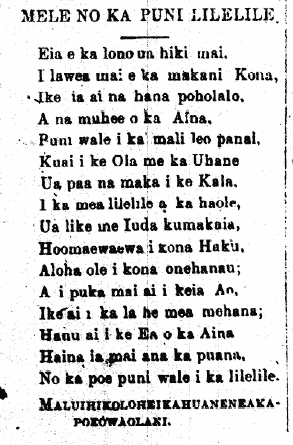
MELE NO KA PUNI LILELILE

Eia e ka lono ua hiki mai,

I lawea mai e ka makani Kona,

Ike ia ai na hana poholalo,

A na muhee o ka Aina,

Puni wale i ka mali leo panai,

Kuai i ke Ola me ka Uhane,

Ua paa na maka i ke Kala,

I ka mea lilelile a ka haole,

Ua like me Iuda kumakaia,

Hoomaewaewa i kona Haku,

Aloha ole i kona onehanau;

A i puka mai ai i keia Ao,

Ike ai i ka la he mea mehana;

Hanu ai i ke Ea o ka Aina,

Haina ia mai ana ka puana,

No ka poe puni wale i ka lilelile.

Maluihikoloheikahuaneneakapoeowaolani.

[There are not only patriotic compositions that laud and encourage, but there are also those like this one here which ridicule and disparage. This one goes something like:]

A SONG FOR THOSE WHO COVET SHINY THINGS.

The news has arrived,

Carried by the Kona breeze,

Witnessed are the deeds of deceit,

By the squids¹ of the Land,

Fawning after the sweet talk of reciprocity,

Selling away Life and Soul,

Eyes set on Riches,

That shiny thing of the haole,

Just like Judas the traitor,

Scorning his Lord,

With no aloha for his homeland;

If he’d come forth into the Light,

He’d see that the sun is a thing of warmth,

He’d breathe in the Ea² of the Land.

Let the story be told,

Of those who covet shiny things.

Maluihikoloheikahuaneneakapoeowaolani.

¹A squid can swim as easily backward as forward, so you never know if it is coming or going, and is thus used to describe a two-faced person.

²Ea can be seen as a play on the idea of Air as well as Sovereignty.

(Leo o ka Lahui, 2/21/1893, p. 3)

MELE NO KA PUNI LILELILE.

Ka Leo o ka Lahui, Buke II, Helu 646, Aoao 3. Feberuari 21, 1893.

Patriotic mele, 1893.

[Here is a patriotic mele famous to this day, it is also known as Mele Ai Pohaku, but familiar to most as Kaulana na Pua. This composition is published many times and in more than one Hawaiian-Language Newspaper. It is a song which both lauds and encourages.]

AN ADORNMENT FOR THE PATRIOTS.

Famous are the blossoms of Hawaii

Who stand steadfast behind the Land

When the evil Messenger arrives

With his documents of greed and plunder

I won’t affix my signature

To the papers of the Enemy

That Annex and sell wrongfully

The Civil rights of the people

We will not feel longing

For the sums of money of the Government

We are satisfied with the stones

The amazing food of the land

We stand behind the Sovereign

She will be placed back upon the Throne

Let the refrain be told

Of the people who Love the Land.

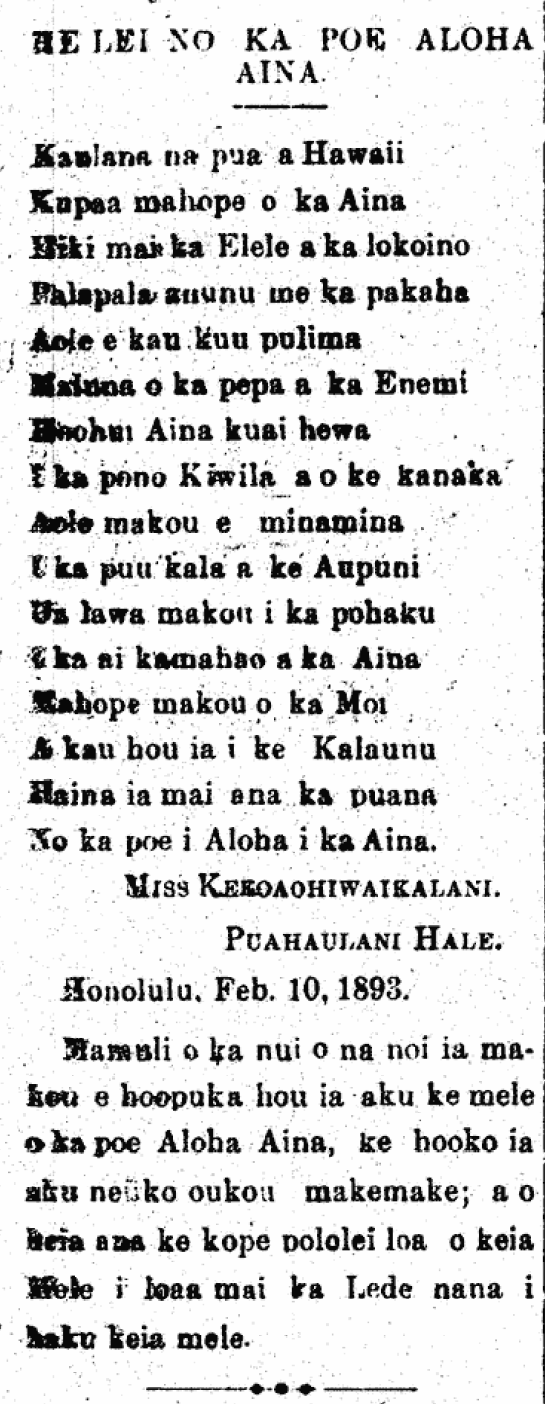
Miss Kekoaohiwaikalani.
Puahaulani Hale.
Honolulu, Feb. 10, 1893.

Because of the many requests for us to reprint the song of the Patriots, we are fulfilling your desire; and this is a correct copy of this song which we received from the Lady who composed this song.

(Leo o ka Lahui, 5/11/1893, p. 3)

HE LEI NO KA POE ALOHA AINA.

Ka Leo o ka Lahui, Buke II, Helu 703, Aoao 3. Mei 11, 1893.

A mele about Kahuailanawai, up in Nuuanu, 1912.

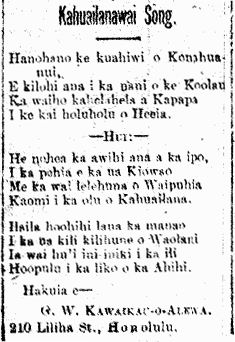
Kahuailanawai Song.

Hanohano ke kuahiwi o Konahuanui,
E kilohi ana i ka nani o ke Koolau,
Ka waiho kahelahela a Kapapa,
I ke kai holuholu o Heeia.

Hui:

He nohea ka awihi ana a ka ipo,
I ka pehia e ka ua Kiowao,
Me ka wai lelehuna o Waipuhia,
Kaomi i ka olu o Kahuailana.

Ilaila hoohihi laua ka manao,
I ka ua kili kilihune o Waolani,
Ia wai hu’i ini-iniki i ka ili,
Hoopulu i ka liko o ka Ahihi.

Hakuia e
G. W. Kawaikau-o-alewa.
210 Liliha St., Honolulu.

…which goes something a little like:

Kahuailanawai Song.

Exalted is the mountain, Konahuanui,
Gazing at the beauty of the Koolau,
The great expanse of Kapapa,
And the rhythmic sea of Heeia.

Chorus:

So alluring is the lover’s wink,
Pelted by the Kiowao rain,
And the spray of Waipuhia,
Held in the comfort of Kahuailana.

There the two of them are entranced,
By the sprinkling rain of Waolani,
The chilling water that stings the skin,
Moistening the buds of the Ahihi.

Composed by
G. W. Kawaikau-o-alewa.
210 Liliha St., Honolulu.

[The composer’s name sounds like a pen name. Anyone know of a way to find out who was living at 210 Liliha St. a hundred years ago…]

Kahuailanawai Song.

Ke Aloha Aina, Buke XVI, Helu 1, Aoao 1. Ianuari 6, 1912.

Kaena Song (Kuu Lei Momi), 1913

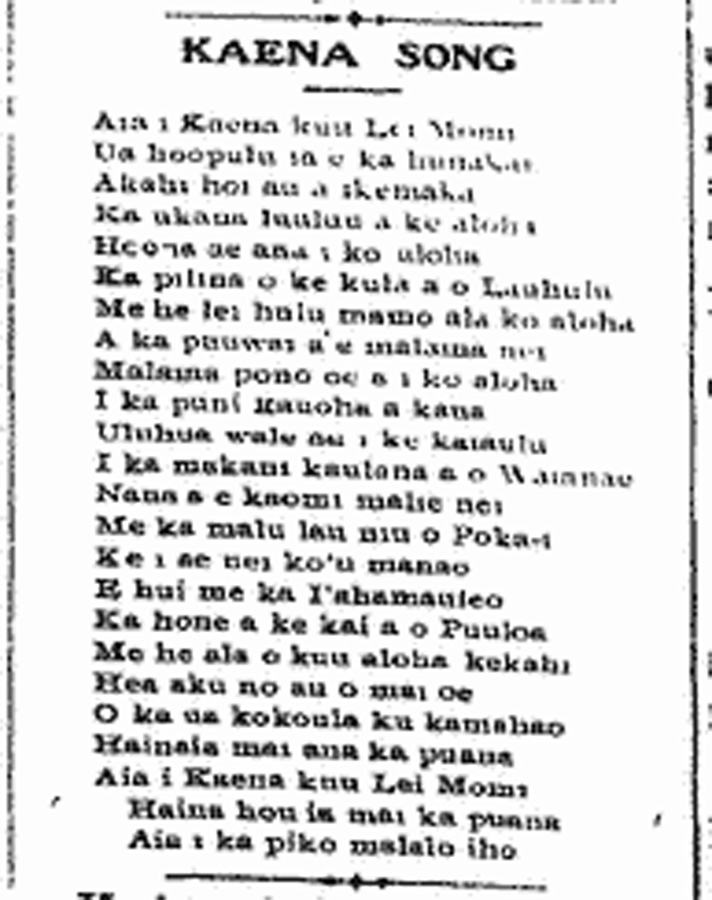
KAENA SONG

Aia i Kaena kuu Lei Momi

Ua hoopulu ia e ka hunakai

Akahi hoi au a ikemaka

Ka ukana luuluu a ke aloha

Hoona ae ana i ko aloha

Ka pilina o ke kula a o Lauhulu

Me he lei hulu mamo ala ko aloha

A ka puuwai a e malama nei

Malama pono oe a i ko aloha

I ka puni kauoha a kaua

Uluhua wale au i ke kaiaulu

I ka makani kaulana a o Waianae

Nana a e kaomi malie nei

Me ka malu lau niu o Poka-i

Ke i ae nei ko’u manao

E hui me ka I’ahamauleo

Ka hone a ke kai a o Puuloa

Me he ala o kuu aloha kekahi

Hea aku no au o mai oe

O ka ua kokoula ku kamahao

Hainaia mai ana ka puana

Aia i Kaena kuu Lei Momi

Haina hou ia mai ka puana

Aia i ka piko malalo iho

[Versions of familiar mele like this one (attributed to Samuel K. Halstead), and many others not heard today, are found all over the newspapers! There is so much that the haku mele of today can learn from them, if they would just look back…]

[A large portion of the digital images for this paper are illegible, and hopefully they will be reshot before it is too late.]

(Holomua, 12/20/1913, p. 4)

KAENA SONG

Ka Holomua, Buke I, Helu 12, Aoao 4. Dekemaba 20, 1913.

Liliuokalani plays the first organ at Kawaiahao Church, 1867.

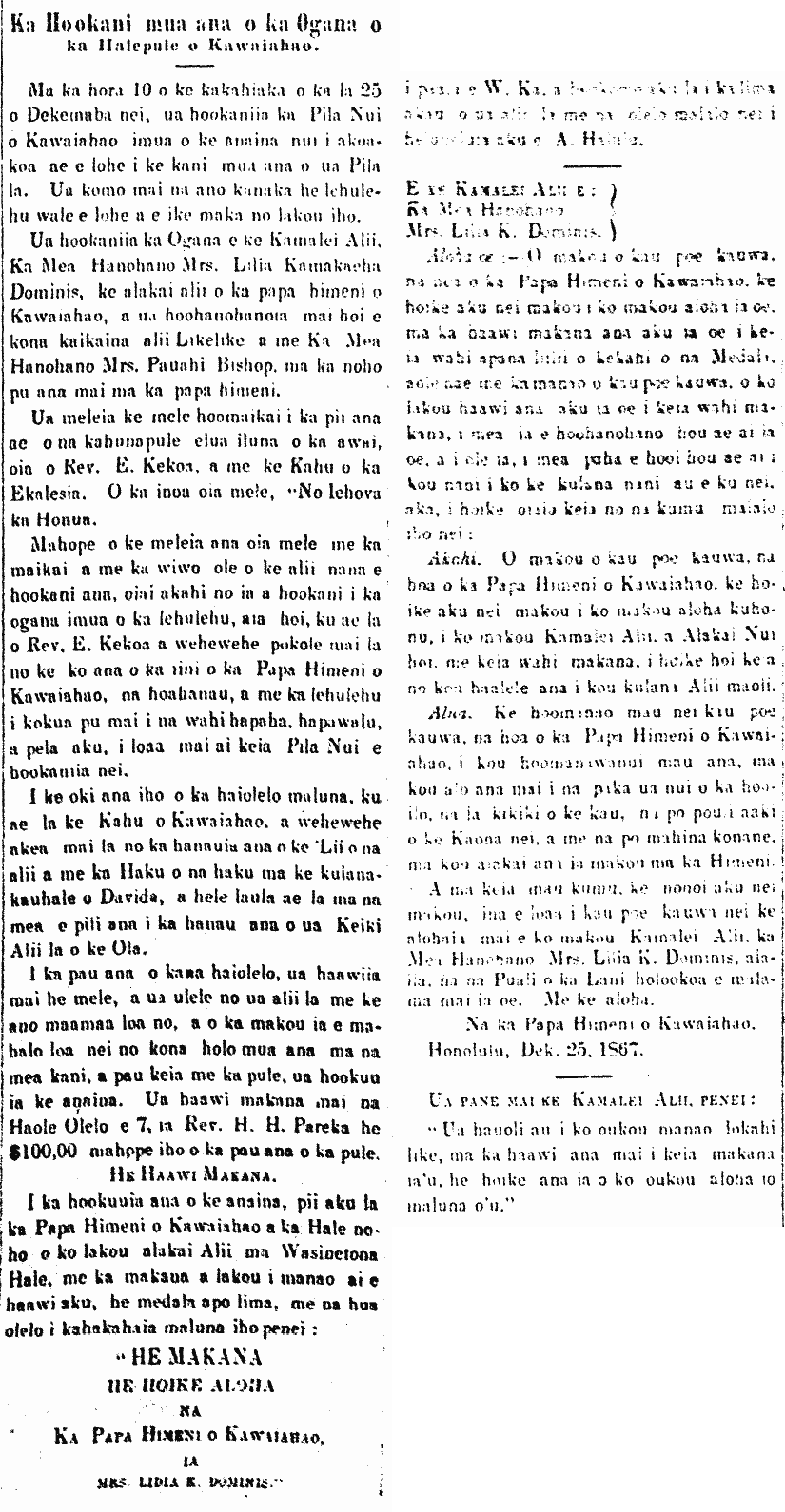
First Playing of the Organ of Kawaiahao Church.

At 10 in the morning of the 25th of December, the great musical instrument of Kawaiahao was played before the great crowd who gathered there to hear it being played for the first time. A great assortment of people came to hear and to see for themselves.

The Organ was played by the Princess, the Honorable Mrs. Lilia Kamakaeha Dominis, the royal leader of the Kawaiahao choir, and she was honored by her royal younger sister, Likelike, as well as the Honorable Mrs. Pauahi Bishop, who sat in the choir.

A song of gratitude was sung while the two pastors walked up to the pulpit, they being the Rev. E. Kekoa and the Kahu of the Church. The name of the hymn was “No Iehova ka Honua.”

After the singing of the hymn, nicely and fearlessly by the royal one who performed it, albeit this was the first time she played the organ before a crowd; then Rev. E. Kekoa stood and explained briefly the fulfilling of the dream of the Kawaiahao Choir, the church members, and the public, who helped with their 25¢ and their 12½¢ so that we could have this Great Instrument which is being played.

At the closing of this speech above, the Kahu of Kawaiahao stood and explained to all the birth of the King of kings, and the Lord of lords in the city of David, and expanded on things related to the birth of that Prince of Life.

At the conclusion of his speech, a hymn was given, and that alii lept into action, like she was very accustomed to it; and we are greatly appreciative for her advancement in musical instruments; and this was followed by a prayer, and then the congregation was released. The 7 foreign language speaking haole [?] gifted to Rev. H. H. Parker, $100.00 after the end of the prayer.

PRESENTING OF A GIFT.

After the congregation was let go, the Kawaiahao Choir went up to the Residence of their royal leader, to Washington Place, with a gift they wanted to present to her, a medal [?] bracelet with words engraved upon it, thusly:

“A GIFT
AN EXPRESSION OF ALOHA
BY
The Kawaiahao Choir
TO
MRS. LIDIA K. DOMINIS.”

which was [….] by W. Ka, and it was placed on the right hand of that royal one with the words below [….] by A. H[…..].

O Princess:
The Honorable
Mrs. Lilia K. Dominis.

Aloha oe:—We are your servants, the members of the Kawaiahao Choir, we show our aloha for you by presenting you with this gift of a small part of a Medal [?]; but it is not with thoughts of your servants, that their giving you this gift is something that should give you more honor, or that perhaps it will increase your already beautiful nature, but as a true expression of the things below:

One. We, your servants, the members of the Kawaiahao Choir, show our deep aloha to our Princess, and our Leader, with this small gift, as a symbol for your leaving your true Alii status [?]

Two. Your servants, the members of the Kawaiahao Choir, constantly think of your everlasting patience as you face the heavy rains of the winter, the scorching sun of the summer, the pitch dark nights of Town, and the bright moonlit nights, as you lead us in our Hymns.

And for these reasons, we ask of you, should your servants have the aloha of our Princess, the Honorable Mrs. Lilia K. Dominis, then let the Army of the wide Heavens watch over you. With aloha.

The Kawaiahao Choir.

Honolulu, Dec. 25, 1867.

—————

The Princess Replied Like This:

“I am joyful at your combined thought in gifting me with this present; it is a symbol of your true love for me.”

(Kuokoa, 12/28/1867, p. 3)
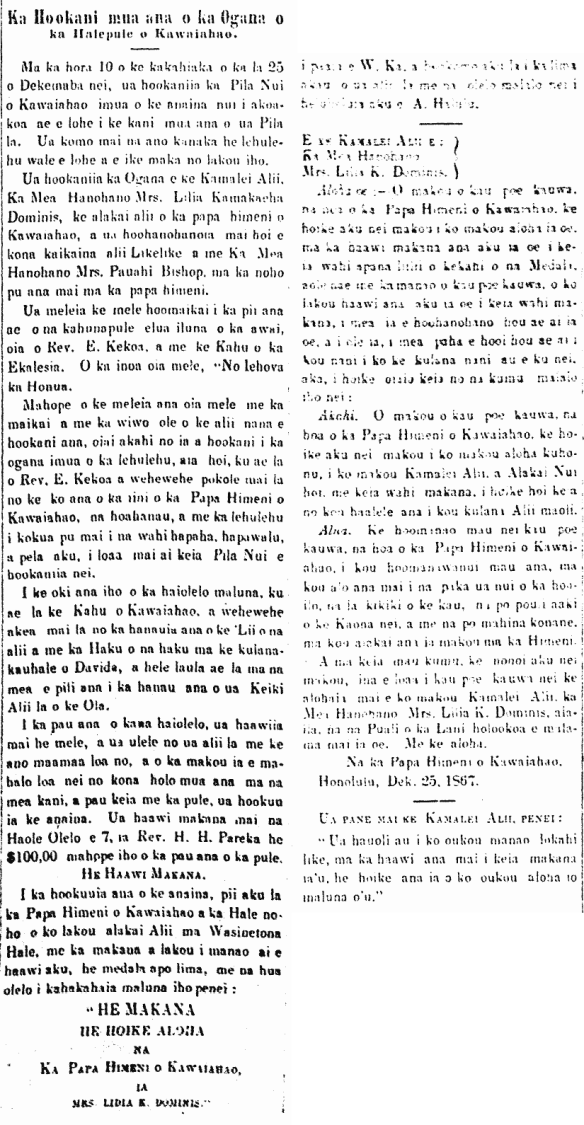
Ka Hookani mua ana o ka Ogana o ka Halepule o Kawaiahao.

Ka Nupepa Kuokoa, Buke VI, Helu 52, Aoao 3. Dekemaba 28, 1867.

“Liliu E,” 1922.

LILIU E

1—Liliu e, noho nani mai,

Ko kino e, kii milimili.

2—Ko maka e, noweo wale,

Ko papalina, e kuku ana.

3—Ko poohiwi, kii peahi,

Ko poli e, nahenahe wale.

4—Ko kuli e, nuku moi oe,

Ko wawae, Pahu ai luna.

5—E o e Liliu i ko wehi,

Ko hae kalaunu a o Hawaii.

6—Haina ia mai ana ka puana,

Liliuokalani noho nani mai.

LILIU E

Nupepa Kuokoa, Buke LXI, Helu 3, Aoao 2, Ianuari 20, 1922.