This is an independent blog. Please note that I am nowhere near fluent, and that these are not translations, but merely works in progress. Please do comment if you come across misreads or anything else you think is important.
In the upland of Manoa, at the home of Mrs. A. P. (Ahuena) Taylor, at “Luana Pua,” an audience was given in honor of the Maori of New Zealand living here in this town. Present were a great many Hawaiians where they spent a great amount of time last night socializing with the malihini, and comparing the old Hawaiian stories with the stories of the Maori people.
This is the second time that the Maori showed up at the home of Mrs. A. P. Taylor. On this night, because of the wish of these malihini to have abundant time to meet and speak with descendants of the great families of Hawaii nei.
Present were the descendants of the Kamehameha and Kalakaua lines that night, so too were some kamaaina possessing deep knowledge of the history of the Hawaiian lahui to satisfy what these malihini desired. Continue reading →
The angel of death came and shut the bodily house of Jos. B. Kaaoao, and forced out the spirit to return to whence it came, in the evening of Sunday, the 28th of July, at Olowalu, Maui, at his own residence, Wehekaolu.
He was born at Lahaina in September 1829, from the loins of Keliiahonui (m) and Ailaau (f). He was taken by his mother to go live at Haliimaile, Makawao, as per the desire of his father, Keliiahonui. The Monarchs [?] during those days were not pleased with that child, and from there they went to live at Kamaile, Waianae, Oahu. Continue reading →
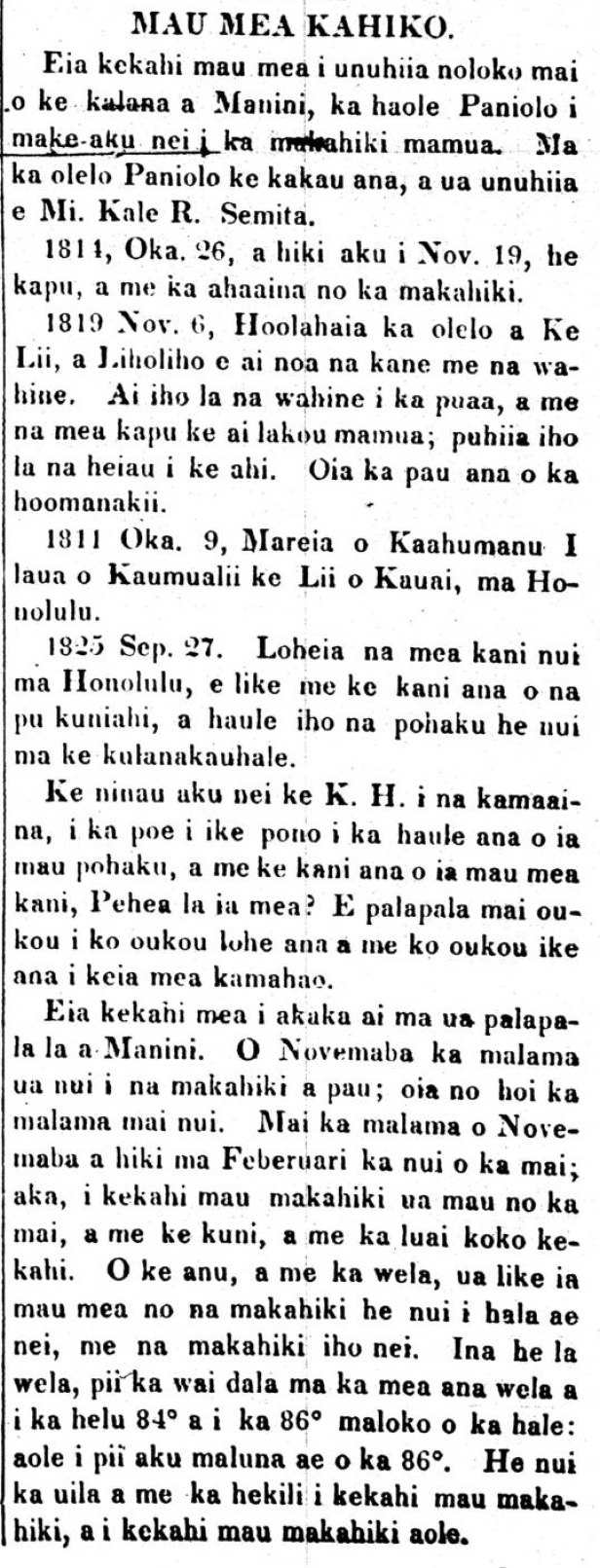
Here are some things translated from the writings of Francisco de Paula Marin [Manini], the Spanish haole who died the previous year. The writing was done in Spanish, and they were translated by Mr. Charles R. Smith [Mi. Kale R. Semita].
1814, Oct. 26, until Nov. 19, there was a kapu, and a feast for the Makahiki.
1819, Nov. 6, The word of the King, Liholiho, that the men and women would eat freely. The women ate pig, and other foods that were kapu to them previously; the heiau were burned down. It was the end of idolatry [hoomanakii].
1811, Oct. 9, Kaahumanu I was married to Kaumualii, the King of Kauai, at Honolulu.
1825, Sep. 27. There was a great noise heard in Honolulu, like the sound of canons; there were a lot of rocks which rained down upon the town.
Ke Kumu Hawaii newspaper asks the kamaaina, the ones who witnessed the falling of these rocks, and the sound of it [falling]. What was this like? Write to us how it sounded to you and how this amazing thing appeared to you.
Here is another thing that was clear through those writings of Manini. November is the month that there is much rain every year, and that is the month when there is much sickness. From the month of November to February there is much sickness; but some years, the sicknesses go on, along with fever, and also vomiting blood. Cold and heat, they are the same as many years before, as well as recent years. If it is a hot day, the mercury rises in the thermometer to 84° to 86° indoors; it does not go above 86°. There is much lightning and thunder some years, and in others there is none.
The year 1828 was famous for Kaahumanu going to Hawaii and retrieving Lilinoe on Mauna Kea, who was an ancient woman; a thousand and more years she was left on the mountain of Mauna Kea, according to her sworn statement. It was said that Lilinoe remained with body unspoiled, her hair remained affixed and had not fallen out. And should you want to see her descendants, they can be found by way of Huanuiikalailai; she became a kupuna of the alii, and came forth was Umiokalani, the son of Keawenuiaumi and Hoopiliahoe. But it was stated that Lilinoe was not found by Kaahumanu and that she was hidden away. Liloa, Lonoikamakahiki, Kauhoa, and Lole are the only ones who were found by Kaahumanu at Waipio, and they were brought to Kaawaloa. The alii in Hale o Keawe were from the ancestral chiefs to Kalaniopuu and Kiwalao. Hale o Keawe was filled with the bones of the alii, they were arranged and secured in kaai. They were taken to Kaawaloa and a majority of them were burned in fire. That is a very wicked example in Boti’s mind.
Here is another, Kaikioewa was indebt to Mikapalani [William French], that being the haole trader; the other alii were greatly indebted to him, but in his transactions he was a haole who was beyond reproach. The sandalwood that was thrown away by some haole traders were purchased by Mr. French, and therefore he was also called by the name Hapuku because of he indiscriminately gathered [hapuku] the white sandalwood as well as the very small branches, and he was relied upon by the alii and greatly liked; therefore, the alii were much indebted to him. Kaikioewa was one who was indebted, and because he had no sandalwood to pay his debt, therefore Kaikioewa paid his debt with the land of Kawalo [Kewalo] and Kulaokahua which went to Mr. French. So Mr. French prepared to build wooden structures at Kulaokahua adjacent to Waikiki where the Olohe sank.
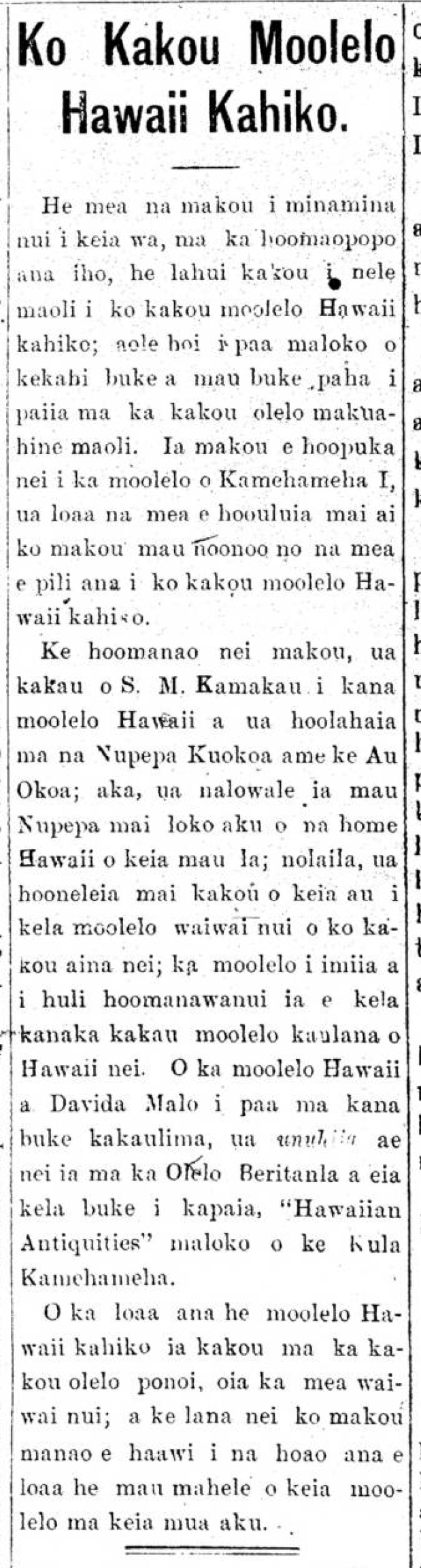
It is something we are regretful about at this time, as we realize, we are a lahui that truly is lacking in our Hawaiian history. It is not published in a book printed in our mother tongue. As we publish the history of Kamehameha I, we have found things that increasingly make us think about matters dealing with our Hawaiian history.
We remember that S. M. Kamakau wrote his Hawaiian history, and it was disseminated by the Nupepa Kuokoa and Au Okoa. But those newspapers have disappeared from the Hawaiian homes of these days; therefore, we are currently left without that very important history of our land, the history that was searched out and patiently studied by that famous historian of Hawaii nei. The Hawaiian history of Davida Malo that is set down in his handwritten book was translated into English and is now a book called, “Hawaiian Antiquities” at Kamehameha School.
Having a Hawaiian history in our own language is a very valuable thing; and we want to try to acquire some portions of this history in the future.
(Na’i Aupuni, 1/17/1906, p. 2)
Ka Na’i Aupuni, Buke I, Helu 44, Aoao 2. Ianuari 17, 1906.
Has anyone seen a Hawaiian language story magazine called “Na Hoonanea o ka Manawa,” or “Ka Hoonanea o ka Manawa”? It was probably put out by Joseph Mokuohai Poepoe.
Who Brought the First Horses to the Islands?—In a valuable document presented by Stephen Reynolds, Esq., to the R. H. A. Society at its first meeting in 1850, the following passage occurs:—Horses.—I have not been able to find the name of him who introduced the first. It appears two were brought and presented to Kamehameha; the natives say Mr. Manine was in the vessel. Several were brought before 1823. From 1824 to 1838 many cargoes were brought from California. The horses born and reared on the islands are superior in all respects to those imported from California,—better limbs, better spirits, and tougher animals.” Continue reading →
Praise for Uilama Hoonaueueihe.—We saw in the English Government paper praise of the translation of the stories from English to Hawaiian of the man whose name is above. It is our desire to have our readers enjoy fine and proper moolelo. Continue reading →
[Found under: “Ka Moolelo Kaao o Hiiaka-i-ka-Poli-o-Pele”]
Then Hiiaka replied, “If you really want to go with the two of us, you can take your young pig. There is but a short distance before you reach the crater. The crater is right there upland. You will find us in no time.”
“It is a tribute, like an uku, a fish from Kahoolawe,” replied Wahineomao, continuing on, “But there is one problem. Maybe when I get back, I will not find the two of you.”
“No. You will find us,” answered Hiiaka. “And when you are making the climb, say o ku o ka, o ku o ka, and keep doing that until you reach the crater. Continue reading →

 nupepa