Patients of the leprosy settlement present gift to the Waipa Trio, 1922.

Presented by the Patients of Molokai

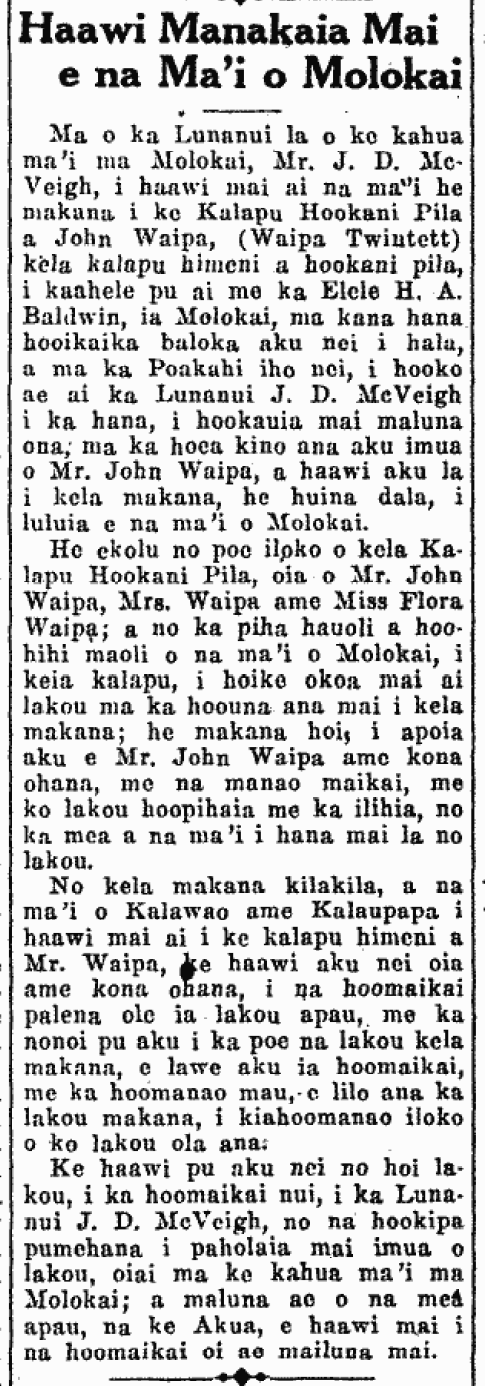
By way of the director of the leprosy settlement on Molokai, Mr. J. D. McVeigh, the patients gave a gift to the Band of John Waipa (The Waipa Twintett) [Waipa Trio]; that singing and musical group that travelled with Representative H. A. Baldwin, to Molokai, in his effort to increase voting; and on this past Monday, Director J. D. McVeigh carried out the duty given to him, by him appearing before Mr. John Waipa and presenting him with this gift, a sum of money donated by the patients of Molokai.

There are three people in that band: Mr. John Waipa, Mrs. Waipa, and Miss Flora Waipa; and because of the great joy and admiration that the patients had in the band, they showed this through the sending of this present; the gift was grasped by Mr. John Waipa and his family with pleasure, and they were filled with awe at this act done for them by the patients.

For this esteemed gift given by the patients of Kalawao and Kalaupapa to the singing group of Mr. Waipa, he and his family extend the endless appreciation to all of them, along with their request to all those who gave the gift, to accept their thanks and to always remember that their gift will be something for them to remember throughout their lives.

They also give their great appreciation to Director J. D. McVeigh for the warm hospitality extended to them while they were at the settlement on Molokai; and above all else, it is God who gives his highest blessings from above.

(Kuokoa, 4/28/1922, p. 1)

Haawi Makanaia Mai e na Ma'i o Molokai

Ka Nupepa Kuokoa, Buke LXI, Helu 17, Aoao 1. Aperila 28, 1922.

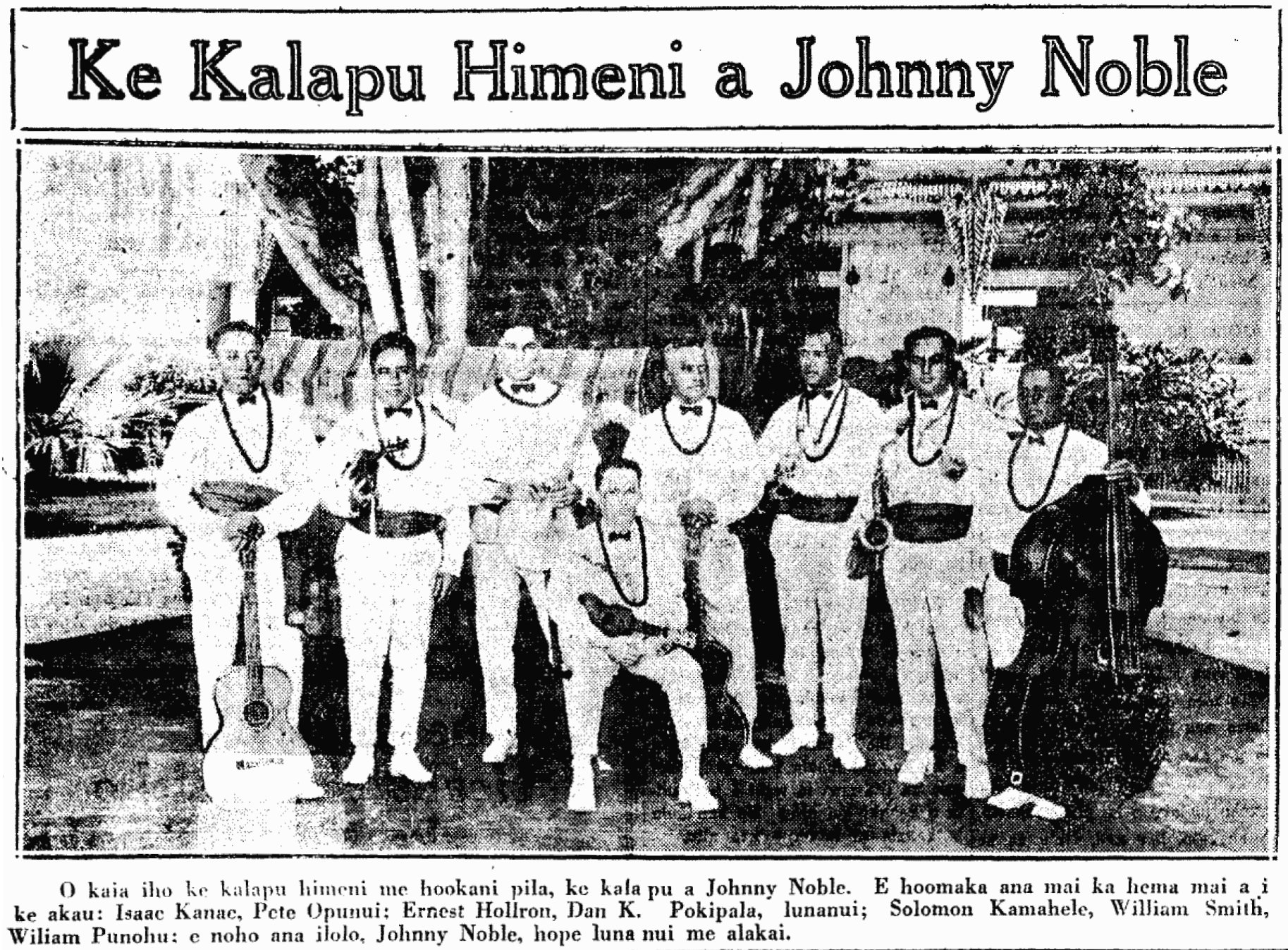
Johnny Noble’s band, 1925.

Johnny Noble’s Singing Group

This is the singing group and band, the club of Johnny Noble. Starting from the left to right, Isaac Kanae, Pete Opunui, Ernest Hollron, Dan K. Pokipala (manager), Solomon Kamahele, William Smith, William Punohu, and seated is Johnny Noble (second in charge and leader of the band).

[If this image looks familiar to you and you were following the Hoolaupai page on Facebook, i am reposting past articles i previously put up there, so that they can be easily searched here at http://nupepa-hawaii.com. I try to categorize it under “repost” when i remember…]

(Kuokoa, 4/23/1925, p. 5)

Ke Kalapu Himeni a Johnny Noble

Ka Nupepa Kuokoa, Buke LXIV, Helu 17, Aoao 5. Aperila 23, 1925.

More on Hawaiians performing in lands afar, 1912.

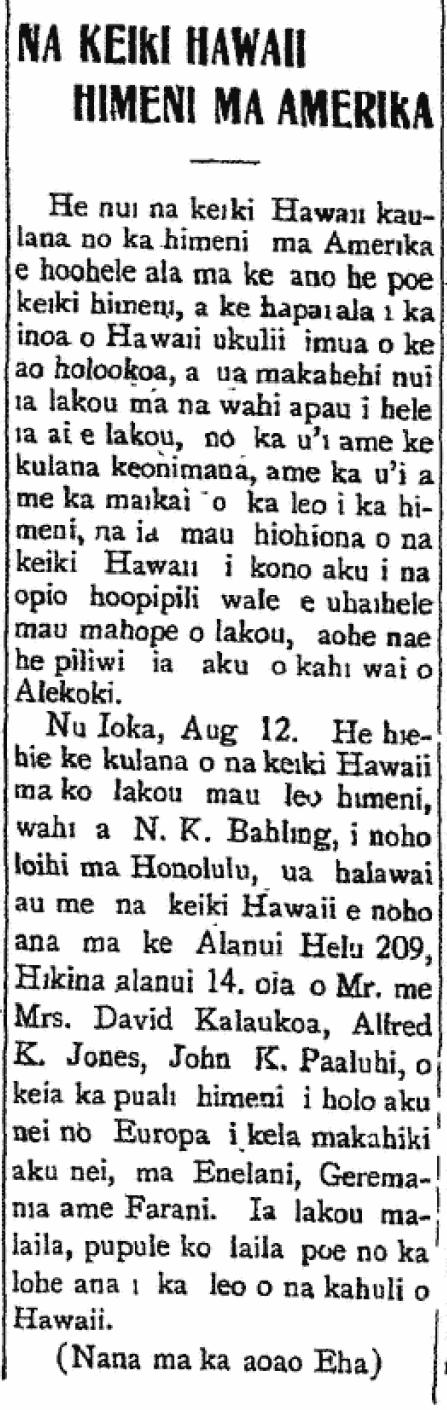
HAWAIIAN YOUTHS SINGING IN AMERICA

There are many Hawaiian youths famous for singing in America that are touring as a band, and they are  bringing the name of tiny Hawaii to the forefront of the whole world; they are greatly admired everywhere they go for their beauty and gentlemanliness, and also for the beauty and excellence of their singing voices; and it is this style of the Hawaiian youths which cause the young fans to chase after them—so unbelievable are the waters of Alekoki.¹

New York, Aug. 12. According to N. K. Bahling, a long-time resident of Honolulu, “The Hawaiian youths are distinguished by their singing; I met up with them living at 209 East 14th Street, they being Mr. and Mrs. David Kalaukoa, Alfred K. Jones, John K. Paaluhi; they are the singing group that went to Europe the other year, to England, Germany and France. While they were there, the people there went “crazy” over hearing the call of the singing kahuli land shells² of Hawaii.

(See page Four)

¹This hearkens back to the opening line from the song “Alekoki” by Lizzie Alohikea, which speaks of the amazing waters of Alekoki, and here is used to describe the craze over the Hawaiian performers: “Aole i piliwi ia, Kahi wai ao Alekoki…”

²Kahuli are the famous land shells of the upland forests which chirp sweetly, often used to describe a melodious singing voice.

(Kuokoa Home Rula, 9/5/1912, p. 2)
NA KEIKI HAWAII HIMENI MA AMERIKA

Kuokoa Home Rula, Buke X, Helu 36, Aoao 2. Sepatemaba 5, 1912.

Boys of the Hawaiian Singing Groups

(From page Two)

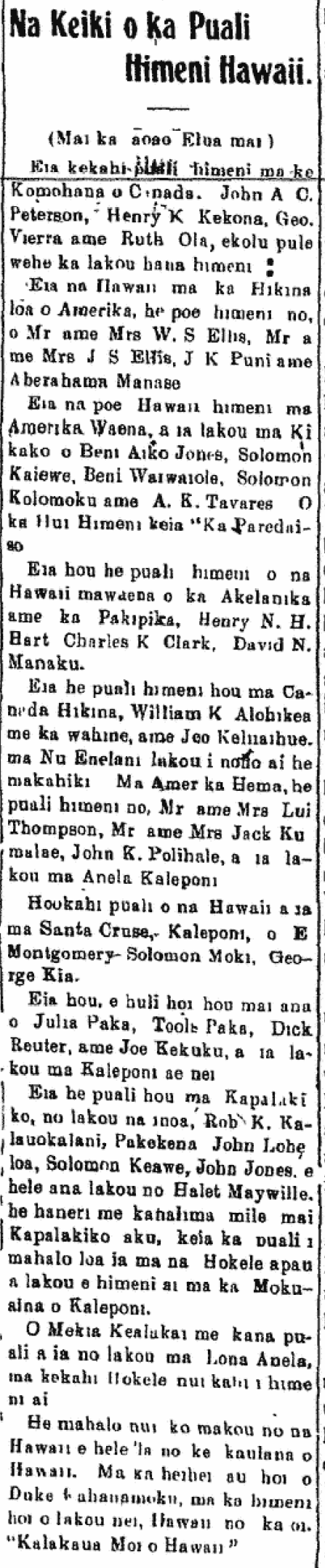
There is a choral group in the West side of Canada. John A. C. Peterson, Henry K. Kekona, George Vierra, and Ruth Ola; their gig will open in three weeks.

These are the Hawaiians on the East Coast of America, they are a group of singers; Mr. and Mrs. W. S. Ellis, Mr. and Mrs. J. S. Ellis, J. K. Puni, and Aberahama [Abraham] Manase.

These are the Hawaiian singers in the Midwest, in Chicago: Beni Aiko Jones, Solomon Kaiewe, Beni Waiwaiole, Solomon Kolomoku, and A. K. Tavares. This is the Singing Group, “Ka Paradaiso [Paradise]”.

Here is another singing group of Hawaiians between the Atlantic and the Pacific: Henry N. H. Hart, Charles K. Clark, David N. Manaku.

Here is a new singing group in Eastern Canada: William K. Alohikea and his wife, and Joe [Joseph] Keliiaihue; they were living in New England for a year. In southern America is also a singing group: Mr. and Mrs. Lui Thompson, Mr. and Mrs. Jack Kumalae, John K. Polihale, and they are in Angel [Los Angeles ?], California.

There is one group of Hawaiians in Santa Cruz, California: E. Montgomery, Solomon Moki, and George Kia.

Also, Julia Paka, Tools Paka, Dick Reuter, and Joe [Joseph] Kekuku are coming back; they are in California.

There is a new singing group in San Francisco whose names are: Rob K. Kalauokalani, Pakekena John Loheloa, Solomon Keawe, and John Jones; they are headed for Halet Maywille [?] which is a hundred and fifty miles from San Francisco; this is the group who was greatly appreciated at every hotel they sang at in California.

Mekia [Major] Kealakai and his group is in Los Angeles, and singing in a huge hotel.

We are greatly appreciative of the Hawaiians who go out to bring fame to Hawaii. In the swimming competition of Duke Kahanamoku, when they sang, Hawaii was the best. “Kalakaua Moi o Hawaii [Kalakaua, King of Hawaii]”.

(Kuokoa Home Rula, 9/5/1912, p. 4)
Na Keiki o ka Puali Himeni Hawaii.

Kuokoa Home Rula, Buke X, Helu 36, Aoao 4. Sepatemaba 5, 1912.
Liliuokalani’s “Aloha Oe,” 1929.

The True Story of “Aloha Oe”

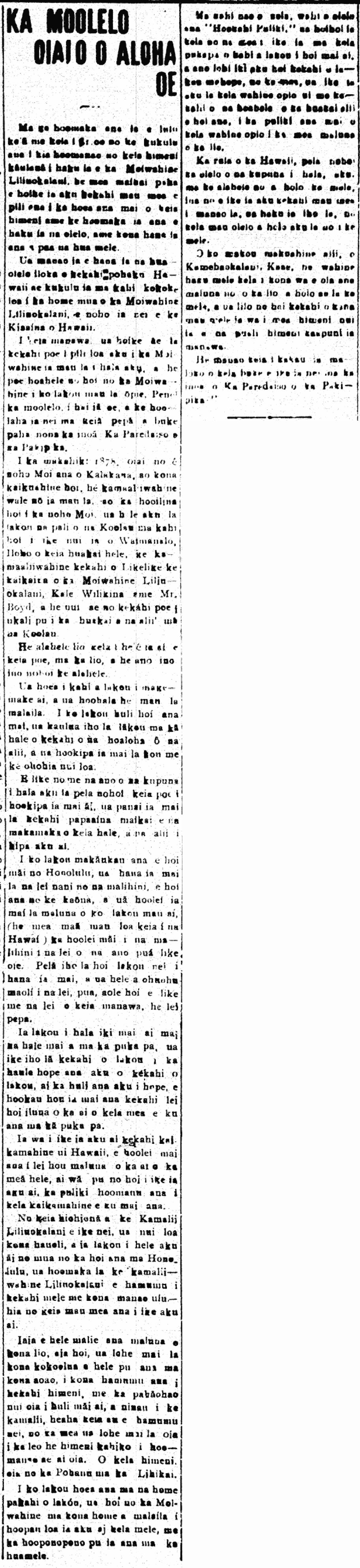
As everyone starts to donate their dollar for the building of a memorial to this famous song composed by Queen Liliuokalani, perhaps it is well to speak about some of the information on the origins of this song, the beginnings of the penning of the lyrics, and it being set to music.

The monument was proposed to be the words in Hawaiian stone that would stand close to the first home of Queen Liliuokalani, now lived in by the Governor of Hawaii.

Now, some intimate with the Queen in days past, and travelling companions of the Queen when they were young, have spoken. This is the story that was told, and it was published in the paper or book called the “Paradise of the Pacific:

In 1878 [1877?], when Kalakaua reigned, and his sister was but a princess and heir to the throne, she travelled to the Koolau side, to well-known Waimanalo. With her was Likelike, Kale Wilikina, Mr. Boyd, and many attendants.

They travelled by horse on horse trail; this was a bad trail.

They arrived at their destination and spent several days there. They spent some days at some friends of the alii, and were welcomed with great gaiety.

Just as the with the kupuna of old, they were welcomed. A feast was laid out by the friends of this home which the alii were visiting.

When were making ready to return to Honolulu, lei of all kinds of flowers were placed about their necks, as was a custom amongst Hawaiians. They were adorned with flower lei, not like the paper lei popular during the time of this article.

When they all were going from the house to exit the estate, they saw one person fall back, and another lei was placed about the neck of the one at the entrance of the yard.

When this beautiful Hawaiian girl was seen giving a lei to the one leaving it also was seen her being embraced.

Because Princess Liliuokalani witnessed this scene, she was overjoyed. While they were headed back to Honolulu, she started to hum a melody, while being full of emotion over what she had seen.

The one next to Liliu heard her humming, and was curious, and asked what she was humming, as it reminded her of an old song. That song was “Rock Beside the Sea” [Pohaku ma ka Lihikai].

When they each returned to their homes, the Queen returned to hers, where she finished this song.
“One embrace” is charming for what was seen at the gateway–one person of their party tarrying as that beautiful young girl hugged the one on horseback.

As was said by the kupuna of yore, mele are composed while travelling, if something that catches ones eye is seen.

Our alii mother, Kamehaokalani Kane was a composer in her lifetime who made songs on horseback. Some of her compositions were well sung back in her time.

This is something written in the book known as the “Paradise of the Pacific.”

[As found in the “Paradise of the Pacific,” 42 (4): 31, 1929; 42 (10): 9, 1929.]

(Hoku o Hawaii, 4/23/1929, p. 2)

KA MOOLELO OIAIO O ALOHA OE

Ka Hoku o Hawaii, Buke XXII, Helu 45, Aoao 2. Aperila 23, 1929.

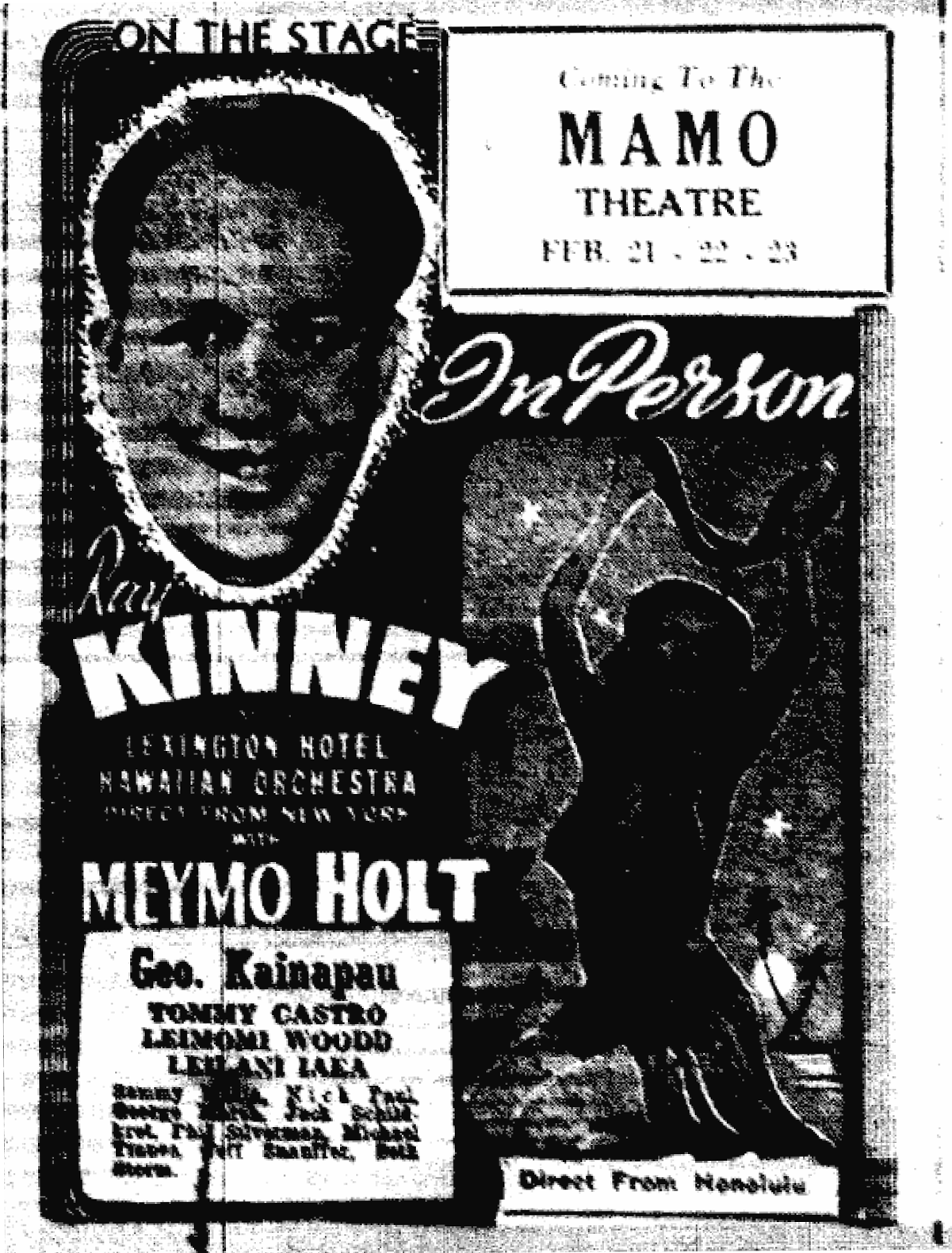
Ray Kinney and group from the Lexington Hotel performing in his hometown, Hilo, 1940.

ON THE STAGE

Coming To The

MAMO

THEATRE

FEB 21 – 22 – 23

In Person

Ray

KINNEY

LEXINGTON HOTEL

HAWAIIAN ORCHESTRA

DIRECT FROM NEW YORK

WITH

MEYMO [Ululani] HOLT

George Kainapau

TOMMY CASTRO

[Lillian] LEIMOMI WOODD

LEILANI IAEA

[illegible group of names]

Direct From Honolulu

[It seems the Senate Honored the entertainers and workers of the Lexington Hotel’s Hawaiian Room on its 75th anniversary just the other month!

There is also going to be a presentation related to this at the Distinctive Women in Hawaiian History Program on Saturday, September 15, 2012)

Unfortunately, the available digital image is as seen below, the actual  newspaper image should probably be much more clear and legible.]

(Hoku o Hawaii, 2/21/1940, p. 4)

ON THE STAGE

Ka Hoku o Hawaii, Volume XXXIV, Number 43, Page 4. Pepeluali 21, 1940.

Kamehameha Serenaders, 1922.

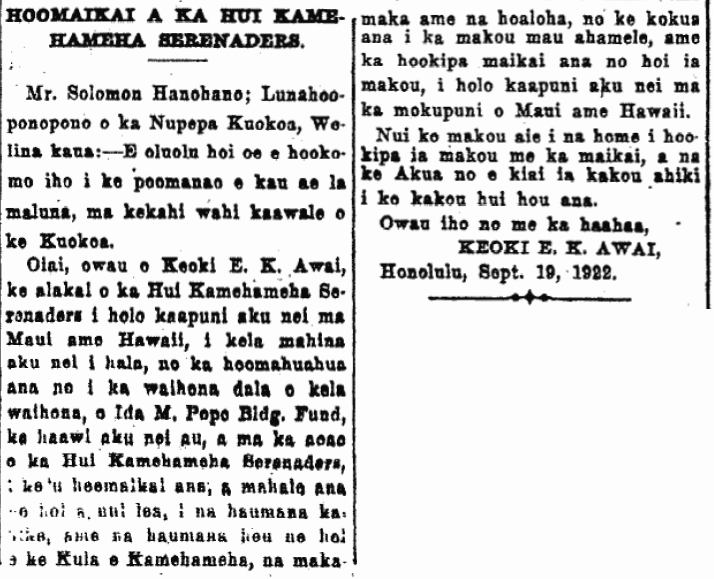
GRATITUDE FROM THE KAMEHAMEHA SERENADERS.

Mr. Solomon Hanohano; Editor of the Kuokoa Newspaper, Greetings:—Please insert this topic above in an open space in the Kuokoa.

Being that I am Keoki E. K. Awai, the leader of the Kamehameha Serenaders which travelled around Maui and Hawaii last month to increase the funds for the Ida M. Pope Bldg. Fund; I give my great appreciation and thanks to the past students and the new students as well of Kamehameha School, and intimates and friends, for their assisting our concerts and for the good care given us while we went around Maui and Hawaii.

We are greatly indebted to the homes which offered us their fine hospitality, and may God watch over us until we meet once again.

Sincerely,

GEORGE E. K. AWAI,

Honolulu, Sept. 19, 1922.

(Kuokoa, 9/21/1922, p. 8)

HOOMAIKAI A KA HUI KAMEHAMEHA SERENADERS.

Ka Nupepa Kuokoa, Buke LXI, Helu 38, Aoao 8. Sepatemaba 21, 1922.

Diamond Kekona passes away in Germany, 1922.

That Hawaiian Boy Dies in Germany

Diamond Kekona Grew Weary of This Life After One Week of Being Ill.

HIS WIFE WAS AT HIS DEATH BED

It was His Wife Who Announced the Sad News to Honolulu nei on Monday

On Monday, this town received the sad news about the death of Diamond Kekona, the son of D. K. Kekona of this town, in Berlin, Germany, on the 13th of last month, February.

It was Mrs. Diamond Kekona, the wife of Kekona, who sent the sad news of the death of her husband to Mekia Kealakai, the leader of the Royal Hawaiian Band [Bana Hawaii], because he was a friend of the young Kekona and his wife when they were all living in London.

A letter was also received by Mr. D. K. Kekona, the father of the young man, confirming the news about the passing of his son.

Diamond Kekona was born on the 6th of October, 1890, so at his death, he was thirty-three years old and some.

Diamond left Honolulu in 1905 for New York, with a group of singers and musicians. He spent many years in America in this occupation.

During the great war of the world, Diamond Kekona was in England, and he enlisted in the service under Britain, going off to war in France and Belgium. He married a British woman and had two children, however the two of them died.

At the end of the war, Mr. and Mrs. Kekona lived in Belgium, and just last year they went to Berlin, Germany, where they met up with Joe Puni, William Kanui, and Joseph Nihali [?]; but according to the letter of Mrs. Kekona, he did not get along with Joe Puni, and they did not talk.

Mr. Kekona was not sick for long before he died, it was just a week; and in the letter his wife wrote to Mr. D. K. Kekona, she told him of her intent to return the body of her husband to London to bury, in her homeland, close to her home.

With the passing of this Hawaiian youth in foreign lands, he left behind, grieving for him: his young British wife; his grandmother, Mrs. Makalohi, who is 91; his father, Mr. D. K. Kekona, working in the sheriff department and a pastor of the Christian Science Church [Hoomana Naauao]; two younger brothers named Hugo and August Kekona; and their sister, Mrs. Lonohira [Mrs. George Lonohiwa]; and a big family.

(Kuokoa, 3/22/1922, p. 1)

Make Ia Keiki Hawaii Maloko o Kelemania

Ka Nupepa Kuokoa, Buke LXI, Helu 12, Aoao 1. Maraki 22, 1922.

Maybe that wasn’t the final word on Diamond Kekona, 1922.

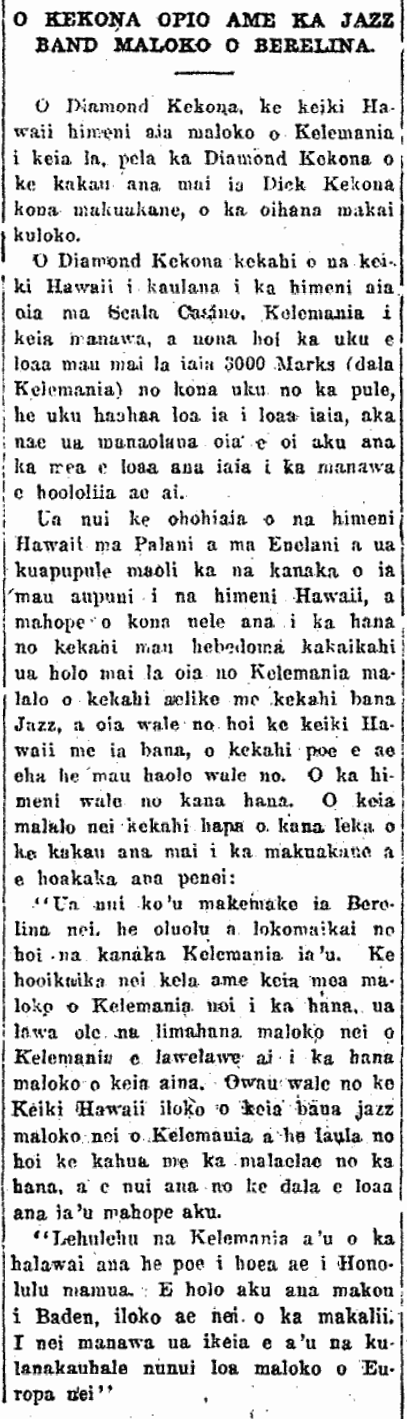
THE YOUNG KEKONA AND JAZZ BAND IN BERLIN.

Diamond Kekona, the Hawaiian singer is in Germany today, that according to what Diamond Kekona wrote to Dick Kekona, his father, who is in the local police department.

Diamond Kekona is one of the Hawaiian boys famous for his singing, in Scala Casano [?], Germany now, and is getting paid 3,000 Marks (German dollars) per week, which is a very low wage for him, but he hopes he will receive more when it is changed.

There was much enthusiasm in France and England about Hawaiian music and the people there went crazy over Hawaiian music, and after he was out of work for a few weeks, he went to Germany under a contract with a Jazz band, and he is the only Hawaiian in the band; the other four are all haole. He only sings. Here below is a portion of his letter written to his father explaining:

“I’ve met many Germans who have been to Honolulu before. We are headed for Baden in the summer. I am now seeing the huge cities of Europe.”

[I went back earlier into the year to see if i might find a death announcement for Diamond Kekona, because we have received kind word from Sabine, a dear reader in Germany, that she’d attempt looking for Diamond Kekona’s grave, and this is what I found first from early in 1922.]

(Kuokoa, 1/27/1922, p. 1)

O KEKONA OPIO AME KA JAZZ BAND MALOKO O BERELINA.

Ka Nupepa Kuokoa, Buke LXI, Helu 4, Aoao 1. Ianuari 27, 1922.

More mele, this time from Liliuokalani! 1920.

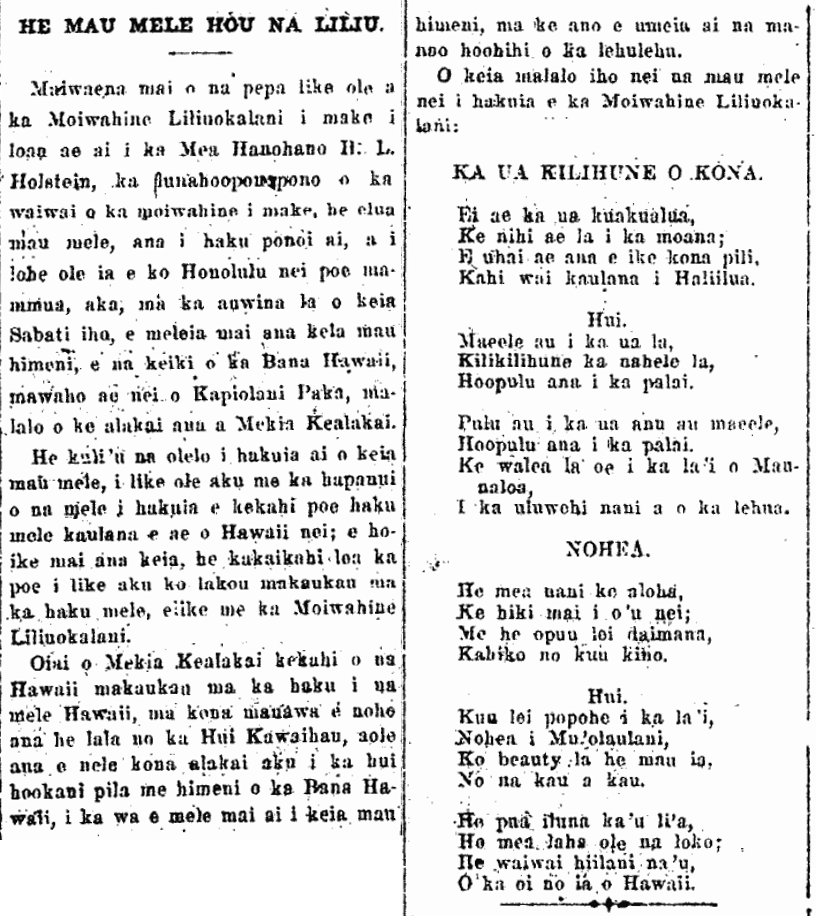
NEW MELE BY LILIU.

From within the various papers of the deceased Queen Liliuokalani, the Honorable H. L. Holstein, the executor of the deceased queen’s estate, found two mele which she composed herself, and which Honolulu’s people have not heard before; however, on the evening of this Sunday, the mele will be sung by the Royal Hawaiian Band [Bana Hawaii] outside of Kapiolani Park, under the direction of Mekia Kealakai.

The words of these compositions are profound, unlike most of the mele composed by other famous composers of Hawaii nei; this shows that there are but few people who are adept at composing mele like Queen Liliuokalani.

Being that Mekia Kealakai is one of those skilled at composing Hawaiian mele while he was a member of the Hui Kawaihau [Kawaihau Glee Club], there will be nothing lacking in his directing of the playing and singing of the Royal Hawaiian Band, when the mele are sung, drawing forth feelings of admiration from the audience.

Here below are the mele composed by Queen Liliuokalani:

KA UA KILIHUNE O KONA.

Ei ae ka ua kuakualua
Ke nihi ae la i ka moana;
E uhai ae ana e ike kona pili,
Kahi wai kaulana i Haliilua.

Hui.

Maeele au i ka ua la,
Kilikilihune ka nahele la,
Hoopulu ana i ka palai.

Pulu au i ka ua anu au maeele,
Hoopulu ana i ka palai.
Ke walea la oe i ka la’i o Maunaloa,
I ka uluwehi nani a o ka lehua.

NOHEA.

He mea nani ke aloha,
Ke hiki mai i o’u nei;
Me he opuu lei daimana,
Kahiko no kuu kino.

Hui.

Kuu lei popohe i ka la’i,
Nohea i Mu’olaulani,
Ko beauty la he mau ia,
No na kau a kau.

He pua iluna ka’u li’a,
He mea laha ole na loko;
He waiwai hiilani na’u,
O ka oi no ia o Hawaii.

[This must have been some performance! “Nohea” is also known as “Nohea i Mu’olaulani” and as just “Mu’olaulani.” I am not sure why this song is referred to as an unknown composition in 1920. But does anyone know if there are any recordings of “Ka Ua Kilihune o Kona”?]

(Kuokoa, 12/10/1920, p. 3)

HE MAU MELE HOU NA LILIU.

Ka Nupepa Kuokoa, Buke LVIII, Helu 50, Aoao 3. Dekemaba 10, 1920.

Mele are everywhere in the newspapers. 1907.

KA HANU O EVALINA.

1. Homai, na’u e honi aku,
I ka lau aala vabine,
He moani lau liilii,
Ka hanu o Evalina.

He anoi au e honi,
I ka nae ala vabine,
He moani lau liilii,
Ka hanu o Evalina.

2. Hui mala’nu ke aloha,
Ke hiki mai nei welawela,
Ua luhi a maopaopa,
He pali kiekie kelakela.

3. He uwila hiki aumoe,
He pakuikui oloolo,
He kulana mapuna hoe,
Kunewa i ka nui o ka holo.

4. Ua holo ka’u kaona,
Ua ikeia e ka nui manu,
Hookahi no hailona,
Ka puia aala o ka hanu.

[This mele is not preceded by an introductory article, and is given without composer. “Ka Hanu o Evalina” is credited to Kalakaua and Liliuokalani, and this is one of the variants.]

(Kuokoa, 3/21/1907, p. 5)

KA HANU O EVALINA.

Ka Nupepa Kuokoa, Buke XLII, Helu 13, Aoao 5. Maraki 21, 1907.