Mr. Montano has presented us with a handsome photograph of Her Majesty the Queen Dowager. The portrait is a full length and represents Her Majesty in a commanding position, standing, with her dress train sweeping into the foreground; the features and figure are admirably clear; Continue reading
Category Archives: Photograph
A. A. Montano takes pictures of Queen Emma, 1880.
Mr. Montana [A. A. Montano] has lately made an addition to his premises in Fort Street in the form of a photographic show room, which will well repay a visit. A large number of the productions of his studio and of other works of art are to be seen there tastefully arranged and forming a really interesting collection. Continue reading
Queen Emma portrait offered for 1881 subscription of Kuokoa, 1880.
THE
KUOKOA NEWSPAPER
FOR 1881!
“While the rain is still in the sky, clear the fields below.”
“Time and tide wait for no man; we need to be prepared.”
Therefore, O Friends of
“The Greatest Prize of the Hawaiian Nation.”
Make ready for the benefits of the
KUOKOA
carried and place before you for the new coming year. Continue reading
Tourism and the revival of lauhala, 1936.
Tourist Business In Hawaii Booms As Result Of Publicity
An influx of visitors to the Hawaiian islands during the past few years has revived many of the interesting traditions and practices of Old Hawaii.
This paradox was recently pointed out by Percy A. Swift, manager of the merchandise department of American Factors, Ltd., in a discussion of Hawaii’s tourist industry.
“An interesting sidelight of the travel business here has been the way it has encouraged Island customs and activities,” he said. “The nourishing influence of tourist interest has given added impetus to the lei tradition, for example; and it has revived native sports such as surfing and outrigger canoe riding, which were on the point of dying out 15 years ago.” Continue reading
Robert K. Bonine film, 1921.
Leper Settlement is Shown in New Aspect
An attractive and unusual film of scenes from the Molokai settlement has been displayed to a party of friends by Robert K. Bonine, Honolulu photographer and pioneer in the exposition abroad of Hawaii through the moving picture, reports the Advertiser. Among those at the “first night” at Mr. Bonine’s studio in the Oregon building were Dr. A. L. Dean, president of the University of Hawaii, Frederick E. Trotter, president of the board of health, and Dr. G. A. Barton. Continue reading
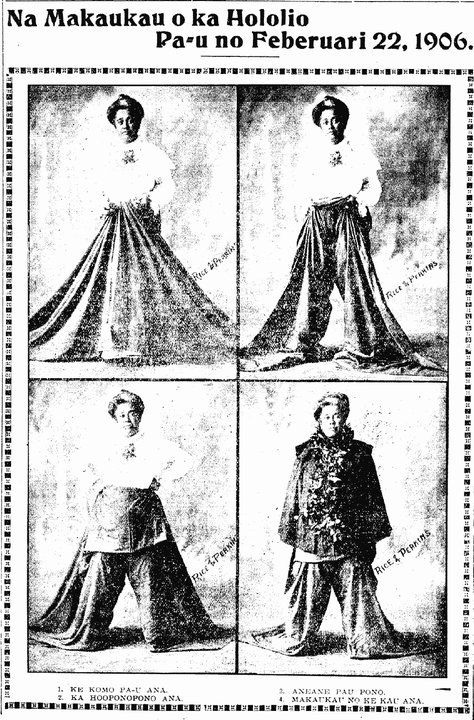
Putting on a Pāʻū, 1906.
Preparations for the Pa-u Riding of February 22, 1906.
1. Putting on a pa-u.
2. The adjusting.
3. Almost done.
4. Ready to ride.
[This was for the parade on Washington’s birthday. An article describing these steps was printed in the 2/4/1906 issue of the Sunday Advertiser.]
(Kuokoa, 2/9/1906, p. 4)
Mary Mahiai, what a story! 1901.
MARY MAHIAI.
The picture above is of Mary Mahiai, a Hawaiian woman who is ninety years old or more. Last week, she was called to court over land that is being fought over. Here, her story was heard. Because of her good story and her long life, one of our writers went once again to ask her about her history. And this is it:
I don’t know when I was born, but I was born before the arrival of the missionaries. I was very small at that time, and maybe I was this tall. One day, we boarded a canoe, her Uncle and five others; they wanted to visit Molokai. They were caught up in a storm in the middle of the ocean, and blown outward; they did not eat for ten days and nights. Because I was so young, I cried a lot. I wanted to eat, and I was thirsty. We had nothing to eat, and had no water left. Water came in the waa, and some of us drank the bilge water. We were near crazy with hunger and thirst. We lost hope that we would live. One day we spotted a ship. We tried to get noticed. We were fetched and taken aboard the ship. My duty aboard the ship was to care for the children. The captain and his wife were kind. We landed at Lardone [??]. Five of them got off with the intent of living there. We heard that they were eaten after that by the people this place. My uncle and I went all the way to China. I cared for the baby some missionaries, Mr. and Mrs. Brown. Thereafter, my uncle died and I was left alone with those haole. I was the caretaker of the baby. I lived for perhaps six whole years in China. I travelled around many places. Later, Mrs. Brown died. I lived with Mr. and Mrs. Bates. After that he wanted to go to California to prospect for gold. We accompanied him on a boat, and saw Cape Horn [Kepahoni], that place famous for rough seas. I saw many lands. I lived for three months in the gold fields. I wanted very much to return to Hawaii. Afterwards, these haole agreed and we all left for Hawaii nei. When we arrived, I immediately wrote to my parents and younger siblings. They came to Honolulu at once. They believed that I had died earlier. My father died without me knowing him.
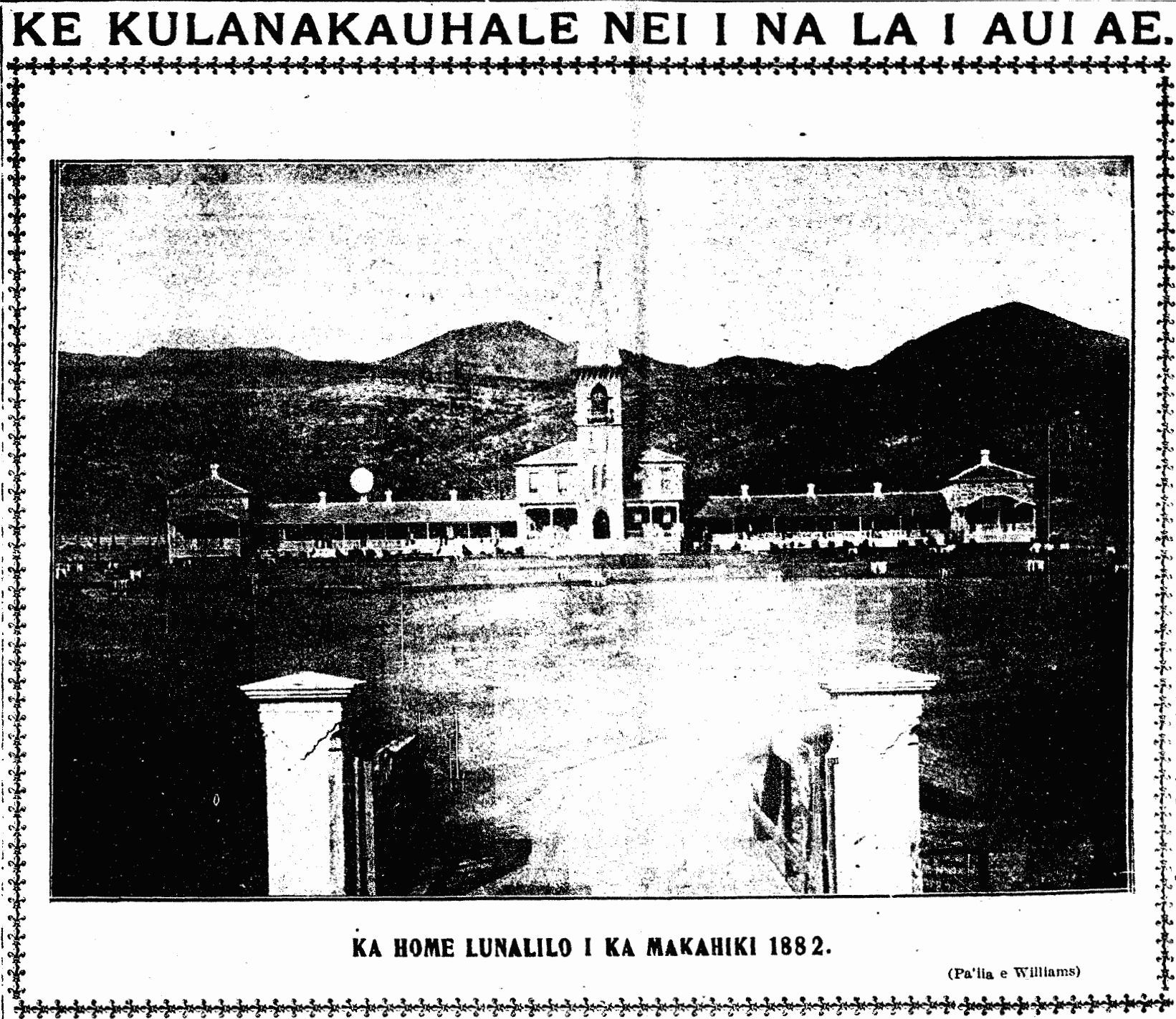
More images from the past looking back into the past—Lunalilo Home, 1903 / 1882.
THIS TOWN IN DAYS GONE BY.
LUNALILO HOME [HOME LUNALILO] IN THE YEAR 1882.
(Photographed by Williams)
[Also read more here at naneaarmstrongwassel on instagram.]
(Kuokoa, 5/22/1903, p. 1)
More on Kaiulani buttons, 1899.
Kaiulani Souvenirs.
B. Lichtig, the artist, has produced a number of photographic buttons with the picture of the late Princess. They are fro sale at 606 Fort street, near Beretania street, and at the gallery of J. S. Williams. The loyal Hawaiians will wear the button on the day of the funeral.
[How is that for advertising? “The loyal Hawaiians will wear the buttons…”]
(Independent, 3/7/1899, p. 3)
J. J. Williams Photographer advertisement, 1902.
J. J. WILLIAMS
PHOTOGRAPHER
CRAYONS
WATER COLORS
LANTERN SHOWS
ONLY COMPLETE
COLLECTION OF
ANCIENT
& MODERN
HAWAIIAN VIEWS.
Fort Street
Photography shoots are very reasonable at Wiliama’s place; you will receive beautiful prints from 4.00 for a dozen.
[Speaking of photography, the microfilming of these newspapers were done many years ago, and the resulting images taken from those microfilms are many times not legible. I barely could make out the tiny print. There needs to be funding to reshoot the Hawaiian-Language Papers, so that the words from the past can be seen clearly today!!]
(Aloha Aina, 1/11/1902, p. 3)