More on Jack Desha, 1912.

KIWINI HAS A GRANDCHILD.

Amongst the youth of Hawaii nei who are pursuing education who have gone to “Foreign Lands” [Aina E], one of them is the son of our friend, Rev. Stephen Desha. He left for Harvard College. This Hawaiian youth lived at the home of the parents of a girl by the name of Miss Agnes Reddy, in Medford, Massachusetts. This Hawaiian youth was enraptured with this young lady. With all the might in the young Desha, he asked the father of the woman who he was taken with to agree that there be the bond of holy matrimony between him and his daughter. The father of the young lady refused, that his daughter could not marry a Protestant being that this family was of the Catholic faith.

So the two young ones fled to Nashua, New Hampshire, without the parents of the woman or anyone else knowing about it. And there they were wed; then they went before her father and revealed to him of their marriage. The father told them that they must have a Catholic marriage. This was carried out. The day they were were wed was on New Year’s Day, of the year 1910, and on the 11th of Dec., 1910, they had their baby. She was named Evalina C. M. Desha.

The schoolmates of young Desha had no idea that living amongst them was a boy that was married and had a large baby; until the next New Year’s Day, when for the first time that the knowledge-seeking Hawaiian announced it outright before his schoolmates.

We hear that the young Desha will enter into Medical School.

(Aloha Aina, 7/13/1912, p. 1)
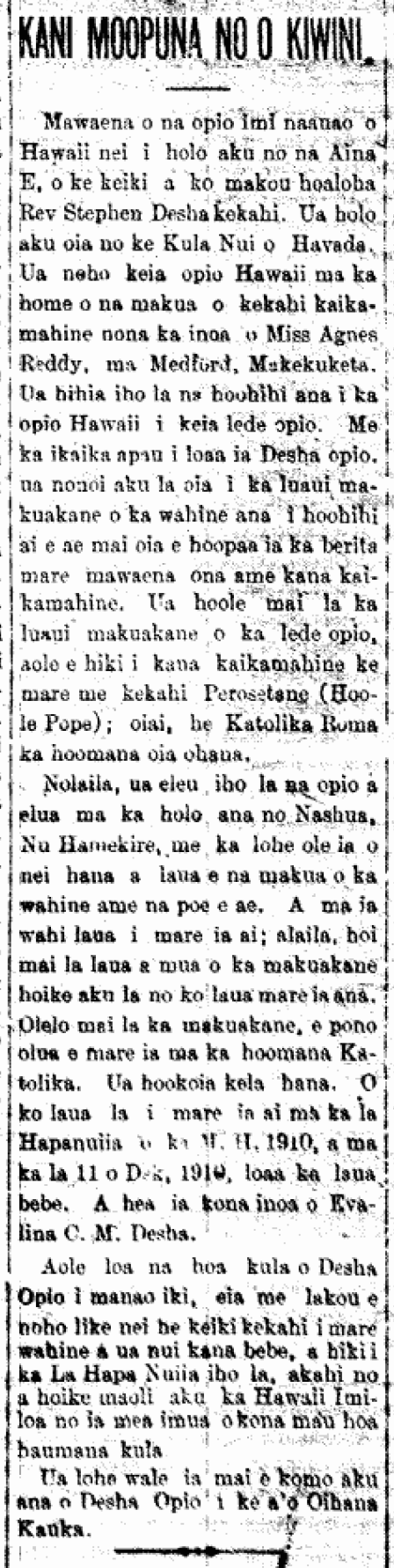
KANI MOOPUNA NO O KIWINI.

Ke Aloha Aina, Buke XVII Helu 28, Aoao 1. Iulai 13, 1912.

Looking back at looking back at Honolulu, 1902.

SCENES FROM HONOLULU OF DAYS PAST

THE BETHEL CHURCH

THE PICTURE ABOVE IS THE BETHEL CHURCH [Luakini Betela] BUILT AT THE CORNER OF BETHEL AND KING STREETS, IN THIS TOWN, WHERE ATTORNEY DICKEY’S OFFICE NOW STANDS. THIS CHURCH BECAME AS OF NAUGHT BECAUSE OF THE FIRE OF 1883 [1886]. THIS SCENE IS NOT FORGOTTEN BY THE OLD PEOPLE AND THE KAMAAINA OF THIS TOWN.

(Shot by Williams)

(Kuokoa, 12/12/1902, p. 1)

HIOHIONA O HONOLULU O NA LA I HALA

Ka Nupepa Kuokoa, Buke XL, Helu 50, Aoao 1. Dekemaba 12, 1902.


Plans for the building to commemorate the 100th anniversary of the coming of the missionaries, 1914.

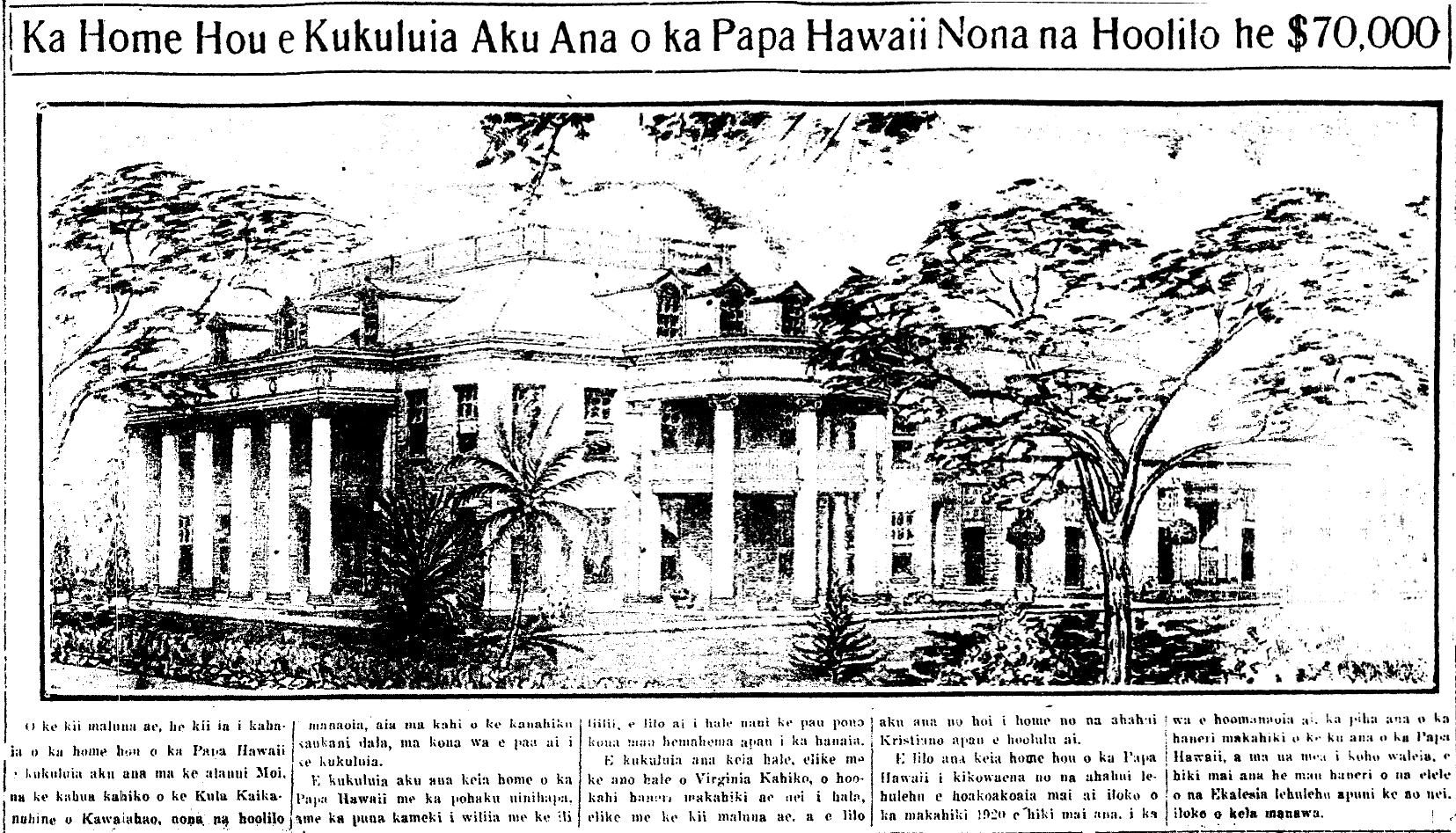
New Home Being Built by the Hawaiian Evangelical Association to Cost $70,000

The picture above is a sketch drawn of the new home of the Hawaiian Evangelical Association [Papa Hawaii] to be built on King Street on the old site of the Kawaiahao Girls’ School [Kula Kaikamahine o Kawaiahao], that is estimated to cost about seventy thousand dollars at its completion.

This home of the Papa Hawaii will be built using brick and concrete, and it will be a beautiful house once all the finishing touches are completed.

This house will be build in the style of those of old Virginia of a hundred years ago, like the image above, and it will become a home for all the Christian associations at where to gather.

This new home of the Papa Hawaii will be a center for the many groups to gather during the coming year 1920 when the 100th anniversary of the Papa Hawaii is celebrated, and it is imagined several hundred representatives of the many Churches from around the world will come them.

(Kuokoa, 10/2/1914, p. 1)

Ka Home Hou e Kukuluia Aku Ana o ka Papa Hawaii Nona na Hoolilo he $70,000

Ka Nupepa Kuokoa, Buke LII, Helu 41, Aoao 1. Okatoba 2, 1914.

Sanford B. Dole, the Congregationalists, and Annexation, 1902.

THE HAWAIIAN SITUATION.

On Monday evening, April 28 last, Governor Dole was the guest of the Congregational Club of Boston. Elsewhere in this issue will be found a sketch made by Dole of the Hawaiian situation. It is characteristic of the man. Having the full support of the Administration behind him he is not afraid to say in public what he has been thinking in private for many long years. Let us see and take up his points one by one.

Point No. 1.—”The monarchy was overthrown and annexation was accomplished for the sake of good government for the islands; that is, for their benefit.”—It is true! Annexation was accomplished, by a handful of Congregationalists because the reciprocity treaty between the United States and Hawaii was in imminent danger of being abrogated. The monarchy was overthrown, so as to save the $40 per ton duty on sugar. It was then as it is now for the Congregationalists:—Money before principle.

Point No. 2:—”We have given you everything we have by being annexed.”—That is, Sanford B. Dole, and his Congregationalist friends have given to the United States that which did not belong to them. With the help of an American cruiser, American marines and an American Minister, they have robbed the native Hawaiians of their country so as to enable a few Congregationalist planters to keep up receiving big dividends from their sugar stocks which would have been materially cut down had a $40 duty been imposed upon each ton of sugar. The Springfield Republican adds the following comment to Point No. 2: “But the second point that they have given us all they have is not at all consistent with his first point that they sought Annexation for the benefit of the Islands, and it shows that they are still trying to work the United States for the benefit of the Hawaiians.” Continue reading

Waialua news, 1841.

WAIALUA.

I was at Waialua today (Sep. 9.) and came back. I measured the border of the ‘farming school’ there, however the acreage is not currently calculated. The school there is good; there are 16 students and they are happy with the work and the school. They farm with cows and digging sticks [oo]; they weed the sugarcane, plant corn, plant beans, watch over the calves in the fields, irrigate, build houses, and other work, and they are greatly prepared with activities that are enlightened and knowledgeable. I saw the corn, and it is very fine, and so too of the beans. I looked over the land, and I thought of the land farmed in America; they are almost the same, and aloha for my land welled up in me.

The foundation of the new church in Waialua are filled in with stone; here are its dimensions: 87 feet long and 48 feet wide. The completion of the church will perhaps go quickly, because the lumber and the coral are piled up, and the adobe [pohaku] are soon to come. However, this all depends on the vigor and the patience of the brethren who are working on it. O Brethren of Waialua, be strong, don’t be hesitant and uncertain and lazy, but be courageous and your church will be complete in no time.

The congregation on Sunday at Waialua is now a little bigger; the great apathy  of that area has been warded off, and some have regained their faith in the word of God.

It is said that there is much apathy amongst the brethren in Ewa. This is true in Honolulu as well; the churches are filled on Sunday, but the hearts of the brethren are not filled with the spirit of God. There is much sleeping, leisure, and true skepticism. Alas, we are living with apathy in Zion! O Let us awaken once more, trim our lamps, and be vigilant, lest the bridegroom arrive at once and we will be alarmed.¹

Armstrong.

¹Referencing the parable of the ten virgins found in Matthew 25.

[Today was Liliuokalani Church’s Annual Luau! Mahalo to KK for thinking of me with a delivery, everything was ono!!]

(Nonanona, 9/14/1841, p. 23.)

WAIALUA.

Ka Nonanona, Buke 1, Pepa 6, Aoao 23. Sepatemaba 14, 1841.

One more story from Kalaupapa, 1906.

QUARTERLY HOIKE OF THE SUNDAY SCHOOL OF “KANAANA HOU.”

Mr. Editor of the Kuokoa Newspaper, Honolulu, T. H.

Please insert the activities of the Hoike of the Sunday School of Kanaana Hou, at 9:30 a. m. the activities began, led by L. M. Painamu, assistant Kahu of the Sunday School.

Group Hymn, 36 L. H.;¹ prayer by Rev. D. Kaai; group hymn, 39 L. H.

Hoike of the Men’s Class, led by W. Paoa; speech by Mrs. Lono Lee Shu; hymn 193 L. H., led by Youth; women’s class, led by

J. Kiaaina; speech, Elia Kaaihue; hymn 126 L. H., led by the Youth; Ahahui H. K.² class, led by Mrs. A. Unea; hymn 126 L. H., led by the Youths (f).

Donations from the Sunday School, led by J. K. Keliihuli, $13.65; hymn 191 L. H., led by the women; Youth (m) class, led by J. K. Waiamau; speech, William Notley; hymn 20, L. H., led by the Aha H. K.; youth (f) class, led by J. K. Keliikuli; hymn 88, L. H., led by the men.

Messages of encouragement—J. K. Waiamau, J. K. Keliikuli, S. K. Kaunamano, of the parochial class, led by Kahu Rev. D. Kaai with this class for the entire congregation. Closing Hymn, 30 L. H.; closing prayer, Rev. D. Kaai.

May it please you that the number of students at this hoike were 44: 7 men, 14 women, 11 boys, 12 girls, and 58 visitors, for a total of 102. The exercise went well, and they were filled with joy for Christ, and it was carried out peacefully.

With appreciation,

NAIHE KALA.

¹”L. H.” most likely is an abbreviation of the hymnal just published in 1902 by the Hawaiian Evangelical Association, “Leo Hoonani”.

²”Aha H. K.” is short for “Ahahui Hooikaika Karistiano,” which is the “Christian Endeavor Society,” also seen as “C. E.”.

[Many of the names that were mentioned tonight at the talk put on at Native Books appear in this report!]

(Kuokoa, 10/19/1906, p. 6)

HOIKE HAPAHA O KE KULA SABATI O "KANAANA HOU."

Ka Nupepa Kuokoa, Buke XLV,Helu 42, Aoao 6. Okatoba 19, 1906.

Brother Dutton on Molokai, 1911.

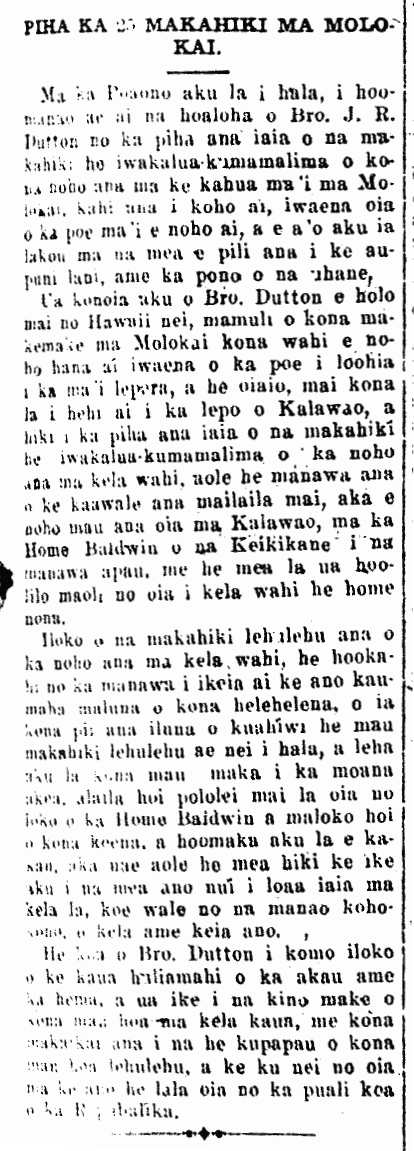
25 Years on Molokai.

Last Saturday, the friends of Bro. J. R. Dutton celebrated the twenty-fifth anniversary of his living at the sanatorium at Molokai, where he chose to be amongst the patients, and to teach them of the kingdom of heaven and the righteousness of the spirit.

Bro. Dutton was invited to come to Hawaii as a result of his desire to minister on Molokai amongst the people afflicted with leprosy; and it is true, from the moment he stepped upon the soil of Kalawao, until living there for 25 years, there was not a single moment he spent away, but he remained there at Kalawao at the Baldwin Boys’ Home at all times, as if he made this his home.

In his many years living there, there was only a single time he showed signs of grief, when he climbed into the hills many years ago, his eyes looked out to the wide ocean, and he returned immediately to the Baldwin Home to his room. He then began to write. However, it is unknown what happened that day, except through conjecture.

Bro. Dutton was a soldier engaged in a fierce battle between the north and the south; and he saw the dead bodies of his comrades in battle. He visited the graves of his many friends, and he remains a member of the soldiers of the Republic.

(Kuokoa, 8/4/1911, p. 5)

PIHA KA 25 MAKAHIKI MA MOLOKAI.

Ka Nupepa Kuokoa, Buke XLVII, Helu 31, Aoao 5. Augate 4, 1911.

Words of comfort in the face of the passing of Nahienaena? 1837.

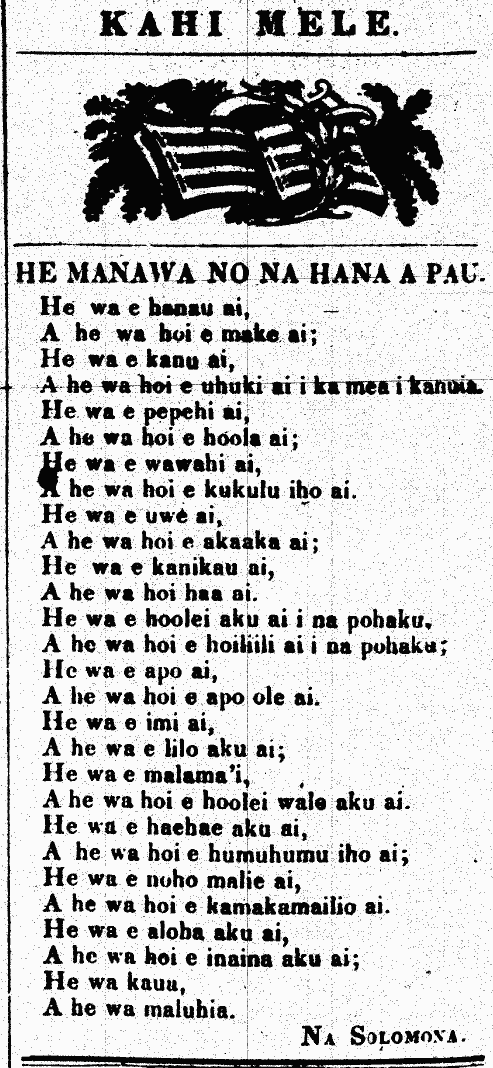
HE MELE.

HE MANAWA NO NA HANA A PAU.

He wa e hanau ai,
A he wa hoi e make ai;
He wa e kanu ai,
A he wa hoi e uhuki ai i ka mea i kanuia.
He wa e pepehi ai,
A he wa hoi e hoola ai;
He wa e wawahi ai,
A he wa hoi e kukulu iho ai.
He wa e uwe ai,
A he wa hoi e akaaka ai;
He wa e kanikau ai,
A he wa hoi [e] haa ai.
He wa e hoolei aku ai i na pohaku,
A he wa hoi e hoiliili ai i na pohaku;
He wa e apo ai,
A he wa hoi e apo ole ai.
He wa e imi ai,
A he wa e lilo aku ai;
He wa e malama’i,
A he wa hoi e hoolei wale aku ai.
He wa e haehae aku ai,
A he wa hoi e humuhumu iho ai;
He wa e noho malie ai,
A he wa hoi e kamakamailio ai.
He wa e aloha aku ai,
A he wa hoi e inaina aku ai;
He wa kaua,
A he wa maluhia.

Na Solomona.

A Mele.

THERE IS A TIME FOR ALL THINGS.

A time to be born,
And a time to die;
A time to plant,
And a time to pluck up that which is planted;
A time to kill,
And a time to heal;
A time to break down,
And a time to build up;
A time to weep,
And a time to laugh;
A time to mourn,
And a time to dance;
A time to cast away stones,
And a time to gather stones together;
A time to embrace,
And a time to refrain from embracing;
A time to get,
And a time to lose;
A time to keep,
And a time to cast away;
A time to rend,
And a time to sew;
A time to keep silence,
And a time to speak;
A time to love,
And a time to hate;
A time of war,
And a time of peace.

By Solomon.

(Kumu Hawaii, 2/15/1837, p. 76)

KAHI MELE.

Ke Kumu Hawaii, Buke 2, Pepa 19, Aoao 76. Feberuari 15, 1837.

Fancy typesetting, 1874.

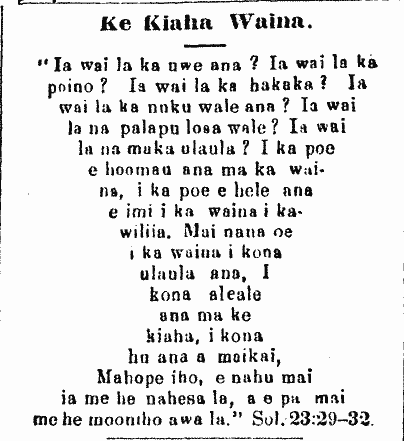
The Wine Glass.

“Who hath woe? who hath sorrow? who hath contentions? who hath babbling? who hath wounds without cause? who hath redness of eyes?  They that tarry long at the wine; they that go to seek mixed wine. Look not thou upon the wine when it is red, when it giveth his colour in the cup, when it moveth itself aright.At the last it biteth like a serpent, and stingeth like an adder.” Proverbs 23:29–32.

(Kuokoa, 8/8/1874, p. 4)

Ke Kiaha Waina.

Ka Nupepa Kuokoa, Buke XIII, Helu 32, Aoao 4. Augate 8, 1874.